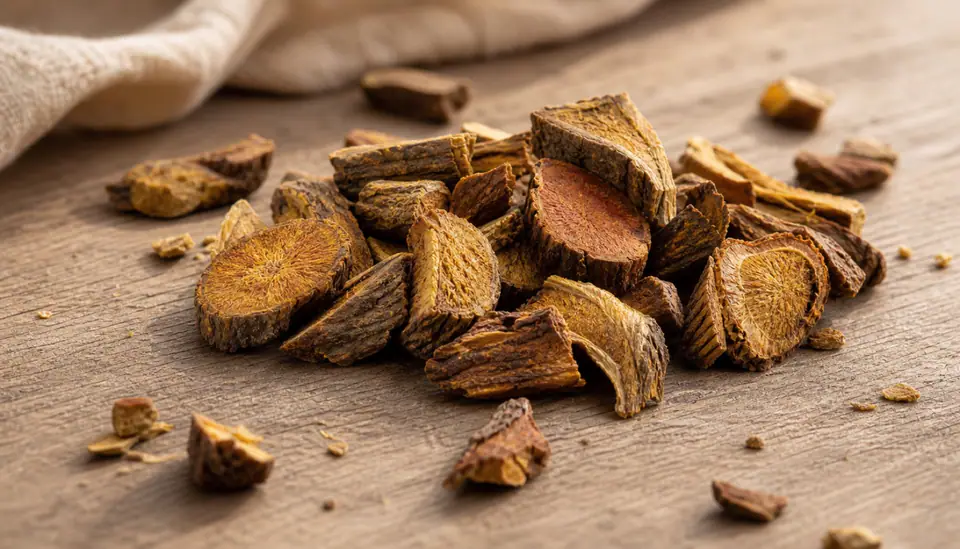
The General, the Fast Medicine, Why Rhubarb (Daehwang) carries both the praise of 'strength' and the warning that 'long-term use causes damage'
According to the Bencao Gangmu, Rhubarb has the nickname 'The General'. The origin of this name lies in its efficacy, which is described as "pushing out the stale and bringing in the new, much like a general who suppresses chaos and brings peace." The Bencao Gangmu also quotes Tao Hongjing, explaining that "the title of General is given because its effects are extremely rapid and powerful." As such, Rhubarb has been recognized in traditional medicine as a 'strong and fast medicine.'
However, the evaluation of being 'strong' also necessarily means 'one must be cautious.' The Bencao Xinbian warns regarding Daeseunggitang, a formula containing Rhubarb, that "even a slight misuse can lead to immediate danger after administration; while this prescription is a life-saving medicine, improper use can instead lead to loss of life." In other words, because the power of Rhubarb is so great, it can become dangerous if the scope and method of use are not accurately understood.
This tension persists in modern medicine. The Korean Pharmacopoeia stipulates that Rhubarb must contain a certain amount of sennoside A and anthraquinones, which serve as the basis for its action in promoting intestinal motility. Simultaneously, the precautions for over-the-counter Rhubarb preparations explicitly state that pregnant women, breastfeeding women, and patients with intestinal obstruction or appendicitis should not take it. It is a representative medicinal herb where 'strength' directly leads to 'restriction.'
Therefore, it is particularly important how much, who, and how Rhubarb is used. Below, we will guide you step-by-step through the properties of Rhubarb, its primary prescriptions, and the essential precautions you must know.
Summary at a Glance
The following table summarizes what kind of medicinal herb Rhubarb is, where it acts, and why caution is required.
| Category | Content |
|---|---|
| Origin | Hanja name: 大黃 (Daehwang), Scientific name Rheum palmatum L. (Senna leaf Rhubarb). "Rhubarb" in the Korean Pharmacopoeia R. palmatum, R. tanguticum, R. officinale includes the roots and rhizomes of three species, but the subject of this section Rheum palmatum is limited to L. |
| Properties and Meridian Tropism | Bitter (taste), Cold (property). Enters the Spleen, Stomach, Large Intestine, Pericardium, and Liver meridians. |
| Representative Aliases | The General, Hwangryang, Hwasam, Buyeo |
| Efficacy Recorded in Literature | Clearing heat and promoting bowel movements, invigorating blood and removing stasis, cooling blood and detoxifying, clearing heat and drying dampness. |
| Main Ingredients | Sennoside A, Anthraquinones (Aloe-emodin, Rhein, Emodin, Chrysophanol, Physcion) |
| Combinations, Contraindications, and Precautions | Rhubarb is a strong purgative. It is not used for pregnant women, breastfeeding women, or those with intestinal obstruction, appendicitis, acute abdominal diseases, severe dehydration, or electrolyte imbalance. Since evidence for direct concurrent use with restorative herbal medicines (tonics) for supplementing Yang or Yin has not been confirmed, consultation with a medical professional is required. |
Is this medicinal herb right for me?
Due to its 'strong and fast' characteristics, Rhubarb can relieve heat and stagnation at the necessary moment for the right person, but it may cause dehydration, electrolyte imbalance, or abdominal pain in those for whom it is unsuitable. The following criteria are based on the Korean Pharmacopoeia, precautions for over-the-counter medicines, and traditional herbal records.
- Generally suitable cases: When there is a tendency toward heat symptoms accompanied by a hard, bloated abdomen (abdominal distension) and constipation, traditionally, formulas such as Daeseunggitang address these symptoms. However, this is not a matter for self-diagnosis, but refers to cases where it is prescribed after an evaluation by a Korean medicine doctor.
- Cases requiring caution: In cases of dizziness, lethargy, severe fatigue, the elderly, or those taking other laxatives or antispasmodics. The Bencao Xinbian referred to Daeseunggitang as a "life-taking medicine," warning that even a small difference could endanger life. Additionally, concurrent use with digoxin, diuretics, or arrhythmia medications may theoretically worsen potassium depletion, so consultation with a medical professional is required.
- Cases to avoid: Women who are pregnant or may be pregnant, breastfeeding women, cases where acute abdominal diseases such as ileus or appendicitis are suspected, or those with severe dehydration or electrolyte imbalance. The uterine-contracting action and anthraquinone components of Rhubarb may cause risk of miscarriage, premature birth, or diarrhea in infants.
Practical Q&A
Because of its 'strong and fast' characteristics, there are many questions regarding Rhubarb before taking it. We have summarized answers based on confirmed facts from frequently asked questions during medical evaluations.
Does the effect of Rhubarb vary depending on the individual's constitution?
Yes, that is correct. Daehwang (Rhubarb) is a strong purgative with bitter and cold properties. The 'Boncho Sibeonrok' describes it as a substance that naturally pushes downward vigorously, stating, "Daehwang's flavor and energy are both strong, and it is inherently a substance for drastic purging." Therefore, it may be appropriately considered for those with sufficient physical strength and severe heat blockage; however, it may cause harm to those with a cold or weak constitution. Traditionally, it is a medicinal herb used for 'excess patterns' (Sil-jeung) and handled with caution for 'deficiency patterns' (Heo-jeung).
Can I use Daehwang frequently when I have constipation?
Long-term use is not recommended. The precautions for over-the-counter Daehwang preparations advise avoiding excessive or long-term use, as prolonged stimulation by anthraquinone components can lead to electrolyte imbalances, such as hypokalemia. If constipation recurs, it is necessary to first identify the cause, and Daehwang should be limited to short-term, situational use.
Can it be taken during pregnancy?
As a rule, pregnant women should not take it. The precautions for over-the-counter Daehwang preparations explicitly state, "Pregnant women or women who may be pregnant should not take this medication." This is because there is a risk of miscarriage due to the uterine contraction effects of Daehwang or the purging action on pelvic organs. It should also be avoided during breastfeeding, as anthraquinone derivatives can be transferred to breast milk and may cause diarrhea in infants.
Are there problems if I take Daehwang with Western medicine?
Caution is required when combining it with certain Western medicines. Since long-term use can lower potassium levels, there is a theoretical concern that toxicity may increase due to potassium depletion when used with digoxin, diuretics, or anti-arrhythmic drugs. Additionally, medications that inhibit intestinal motility (such as atropine or powdered antispasmodics) may offset the laxative effect of Daehwang. If you are currently taking any medication, it is safest to decide after consulting with a Korean medicine doctor.
What are some prescriptions that contain Daehwang?
The most iconic among traditional prescriptions is Daeseunggitang from the 'Shanghan Lun'. It consists of 15g of Daehwang, 7.5g of Mangcho, 7.5g of Jisil, and 7.5g of Hubak, and has been traditionally used when a cold-damage disease moves inward, causing blocked stools, abdominal bloating, and severe heat. Other representative prescriptions centered on Daehwang include Moryeodaehwangtang from the 'Dongui Bogam', Daehwangmokdanpitang from the 'Jingui Yaolüe', and Daehwanghwangryeontang from the 'Uijong Geumgam'. Since these are selected based on symptoms and constitution, professional consultation is required rather than self-diagnosis.
What should I do if I experience severe diarrhea after taking Daehwang?
Since Daehwang is inherently a strong purgative, if excessive diarrhea, abdominal pain, or dehydration symptoms occur after use, you should stop use immediately and consult a medical professional. In particular, those with severe dehydration, electrolyte imbalance, or suspected acute abdominal conditions such as bowel obstruction or appendicitis must not use preparations containing Daehwang. If an adverse reaction occurs during use, it is helpful to provide the exact product name, dosage, and timing of intake during your consultation.
Relationship with Other Medicinal Herbs (Yakdae/Pairing)
Daehwang is rarely used alone. Because its cold and bitter properties are so strong, it is a medicinal herb that finds its proper role only when used with other herbs. In tradition, such pairs are called 'Yak-dae' (medicinal pairs). Depending on the pair, the direction of the purging effect of Daehwang changes, and sometimes a cold laxative combined with warm herbs creates entirely different indications. Below are some confirmed combination examples.
-
Daehwang + Mangcho + Jisil + Hubak — Daeseunggitang: A representative Daehwang prescription recorded in the 'Shanghan Lun'. It is structured so that Daehwang pushes heat and stagnation downward, Mangcho draws moisture into the intestines to relieve constipation, and Jisil and Hubak resolve abdominal gas and stagnation. It has been traditionally used for urgent interior patterns (Ri-jeung), abdominal bloating, and constipation associated with cold-damage disease. 'Shanghan Lun', Korea Traditional Knowledge Portal "Daeseunggitang A"
-
Daehwang + Moryeo + Gamcho + Hwanggwalu — Moryeodaehwangtang: A prescription found in the Miscellaneous Diseases section of the 'Dongui Bogam', traditionally used for anorectal abscesses (Byeon-ong) and blood-related intestinal colic (Hyeol-san). This combination adds the softening action of Moryeo and the harmonizing action of Gamcho to the blood-activating and laxative effects of Daehwang. 'Dongui Bogam', Korea Traditional Knowledge Portal "Moryeodaehwangtang A"
-
Daehwang + Mangcho + Donggwaja + Mokdanpi + Do-in — Daehwangmokdanpitang: A prescription from the 'Jingui Yaolüe', traditionally used for conditions where blood stasis and heat are intertwined in the lower abdomen, particularly for intestinal abscesses (Jang-ong). In modern Korea, it is licensed in the form of Daehwangmokbaeksan (over-the-counter medicine). 'Jingui Yaolüe', comedi.kr "Daehwangmokbaeksan (Daehwangmokdanpitang)"
-
Daehwang + Buja + Seshin — Daehwangbuja-tang: When cold Daehwang (rhubarb) meets hot Buja (aconite) and Sesin (asarum), it becomes a warming purgative prescription to relieve constipation caused by cold accumulation (hanjeok). This combination demonstrates that Daehwang is not used exclusively for 'heat symptoms,' and its indications can change depending on the paired ingredients. 《本草思辨錄》
-
Daehwang + Injin (Artemisia capillaris) + Chija (Gardenia) — Injinhotang: This is a combination where Daehwang directs the discharge of heat through urine rather than stool. It has been traditionally used for damp-heat jaundice (seupyeol-hwangdal), serving as a typical example of how the same ingredient can create different outlets within a prescription. 《本草思辨錄》
It is also helpful to remember precautions based on the combination. Since Daehwang is a strong purgative, its simple concurrent use with restorative medicines (boyak) is only considered under the clear Korean medicine principle of 'simultaneous attacking and supplementing (gongbo-gyeomyong).' As there is no confirmed evidence for the direct concurrent use of Daehwang with restorative medicines such as Gongjindan or Gyeongokgo, please consult your attending medical staff regarding the possibility of concurrent use if you are taking or are prescribed preparations containing Daehwang.
In what form is it consumed?
As Daehwang is a potent medicinal herb, its effects vary significantly depending on the form and dosage used. It is not suitable for light consumption as a general food or tea; in most cases, it is used as a decoction (jeontang, a liquid medicine boiled and extracted) through a professional prescription.
-
Drinking as tea Not common. Daehwang is a strong purgative containing anthraquinones, which are constipation-relieving components, and its action is too potent to be lightly steeped as a tea. The Korean Pharmacopoeia also defines Daehwang as a medicinal root/rhizome and does not classify it as a general tea beverage.
-
Consumption as food Not common. While Western rhubarb uses the stalk as a food ingredient, the Korean herbal medicine Daehwang uses the root and rhizome for medicinal purposes, and it is not appropriate to process it as food for consumption.
-
Consumption as a decoction (jeontang) This is the most traditional and common form of use for Daehwang. It is a method of boiling Daehwang in water and taking it with other medicinal herbs, as seen in Daeseunggi-tang from the 'Shanghan Lun'. Caution is required in the preparation method: if Daehwang is boiled for too long, its heat-clearing (sayeol) effect weakens, and if boiled for too short a time, its purgative (saha) effect tends to strengthen; therefore, the time is adjusted according to the purpose of the prescription.
-
Professional prescription (Korean medicine clinic preparation) This is the most appropriate form. In Korea, Daehwang extract powder and Daehwang powder are approved as over-the-counter drugs, but there are clear contraindications such as pregnancy, lactation, intestinal obstruction, and appendicitis, and excessive intake may cause serious side effects such as dehydration, electrolyte imbalance, and abdominal pain. Therefore, it is safe to use Daehwang only when prescribed under the judgment of medical staff.
Interactions and Safety During Use
Daehwang is a medicinal herb with an action so strong and fast that it is referred to as the 'General.' Accordingly, it is important to first know when it should not be used and in which situations you must consult medical staff. The following information is based on facts confirmed in the Korean Pharmacopoeia, precautions for over-the-counter drugs, and traditional herbal records.
Pregnancy and Breastfeeding
- As a rule, pregnant women should not take it. The precautions for over-the-counter drugs containing Daehwang explicitly state, "Do not take if pregnant or potentially pregnant." This is because there may be a risk of miscarriage due to the uterine contraction effect or the drainage effect on pelvic organs caused by Daehwang.
- Consumption should also be avoided during lactation. There are concerns that anthraquinone derivatives in Daehwang may be transferred to breast milk and cause diarrhea in infants.
Diseases with clear contraindications
- Intestinal obstruction (ileus), appendicitisIf these conditions are present, over-the-counter drugs containing Daehwang are contraindicated.
- Acute abdominal diseases, severe dehydration, electrolyte imbalanceIn these cases as well, anthraquinone-containing purgatives are generally not used.
Precautions When Using with Western Medicine
- Long-term use should be avoided. Long-term use of Daehwang (Rhubarb) may cause hypokalemia (a decrease in blood potassium levels). Theoretically, using it in combination with digoxin, diuretics, or antiarrhythmic drugs may increase toxicity due to potassium depletion; however, clinical interaction data for Daehwang alone in Korea requires further verification.
- Intestinal motility inhibitors (atropine, powdered antispasmodics, etc.)When used together, the laxative effect of Daehwang may be neutralized.
- Anticoagulants and antiplatelet agentsPotential interactions are theoretically mentioned, but clinical evidence requires further verification.
Self-administration and Combined Use with Restorative Herbal Medicine
- Daehwang is a strong purgative (laxative). Evidence for direct combined use with restorative herbal medicines such as Gongjindan or Gyeongokgo has not been confirmed. In Korean medicine, there is a principle of "combining attacking and supplementing (Gong-bo) for deficiency patterns (Heo-jeung)," but Daehwang must be prescribed only after a medical professional evaluates your constitution and symptoms.
- It is not appropriate to use Daehwang preparations unconditionally just because you have constipation. Particular caution is required for the elderly, those with a weak constitution, or those with chronic diseases.
“大黃用之於承氣湯中,少若差錯,下喉立亡…夫承氣湯,乃奪命之藥也. 不善用之,奪命變為喪命矣” 《本草新編》
The warning in the "Boncho Sinpyeon" is not an exaggeration. Prescriptions containing Daehwang, such as Daeseunggi-tang, are used only when the symptoms and constitution match exactly; incorrect use can be dangerous.
If you experience diarrhea, abdominal pain, or symptoms of dehydration during use, or if you are currently taking Western medicine, please stop use and consult a professional. Daehwang is a medicinal herb used only for the right person at the necessary moment.
If you experience these symptoms
If these symptoms appear
Daehwang is a medicinal herb with an action so strong and fast that it is called the "General." Therefore, if the following signals appear during use, do not simply dismiss them as "the medicine is strong," but be sure to inform your attending Korean medicine doctor. This is especially important if you have increased the dosage or duration of use on your own.
- Severe abdominal pain or spasmodic diarrhea
- Persistent watery stools or symptoms of dehydration (extreme thirst, decreased urine output, dizziness)
- Symptoms suggesting electrolyte imbalance (muscle weakness, irregular heartbeat, fatigue)
- Immediately stop all use if there is a possibility of pregnancy or if breastfeeding
These symptoms are known warning signs indicating that the strong purgative action of Daehwang and its anthraquinone components can affect organs and electrolyte balance. In particular, Daehwang should not be used by individuals with intestinal obstruction, appendicitis, acute abdominal diseases, or severe dehydration and electrolyte imbalance.
If symptoms are severe or worsen rapidly, please visit an emergency medical institution.
Differences from other restorative medicines
Daehwang is a medicinal herb that works in the opposite direction of restorative herbal medicine (Boyak). While restorative medicine focuses on filling deficient energy or supplementing the constitution, Daehwang is an "attacking medicine (Gong-yak)" that expels heat and turbidity accumulated in the body. Therefore, rather than comparing it directly with restorative medicines like Gongjindan or Gyeongokgo, it is more accurate to distinguish when to use restorative medicine and when a prescription containing Daehwang is necessary.
In traditional medicine, there is a principle of "combining attacking and supplementing (Gong-bo Gyeomyong)", using attacking and restorative medicines together, for deficiency patterns (Heo-jeung, a state of lacking energy). However, because Daehwang is a strong purgative, taking it alone with restorative medicine is not recommended without consultation with a medical professional. Particular caution is needed when combining it with restorative medicine due to the risk of electrolyte imbalance or dehydration during long-term use or at high doses.
Ultimately, whether Daehwang is necessary or if restorative medicine is more appropriate must be determined after a comprehensive evaluation of the pulse, symptoms, abdominal condition, and bowel habits. If you are curious about which direction is right for you, the most accurate way is to check during your medical evaluation.
References
- Evidence data regarding Daehwang 1: Crude drug data from the National Institute of Food and Drug Safety Evaluation.
- Supporting evidence for Rhubarb 2: Crude drug data from the National Institute of Food and Drug Safety Evaluation.
- Supporting evidence for Rhubarb 3: koreantk.com evidence materials.
- Supporting evidence for Rhubarb 4: koreantk.com evidence materials.
- Supporting evidence for Rhubarb 5: koreantk.com evidence materials.
- Supporting evidence for Rhubarb 6: health.kr supporting evidence.
- Supporting evidence for Rhubarb 7: comedi.kr supporting evidence.
- Supporting evidence for Rhubarb 8: comedi.kr supporting evidence.
If you would like to check if this medicinal herb is right for you or which prescription it should be used with, please leave a medical inquiry. For those who find it difficult to visit the clinic, non-face-to-face consultations are available; we will provide guidance after first reviewing your current condition and current medications.

Medical Staff Review
Director Choi Yeon-seung
Chief Director of Baekrokdam Korean Medicine ClinicRhubarb Dictionary Entry, reviewed the safety of expressions and the scope of verification before administration.
Review Scope: Clinical Accuracy, Pharmacology, Contraindications, Combinations, QA · Last Reviewed 2026-08-16
- Graduated from Kyung Hee University College of Korean Medicine
- Providing Korean medicine treatment since 2010
- Consultations for Gongjindan, Gyeongokgo, Nokyong (Deer Antler) restorative medicine, and customized restorative herbal medicine