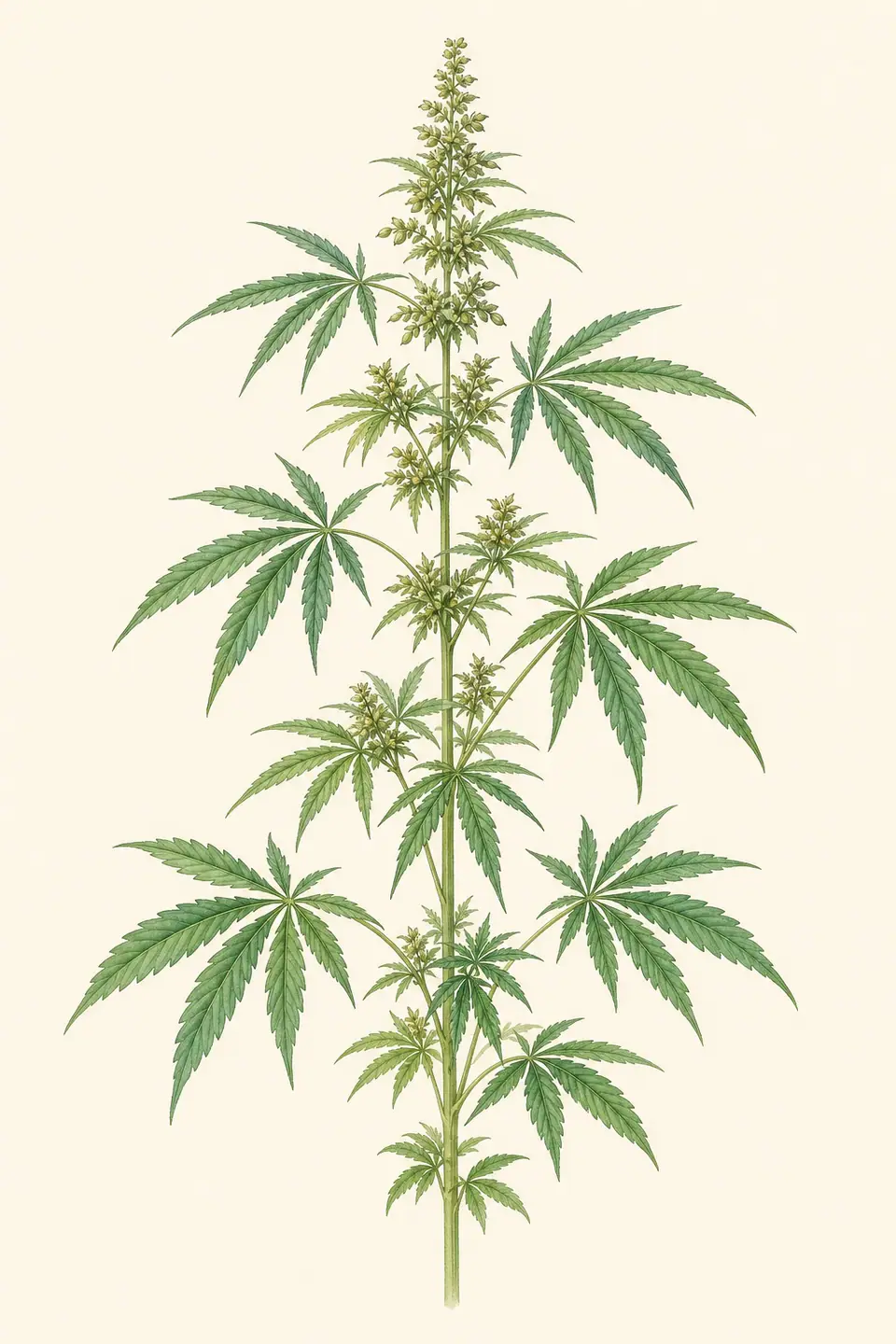
Seeds of the Spleen, Oil of the Intestines, Majain (Hemp Seed Kernel)
The "Shennong Bencao Jing" listed Majain as a first-grade herb, stating, "The taste is sweet and its nature is neutral; it primarily supplements the middle burner and benefits the Qi, promoting health and longevity." This means it supplements the middle burner (Jung-cho) and supports energy. The "Myeongui Byeollok" and "Ilhwaja Gu Bencao" added effects such as "supplementing deficiency and fatigue," "expelling all wind-qi," and "promoting lactation," while the "Bencao Gangmu" summarized it as "moistening the five viscera and benefiting the large intestine from wind-heat, stagnation, and dryness." Although the name means 'the kernel of the seed of hemp,' the classics first focused on supplementing the body and supporting energy rather than simply emptying the bowels.
However, today, Majain is most commonly associated with the image of an 'oily seed good for constipation.' This perception is not incorrect. Majain-hwan (Hemp Seed Kernel Pill), found in the "Shanghan Lun" and "Jingui Yaolue," is a representative prescription for 'Bi-yak', a condition where the intestines dry out due to stomach heat, leading to frequent urination and hard stools. The "Benjing Fengyuan" stated, "Its nature is nourishing and moistening; it is suitable for those whose viscera are knotted and dry." The issue is that this oily property affects everyone differently. The same "Benjing Fengyuan" warns, "Initial administration can cause diarrhea." While those with dry intestines need moistening, it can actually induce diarrhea in those with a deficient and cold spleen or 'slippery' intestines. Herein lies the paradox: the 'seed of the spleen' can actually be harmful to those with a weak spleen.
Therefore, Majain is a medicinal herb where efficacy and contraindications are closely linked. The "Bencao Gangmu" noted that "excessive consumption damages the blood vessels, slips the essence-qi, and weakens the Yang-qi," and the Traditional Knowledge Portal of Korea summarizes it as "avoided by those with slippery intestines." The Daehwang (Rhubarb) contained in the Majain-hwan of the "Shanghan Lun" is a potent purgative, to the extent that modern Japanese PMDA data warns against its use during pregnancy. In this way, the power of moistening purgation is always a double-edged sword.
Ultimately, Majain is a herb where 'how much, who, and how' it is used makes all the difference. Even if it is recorded as 'non-toxic' in herbal medicine studies, that non-toxicity can be overturned depending on the constitution, symptoms, duration of intake, and other herbs used together. On this page, we will organize those criteria step by step.
Summary at a Glance
The core of Majain stems from its physical property as an 'oily seed.' The table below summarizes its origin, properties, primary effects, and the contraindications that must be checked first at a glance.
| Category | Content |
|---|---|
| Origin | Majain (麻子仁): Plant of the Cannabaceae family Cannabis sativa The mature seeds (kernels) of L. are used medicinally. The Bencao Gangmu distinguishes that "the shell is toxic, but the kernel is non-toxic." |
| Properties and Meridian Tropism | Sweet, Neutral; Hand Yangming Large Intestine Meridian, Foot Taiyin Spleen Meridian, Stomach Meridian. |
| Representative Aliases | Main (麻仁), Daemain (大麻仁), Hwamain (火麻仁), Daemaja (大麻子). |
| Efficacy Recorded in Literature | "Shennong Bencao Jing": "Supplements the middle burner and benefits the Qi, promoting health and longevity." "Bencao Gangmu": "Moistens the five viscera and benefits the large intestine from wind-heat, stagnation, and dryness." "Yaksung-ron": "Endures aging and benefits the Qi; long-term use prevents hunger." |
| Main Ingredients | An oily seed rich in fat. The Bencao Gangmu records cooking methods using oily extracts, such as "extracting the juice to cook porridge." |
| Combinations and Contraindications | Representative combination: Majain-hwan (Hemp Seed Kernel Pill) from "Shanghan Lun" and "Jingui Yaolue", used for constipation due to Bi-yak. Contraindications: Those with slippery intestines (diarrhea/loose stools); incompatible with Oyster Shell (Moryeo) and Baiwei (Baekmi); antagonistic to Poria cocos (Bokryeong). Records state that excessive amounts "damage blood vessels, slip essence-qi, and weaken Yang-qi." Pregnant women should be cautious when using Majain-hwan preparations containing Daehwang. |
Is this medicinal herb right for me?
Majain is a representative herb for 'moistening purgation,' but its oily nature can cause diarrhea in people with weak intestines. Please check based on the following three criteria first.
- Generally suitable cases: This is most applicable when stools are hard and dry, requiring significant effort to bowel move, when the mouth and throat are dry with frequent urination, and in cases of 'Bi-yak' as described in the "Shanghan Lun", a state where the intestines have become dry due to stomach heat.
- Cases requiring caution: You must consult a Korean medicine doctor before use if you have a cold abdomen and slow digestion, experience alternating constipation and diarrhea, are pregnant or breastfeeding, or are taking anticoagulants or antiplatelet agents. In particular, since Majain-hwan preparations contain Daehwang, it is advisable for pregnant women to avoid them.
- Cases to avoid: It is recommended to avoid use if you have diarrhea, loose stools, a 'slippery intestine' constitution, abdominal pain, enteritis, or a deficient and cold spleen, as the lubricating action of Majain may worsen these symptoms.
Practical Q&A
Majain is commonly known as a constipation remedy, but in reality, it is a herb that can produce quite different reactions depending on the constitution and form of administration. We have gathered answers to frequently asked questions in the clinic based on the content covered on this page.
Is Majain only used for constipation?
No. The reason the "Shennong Bencao Jing" listed Majain as a first-grade herb was for its "Bo-jung-ik-gi" effect, supplementing the middle burner and benefiting the Qi. The "Myeongui Byeollok" and "Ilhwaja Gu Bencao" add effects such as "supplementing deficiency and fatigue" and "promoting lactation," and the "Bencao Gangmu" summarizes it as "moistening the five viscera and benefiting the large intestine from wind-heat, stagnation, and dryness." It is used to relieve constipation without damaging the intestines, rather than being a simple purgative.
Are Majain-hwan and Majain the same thing?
They are not the same. Majain-hwan (Hemp Seed Kernel Pill) is a prescription found in the "Shanghan Lun" and "Jingui Yaolue," containing not only Majain but also Peony root, Zhishi, Daehwang, Magnolia bark, and Apricot seed. This prescription targets a specific state called 'Bi-yak', where the intestines dry out due to stomach heat, leading to frequent urination and hard stools. Its composition, indications, and precautions differ from Majain used alone. In particular, because it contains Daehwang, pregnant women or those with weak intestines need to be more cautious.
Can I take Majain every day?
Classical texts contain records stating, “Long-term use makes one plump, healthy, and prevents aging,” but this was based on the administration methods and dosages of that time and is difficult to apply directly today. The 《Bencao Gangmu》 also warns that “excessive consumption damages the blood vessels, makes the essence and qi slippery, and weakens the yang qi.” For long-term use, it is advisable to consult a Korean medicine doctor to determine the dosage and duration appropriate for your constitution and symptoms.
Can people who have frequent diarrhea take this?
It is not recommended. Mazajin (Hemp seed) is an oily seed that has a ‘Yun-ha’ (moistening and purging) effect that lubricates the intestines. For those who already have a weak bowel or experience diarrhea or fecal urgency (difficulty holding stool), it may worsen symptoms. The 《Bencao Gangmu》 explicitly states, “Forbidden for those with slippery intestines.”
Is it safe during pregnancy?
Official clinical safety data for Mazajin alone is limited. More importantly, many formulations sold as ‘Mazajin-hwan’ contain Daehwang (Rhubarb). According to Japanese PMDA data, Mazajin-hwan preparations containing Rhubarb may cause uterine contractions or congestion of pelvic organs, and it is warned to avoid use during pregnancy. Pregnant women or those who may be pregnant must consult a specialist.
Are there any precautions when taking it with Western medicine?
There are cases where caution is theoretically required. Animal studies have reported that hemp seed may increase the risk of bleeding when used in combination with anticoagulants or antiplatelet agents, and particular caution is needed when used with drugs such as warfarin. However, human clinical evidence is still insufficient. If you are currently taking anticoagulants or blood-related medications, please consult your attending medical staff before using Korean herbal medicine preparations containing Mazajin.
Relationship with Other Medicinal Herbs (Yakdae/Pairing)
Mazajin is rarely used alone. The true value of this medicinal herb is revealed when paired with other herbs, especially when the prescription is designed to help lubricate the intestines. In traditional medicine, such pairs are called ‘Yak-dae’ (medicinal pairs). When the oily seeds of Mazajin meet other purgatives, wind-relieving herbs, or qi-regulating herbs, they are used in various contexts beyond simple constipation relief. However, since contraindications vary depending on the combination, it is important to first check which prescription it is paired with.
- Mazajin + Jakyak (Peony Root) + Jiksil (Citrus Aurantium) + Hubak (Magnolia Bark) + Daehwang (Rhubarb) + Haeng-in (Apricot Kernel) — Mazajin-hwan: A representative prescription found in the 《Shanghan Lun》 and 《Jingui Yaolue》. It is structured so that Mazajin lubricates the intestines while Daehwang and Jakyak guide stool hardened by heat downward; it has traditionally been used for symptoms called ‘Bi-yak’ (Spleen contraction). Because this prescription contains Daehwang, particular caution is required for pregnant women or those with weak intestines.
- Mazajin + Do-in (Peach Kernel) + Jogak (Gleditsia Fruit) + Daehwang, Ganghwal, Bangpung, Dang-gui Sopung-yunjang-hwan: A prescription recorded in the Internal Medicine section of the 《Dongui Bogam》, traditionally used when stool is trapped due to a combination of wind-heat and stagnation.
- Mazajin + Jinhyang (Agarwood) + Yukjongyong (Cistanche) Yunjang-hwan: A prescription recorded in the 《Se-ui Deuk-hyo Bang》, formulated for cases where the large intestine has dried out due to fluid loss from sweating or frequent urination.
- Mazajin + Gyeongmi (Non-glutinous Rice) Mazajin-juk (Mazajin Porridge): A dietary form found in the 《Bencao Gangmu》 and other texts, traditionally used for abdominal bloating due to wind-water, wind-closure in the elderly, or pain during urination and defecation.
As shown, Mazajin is always used with other medicinal herbs, and depending on the combination, the direction of ‘Yunjang’ (lubricating the intestines) is strengthened or the direction of ‘ Bo-jung’ (tonifying the center) is enhanced. In particular, prescriptions containing purgative or heat-clearing components such as Daehwang or Jogak must be selected after accurately assessing the individual's constitution and symptoms.
In what form is it consumed?
Due to its properties as an oily seed, Mazajin can be used in various forms, but not all forms are recommended for daily use. I have summarized them into the following four forms, and forms that are not applicable are honestly marked as ‘Not common.’
-
Tea Not common: Brewing Mazajin directly as a tea is not common in either classical or modern times. While the 《Bencao Gangmu》 contains records such as “boil the juice into porridge” or “decoct with a small amount of salt,” these are closer to porridge, juice, or decoction forms rather than tea.
-
Food (Dietary Therapy) Possible: Mazajin-juk (Mazajin Porridge) is recorded in the 《Bencao Gangmu》. This method involves grinding half a geun of winter Mazajin in water to extract the juice and making porridge with 2 hop of non-glutinous rice; it was traditionally used for wind-water abdominal bloating, wind-closure in the elderly, and constipation. Additionally, the 《Yak-seong-ron》 records the use of a pill made by roasting 2 seung of Mazajin and 1 seung of soybeans, grinding them into powder, and mixing with honey.
-
Decoction Possible: Mazajin can be used in a decoction. However, because it is an oily seed and does not dissolve well in water, it is often powdered or crushed depending on the preparation method when decocted with other herbs.
-
Professional Prescriptions (Pills · Compound Formulas) Most common: Mazajin is used more frequently within a prescription than alone. Representative examples include Mazajin-hwan from the 《Shanghan Lun》 and 《Jingui Yaolue》, and it is included in various pills and compound formulas such as Sopung-yunjang-hwan, Yunjang-hwan, and Jogak-won. These professional prescriptions are combined with herbs like Daehwang, Hubak, Jiksil, and Jakyak to help lubricate the intestines and facilitate bowel movements.
Interactions and Safety During Use
In herbal medicine studies, Majayin (apricot kernel) is recorded as 'non-toxic.' In Korea, it is managed as a non-narcotic herbal medicine outside the pharmacopeia; however, this does not mean it can be used without limit or caution. In particular, the lubricating property of oily seeds on the intestines may increase discomfort depending on an individual's constitution and the form of administration. Therefore, it is important to first review confirmed interactions and contraindications.
- Those with a 'slippery bowel' (Jang-hwal) constitution or a tendency toward diarrhea: Majayin (Hemp seed) is a medicinal herb that moistens the intestines. If taken by those who already have slippery bowels, diarrhea, or fecal urgency (difficulty holding stool), symptoms may worsen. The Bencao Gangmu also records, "Avoid in those with slippery bowels."
- Those with a weak gastrointestinal system: Those who frequently experience loss of appetite, abdominal pain, or diarrhea may experience discomfort, particularly with Majayin-hwan preparations containing Daewhang (Rhubarb).
- Pregnant women: Official clinical safety data for Majayin alone is limited. However, for Majayin-hwan preparations containing Daewhang, Japanese PMDA data warns that "it is advisable not to administer to women who are pregnant or may become pregnant." This is because the uterine-contracting and pelvic organ congestion effects of Daewhang theoretically pose a risk of premature birth or miscarriage.
- Those taking anticoagulants: Animal studies report that Hemp seed may theoretically increase the risk of bleeding when used in combination with anticoagulants or antiplatelet agents. Caution is required if you are taking medications such as warfarin, although human clinical evidence is still insufficient.
- Overlapping use of preparations containing Daewhang: Since Majayin-hwan preparations contain Daewhang, using them alongside other herbal medicine preparations containing Daewhang increases the risk of diarrhea and electrolyte imbalance.
- Excessive intake: Modern reports have noted cases of toxicity from excessive intake of roasted Majayin. The Bencao Gangmu also records that "eating too much damages the blood vessels, slips the vital essence, and weakens the yang energy."
As a 'seed of the spleen,' Majayin is a medicinal herb that moistens the large intestine; however, it presents a paradox where its oily nature can cause diarrhea in people with a deficient and cold spleen. Whether this herb is suitable for you, in what form, and with which prescription it should be used must be determined by comprehensively considering your individual constitution, current medications, and possibility of pregnancy. Please confirm the specific use and dosage through a consultation.
If you experience these symptoms
Majayin is a medicinal herb that works by using oily seeds to moisten the intestines. Therefore, if the following signals appear after intake, it is better to view them as a sign that there may be an issue with the dosage or constitutional fit, rather than simply thinking 'the medicine is working.' Especially when taking preparations containing Daewhang, such as Majayin-hwan, diarrhea can go beyond a stage of herbal action and lead to electrolyte imbalance, so more caution is needed. If these signals appear, do not adjust the dose yourself and inform your attending Korean medicine doctor.
- Diarrhea or loosening of stools This indicates that the intestine-moistening action of Majayin has become excessive. This is particularly common in those with a constitution where the intestines are originally weak or cold.
- Worsening or persistent abdominal pain This is difficult to view as a simple process of constipation improvement. In the case of preparations containing Daewhang, intestinal peristalsis may be excessively stimulated.
- Accompanied by nausea or vomiting Gastrointestinal irritation may have increased.
- Dizziness or severe fatigue This may suggest loss of water and electrolytes due to diarrhea.
- Lower abdominal pain or bleeding after intake during pregnancy Since uterine contraction and pelvic organ congestion effects have been reported for preparations containing Daewhang, such as Majayin-hwan, you must stop use immediately and seek medical evaluation.
- Tendency toward bleeding, such as easy bruising or bleeding gums, while taking anticoagulants There are reports that seeds such as Majain (hemp seed) may theoretically interact with anticoagulant or antiplatelet effects, so verification is required.
Please visit an emergency medical institution in the following cases: when severe diarrhea occurring several times a day is accompanied by dehydration symptoms (extreme thirst, decreased urine output, dizziness), when abdominal pain becomes intense and the abdomen becomes hard, when bloody or black stools are observed, or when a pregnant woman experiences abdominal pain or bleeding after administration.
Differences from other restorative medicines
Majain is also a high-grade medicinal herb in the Shennong Bencaojing, which records 'replenishing the center and augmenting Qi.' Many people wonder how it differs from other preparations labeled as restorative tonics, such as Gongjindan, Gyeongokgo, and Gwibitang. We explain this by simplifying it into one criterion.
Majain is a 'seed' that helps moisturize the intestines and spleenAs recorded in the Bencao Gangmu, "moistening the five viscera and benefiting the large intestine from wind-heat dryness," its core purpose is to relieve dry heat within the intestines and soften the stool. The phrase "replenishing the center and augmenting Qi, promoting health and longevity" from the Shennong Bencaojing is a secondary effect, not the primary purpose of this herb. In contrast, Gongjindan or Gyeongokgo are complex restorative tonics that supplement and regulate the overall Qi, blood, Yin, and Yang of the body, focusing more on supplementing general deficiency (Xu) rather than the 'moisturizing' of a specific organ.
Therefore, Majain is a more suitable herb when accompanied by constipation and a tendency toward 'Spleen contraction' (Pi-yak), where the intestines are dry, urination is frequent, and stools are hard. It is not suitable for general restorative needs such as 'wanting to supplement due to lack of energy' like Gongjindan or Gyeongokgo; in such cases, using it alone may cause diarrhea or abdominal discomfort due to the lubricating properties of the oily seed.
Ultimately, whether Majain acts as a restorative tonic or not depends on the context of the symptomsIn a state where the intestines are dry and there is heat, moisturizing and supplementing work together; however, for those with a deficient and cold spleen constitution, it is not a tonic but rather a burdensome herb. The most accurate way to determine which category you fall into, and whether Majain is appropriate as a supplementary or standalone herb, is through a medical consultation.
References
- Evidence material 1 regarding Majain: GBIF plant classification data.
- Evidence material 2 regarding Majain: GBIF plant classification data.
- Evidence material 3 regarding Majain: GBIF plant classification data.
- Evidence material 4 regarding Majain: PubMed academic paper.
- Evidence material 5 regarding Majain: PubMed academic paper.
- Evidence material 6 regarding Majain: PubMed academic paper.
- Evidence material 7 regarding Majain: PubMed academic paper.
If you would like to check if this medicinal herb is right for you or which prescription it should be used with, please leave a medical inquiry. For those who find it difficult to visit the clinic, non-face-to-face consultations are available; we will provide guidance after first reviewing your current condition and current medications.

Medical Staff Review
Director Choi Yeon-seung
Chief Director of Baekrokdam Korean Medicine ClinicMajain Dictionary Entry, reviewed the safety of expressions and the scope of verification before administration.
Review Scope: Clinical Accuracy, Pharmacology, Contraindications, Combinations, QA · Last Reviewed 2026-08-16
- Graduated from Kyung Hee University College of Korean Medicine
- Providing Korean medicine treatment since 2010
- Consultations for Gongjindan, Gyeongokgo, Nokyong (Deer Antler) restorative medicine, and customized restorative herbal medicine