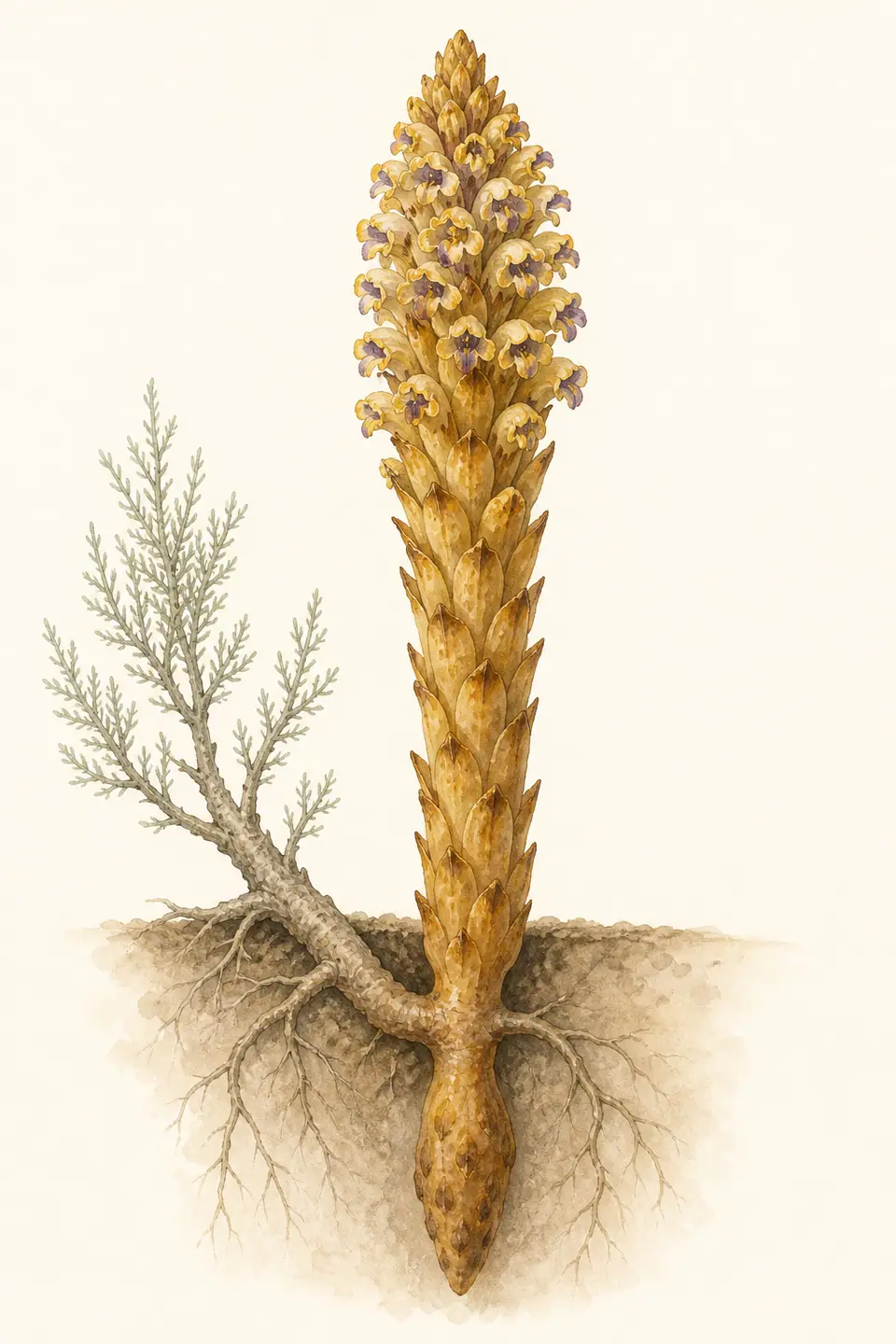
Ginseng of the Desert, a Restorative Medicine in the Shade
The "Shennong Bencao Jing" (Divine Farmer's Materia Medica) classifies Cistanche (Yukjongyong) as a top-grade herb. It is recorded to "tonify the five viscera, strengthen the yin, supplement the vital essence, and regulate female reproduction." The name 'Yukjongyong' comes from its fleshy stem that resembles the body of a dragon. It is a unique medicinal herb, being a parasitic plant that takes root beneath the cool desert sands. In modern taxonomy, it belongs to the Orobanchaceae family, Cistanche deserticola recorded as Cistanche Ma, and it is academically confirmed to be a holoparasitic plant that has lost almost all of its chloroplasts.
This herb often brings to mind 'tonifying the kidney' and 'strengthening the yang,' and its image is sometimes narrowed down to a simple 'men's restorative.' However, classical records view its scope much more broadly. The expression of tonifying the five viscera and aiding vital essence does not refer solely to an individual's reproductive function, but points toward supplementing the yin energy and essence deep within the body. In other words, Cistanche is a medicinal herb used to fill 'moisture and stability' inside rather than outward 'strength.'
However, among the self-published corpus of Baekrokdam that we have organized, no clinical texts directly linked to Cistanche have been identified at this time.
Therefore, this herb must be handled with even greater caution. If one thinks that anything can be 'filled in' under the name of a restorative medicine, it may instead disrupt the body's balance. The key is whether Cistanche is actually helpful, for whom, to what extent, and with which prescription it should be used. On this page, we will organize those criteria step by step.
Summary at a Glance
If you would like to quickly understand what kind of medicinal herb Cistanche is, please refer to the table below first. We have summarized everything from its core identity to its properties and precautions at a glance.
| Category | Content |
|---|---|
| Origin | Hanja name: 肉蓯蓉, Scientific name: Cistanche deserticola Cistanche Ma. The fleshy stem of a holoparasitic plant belonging to the Orobanchaceae family is used medicinally. |
| Properties and Meridian Tropism | The taste is sweet with a slight bitterness at the end, and the property is warm. It primarily acts on the Kidney Meridian and Large Intestine Meridian. |
| Representative Aliases | Daeyun, Geumchik, Desert Ginseng |
| Efficacy Recorded in Literature | Classified as top-grade in the "Shennong Bencao Jing," it is recorded to "tonify the five viscera, strengthen the yin, supplement the vital essence, and regulate female reproduction." |
| Main Ingredients | Phenylethanol glycosides, iridoids, lignans, and polysaccharides have been reported. |
| Combinations, Contraindications, and Precautions | As a restorative medicine with yang-tonifying and yin-tonifying properties, it is safe for those with excessive body heat, frequent diarrhea, or for pregnant and breastfeeding women to use after consulting a specialist. Verification is also necessary when used concurrently with Western medicine or for long-term consumption. |
Is this medicinal herb right for me?
Cistanche is well-known as a restorative medicine, but it is an herb where suitability varies clearly depending on the individual's constitution or symptoms. Please evaluate based on the following three criteria first.
- Generally suitable cases: Considering that the "Shennong Bencao Jing" placed Cistanche in the top grade and recorded that it "tonifies the five viscera, strengthens the yin, and supplements the vital essence," it has been traditionally considered for those who feel generally exhausted and deficient. Especially as a herb that grows in the dry desert environment, it tends to be used to supplement moisture and essence within the body.
- Cases requiring caution: In herbal medicine, the expression "strengthening the yin" means it is a herb with a strong supplementing nature. Therefore, those with excessive heat or phlegm in the body, a feeling of dullness in the abdomen, or frequent diarrhea should be cautious about taking it alone or long-term. Additionally, as Cistanche is a parasitic plant with limited harvest quantities, and the Korean Herbal Pharmacopoeia (outside the KP) sets purity standards for heavy metals, residual pesticides, and sulfur dioxide, it is important to verify if the product meets these standards.
- Cases to avoid: In the absence of confirmed specific values for clear clinical contraindications or interactions, it is safe for pregnant or breastfeeding women, children, and those currently taking other medications to use it only after consulting a Korean medicine doctor. Just because Cistanche is a restorative medicine does not mean it is unconditionally suitable for everyone.
Practical Q&A
We have collected frequently asked questions about Cistanche heard in the clinic. The answers below are based on contents confirmed in Korean medicine classics, pharmacopoeias, and modern academic materials; parts that may vary depending on an individual's constitution or condition must be based on a consultation.
1. What does Cistanche look like as a medicinal herb?
According to the Korean Herbal Medicine (Crude Drug) Standard outside the Korean Pharmacopoeia, Yukjongyong is Cistanche deserticola the fleshy stem, the plump, flesh-like part of the stem, of Cistanche Ma or other closely related species of the same genus. It is cylindrical in shape, approximately 3 to 15 cm in length and 3 to 6 cm in diameter. The exterior is yellowish-brown to dark brown and covered with scales, has a characteristic odor, and tastes sweet with a slight bitterness at the end. This fleshy form is the origin of the name 'Yukjongyong' (Cistanche).
2. How is Cistanche classified in terms of properties and actions?
In the "Shennong Bencao Jing," Cistanche is listed as a top-grade herb, and it is recorded to "tonify the five viscera, strengthen the yin, supplement the vital essence, and regulate female reproduction." This is traditionally understood as tonifying the kidney and essence, and it serves as the basis for it being frequently considered in restorative prescriptions dealing with weak constitutions or symptoms related to aging.
3. Are there people who should specifically avoid taking Cistanche (Yukjongyong)?
This is a medicinal herb that clearly suits some constitutions and symptoms while not suiting others. For those with constipation who have difficulty with bowel movements, those with a 'sil-jeung' (excess pattern) constitution characterized by a hard, swollen abdomen, or those experiencing heart palpitations and excessive night sweats due to 'eum-heo-hwa' (yin deficiency fire), Cistanche may actually aggravate the symptoms. Additionally, individuals with frequent diarrhea, weak digestion, or those who are pregnant or breastfeeding must consult a Korean medicine doctor before deciding to use it.
4. How much Cistanche should be taken per day, and for how long?
Because the exact dosage and duration of intake vary depending on constitution, symptoms, and other medications being taken, it is difficult to set a uniform standard without a consultation. When prescribed at a Korean medicine clinic, the Korean medicine doctor will adjust the dosage and duration based on the individual's condition. Regular check-ups are necessary when taking it for a long period.
5. Can it be taken together with Western medicine or health functional foods?
There is insufficient official evidence in this section regarding interactions between Cistanche and specific Western medicines or health functional foods. However, since tonic herbs may overlap with other supplements or hormone-related agents, it is recommended that you disclose all currently taken medications and health functional foods and confirm safety through a consultation.
6. I am confused by other medicinal herbs with similar names; how can I tell them apart?
Cistanche is the medicinal herb with the Chinese name 肉蓯蓉 and the scientific name Cistanche deserticola Cistanche deserticola (or Cistanche tubulosa). It must be clearly distinguished from other herbs with similar names or those that frequently appear in the same prescriptions. When purchasing or taking medicinal herbs, always verify the Chinese name and scientific name, and use only those prescribed by a Korean medicine clinic.
Relationship with Other Medicinal Herbs (Yakdae/Pairing)
Cistanche is a herb whose properties become more distinct when used with other herbs rather than alone. In traditional medicine, such pairing combinations are called 'yak-dae' (medicinal pairs). Cistanche tends to be paired with other tonics or lubricant laxatives, particularly for the purposes of supplementing (bo-ik) and moistening the intestines (yun-jang). Below is guidance focusing on confirmed classical prescriptions and combination relationships.
- Cistanche + Polygonatum odoratum (Hwangjeong) A pair of tonic herbs. They have been traditionally used to complement each other, with Cistanche moistening the kidneys and large intestine, while Polygonatum odoratum supplements the yin energy of the spleen and lungs. Source: 'Shen Nong Ben Cao Jing', Superior Grade Tonic group.
- Cistanche + Rehmannia glutinosa (Sukjihwang) A combination that supplements kidney yin and essence/blood. Cistanche supports kidney yang and vital energy, while Rehmannia glutinosa supplements the yin blood of the liver and kidneys; this is traditionally utilized for weakness-induced constipation or lethargy in the lower limbs. Source: Cited in tonic prescriptions such as 'Uibang Bichwi'.
- Cistanche + Cnidium officinale (Cheongung) A combination that adds blood-activating properties to a tonic to ensure that qi and blood do not become blocked. When the supplementing nature of Cistanche meets the dispersing nature of Cnidium, it has been traditionally used to reduce the dizziness that can occur when only supplementing. Source: 'Bencao Gangmu', Cistanche section.
- Cistanche + Rheum palmatum (Daehwang) A combination used for both attacking and supplementing to manage constipation. Cistanche moistens the intestines while Rheum palmatum works to move accumulated waste downward; this structure is commonly used for the elderly or those with chronic constipation. Source: Based on lubricant laxatives from the 'Shanghan Lun' lineage.
There are not enough confirmed official records regarding combination contraindications. Since Cistanche itself has warm and moistening properties, caution may be needed when combining it with other herbs for those with strong heat patterns, watery stools, or constitutions with severe phlegm-dampness. Specific prescriptions are determined based on constitution and symptoms during consultation.
In what form is it consumed?
Cistanche is far more commonly used with other herbs within a prescription than as a standalone tea. Here is a summary ranging from forms easily accessible to the general public to professional prescriptions.
- Tea: It is not common as a standalone tea. The taste is sweet with a slight bitterness at the end; rather than steeping the fleshy stem alone, it is mostly decocted (boiled) with other herbs in Korean herbal medicine prescriptions.
- Food (Dietary Therapy): Confirmed traditional dietary therapy data is limited. It is rarely used as a food ingredient in general households. When taking it as an independent supplement outside of a professional Korean herbal medicine prescription, consultation with a Korean medicine doctor is strongly recommended.
- Decoction: The most traditional and common form. Cistanche prescribed at a Korean medicine clinic is boiled with other herbs and taken as a decoction (tang-yak). As one of the tonics classified as Superior Grade in the 'Shen Nong Ben Cao Jing', it is often included in prescriptions for the purpose of supplementing the kidneys and moistening the intestines.
- Professional Prescription: Cistanche is paired with other tonics or lubricant laxatives for purposes such as supplementing kidney yang and essence, and moistening the intestines to facilitate bowel movements. Since specific prescription names and dosages vary according to individual constitution and symptoms, it is advisable to determine the appropriate prescription through a consultation.
Interactions and Safety During Use
Cistanche is well-known as a restorative herbal medicine, but it is an ingredient where suitability varies significantly depending on an individual's constitution and symptoms. Below are the confirmed interactions and contraindications.
- Precautions by Constitution and Symptom: Cistanche is traditionally used to supplement the kidneys (補腎) and moisten the intestines (潤腸). Therefore, it may not be suitable for those with Yin deficiency heat (陰虛火), those with abdominal swelling and frequent diarrhea, or those who naturally have loose stools. Conversely, it is traditionally considered more appropriate for those with deficient kidney qi (腎氣) and constipation caused by dry intestines.
- Pregnancy and Breastfeeding: Those who are pregnant or breastfeeding must consult a professional before use. Safety data is limited.
- Interactions with Western Medicine and Health Supplements: No specific interactions with Western medicines have been identified in current research. However, as Cistanche can affect intestinal motility and water metabolism, you should be cautious when taking it alongside laxatives, anti-diarrheal medications, diuretics, or medications for blood pressure and diabetes.
- Excessive or long-term consumption: Restorative medicines often take time to show effects, leading many to take them over long periods. However, long-term or high-dose use of Cistanche may cause digestive discomfort or reactions incompatible with one's constitution; therefore, regular status checks are necessary.
- Quality Standards: According to the Korean Pharmacopoeia and the Korean Herbal Medicine (Crude Drug) Standard, Cistanche must meet purity standards for heavy metals (lead 5 ppm or less, arsenic 3 ppm or less, mercury 0.2 ppm or less, cadmium 0.3 ppm or less), residual pesticides, and sulfur dioxide (30 ppm or less). It is important to use the ingredient through reliable supply channels.
Suitability varies based on an individual's constitution, symptoms, and current medications. Rather than starting Cistanche as a standalone tea or supplement, we recommend consulting a doctor of Korean medicine to use it in an appropriate dose and duration within a prescription.
If you experience these symptoms
If these symptoms appear
Cistanche is well-known as a restorative herbal medicine, but its suitability varies clearly depending on constitution and symptoms. The following signals are known warning signs that may appear during the intake of Cistanche. For your safety, please inform your attending doctor of Korean medicine to adjust the treatment rather than reducing the dose or stopping it on your own. In particular, if symptoms are severe or progress rapidly, you must visit an emergency medical institution.
- Diarrhea or abdominal discomfort: Cistanche is traditionally used for moistening the intestines (潤腸). If taken by those with a naturally loose bowel constitution or frequent diarrhea, these symptoms may be aggravated.
- Nausea or indigestion: Taking excessive amounts or long-term use of the fleshy stem may place a burden on the gastrointestinal tract.
- Dry mouth or feeling of heat: Cistanche has strong properties for supplementing the kidneys (補腎) and moistening/tonifying (潤補); for those with Yin deficiency heat (陰虛火, a tendency where body fluids are lacking and heat rises), these symptoms may increase.
- Headache or dizziness: These are signals that may appear when the medicine is not compatible with your constitution.
- Rash or itching: This may be a hypersensitivity reaction to the herbal medicine; stop use immediately and seek consultation.
Even if symptoms are mild, if they persist or are accompanied by severe diarrhea, dehydration, difficulty breathing, or decreased consciousness, please visit an emergency medical institution (emergency room).
Differences from other restorative medicines
While Cistanche is a restorative medicine used to supplement the kidneys (補腎) and moisten the intestines (潤腸), different restorative medicines have different directions of action and target subjects. By comparing it with representative tonics such as Gongjindan (拱辰丹) or Gyeongokgo (瓊玉膏), you can more easily understand the role of Cistanche.
Gongjindan is traditionally a prescription to supplement the original qi of the kidneys (腎) and promote harmony between the upper and lower body, possessing a complex kidney-supplementing structure. Gyeongokgo focuses on supplementing and moistening the Yin (陰) of the lungs (肺) and kidneys, making it suitable for cases where dryness and weakness coexist. Unlike these, Cistanche is an ingredient that supplements kidney yang (腎陽) while having a distinct intestinal moistening (潤腸) effect,and tends to be more suitable for a type of deficiency syndrome (虛證) specifically characterized by coldness in the lower body (冷證) combined with dry stools. In other words, rather than choosing it simply because one 'lacks energy' or wants to 'prevent aging,' it is a restorative medicine that holds meaning in patterns where body coldness and intestinal dryness overlap.
However, these differences must be judged within the context of the overall prescription. Whether Cistanche deserticola is more suitable than Gongjindan or Gyeongokgo, or if they are better used together, can only be determined by comprehensively examining your constitution, symptoms, and other medicinal ingredients you are currently taking. It is highly recommended to make a specific choice through a consultation.
References
- Evidence material related to Cistanche deserticola 1: Korea Institute of Korean Medicine official data.
- Evidence material related to Cistanche deserticola 2: GBIF plant classification data.
- Evidence material related to Cistanche deserticola 3: Korea Citation Index academic paper.
- Evidence material related to Cistanche deserticola 4: PubMed academic paper.
- Evidence material related to Cistanche deserticola 5: PubMed academic paper.
- Evidence material related to Cistanche deserticola 6: PubMed academic paper.
- Evidence material related to Cistanche deserticola 7: NCBI original academic data.
If you would like to check if this medicinal herb is right for you or which prescription it should be used with, please leave a medical inquiry. For those who find it difficult to visit the clinic, non-face-to-face consultations are available; we will provide guidance after first reviewing your current condition and current medications.

Medical Staff Review
Director Choi Yeon-seung
Chief Director of Baekrokdam Korean Medicine ClinicCistanche deserticola Dictionary Entry, reviewed the safety of expressions and the scope of verification before administration.
Review Scope: Clinical Accuracy, Pharmacology, Contraindications, Combinations, QA · Last Reviewed 2026-08-16
- Graduated from Kyung Hee University College of Korean Medicine
- Providing Korean medicine treatment since 2010
- Consultations for Gongjindan, Gyeongokgo, Nokyong (Deer Antler) restorative medicine, and customized restorative herbal medicine