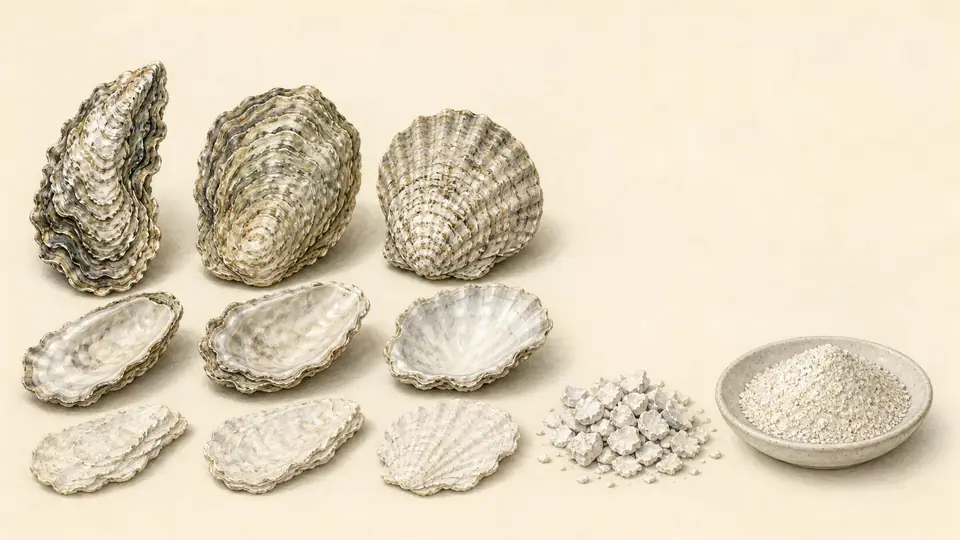
Until the oyster's home in the sea looks like a mineral
Can Moryeo, an oyster shell medicinal herb, be taken like a calcium supplement? In short, just because the shell contains a lot of calcium carbonate does not mean it can be regarded as having the same dosage, absorption, or quality as purified calcium supplements. Moryeo is a shell built up by an animal; depending on which oyster it came from, whether it was washed and dried, heated by fire, or how finely it was ground, different substances may exist under the same name.
This article explores the gaps in quality associated with the name Moryeo. It examines its identity as a traditional medicinal herb, expectations regarding calcium supplementation, differences by product form, intervals from other medications taken together, and the limitations of evidence in humans.
Moryeo is not a mineral
In the Korean Pharmacopoeia, Moryeo is defined as the shell of the Pacific oyster Ostrea gigas Thunberg, the Dalian Bay oyster Ostrea talienwhanensis Crosse, or the rock oyster Ostrea rivularis Gould. While the name sounds like a mineral, it originates from the exoskeleton of a marine mollusk. It is a structure built up by an oyster during its life that becomes a medicinal herb, not a mineral extracted from a mine.
This point is important. The fact that it is an animal-derived raw material places its origin, harvesting environment, processing method, and potential for contamination in a different context. Even if the shell's main component is calcium carbonate, that alone is not enough to conclude that its absorption rate is identical to that of purified calcium supplements.
Why calcium expectations are attached
The reason for expecting calcium supplementation effects from Moryeo is based on analysis showing that calcium carbonate is the main component. However, the name of the ingredient 'calcium carbonate' alone does not reveal the dosage, solubility, absorption rate, or consistency between products. Even with the same raw material, raw shell powder, washed and dried medicinal herbs, and calcined products are not the same substance.
Modern research has reported that Moryeo water extracts showed changes in the proportion of calcium carbonate and in mouse immune cells and tumor models. However, this is not data confirming therapeutic effects in humans. It focuses on component analysis and cell/animal testing, and is not clinical evidence proving efficacy for insomnia, anxiety, gastric acid, or osteoporosis.
Various forms covered by a single name
Under the name Moryeo, various forms are actually mixed. Oyster meat, shell calcium for food, general calcium supplements, raw shell powder, washed and dried medicinal herbs, and calcined products do not share the same raw materials or dosages.
| Category | Points to Check |
|---|---|
| Oyster meat | Part that is not Moryeo, classified as food |
| Shell calcium for food | Processing standards and heavy metal/microbial criteria |
| Raw shell powder | Oyster origin, cleaning, degree of pulverization, single dose |
| Washed and dried medicinal herb | Traditional prescription purpose and usage |
| Calcined product | Changes in components according to heating conditions |
This table is not for simple comparison, but to show the differences by form that might be overlooked if judged solely by the same name.
Contamination and quality are not guaranteed by origin alone
Studies on utilizing shellfish shells as a calcium resource indicate that along with the potential, a review of raw material safety, including heavy metals and microplastics, is necessary. Furthermore, past analyses of commercial calcium products compared lead contamination in natural and refined products, including those derived from oyster shells, demonstrating that quality cannot be guaranteed by origin alone.
You should avoid grinding and consuming shells of unknown origin. As a rule, you should also avoid products where heavy metal, microbial, and processing standards, as well as the single dose, cannot be verified.
Timing interval with other medications
The calcium supplement interactions found in National Institutes of Health (NIH) data refer to quantified calcium supplements. Rather than applying the same interval rules without knowing the actual calcium absorption amount of Moryeo (Oyster Shell), you must verify the specific product and prescription.
In particular, if you are taking thyroid hormones, quinolone antibiotics, dolutegravir, or lithium, it is necessary to show the product, including its calcium content, to your doctor or pharmacist. This is because calcium can affect the absorption or action of other medications.
Individual circumstances and safety signals
As a general rule, you should not self-administer if you have kidney disease, kidney stones, hypercalcemia, parathyroid disease, or if you are taking multiple calcium products simultaneously. Severe thirst, frequent urination, vomiting, confusion, muscle weakness, and irregular heartbeat are signs that require an evaluation for causes such as hypercalcemia. If these symptoms appear, stop taking the medicine and notify your medical provider.
Differences from similar raw materials
The confusion surrounding Moryeo is also evident when compared with similar raw materials. Oyster meat and oyster shells are different parts. Medicinal Moryeo, food-grade shell calcium, and refined calcium differ in purpose and standards. Raw washed and dried products and calcined products differ in their processing state. Total shell content and calcium carbonate content are not the same concept.
In other words, Moryeo is an animal-based raw material, the shell of a specific oyster species, not a concentrate of calcium carbonate. To convert it into a calcium supplement equivalent, one must verify the origin, processing, contamination management, and actual calcium content.
Criteria to Check Today
When choosing Moryeo, check these three things first: Whether it is a medicinal shell from an official oyster origin, food-grade shell calcium, a general calcium supplement, or oyster meat. Whether it is a raw product, calcined product, powder, or decoction, and whether the product's heavy metal, microbial, and processing standards have been verified. Whether you are taking thyroid hormones, quinolone antibiotics, dolutegravir, or lithium, or if you have hypercalcemia, kidney stones, or kidney disease.
So, what should you look for? Rather than focusing on a single component like calcium carbonate, the final standard is to verify the oyster origin, shell processing, contamination management, actual calcium content, and concurrent medications, and to avoid self-converting it as if it were a calcium supplement or therapeutic agent.
References
- Ministry of Food and Drug Safety Korean Pharmacopoeia: Moryeo.
- Ostreae Testa water extract in mouse immune and tumor models.
- Mollusk shells as calcium biomaterials: safety review.
- Lead content of calcium supplements.
- NIH ODS calcium fact sheet for health professionals.
This text explains the origin of the raw materials, the scope of research, and precautions before consumption. As this cannot replace individual diagnosis or treatment, please consult a medical professional if you are taking medication or if symptoms persist. If sudden and severe symptoms such as difficulty breathing or decreased consciousness occur after consumption, seek help from 119 or the emergency room.

Medical Staff Review
Director Choi Yeon-seung
Chief Director of Baekrokdam Korean Medicine ClinicMoryeo Dictionary Entry, reviewed the safety of expressions and the scope of verification before administration.
Review scope: Ingredient origin, human studies, concomitant medications, safety of intake · Last reviewed 2026-08-17
- Graduated from Kyung Hee University College of Korean Medicine
- Providing Korean medicine treatment since 2010
- Consultations for Gongjindan, Gyeongokgo, Nokyong (Deer Antler) restorative medicine, and customized restorative herbal medicine