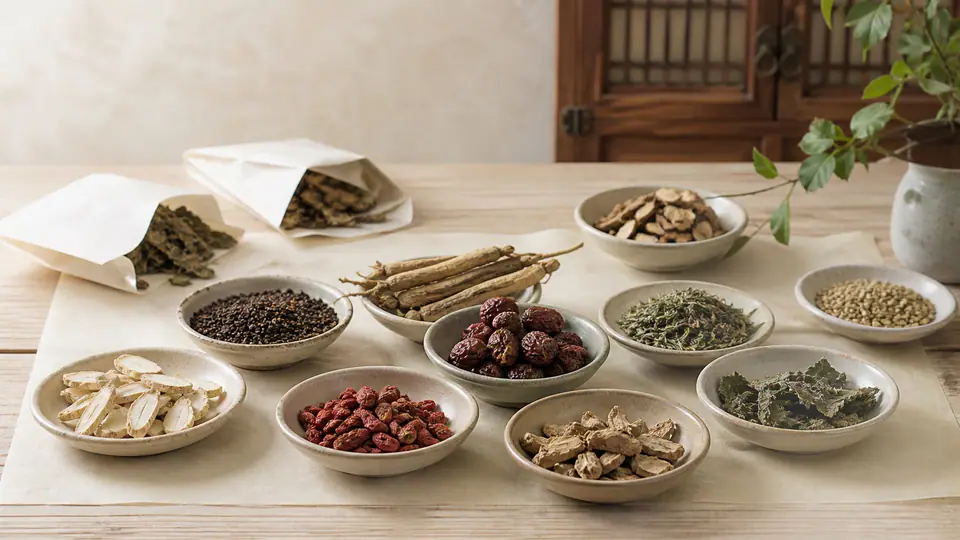
Stop and Remain Still (止而不動), Fire-Roasted Ginger
The 《Boncho Sinpyeon》 explains ginger and roasted ginger (Pogang) in a single sentence: “Dried ginger moves and does not collect, enabling it to disperse pathogenic factors externally; roasted ginger stops and does not move, enabling it to consolidate righteous qi internally.” This means that while dried ginger actively disperses external pathogens, roasted ginger remains stationary to strengthen the internal vital energy. Although they originate from the same root, the process of roasting them over fire completely changes their properties. The phrase ‘Stop and Remain Still’ is the most accurate alias for roasted ginger and summarizes its role within a prescription in a single expression.
Ginger is commonly known simply as something that 'warms the body.' It is remembered as an ingredient in a cup of tea to fight a cold or a spice to remove fishy smells from food. However, roasted ginger takes a different path. While ginger relieves exterior cold (表寒) and promotes sweating, roasted ginger warms the cold-dampness (寒濕) of the middle burner (中焦) and firmly secures the abdomen. The 《Boncho Sinpyeon》 states, “Roasted ginger is used to regulate chronic cold, deep cold, cholera, abdominal pain, and phlegm causing vomiting and diarrhea,” and the 《Deokbae Boncho》 adds, “It dries the cold-dampness of the spleen and stomach, removes cold fullness in the umbilical and abdominal area, warms the heart qi, and warms the liver meridian.” In other words, roasted ginger is a medicinal herb that treats cold syndromes (寒證) occurring in the stomach, intestines, and internal organs, rather than on the body's surface.
However, this warmth is not beneficial for everyone. The 《Deokbae Boncho》 warns that, like dried ginger, roasted ginger should not be used for pregnant women or those with constitutions characterized by yin deficiency with hyperactivity of fire (陰虛火旺) or qi deficiency (氣虛). It also notes that it may exacerbate conditions involving bleeding or diarrhea caused by heat. While warm roasted ginger is suitable for abdominal pain and vomiting/diarrhea caused by cold (寒), it must not be taken for febrile diseases simply because it comes from the same ginger root. Therefore, roasted ginger is a medicinal herb where the dosage, the recipient, and the constitution are particularly important, the dual nature of fire-roasted ginger, where its warmth becomes a point of caution.
Summary at a Glance
Roasted ginger is a Korean herbal medicine made by further processing (炮製) ginger root. The table below summarizes its origin, properties, and primary clinical contexts.
| Category | Content |
|---|---|
| Origin | Hanja Name 炮薑, Scientific Name Zingiber officinale. A processed product made by washing dried ginger (乾薑) and roasting it over fire until it turns yellow. |
| Properties and Meridian Tropism | Pungent and bitter; greatly warm (大溫). Acts on the spleen and stomach (Foot Taiyin) and the blood; possesses a tendency to 'stay and protect.' |
| Representative Aliases | 'Stop and Remain Still (止而不動)', The 《Boncho Sinpyeon》 describes the action of roasted ginger in contrast to dried ginger in this way. |
| Efficacy Recorded in Literature | Relieves cold-dampness (寒濕) of the middle burner (中焦) and cold fullness (寒痞) of the abdomen, warms the heart qi (心氣), and warms the liver meridian (肝經). It has been traditionally used for bleeding, vomiting/diarrhea (吐瀉), and abdominal pain caused by cold (寒). |
| Main Ingredients | It comes from the same plant as ginger, but the component content and excretion characteristics change during the processing. Please refer to official pharmacopeia data for specific standards. |
| Combinations and Contraindications | It is sometimes combined with Ginseng and Atractylodes to treat middle-burner cold (中寒), or combined with Angelica gigas to warm cold-type bloody dysentery. As it is a greatly warm herb, caution is required for febrile symptoms, yin deficiency with hyperactivity of fire (陰虛火旺) constitutions, pregnancy, and qi deficiency (氣虛). Since its indications (方證) differ from tonic medicines intended for supplementing yang or yin, differential diagnosis is essential when used together. |
Is this medicinal herb right for me?
Roasted ginger is a medicinal herb that firmly blocks cold from within the body. While it is reliable when it matches the constitution and direction of the symptoms, it may have the adverse effect of 'adding fuel to the fire' for those with excessive heat or deficient energy. Please check the following three criteria first.
- Generally suitable cases: It is appropriate for use under the prescription of a Korean medicine doctor for those with a cold abdomen and slow digestion, those who frequently experience abdominal pain or diarrhea after eating cold foods, those who feel cold from the inside due to cold extremities, or those with a tendency toward bleeding caused by cold.
- Cases requiring caution: Those who are pregnant, those with weak energy and easy fatigue, those experiencing heat or constipation postpartum, or those whose cause of diarrhea or bloody stools is unclear (whether heat or cold) must consult a Korean medicine doctor before use.
- Cases to avoid: It should be avoided by those with excessive internal heat experiencing dry mouth, sore throat, constipation, or night sweats; those with febrile bleeding or febrile diarrhea; and those intending to take it long-term without a professional diagnosis.
Practical Q&A
Questions about roasted ginger in the clinic are generally similar: “How is it different from ginger tea?”, “Can I take it if my stomach feels cold?”, or “Can I take it with other tonic medicines?”. I will answer the most representative questions below. However, all answers are based on the premise of an examination and constitutional differential diagnosis by a Korean medicine doctor.
Is ginger tea the same as roasted ginger?
Although they come from the same root, they are different herbal medicine materials. The ginger used in ginger tea mainly works to disperse wind‑cold and warm the skin’s surface. In contrast, processed ginger is a processed product made by washing the herb with water and then scorching it over fire. In the Bencao Xin Bian, it states: “Dry ginger moves without stopping, can disperse pathogens outward; processed ginger stays without moving, can secure the essential Qi within.” That is, ginger spreads outward, while processed ginger remains inside and tightly secures the essential Qi. Therefore, ginger tea can be used lightly at the early stage of a cold or when the body feels cold, whereas processed ginger has significance within formulas that treat cold‑dampness in the middle burner, as well as bleeding, abdominal pain, and vomiting caused by cold.
Can anyone with a cold stomach use roasted ginger?
No. While roasted ginger warms internal cold and consolidates righteous qi, it can cause adverse effects if it does not match the person's constitution. Regarding dried ginger, the 《Deokbae Boncho》 states, “If those with qi deficiency take it, it damages the origin. It is forbidden for those with yin deficiency, internal heat, and excessive sweating,” and it specifies for roasted ginger, “Avoid use in the same manner as dried ginger.” It may not be suitable for those with deficient energy, those with internal heat experiencing chest tightness and night sweats, or those whose faces flush easily. Not all 'cold stomachs' are the same type of cold syndrome, so it is important for a Korean medicine doctor to distinguish between cold/heat and deficiency/excess through abdominal and verbal examination before use.
Is roasted ginger also used for bleeding?
It has been traditionally used for bleeding caused by cold. The 《Deokbae Boncho》 records, “It is suitable for vomiting blood, epistaxis, or lower gastrointestinal bleeding in those who have yin but lack yang.” However, this refers to bleeding caused by a lack of yang energy allowing yin-cold to surge. Conversely, it is not suitable for nosebleeds caused by excessive heat, red bloody stools, or menstruation with heavy flow and dark color. The 《Deokbae Boncho》 warns that one should not “generally use roasted ginger” for dysentery where bleeding is caused by heat, or for postpartum cases where heat is generated due to blood deficiency. The most important step is first identifying the cause of the bleeding.
Can I take it with other tonic medicines or Western medicines?
Concurrent use with tonic medicines or Western medicines requires verification. Since roasted ginger is a greatly warm herb, it may not align with tonic medicines focused on supplementing yin or with individuals who have a febrile constitution. Additionally, interactions with modern Western medicines must be further verified through official clinical data. In particular, if you are taking anticoagulants, blood pressure or diabetes medications, gastrointestinal drugs, or if you are pregnant or breastfeeding, please decide only after consulting with a Korean medicine doctor.
Can I decoct and drink Pogang (processed ginger) on my own?
Pogang is generally used within a prescription through decoction. Rather than brewing it as a standalone tea, it is combined with other medicinal herbs such as in Rijung-tang, Yanghwa-tang, or in combination with Dang-gui; the ratio and dosage vary depending on an individual's constitution and symptoms. Self-administration is not recommended. Particular caution is required for those who are pregnant, have bleeding disorders, or are suspected of having febrile conditions.
Can I take it for a long period of time?
Long-term use is not recommended. Pogang is a medicinal herb with strongly warming properties; prolonged use may lead to excessive Yang energy in the spleen and stomach or cause Yin deficiency fire. If you experience abdominal burning, dry mouth, constipation, sore throat, abnormal bleeding, or heart palpitations during use, please stop taking it immediately and visit a clinic. Pogang is a medicinal herb intended for short-term, appropriate use when the direction of symptoms is clear.
Relationship with Other Medicinal Herbs (Yakdae/Pairing)
Pogang is not used alone. Its property of 'stopping without moving' is properly revealed when it is paired with other medicinal herbs within a prescription. In tradition, such pairs are called 'Yak-dae' (medicinal pairs). Pogang specifically meets other herbs to block cold-dampness in the Middle Jiao (central abdominal area) and strengthen the vital energy. Representative combinations identified below are introduced.
-
Pogang + Ginseng + Baekchul + Licorice, Rijung-tang A prescription recorded in the 《Shanghan Lun》, where Ginseng and Baekchul support the energy of the spleen and stomach, Pogang firmly blocks internal cold, and Licorice harmonizes the herbs. It has been traditionally used for Middle Jiao Cold Syndrome, characterized by chest tightness, internal coldness, and a mix of diarrhea and vomiting. 《本草經解》
-
Pogang + Sukjihwang + Sahyang-gakgyo + Cinnamon + Ephedra + Licorice, Yanghwa-tang A prescription found in the 《Yeonbang Sinpyeon》. It is used for cold-natured boils, tuberculosis, or breast diseases known as 'Eum-jeo', where Pogang plays a supporting role in releasing the cold and balancing the vital energy. 《驗方新編》
-
Pogang + Haja + Yang-gwi-gak/O-ek-ja, Hajasan (Dongwonbang) A prescription from the 《Tangdu Gagyeol》, traditionally used to treat cold-induced diarrhea. Here, Pogang also serves to block internal cold. 《湯頭歌訣》
-
Pogang + Osuyu + Cinnamon, Hwajung-hwan A combination recorded in the 《Boncho Gyeonghae》, used to relieve abdominal bloating caused by cold. 《本草經解》
-
Pogang + Dang-gui, For bloody dysentery The 《Deukbae Boncho》 contains records of using Pogang and Dang-gui together to treat bloody dysentery. 《得配本草》
-
Pogang + Samul-tang, Added for postpartum fever The 《Deukbae Boncho》 shows a method of adding Pogang to Samul-tang to manage postpartum fever. However, this is a traditional record; in modern clinical practice, it is used only after an accurate differential diagnosis of the postpartum condition. 《得配本草》
There is a lack of clearly confirmed modern interaction data regarding combination contraindications. However, as Pogang is traditionally a strongly warming herb, particular caution is needed for those with febrile bleeding, Yin deficiency fire, Qi deficiency constitutions, and during pregnancy. Please always consult a Korean medicine doctor when using it in conjunction with other restorative medicines or Western medications.
In what form is it consumed?
Pogang is a Korean herbal medicine with different properties than the ginger tea or cooking ingredients commonly encountered in daily life. We provide an honest summary of which forms of consumption are common and which are not suitable.
- Drinking as a tea: Not common. Rather than boiling Pogang alone to drink as a tea, it is more often prescribed as a decoction combined with other medicinal herbs.
- Consumption as a food item: Not common. Pogang is a Korean herbal medicine produced by further processing (po-je) ginger, and it is distinct from ginger used as a daily food.
- Consumption as a decoction (jeontang): Common. In prescriptions found in the 《Tangdu Gagyeol》, 《Yeonbang Sinpyeon》, and 《Boncho Gyeonghae》, it is confirmed to be consumed in the form of a water-based decoction.
- Take after prescription and differential diagnosis by a Korean medicine doctor: is recommended. Especially for those with bleeding, pregnancy, febrile diseases, or a Qi-deficient (氣虛) constitution, it is safer to use under the examination and constitutional differential diagnosis of a Korean medicine doctor rather than self-administering.
Interactions and Safety During Use
Since Pogang is a medicinal herb that firmly blocks coldness inside the body, it is beneficial for compatible constitutions, but for incompatible ones, it may instead act as a catalyst for heat. In particular, caution should be exercised in the following cases:
- During pregnancy: In traditional pharmacognosy, Gan-gang and Pogang have been handled strictly regarding pregnancy, with records stating, “If a pregnant woman takes it, it may cause the fetus to dissipate.” As modern clinical safety data requires further verification, please be sure to consult a Korean medicine doctor during pregnancy.
- Qi-deficient constitution (氣虛): Using the strongly warming (大溫) Pogang when Qi is deficient may instead damage the original Qi.
- Yin-deficiency with hyperactivity of fire (陰虛火旺), or constitutions with excessive heat and sweating: In a state where body fluids are insufficient and only heat rises, Pogang may aggravate the symptoms.
- Febrile bleeding or febrile diarrhea: Pogang is suitable for cold-type bleeding where “Yin exists without Yang”, meaning there is almost no Yang energy left in the body. It is not appropriate for epistaxis (nosebleeds), bloody stools, menorrhagia, or febrile diarrhea caused by heat.
- Postpartum fever (産熱): If heat symptoms accompany the postpartum period, using Pogang indiscriminately may worsen the condition.
Additionally, specific interactions between Pogang and Western medicines such as anticoagulants, antihypertensives, diabetes medications, and gastrointestinal drugs must be confirmed through official clinical data. This area currently requires further verification.
If any of the following signs appear during administration, it is advisable to stop taking it immediately and seek medical evaluation: a burning sensation in the abdomen accompanied by nausea or vomiting, occurrence of constipation, dry mouth, or sore throat, appearance of abnormal bleeding, or a feeling of heart palpitations or rising blood pressure.
In conclusion, Pogang is a Korean herbal medicine intended to be used in combination with other herbs within a prescription; it is not suitable for self-administration like daily ginger tea or cooking ingredients. Especially if pregnancy, bleeding, febrile disease, or a Qi-deficient constitution is suspected, please decide whether to use it only after examination and constitutional differential diagnosis by a Korean medicine doctor.
If you experience these symptoms
If these symptoms appear
Pogang is a strongly warming (大溫) medicinal herb that firmly blocks coldness inside the body. Therefore, if taken in excessive amounts or for a long period when not compatible with one's constitution, it may cause excessive heat to rise or further damage parts that were already weak. The following signs are warning indicators known in traditional pharmacognosy. If these symptoms appear, it is safer to first notify the prescribing Korean medicine doctor rather than reducing the dose or stopping on your own.
- Burning sensation in the abdomen with nausea or vomiting Strongly warming medications may irritate the gastrointestinal tract.
- Worsening constipation, dry mouth, and sore throat Heat may accumulate in the body or transition into Yin-deficiency with hyperactivity of fire (陰虛火旺).
- Abnormal bleeding such as bloody stools, nosebleeds, or menstrual irregularities Pogang is only suitable for bleeding caused by “Yin without Yang”; if it is febrile bleeding, it may instead worsen the condition.
- Feeling of heart palpitations or rising blood pressure It may cause nerve excitation or vasodilation.
- Uterine contractions or bleeding occur during pregnancy This is a medicinal herb with a traditional contraindication stating, "If taken by a pregnant woman, it may cause the fetus to dissipate."
- Indigestion and loss of appetite occur after long-term use It may cause an excess of Yang energy in the spleen and stomach or damage Qi deficiency.
If symptoms are severe, or if accompanied by difficulty breathing, decreased consciousness, severe abdominal pain, or persistent bleeding, please visit an emergency medical institution immediately. Pogang (processed ginger) is a medicinal herb that is safe when balanced with other herbs within a prescription; therefore, it is important to receive a medical evaluation rather than making your own judgment.
Differences from other restorative medicines
Pogang is a medicinal herb close to 'Onjung' (warming the center), which blocks cold-dampness inside the body and strengthens the vital energy. Therefore, it cannot be used with just any restorative medicine simply because it is a tonic. It is important to first examine the intended direction of the restorative medicine.
Gongjindan is a prescription traditionally used to supplement the energy of the kidneys, which operates on a different level than the cold-dampness of the middle burner (spleen and stomach) that Pogang primarily addresses. Gyeongokgo is a prescription that moisturizes the lung Yin, which may be opposite in direction to the strong warming property of Pogang. If a strong warming medicine is carelessly added to a restorative medicine that supplements Yin, it may instead dry out the area intended for supplementation.
As such, Pogang is a medicinal herb considered for those with a 'Heohan' (deficiency-cold) constitution, especially when cold-dampness in the middle burner is prominent; it is not used simply because the body is weak or because one is taking other restorative medicines. If you are currently taking restorative medicines or health functional foods, you must inform your Korean medicine doctor before receiving a prescription containing Pogang to have your constitution and treatment direction differentiated.
References
- Evidence material related to Pogang 1: Supporting data from data.go.kr.
- Evidence material related to Pogang 2: Korea Institute of Korean Medicine official data.
- Evidence material related to Pogang 3: Crude drug data from the National Institute of Food and Drug Safety Evaluation.
If you would like to check if this medicinal herb is right for you or which prescription it should be used with, please leave a medical inquiry. For those who find it difficult to visit the clinic, non-face-to-face consultations are available; we will provide guidance after first reviewing your current condition and current medications.

Medical Staff Review
Director Choi Yeon-seung
Chief Director of Baekrokdam Korean Medicine ClinicPogang Dictionary Entry, reviewed the safety of expressions and the scope of verification before administration.
Review Scope: Clinical Accuracy, Pharmacology, Contraindications, Combinations, QA · Last Reviewed 2026-08-16
- Graduated from Kyung Hee University College of Korean Medicine
- Providing Korean medicine treatment since 2010
- Consultations for Gongjindan, Gyeongokgo, Nokyong (Deer Antler) restorative medicine, and customized restorative herbal medicine