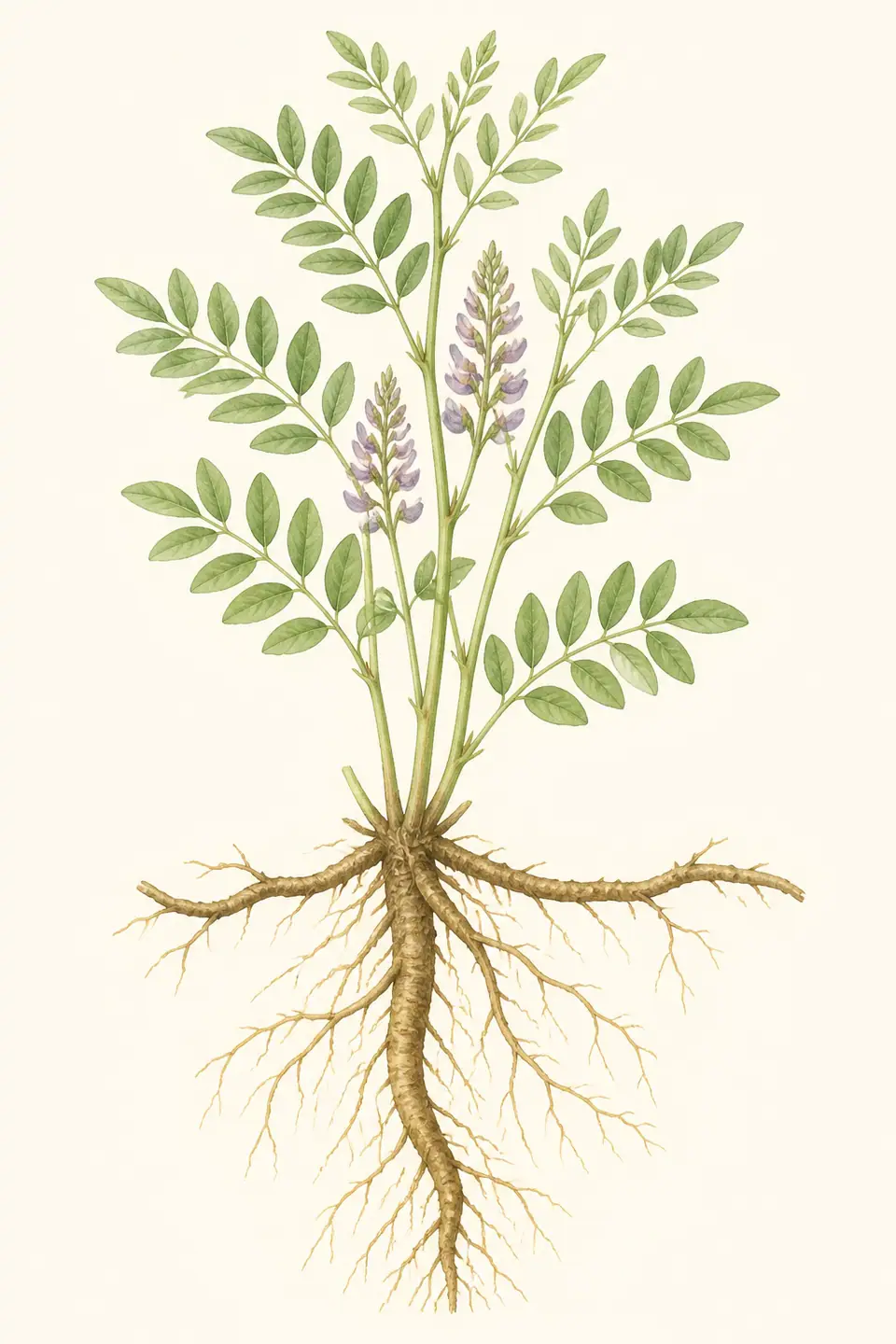
Medicine heated by fire to deepen its role as the 'Grand Old Man', Jagamcho (Honey-fried Licorice)
Licorice (Gamcho) has long been called the 'Gukro' (Grand Old Man). This nickname, which began in the 5th century in Tao Hongjing's 'Myeongui Byeollok' (Records of Famous Physicians), signifies that this herb acts as a mediator and harmonizer among various medicinal ingredients. This explanation is also passed down in the 'Dongui Bogam': "It neutralizes all kinds of medicinal toxins and harmonizes 72 types of mineral herbs and 1,200 types of plant herbs. Because it harmonizes various medicines to make them effective, it is called Guk-ro." When the same root is heated with honey, it becomes Jagamcho (Honey-fried Licorice) rather than Saenggamcho (Raw Licorice). The 'Bencao Gangmu' (Compendium of Materia Medica) clearly distinguishes the two: “Use Jagamcho (fried) for tonifying the center, and Saenggamcho (raw) for clearing fire.” Heating is not a simple preparation method, but a boundary that changes the properties and use of the medicinal herb.
Many people view licorice as a 'seasoning-like herb added to prescriptions to enhance taste.' However, Jagamcho does not hold such a light position. According to the Traditional Knowledge Portal, licorice processed with honey (milja) becomes sweet and warm, showing prominent effects in tonifying the spleen and harmonizing the stomach, as well as augmenting qi and restoring the pulse; it is used for spleen and stomach deficiency or heart qi deficiency. The Jagamcho-tang (Honey-fried Licorice Decoction) from the 'Shanghan Lun' is a prescription centered on Jagamcho, as its name suggests. It is recorded for use in cases of 'intermittent or skipped pulses and heart palpitations' (Maek-gyeol-dae, Sim-dong-gye). The 'Grand Old Man' has entered deeper into the body after meeting the fire.
However, this deepened power also becomes a standard for caution. Since Jagamcho is ultimately the root of licorice, it contains the same active ingredient called glycyrrhizin. A review published in PubMed explains that this component can inhibit 11-β-hydroxysteroid dehydrogenase-2, which may enhance mineralocorticoid activity. Long-term or high-dose administration may lead to hypokalemia, edema, and increased blood pressure. Regarding use during pregnancy, some studies have reported adverse fetal and neonatal outcomes, so decisions must be made carefully under medical supervision. Therefore, Jagamcho is a medicinal herb where 'how much, for whom, and for how long' is particularly important. The deeper the power of harmony, the more precise the standards must be.
Summary at a Glance
Jagamcho is a processed product made by heating licorice with honey to add the power of tonifying the center, augmenting qi, and restoring the pulse. The table below summarizes its key characteristics at a glance.
| Category | Content |
|---|---|
| Origin | Hanja Name 炙甘草, Scientific Name Glycyrrhiza uralensis Fisch., A processed product made by heating the root and rhizome of licorice (Gamcho) with honey. |
| Properties and Meridian Tropism | Sweet (甘), Neutral (平) → After honey processing, the sweet-warm (甘溫) tendency becomes prominent. Acts on the Spleen (脾) and Heart (心). |
| Representative Aliases | Jagam (炙甘), often referred to as the sovereign herb (Gun-yak) in Bokmaek-tang (Pulse-Restoring Decoction). |
| Efficacy Recorded in Literature | Tonifying the center and augmenting qi, augmenting qi and restoring the pulse, harmonizing the stomach and relieving pain. The 'Bencao Gangmu' distinguishes it as "fried for tonifying the center, raw for clearing fire." |
| Main Ingredients | Glycyrrhizin, Hydrolyzed into glycyrrhetinic acid in the body, associated with the inhibition of 11-β-HSD2 and enhancement of mineralocorticoid activity. |
| Contraindications and Cautions | Contraindicated for concurrent use with Euphorbia pekinensis (Daeguk), Daphne genkwa (Wonhwa), and Euphorbia kansui (Gamsu). May be inappropriate for constitutions with strong damp-heat or fire-toxins. Use cautiously under medical supervision in cases of hypertension, hypokalemia, edema, heart disease, or pregnancy. |
Is this medicinal herb right for me?
Jagamcho is a medicinal herb used for tonifying the center, augmenting qi, and restoring the pulse. However, because its power to 'tonify blood and the center' is strong, it may not be appropriate depending on the individual's constitution and pathology. Please check the following three criteria first.
- Generally suitable cases: It has been traditionally used in cases where spleen and stomach deficiency or heart qi deficiency is suspected, such as loss of appetite, chronic fatigue, heart palpitations, or an irregularly felt pulse. Jagamcho-tang from the 'Shanghan Lun' is a representative prescription.
- Cases requiring caution: Please consult a Korean medicine doctor if you have hypertension, a tendency toward hypokalemia, edema, heart disease, or are taking diuretics, antihypertensives, anticoagulants, digoxin, or corticosteroids. Glycyrrhizin, the main component of Jagamcho, converts to glycyrrhetinic acid in the body and can inhibit the 11-β-HSD2 enzyme, which may enhance mineralocorticoid activity, leading to increased blood pressure, decreased potassium, and edema.
- Cases to avoid: Avoid use if you are pregnant or breastfeeding, have a constitution with strong damp-heat or fire-toxins, or are using herbs such as Euphorbia pekinensis (Daeguk), Daphne genkwa (Wonhwa), or Euphorbia kansui (Gamsu). Long-term or high-dose use during pregnancy must be handled with extreme caution, and the safety of use during breastfeeding needs to be verified.
Practical Q&A
Although Jagamcho is made from the same root as licorice heated with honey, its uses and precautions are clearly different from raw licorice. I will answer some of the most frequently asked questions in clinical practice, focusing on facts that can be verified through research.
Q1. What is the difference between Jagamcho and raw licorice?
When licorice (Gamcho) is heated with honey, it becomes Jagamcho. The 'Bencao Gangmu' distinguishes them by stating, "Use Jagamcho for tonifying the center, and raw licorice for clearing fire." According to the Traditional Knowledge Portal, raw licorice has a sweet-cold property and is used for clearing fire, detoxifying, transforming phlegm, and relieving coughs, while Jagamcho becomes sweet-warm and is suitable for tonifying the center, harmonizing the stomach, augmenting qi, and restoring the pulse. This is a representative example of how the properties and primary uses of the same root change through the heating process.
Q2. In which prescriptions is Jagamcho used as a key medicinal herb?
The Jagamcho-tang (Honey-fried Licorice Decoction, also known as Bokmaek-tang) from the 'Shanghan Lun' is the most well-known. This prescription consists of Jagamcho, Rehmannia root, Ophiopogon root, apricot seed, cinnamon twig, ginger, ginseng, donkey-hide gelatin, and jujube. It has been traditionally used for skipped pulses, heart palpitations, fatigue, and insomnia with frequent dreaming caused by deficiency of qi, blood, and yang. Additionally, Jagamcho is blended for its role in tonifying the center and harmonizing in prescriptions such as Gyebi-tang, Saenghwa-tang, Sinhyo-hwanggi-tang, Jakyak-bogi-tang, and Insam-ikgi-tang.
Q3. Can I drink Jagamcho (honey-fried licorice) as a daily tea?
Jagamcho is a Korean herbal medicine ingredient traditionally used in the form of decoctions (boiled herbal medicine). While there are folk remedies involving boiling licorice root for tea, these primarily target raw licorice. Official safety evaluations regarding the daily consumption of Jagamcho as a tea have not been confirmed. In particular, self-administration without a prescription is not recommended for those with hypertension, heart disease, or during pregnancy.
Q4. What precautions are necessary when taking Jagamcho with Western medications?
Glycyrrhizin, the primary active component of licorice, is hydrolyzed into glycyrrhetinic acid in the body, which can inhibit 11-β-HSD2. This may enhance mineralocorticoid activity, potentially leading to hypertension, hypokalemia, and edema; there are also reports related to anticoagulant properties. Since specific precautions for concurrent use with loop diuretics, digoxin, corticosteroids, potassium supplements, antihypertensives, and anticoagulants must be further verified through literature directly cited from official pharmaceutical guidelines, please be sure to inform your attending Korean medicine doctor if you are taking Western medications.
Q5. Can Jagamcho be used during pregnancy?
There is direct research on the use of licorice during pregnancy. In a case where 185 pregnant women took licorice-containing preparations, poor fetal and neonatal outcomes, such as an increased stillbirth rate, were reported compared to the control group. Therefore, the use of Jagamcho during pregnancy should be decided cautiously under medical supervision, and long-term or high-dose consumption should specifically be avoided. Direct evidence regarding use during breastfeeding has not been confirmed.
Q6. What signs should I look for that indicate I need to visit a hospital while taking Jagamcho?
Long-term use or excessive intake may lead to hypertension, hypokalemia, edema, headache, and muscle weakness. If these symptoms appear, stop taking the medicine immediately and seek medical evaluation. In particular, those with hypertension or heart disease, or those taking diuretics, antihypertensives, or anticoagulants, must consult a professional in advance.
Relationship with Other Medicinal Herbs (Yakdae/Pairing)
Jagamcho is not used alone. Its characteristics become more distinct when paired with other medicinal herbs, a concept traditionally called "Yakdae" (medicinal pairs). Although it starts from the same root, Jagamcho, which has been heated with honey, is directed toward supplementing the center, enhancing Qi, and restoring the pulse, and is therefore more frequently found in blood-tonifying and center-tonifying prescriptions than raw licorice. Below are representative prescriptions where Jagamcho forms a core combination.
- Jagamcho + Rehmanniae Radix (fresh) + Ophiopogonis Radix + Cinnamomi Ramulus + Ginseng, etc. — Jagamchotang (Roasted Licorice Decoction), also known as Bokmaektang: A prescription listed in the "Shanghan Lun". Jagamcho has been traditionally used to supplement the heart Qi and, together with other herbs, to regulate the pulse. The "Shanghan Lun" presents "knotted or irregular pulse and palpitations due to cold damage" as the primary indication.
- Jagamcho + Ginseng + Atractylodis Macrocephalae Rhizoma + Poria Cocos + Dioscoreae Rhizoma, etc. Gyebitang: A prescription included in the "Clinically Frequently Used Prescriptions," where Jagamcho serves to supplement and harmonize the spleen and stomach. It is sometimes used with modifications for diarrhea caused by irritable bowel syndrome or after excessive alcohol consumption.
- Jagamcho + Angelicae Gigantis Radix + Rehmanniae Radix (prepared) + Aurantii Fructus Immaturus, etc. Bo-hyeol-tang (Blood-tonifying decoction) series: In prescriptions that supplement Qi and blood, Jagamcho often plays a supporting and harmonizing role.
Meanwhile, since Jagamcho is licorice heated with honey, the same contraindications as licorice apply. According to the Korean Traditional Knowledge Portal, the principle is not to use licorice together with Euphorbia pekinensis (Daeguk), Daphne genkwa (Wonhwa), or Euphorbia kansui (Gamsu). This is a combination contraindication consistently presented in classics such as the "Bencao Gangmu". Since prescriptions are determined by medical staff based on the patient's overall condition, please be sure to determine individual use through a consultation.
In what form is it consumed?
Because Jagamcho is a Korean herbal medicine ingredient made by heating licorice with honey, the most common traditional form is a decoction boiled in water. Using it as a daily tea or food ingredient is a folk usage closer to raw licorice, and official safety evaluations for consuming Jagamcho itself as a tea or food have not been confirmed.
- Decoction: The most common form. It was used in a water-decocted method in Jagamcho-tang from the "Shanghan Lun" and Saenghwa-tang from the "Gibang Yupyeon". The standard is to take it as a decoction prescribed at a Korean medicine clinic.
- Professional Prescription: Taken as part of a prescription under the diagnosis of a Korean medicine doctor. Jagamcho is an ingredient whose role is revealed when combined with other herbs such as ginseng, fresh rehmannia, cinnamon twig, and jujube, rather than when used alone.
- Tea: Boiling Jagamcho as a daily tea is not common. While there are folk methods of using licorice root in tea form, this applies to cases closer to raw licorice, and there is insufficient direct safety evidence for Jagamcho.
- Food: Consuming Jagamcho as a daily food item is not common. While licorice is used as a seasoning or snack ingredient, this mainly refers to raw licorice or general licorice extracts; Jagamcho heated with honey should be treated as a prescription-grade medicinal herb.
Interactions and Safety During Use
Jagamcho is a medicinal herb that adds the power of supplementing the center, enhancing Qi, and restoring the pulse by heating licorice with honey. However, this "power" also serves as the basis for caution. Glycyrrhizin, the primary active component of licorice, converts to glycyrrhetinic acid in the body and can inhibit the enzyme 11-β-hydroxysteroid dehydrogenase-2 (11-β-HSD2). When this enzyme is inhibited, mineralocorticoid activity is enhanced, causing the body to retain sodium and rapidly excrete potassium; therefore, long-term or high-dose consumption may lead to hypertension, hypokalemia, and edema.
Below are the currently identified interactions and precautions.
- Caution when taking Western medications concurrently: While it is known that licorice is used as a "guiding herb" to regulate the efficacy of other drugs in nearly half of all herbal prescriptions, specific concurrent-use tables with particular Western medications have not been further secured from literature directly cited in official Korean or English pharmaceutical guidelines. If you are taking loop diuretics, digoxin, corticosteroids, potassium supplements, antihypertensives, or anticoagulants, please be sure to inform your Korean medicine doctor and pharmacist first.
- Pregnancy and Breastfeeding: Clinical studies regarding the use of licorice during pregnancy have reported some poor fetal and neonatal outcomes. Since roasted licorice (Jagamcho) is made from the same root, its use during pregnancy should be decided carefully under medical supervision, and long-term or high-dose intake should be avoided. Direct evidence regarding use during breastfeeding requires further verification.
- Precautions by Constitution and Symptom: Roasted licorice (Jagamcho) has sweet and warm properties and is used to tonify the middle burner, harmonize the stomach, supplement Qi, and restore the pulse; therefore, it may not be suitable for constitutions with strong damp-heat or fire-toxin.
- Contraindicated Combinations (Ban-yak): It is traditionally taught that licorice should not be used together with Euphorbia pekinensis (Daeguk), Daphne genkwa (Wonhwa), or Euphorbia kansui (Gamsu). Since roasted licorice is made from the same raw material, the same contraindications may apply.
As this medicinal herb has a strong ability to help harmonize prescriptions, the dosage, the combination of other herbs, and the duration of use are critical. Please use it under the diagnosis and prescription of a Korean medicine doctor rather than self-administering. If you experience headaches, edema, increased blood pressure, muscle weakness, or irregular heartbeat during intake, please stop taking the medicine and seek medical evaluation.
If you experience these symptoms
When licorice-based herbs, including roasted licorice, are taken for a long period or in excessive amounts, most warning signs that appear in the body are linked to the active mechanism of glycyrrhizin. After converting to glycyrrhetinic acid in the body, it inhibits 11-β-hydroxysteroid dehydrogenase-2, which can enhance mineralocorticoid action and affect electrolyte balance and blood pressure. If the following signs appear, it is safer to first notify the Korean medicine doctor who provided the prescription to adjust the dosage together rather than reducing or stopping the dose on your own.
- Edema: Especially when you feel swelling in the face or legs.
- Headache: When persistent headaches occur that are different from usual.
- Muscle Weakness/Spasms: When you feel a loss of strength or muscle tremors.
- Increased Blood Pressure: If you suffer from hypertension or feel that your blood pressure has risen abnormally.
- Abnormal Heartbeat: When you feel heart palpitations or an irregular pulse.
- Hypokalemia-related Symptoms: Extreme fatigue, lethargy, and indigestion may accompany these symptoms.
If these symptoms appear severely, or if there are sudden changes such as chest pain, difficulty breathing, or decreased consciousness, it is appropriate to visit an emergency medical institution. Since roasted licorice has a strong power to supplement blood and the middle burner, it is important to regularly verify the duration and dosage with your attending Korean medicine doctor.
Differences from other restorative medicines
Roasted licorice may be found in various prescriptions under the name of 'tonics' (Boyak), but it is better to distinguish its nature from general restorative tonics such as Gongjindan or Gyeongokgo. This is a point we frequently explain during consultations; the core lies in the specific direction of 'tonifying the middle burner, supplementing Qi, and restoring the pulse.'
Gongjindan and Gyeongokgo are known as representative tonics used in a broad sense to supplement a weak constitution or vital energy. They primarily aim for overall energy recovery and tonifying deficiency, often having a relatively wide range of applications. In contrast, rather than being a broad restorative tonic, roasted licorice specializes in a harmonizing role, 'maintaining balance, supporting energy, and evening out the pulse', within a specific prescription. As seen in the Jagamcho-tang (Bokmaek-tang) of the 'Shanghan Lun', its traditional use is to be paired with other herbs in situations where deficiency of heart-Qi and pulse irregularity coexist.
Another difference is the clarity of safety standards. While Gongjindan and Gyeongokgo may not suit everyone depending on their constitution and symptoms, roasted licorice is more specifically linked to precautions regarding electrolytes and blood pressure, such as hypertension, hypokalemia, and edema, due to the glycyrrhizin component unique to licorice. In other words, rather than the perception that 'it will be mild because it is a tonic,' it is a medicinal herb where 'who it is used for, how much, and within which prescription' is far more important.
Therefore, if you are wondering whether roasted licorice is a tonic similar to Gongjindan or Gyeongokgo, or a prescription drug of a different nature, we first recommend a consultation to examine your current symptoms, constitution, and medications you are currently taking. The direction and precautions of this herb are too distinct to choose it on your own simply because it is called a tonic.
References
- Evidence materials related to roasted licorice 1: Crude drug data from the National Institute of Food and Drug Safety Evaluation.
- Supporting evidence for roasted licorice (Jagamcho) 2: Crude drug data from the National Institute of Food and Drug Safety Evaluation.
- Supporting evidence for roasted licorice (Jagamcho) 3: GBIF plant classification data.
- Supporting evidence for roasted licorice (Jagamcho) 4: koreantk.com evidence materials.
- Supporting evidence for roasted licorice (Jagamcho) 5: PubMed academic paper.
- Supporting evidence for roasted licorice (Jagamcho) 6: PubMed academic paper.
- Supporting evidence for roasted licorice (Jagamcho) 7: PubMed academic paper.
- Supporting evidence for roasted licorice (Jagamcho) 8: GBIF plant classification data.
If you would like to check if this medicinal herb is right for you or which prescription it should be used with, please leave a medical inquiry. For those who find it difficult to visit the clinic, non-face-to-face consultations are available; we will provide guidance after first reviewing your current condition and current medications.

Medical Staff Review
Director Choi Yeon-seung
Chief Director of Baekrokdam Korean Medicine ClinicRoasted Licorice (Jagamcho) Dictionary Entry, reviewed the safety of expressions and the scope of verification before administration.
Review Scope: Clinical Accuracy, Pharmacology, Contraindications, Combinations, QA · Last Reviewed 2026-08-16
- Graduated from Kyung Hee University College of Korean Medicine
- Providing Korean medicine treatment since 2010
- Consultations for Gongjindan, Gyeongokgo, Nokyong (Deer Antler) restorative medicine, and customized restorative herbal medicine