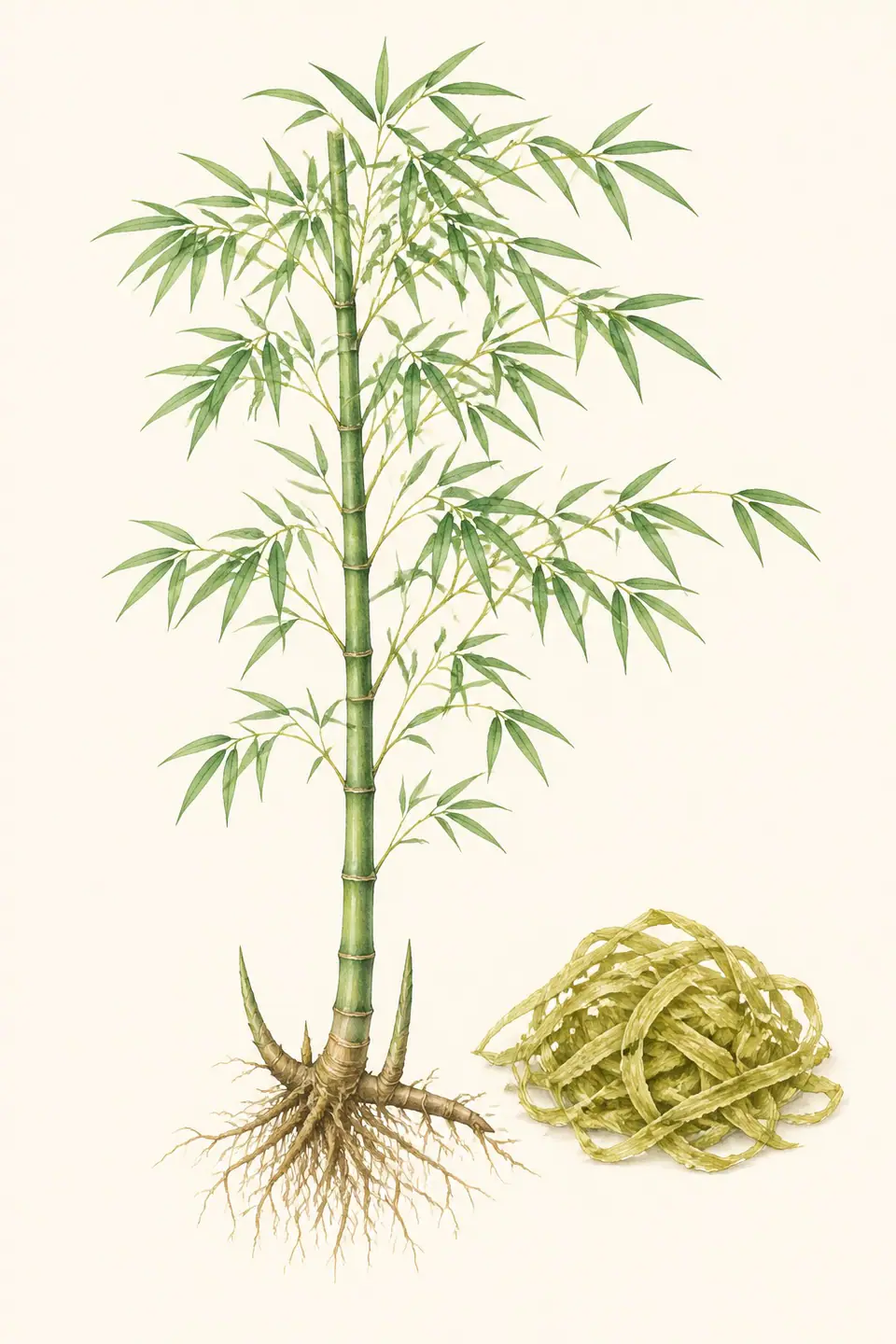
The Green Essence of Bamboo, Jukyeo (Bamboo Sap)
The Bencao Gangmu (Compendium of Materia Medica) distinguishes between Dam-jukyeo (bland bamboo sap), Go-jukyeo (bitter bamboo sap), and Geun-jukyeo, noting that "Dam-jukyeo is effective for vomiting blood, uterine bleeding, and nosebleeds." While the name 'Jukyeo' may sound like 'bamboo hair,' it is actually the green inner skin scraped from the middle layer of the bamboo stem after the outer bark is removed. The Benjing Fengyuan states, "Jukyeo specializes in clearing heat from the stomach and is an essential medicine for deficiency-heat restlessness, thirst, and vomiting due to stomach deficiency." This indicates that the medicine used to resolve 'heat in the stomach' is the 'essence of bamboo,' which explains the origin of its name.
Due to the image of 'bamboo,' many perceive Jukyeo as merely a cooling herb used to clear heat. However, in classical texts, Jukyeo is primarily used for 'transforming phlegm' (Hwa-dam), 'relieving restlessness and stopping vomiting' (Je-beon-ji-gu), and 'stabilizing the fetus' (An-tae). The Miscellaneous Diseases section of the Dongui Bogam (Principles and Practice of Eastern Medicine) uses Jukyeo for hiccups, nausea, vomiting, and morning sickness (O-jo) during pregnancy. Furthermore, Jukyeo-tang, passed down from the Seonghye, combines green bamboo sap with Ophiopogon root, Peucedanum root, tangerine peel, and reed rhizome to treat early pregnancy morning sickness. Contrary to its cool image, Jukyeo is a medicinal herb that lowers both heat and phlegm in the stomach and stabilizes the fetus without affecting the middle burner.
Therefore, Jukyeo should not be chosen based solely on the impression that it is 'cool.' For vomiting and hiccups caused by stomach heat, it is used with tangerine peel, ginseng, ginger, licorice, and jujube, as seen in the Gyulpi-jukyeo-tang from the Uibanggo. However, for those with a deficient and cold spleen and stomach, it may actually worsen symptoms. The key to this herb is how much is used, who uses it, and how it is administered, we will guide you through these criteria step-by-step below.
Summary at a Glance
Jukyeo is a medicinal herb that is not as simple as its name suggests. The table below provides an outline of its core identity and usage.
| Category | Content |
|---|---|
| Origin | Hanja Name 竹茹, Scientific Name Phyllostachyos Caulis in Taeniam. The inner skin (middle layer) of the stems of Poaceae bamboo, such as Phyllostachys nigra var. henonis or P. bambusoides, is used after removing the outer bark. |
| Properties and Meridian Tropism | Taste: Sweet; Property: Slightly cool/cool; Toxicity: Non-toxic. It enters the Lung, Stomach, and Gallbladder meridians. |
| Representative Aliases | Bamboo skin (Jukpi), Green bamboo sap (Cheong-jukyeo), Bland bamboo sap (Dam-jukyeo), Ginger-processed bamboo sap (Gang-jukyeo), Juk-i-cheong. |
| Efficacy Recorded in Literature | Clearing heat and transforming phlegm, relieving restlessness and stopping vomiting, cooling the blood and stabilizing the fetus. The Benjing Fengyuan records it as an "essential medicine to clear heat from the stomach and treat deficiency-heat restlessness, thirst, and vomiting due to stomach deficiency." |
| Main Indications | Nausea, vomiting, and hiccups caused by stomach heat; cough and phlegm caused by phlegm-fire; early pregnancy morning sickness (O-jo); deficiency-heat restlessness, etc. |
| Key Combinations | When used with tangerine peel, it lowers rebellious qi and clears stomach heat. Gang-jukyeo, stir-fried in ginger juice, is used to stop vomiting and nausea. |
| Combination and Constitution Contraindications | It may be unsuitable for those with a deficient-cold spleen and stomach constitution, vomiting or spasms caused by stomach cold, cough with cold phlegm, or diarrhea due to spleen deficiency. As its properties may conflict with restorative medicines intended to supplement yang or yin, it should be used concurrently only after a professional diagnosis (pattern identification). |
Is this medicinal herb right for me?
Jukyeo is a medicinal herb with a clear direction: 'calming heat and phlegm in the stomach and stopping nausea and vomiting.' Therefore, it is not a 'universal digestive' suitable for everyone, but a medicine used when the constitution and symptoms align. You can first assess this based on the following three criteria.
- Generally suitable cases: When the stomach feels stuffy and hot, accompanied by loss of appetite, nausea, or vomiting; when the mind is unsettled, the chest feels tight, and sleep is difficult; when there is nausea and vomiting due to early pregnancy morning sickness (under a Korean medicine doctor's prescription); when there is vomiting due to alcohol or stomach heat.
- Cases requiring caution: Those who typically have cold hands and feet or a cold stomach constitution; those who are pregnant or breastfeeding; those taking Western medications such as anticoagulants, gastrointestinal drugs, or diabetes medication; those requiring long-term use for more than 2 to 4 weeks. In these cases, it is best to decide after consulting a Korean medicine doctor.
- Cases to avoid: Cases of cold phlegm or cold-type vomiting/diarrhea due to a deficient and cold stomach; cases where vomiting, abdominal pain, or diarrhea worsen, or hands and feet become colder after intake; those with bamboo allergies or those who develop new rashes or difficulty breathing; when abdominal pain, bleeding, or uterine contractions occur during pregnancy.
Practical Q&A
Although the name Jukyeo sounds light, it is a medicinal herb that can only be used when the constitution and symptoms are aligned. We have gathered some of the most frequently asked questions from clinical practice regarding the characteristics of this herb.
Can I take Jukyeo if I have a poor stomach?
Jukyeo is not a medicine used generally just because the stomach is in poor condition. As stated in the Benjing Fengyuan, "Jukyeo specializes in clearing heat from the stomach and is an essential medicine for deficiency-heat restlessness, thirst, and vomiting due to stomach deficiency," it is intended for those who have heat in the stomach, resulting in chest tightness, dry mouth, nausea, and vomiting. Conversely, it may be unsuitable for those who have diarrhea because their stomach is cold or those who feel immediate discomfort after eating cold foods. It is safest to have a Korean medicine doctor determine whether the cause of the stomach issue is heat or cold through an examination.
I have severe morning sickness; will Jukyeo help?
Jukyeo appears several times in classical texts regarding early pregnancy morning sickness (O-jo). Jukyeo-tang, recorded in the Dongui Bogam, is a prescription containing green bamboo sap, Ophiopogon root, Peucedanum root, tangerine peel, and reed rhizome to treat early pregnancy morning sickness. However, because Jukyeo has a cool property and a tendency to 'cool the blood and stabilize the fetus,' its use during pregnancy must be carefully decided under the prescription of a Korean medicine doctor. If pain or bleeding occurs during use, stop immediately and seek medical evaluation.
Can I brew Jukyeo as a tea and drink it?
Due to the characteristics of the medicinal herb, it is standard to use Jukyeo (bamboo shavings) as part of a prescription or in the form of Jeontang (decoction), where it is boiled in water, rather than steeping it alone as a tea. For the purpose of stopping vomiting, Gang-jukyeo (Jukyeo stir-fried in ginger juice) is sometimes used. While professional literature records a daily dosage range of 4.5~12g, this is for reference within the context of a prescription and is not a guideline for self-administration. Long-term or high-dose consumption is not recommended; if symptoms do not improve within 1 week, we recommend visiting a Korean medicine clinic.
Can I take it together with Gongjindan or Gyeongokgo?
Jukyeo is a cold-natured herb used to clear heat and resolve phlegm (Cheongyeol-hwadam) and stop restlessness and vomiting (Jebeon-jigu). Its properties may differ from the nature of restorative herbal medicines that focus on nourishing energy or blood, such as Gongjindan or Gyeongokgo. In particular, if you have a heat-prone constitution or Dam-hwa (phlegm-fire), a professional diagnosis (Byeonjeung) is necessary before combining them. Since literary evidence regarding specific interactions has not been confirmed, please be sure to mention any such supplements during your consultation.
What warning signs should I look for while taking Jukyeo?
While Jukyeo is used for vomiting caused by stomach heat, if vomiting or abdominal pain worsens after intake, it may be due to stomach coldness (Wihan) or other conditions. Additionally, if diarrhea occurs or your hands and feet become cold, side effects due to its cold nature should be suspected. If new bleeding symptoms appear or worsen, such as nosebleeds, gum bleeding, or bloody stools, you must stop use and seek medical evaluation. Those with bamboo allergies should be cautious of rashes or difficulty breathing.
Relationship with Other Medicinal Herbs (Yakdae/Pairing)
The characteristics of Jukyeo become more distinct when used with other herbs rather than alone. Since it is specifically intended to cool stomach heat, resolve phlegm, and lower rebellious Qi (energy flowing upward), it requires pairing herbs that complement or neutralize this direction. In traditional medicine, these pairs are called 'Yakdae'. When Jukyeo is paired with herbs such as Gyulpi (dried tangerine peel), ginger, ginseng, and licorice, its original role of lowering heat and stopping vomiting is manifested more stably.
Below are representative prescriptions in which Jukyeo forms a core combination.
- Gyulpi-jukyeo-tang A prescription found in the Miscellaneous Diseases section of the Dongui Bogam and the Uibanggo. Composed of Gyulpi, Jukyeo, ginseng, ginger, licorice, and jujube, it has been traditionally used when the middle Qi is weak after an illness and hiccups, nausea, or vomiting occur due to deficiency heat. The structure is designed so that Jukyeo clears stomach heat, Gyulpi and ginger lower rebellious Qi, and ginseng, licorice, and jujube supplement the middle Qi.
- Galgeun-jukyeo-tang A prescription cited in the Miscellaneous Diseases section of the Dongui Bogam from the Dansim Jiphyo and Ipmun. It adds Jukyeo to Galgeun (kudzu root), Banha (pinellia tuber), licorice, ginger, and jujube, and has been traditionally used for vomiting caused by stomach heat, particularly nausea after drinking alcohol.
- Cheongyeol-ijin-tang A prescription cited in the Miscellaneous Diseases section of the Dongui Bogam from the Hoechun. Composed of Banha, Jinpi, red Bokryeong, licorice, ginseng, Baekchul, Jukyeo, Sain, San-chija, and Maekmundong, it is used for symptoms of vomiting and frothy saliva caused by Dam-hwa (phlegm-fire).
- Jukyeo-tang A prescription found in the Seonghye and the Women's section of the Miscellaneous Diseases in the Dongui Bogam. Composed of Cheong-jukyeo, Maekmundong, Jeonho, Gyulpi, and Nogeun, it has been traditionally used for morning sickness (Ojo) in early pregnancy.
- Sinje-gyulpi-jukyeo-tang A prescription found in the Onbyeong Jobyeon. Composed of Gyulpi, ginger, Siche (persimmon stalk), and Jukyeo, it is used to lower rebellious Qi, stop vomiting, and clear heat when there is stomach heat vomiting accompanied by stomach Qi deficiency.
Since Jukyeo is an herb with a cool nature and a clear direction of resolving phlegm, for those with a stomach coldness (Wihan) or spleen-stomach deficiency-cold constitution, it must first be determined if the overall direction of the prescription is appropriate, even when combined with warm-natured herbs like Gyulpi and ginger. Even with the same prescription, if it does not match the constitution and symptom direction, it may instead cause abdominal coldness or diarrhea. Therefore, it is safer to use it under the diagnosis (Byeonjeung) of a Korean medicine doctor rather than through self-administration.
In what form is it consumed?
Rather than steeping it alone like a tea, Jukyeo is generally used as one component of a prescription boiled in water. Depending on its properties and intended use, it is divided into raw (unprocessed) and processed forms. We have summarized this into four forms.
- Tea form Not common. Jukyeo is an herb whose efficacy is extracted through decoction (boiling) rather than simple steeping. Evidence for safety and appropriate dosage as a daily tea beverage has not been confirmed.
- Food form Not common. Jukyeo is classified as a Korean herbal medicine ingredient; there are no safety or dosage standards for it as a general food ingredient.
- Decoction form Standard. Boiling in water for consumption is the basic method. Traditionally, raw Jukyeo is used to resolve phlegm, and Gang-jukyeo (stir-fried in ginger juice) is used to stop vomiting and nausea.
- Professional prescription form Recommended. Since Jukyeo is an herb that requires judgment of constitution and symptom direction, it is generally used in combination within prescriptions such as Gyulpi-jukyeo-tang, Galgeun-jukyeo-tang, and Cheongyeol-ijin-tang under the prescription of a Korean medicine doctor. Long-term or high-dose self-administration is not recommended.
Interactions and Safety During Use
As Jukyeo is an herb with a clear direction for managing stomach heat and phlegm, it may actually worsen symptoms if it does not match your constitution or the nature of the condition. We have summarized the contraindications and precautions you must check before intake.
- Constitution with Spleen and Stomach Deficiency-Cold, vomiting or spasms caused by Stomach-Cold, cold-phlegm cough, and Spleen Deficiency diarrhea: Bamboo shavings (Jukyeo), which have a cool nature, may not be suitable in these cases.
- Pregnancy and Breastfeeding: While traditionally used in prescriptions like Jukyeo-tang for treating early pregnancy morning sickness (Ojo) according to the "Seonghye," self-administration during pregnancy is not recommended despite its reported "blood-cooling and fetal-stabilizing (Yanghyeol-antae)" effects. There is insufficient confirmed data regarding safety for breastfeeding women.
- Interactions with Western Medicine: No specific systematic clinical interaction studies for bamboo shavings have been confirmed to date. Please be sure to consult a Korean medicine doctor or pharmacist when using them in combination with anticoagulants, gastrointestinal medications, or diabetes medications.
- Relationship with tonifying medicines: As the properties may conflict with restorative herbal medicines that tonify energy or blood, such as Gongjindan or Gyeongokgo, a pattern identification (Byeonjeung) is necessary when used together.
- Long-term or high-dose intake: Depending on your constitution, it may damage the Spleen and Stomach. If symptoms do not improve within 1 week or if administration is required for more than 2 to 4 weeks, visiting a Korean medicine clinic is recommended.
If any of the following symptoms appear during administration, stop use and seek a consultation: persistent vomiting or worsening abdominal pain, diarrhea or abdominal coldness, bleeding symptoms such as nosebleeds, gum bleeding, or bloody stools, pain, bleeding, or uterine spasms during pregnancy, or rashes and difficulty breathing suspected to be a bamboo allergy. Since bamboo shavings are used as one component of a prescription, it is safest to use them after consulting a Korean medicine doctor, considering your constitution and current medications.
If you experience these symptoms
Jukyeo is a medicinal herb with a clear direction of calming heat and phlegm in the stomach. Therefore, if the following signals appear during use, do not simply dismiss them as 'the medicine doesn't suit me'; you must inform your attending Korean medicine doctor. In particular, if symptoms worsen after use, or if bleeding, abdominal pain, or pregnancy-related changes occur, contact the clinic for medical evaluation immediately.
- Persistent vomiting or worsening abdominal pain: Bamboo shavings are used for nausea and vomiting caused by stomach heat, but if vomiting or abdominal pain worsens after administration, it may be due to Stomach-Cold (Wihan) or other conditions.
- Diarrhea or abdominal coldness: If diarrhea occurs due to the cold nature of the herb, or if the abdomen becomes cold and hands and feet feel chilly, stop administration and seek a consultation.
- Bleeding symptoms: If nosebleeds, gum bleeding, or bloody stools occur newly, or if existing bleeding worsens.
- Abnormalities during pregnancy: If pain, bleeding, or uterine spasms occur during administration.
- Allergic reactions: For those with bamboo allergies, rashes or difficulty breathing may occur.
- Spleen and Stomach damage during long-term use: Administration for more than 2 to 4 weeks may damage the Spleen and Stomach depending on the constitution; if symptoms do not improve within 1 week, visiting a Korean medicine clinic is recommended.
If adverse reactions are severe or progress rapidly, please visit an emergency medical institution.
Differences from other restorative medicines
Bamboo shavings are not a tonic herb for supplementing the body. They are used to cool heat in the stomach, resolve phlegm, and lower rebellious energy, acting more as a type of 'regulatory' herb. Therefore, they are fundamentally different in nature from restorative medicines like Gongjindan or Gyeongokgo, which supplement energy or blood.
Restorative medicines with Yang-tonifying (Boyang) or Blood-tonifying (Bobyeol) tendencies, such as Gongjindan and Gyeongokgo, aim to fill the body's foundation. In contrast, bamboo shavings aim to calm stomach heat, phlegm, and rebellious energy (Yeokgi) through heat-clearing (Cheongyeol), phlegm-transforming (Hwadam), and anti-vomiting (Jegoo) effects. Depending on the constitution or condition, these two properties may conflict. For example, if restorative medicine is used concurrently in a person with a heat-type constitution or phlegm-fire (Damhwa), the supplementing action of the tonic and the heat-clearing action of the bamboo shavings may clash, necessitating pattern identification (Byeonjeung).
However, there is insufficient documented evidence regarding the specific combination of bamboo shavings with Gongjindan or Gyeongokgo. The decision on which restorative medicine to combine and how should be made after comprehensively reviewing the direction of symptoms, constitution, and current prescriptions. If you are wondering if bamboo shavings are right for you or if they can be used with restorative medicine, we recommend reviewing this during your medical evaluation.
References
- Evidence materials related to bamboo shavings 1: Crude drug data from the National Institute of Food and Drug Safety Evaluation.
- Supporting evidence for Jukyeo 2: Korea Institute of Korean Medicine official data.
- Supporting evidence for Jukyeo 3: PubMed academic paper.
- Supporting evidence for Jukyeo 4: PubMed academic paper.
- Supporting evidence for Jukyeo 5: PubMed academic paper.
- Supporting evidence for Jukyeo 6: herba.kr evidence.
If you would like to check if this medicinal herb is right for you or which prescription it should be used with, please leave a medical inquiry. For those who find it difficult to visit the clinic, non-face-to-face consultations are available; we will provide guidance after first reviewing your current condition and current medications.

Medical Staff Review
Director Choi Yeon-seung
Chief Director of Baekrokdam Korean Medicine ClinicJukyeo Dictionary Entry, reviewed the safety of expressions and the scope of verification before administration.
Review Scope: Clinical Accuracy, Pharmacology, Contraindications, Combinations, QA · Last Reviewed 2026-08-16
- Graduated from Kyung Hee University College of Korean Medicine
- Providing Korean medicine treatment since 2010
- Consultations for Gongjindan, Gyeongokgo, Nokyong (Deer Antler) restorative medicine, and customized restorative herbal medicine