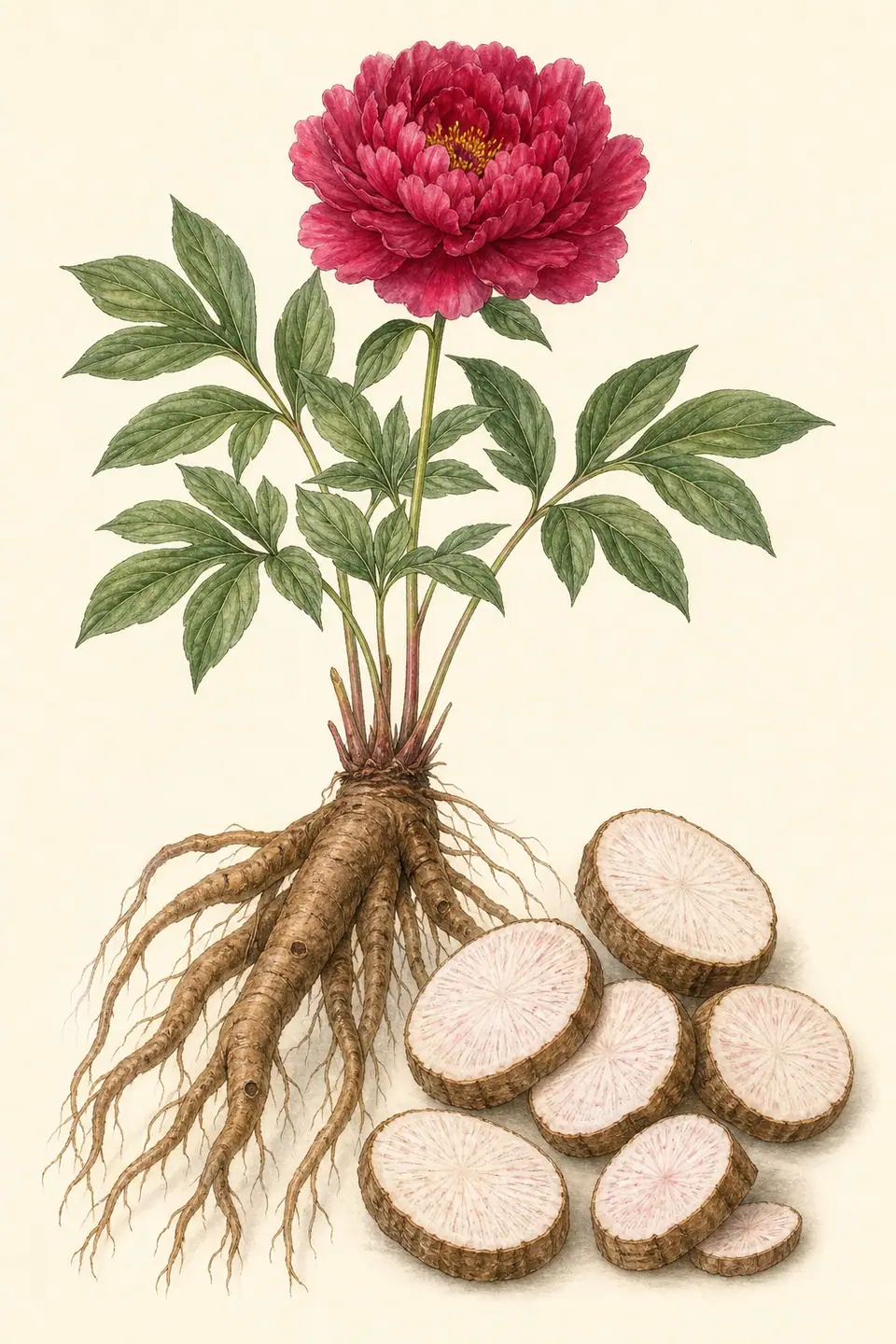
Jeok-jak (赤芍), the cooling property of the red root
In the Bencao Gangmu, Li Shizhen divided peony into two types. Those processed to be white by removing the bark were called 'Geum-jag-yak' (Golden Peony), and those left red with the bark intact were called 'Mok-jag-yak' (Wood Peony). 'Jeok' (赤) refers to the color of the root, and 'Jak' (芍) describes the bright blooming of the peony flower. This red root has long been called 'Jeok-jag-yak' (Red Peony Root) and has been used as a medicinal herb to cool heat and resolve blood stasis. The Shennong Bencao Jing records that it 'primarily treats abdominal pain caused by pathogenic factors (邪氣), eliminates blood stasis (血痹), breaks down hard accumulations (積), and stops pain.'
Many people first think of 'antispasmodic' and 'analgesic' effects when they think of peony. However, Red Peony Root has a slightly different character. As noted in the Bencao Beiyao, 'Red Peony Root is generally similar to White Peony Root, but it specifically clears liver fire (肝火), scatters bad blood (惡血), and treats hard masses in the abdomen, blood stasis, postpartum blood stasis, boils/swelling (癰腫), and redness of the eyes.' Thus, rather than simply relieving tension, Red Peony Root focuses on resolving heated blood and stagnant blood stasis within the body. Even among peonies, Red Peony Root, which retains its red bark, possesses a cold and bitter taste, making the expression 'governing the blood with a cooling property' appropriate.
However, this cooling property is not suitable for everyone. It may be harmful to those with a deficient-cold (虛寒) constitution, should not be used with Veratrum (藜蘆), and requires caution during pregnancy. When used concurrently with anticoagulants, the risk of bleeding may increase. Therefore, it is particularly important to determine the proportion of Red Peony Root within a prescription, which herbs it is paired with, and the duration of use. This page will guide you through those criteria step-by-step.
Summary at a Glance
This table provides an overview of the origin, properties, and traditional applications of Red Peony Root. Detailed explanations follow below.
| Category | Content |
|---|---|
| Origin | Hanja Name: 赤芍藥 · Scientific Name Paeonia lactiflora Pall. (unpeeled root). A red medicinal herb made by drying the root of the peony with the bark intact. |
| Properties and Meridian Tropism | Bitter (苦), slightly cold (微寒/凉), and has a sour taste (酸). It is recorded as non-toxic (無毒). It is said to primarily enter the Liver meridian (肝經) and also the Spleen meridian (脾經). |
| Representative Aliases | Mok-jag-yak (木芍藥), Hong-jag-yak (紅芍藥), Jeok-jak (赤芍). |
| Efficacy Recorded in Literature | Clearing heat and cooling blood (淸熱凉血), scattering stasis and stopping pain (散瘀止痛), reducing boils and swelling (消癰散腫), and removing irritability (除煩). The Shennong Bencao Jing states it primarily treats 'abdominal pain caused by pathogenic factors (邪氣), blood stasis (血痹), accumulations (積), and pain.' |
| Main Ingredients | Verification required. Please inquire during your consultation. |
| Contraindications and Cautions | It is incompatible with Veratrum (藜蘆) and must not be used simultaneously. Caution is required for those with a deficient-cold constitution (虛寒證), during pregnancy or lactation, and for those with a tendency to bleed or those taking related Western medications, as anticoagulant and antithrombotic properties have been reported. Concurrent use with restorative herbal medicines for supplementing Yang or Yin is possible depending on the pattern identification (辨證), but self-administration is not recommended. |
Is this medicinal herb right for me?
Red Peony Root is a medicinal herb with a distinct tendency to cool heat and resolve blood stasis. Therefore, while it is used in situations where there is heat in the body and pain due to blocked blood, it can be burdensome for those whose bodies are cold and whose energy is deficient. Please refer to the following three criteria.
- Generally suitable cases: Cases where the face is red due to heat in the blood, or where pain is distinct due to blood stasis; cases identified as a combination of heat and blood stasis, such as postpartum blood stasis, abdominal pain, or the early stages of purulent boils.
- Cases requiring caution: Cases of pregnancy or lactation, those taking anticoagulants or antiplatelet agents (such as warfarin or aspirin), or those with a tendency to bleed. In these situations, the decision to use it must be made after consulting with a Korean medicine doctor.
- Cases to avoid: Cases with a deficient-cold syndrome (虛寒證) where the body is cold and weak, cases of blood deficiency (血虛) where there is deficiency without blood stasis, cases of boils/carbuncles (癰疽) where ulcers have already progressed, and because it is an incompatible herb with Veratrum (藜蘆, Veratrum), they must not be used together.
Practical Q&A
We have collected frequently asked questions about Red Peony Root from the clinic. We hope this helps you understand the characteristics of the herb and the criteria for its safe use.
Are Red Peony Root and White Peony Root the same medicine?
Although they come from the same plant root, the processing methods differ. Red Peony Root (Jeok-jak-yak) is the root dried with its red skin intact, while White Peony Root (Baek-jak-yak) is the root that has been peeled and processed to be white. In the Bencao Gangmu, these two are distinguished as 'Wood Peony' and 'Gold Peony,' respectively. Red Peony Root is more commonly used to cool heat and resolve blood stasis, whereas White Peony Root is more widely used to soften the liver meridian and manage pain. Depending on the symptoms, a Korean medicine doctor will often select different herbs.
What symptoms is Red Peony Root used for?
Traditionally, it is recorded as a medicinal herb with properties to clear heat and cool the blood, resolve stasis and stop pain, and reduce abscesses and swelling. Simply put, it is used when there is heat in the body and pain caused by blocked blood, or in the early stages of swollen and painful boils. The Shennong Bencao Jing states it is used for "abdominal pain caused by pathogenic factors, blood stasis, hard masses, and pain," and the Bencao Gangmu explains that "Red Peony Root disperses pathogenic factors, cools heat, and resolves blood stasis."
Can it be taken during pregnancy?
Caution is required during pregnancy. Red Peony Root is an herb that promotes blood circulation and resolves stasis; therefore, you must decide whether to take it after thorough consultation with a Korean medicine doctor. If you experience abdominal pain or bleeding after taking it during pregnancy, you must visit a hospital immediately.
I am taking anticoagulants; can I use this together?
Caution is necessary if you are taking anticoagulants such as warfarin or aspirin. Antithrombotic and anticoagulant effects have been reported for Red Peony Root, which may increase the risk of bleeding when used concurrently. For your safety, you must adjust the use of Western medicine and Korean herbal medicine through an individual consultation with a Korean medicine doctor.
Can it be brewed as a tea or used in food?
Red Peony Root is a medicinal herb traditionally used in the form of a decoction (boiled in water). It is not appropriate to brew it as a tea or use it as a daily food item. Furthermore, it may be inappropriate for those with deficiency-cold syndrome, when used together with Veratrum, or for deficiency syndromes without blood stasis; therefore, it is advisable to use it under the prescription and supervision of a Korean medicine doctor.
Is it okay to take this for a long period?
Red Peony Root has a slightly cold and sour nature and acts to resolve stasis and promote blood circulation; therefore, taking large doses over a long period may cause concerns regarding gastrointestinal deficiency-cold or damage to vital energy. If symptoms such as persistent diarrhea, abdominal discomfort, excessive menstruation, abnormal bleeding, fatigue, numbness in the hands and feet, or paleness appear, you must stop taking it and visit a hospital. As a rule, Red Peony Root should be prescribed for short-term use according to a specific purpose.
Relationship with Other Medicinal Herbs (Yakdae/Pairing)
Red Peony Root is rarely used alone. It becomes meaningful only when paired with other herbs within a prescription to perform its role; in traditional medicine, such pairs are called 'Yak-dae' (medicinal pairs). Because Red Peony Root has properties to clear heat and cool the blood and resolve stasis and stop pain, it is often paired with herbs that clear heat toxins or disperse blood stasis. Below, we introduce actual classical prescriptions and the meaning of their combinations.
- Seonbang Hwalmyeong-eum A prescription found in the Gyoju Buin Ryangbang. It is used together with honeysuckle, angelica gigas, saposhnikovia root, myrrh, frankincense, cnidium, and processed peony root. Red Peony Root serves to clear heat toxins and disperse blood stasis in the early stages of boils or tumors that began as Yang-syndrome. This prescription can also be verified in the Chinese Medicine Prescription Image Database of the Chinese University of Hong Kong.
- Jeok-jak-yak-san A prescription recorded in the Taiping Sheng Hui Fang, where the blood-clearing and stasis-resolving effects of Red Peony Root were used in the context of managing postpartum blood stasis and abdominal pain.
- Saeng-ji-hwang-tang A prescription from the Tang-shi cited in the Dongui Bogam, where Red Peony Root was included to clear heat and cool the blood to manage fetal heat.
- Saeng-gye-san A prescription from the Deuk-hyo cited in the Dongui Bogam, used to manage bone-steaming fever, with Red Peony Root providing support for blood clearing and heat regulation.
It is also helpful to remember combination contraindications. Red Peony Root is incompatible with Veratrum, so they are not included in the same prescription. Additionally, it is avoided for deficiency-cold syndrome (where the body is cold and energy is deficient) and must be used with caution during pregnancy.
In what form is it consumed?
Red Peony Root is traditionally used in the form of a 'decoction,' which is boiled in water and drunk. There are no confirmed cases of it being brewed like tea or used as a general food ingredient.
- Steeping as tea Not common. A decoction is the standard form of intake for Red Peony Root, and examples of brewing it as a tea have not been confirmed in traditional prescriptions.
- Food or cooking ingredient Not common. Red Peony Root is a medicinal root, and there is no evidence that it has been approved as a food ingredient.
- Consumption as a decoction (boiled herbal tea) This is applicable. The Yakja records a dosage of "6–15g for decoction," and the Traditional Knowledge Portal of Korea guides that it can be used raw or roasted.
- Use under professional prescription and the supervision of a Korean medicine doctor This is recommended. Due to contraindications for deficiency-cold patterns, incompatibility with Veratrum, precautions during pregnancy, and potential interactions with anticoagulants, it is appropriate to use this under the prescription and supervision of a Korean medicine doctor.
Interactions and Safety During Use
Since Red Peony Root has a distinct ability to clear blood and cool heat, caution is required depending on the patient's constitution and other medications being taken. In particular, the following four points must be verified during the consultation.
- Unsuitable for deficiency-cold constitutions For those with a cold body and weak energy, it may actually aggravate the symptoms.
- Incompatible with Veratrum (Veratrum) These should not be included in the same prescription.
- Caution is required during pregnancy Traditional records state "use with caution in pregnant women," so the decision to take it during pregnancy is made after consulting with a Korean medicine doctor.
- Caution is required when used concurrently with anticoagulants or antiplatelet agents Modern research has reported antithrombotic and antiplatelet effects for Red Peony Root. When used with medications such as warfarin or aspirin, the risk of bleeding may increase, so you must inform us if you are taking Western medications.
Additionally, as it is a medicinal herb with a strong tendency to resolve blood stasis and promote blood circulation, it is used cautiously for those who already have a tendency to bleed, heavy menstrual bleeding, or cases where an abscess has already ulcerated.
The standard method for Red Peony Root is to use it as a decoction prescribed by a professional; self-administration in the form of tea or food is not recommended. If you are unsure whether it suits your constitution or current medications, we will verify this during your consultation.
If you experience these symptoms
If you experience these symptoms
Red Peony Root is a medicinal herb with distinct properties for clearing heat, cooling blood, resolving stasis, and relieving pain. In other words, it works to cool internal heat and resolve blocked blood, but side effect signals may appear depending on the constitution or concurrent medication. The following signals are cases where you should first notify the prescribing Korean medicine doctor for adjustment, rather than reducing or stopping the dose on your own.
- Persistent diarrhea, abdominal pain, or abdominal discomfort Because the properties of Red Peony Root are slightly cold and sour, excessive or long-term use may burden the digestive function of those with a deficiency-cold stomach.
- Sudden increase in menstrual flow or abnormal bleeding Due to its blood-resolving and blood-circulating effects, bleeding may increase in those who already have a bleeding tendency or are taking anticoagulants.
- Severe fatigue, numbness in hands and feet, or a pale complexion As it is unsuitable for deficiency-cold constitutions, it may further damage the vital energy.
- When abdominal pain or bleeding occurs during pregnancy Pregnant women must use it with caution, and if such signals appear during use, an immediate hospital visit is necessary.
If symptoms are severe or progress rapidly, it is safe to visit an emergency medical institution in addition to your Korean medicine doctor. Especially in cases accompanied by bleeding or acute abdominal pain, please visit a medical institution immediately without delay.
Differences from other restorative medicines
Red Peony Root (Jeok-jagyak) is a medicinal herb used to clear heat, cool the blood, and disperse blood stasis to relieve pain. Therefore, its properties differ from restorative herbal medicines like Gongjindan or Gyeongokgo, which are designed to supplement Qi and blood and warm the body. Based on our review, we have not identified specific traditional prescriptions or modern clinical studies that combine Red Peony Root with Gongjindan or Gyeongokgo. Theoretically, they could be combined under the diagnosis of a Korean medicine doctor in complex cases involving both blood heat and blood stasis; however, there is little need to use Red Peony Root when taking restorative medicine alone. In fact, the blood-tonifying effects of restorative medicine may conflict with the blood-clearing and stasis-dispersing effects of Red Peony Root, so we do not recommend combining them on your own. It is safest to determine which restorative medicine to use and how to combine it through a consultation after evaluating your symptoms and constitution.
References
- We verified the properties, meridian tropism, contraindications, aliases, and efficacy of Red Peony Root (Jeok-jagyak) via the Traditional Knowledge Portal of Korea. Red Peony Root (Jeok-jagyak), Traditional Knowledge Portal of Korea
- We verified the origin, harvesting/processing, appearance, and meridian tropism of Red Peony Root (Jeok-jagyak) via the Herbal Medicine Resource Research Center of the Korea Institute of Oriental Medicine. Red Peony Root (Jeok-jagyak), Herbal Medicine Resource Research Center
- We verified the medicinal part, appearance, and origin plant of Peony (Jagyak) via the crude drug research report from the Herbal Medicine Quality Standardization Research Group under the Ministry of Food and Drug Safety. Peony (Jagyak) Paeoniae Radix Crude Drug Research, Herbal Medicine Quality Standardization Research Group
- We verified classical citations from the Compendium of Materia Medica, Bencao Gangmu, Diannan Bencao, and Bencao Beiyao in the Red Peony Root literature section of the Yak-Ja International Edition. Yak-Ja International Edition, Red Peony Root Literature Section
- We verified the prescription composition and the role of Red Peony Root in the Xianfang Huoming Yin entry of the Traditional Chinese Medicine Formula Image Database at Hong Kong Baptist University. Xianfang Huoming Yin, Hong Kong Baptist University Traditional Chinese Medicine Formula Image Database
- We verified reports of antithrombotic and anticoagulant effects in Paeonia lactiflora related research on PubMed. Anti-inflammatory and immunomodulatory effects of Paeonia lactiflora Pall. — PubMed
- We verified the meridian tropism, pregnancy precautions, and antiplatelet effects of Red Peony Root via KingNet National Network Medicine. Red Peony Root, KingNet National Network Medicine
If you would like to check if this medicinal herb is right for you or which prescription it should be used with, please leave a medical inquiry. For those who find it difficult to visit the clinic, non-face-to-face consultations are available; we will provide guidance after first reviewing your current condition and current medications.

Medical Staff Review
Director Choi Yeon-seung
Chief Director of Baekrokdam Korean Medicine ClinicRed Peony Root Dictionary Entry, reviewed the safety of expressions and the scope of verification before administration.
Review Scope: Clinical Accuracy, Pharmacology, Contraindications, Combinations, QA · Last Reviewed 2026-08-16
- Graduated from Kyung Hee University College of Korean Medicine
- Providing Korean medicine treatment since 2010
- Consultations for Gongjindan, Gyeongokgo, Nokyong (Deer Antler) restorative medicine, and customized restorative herbal medicine