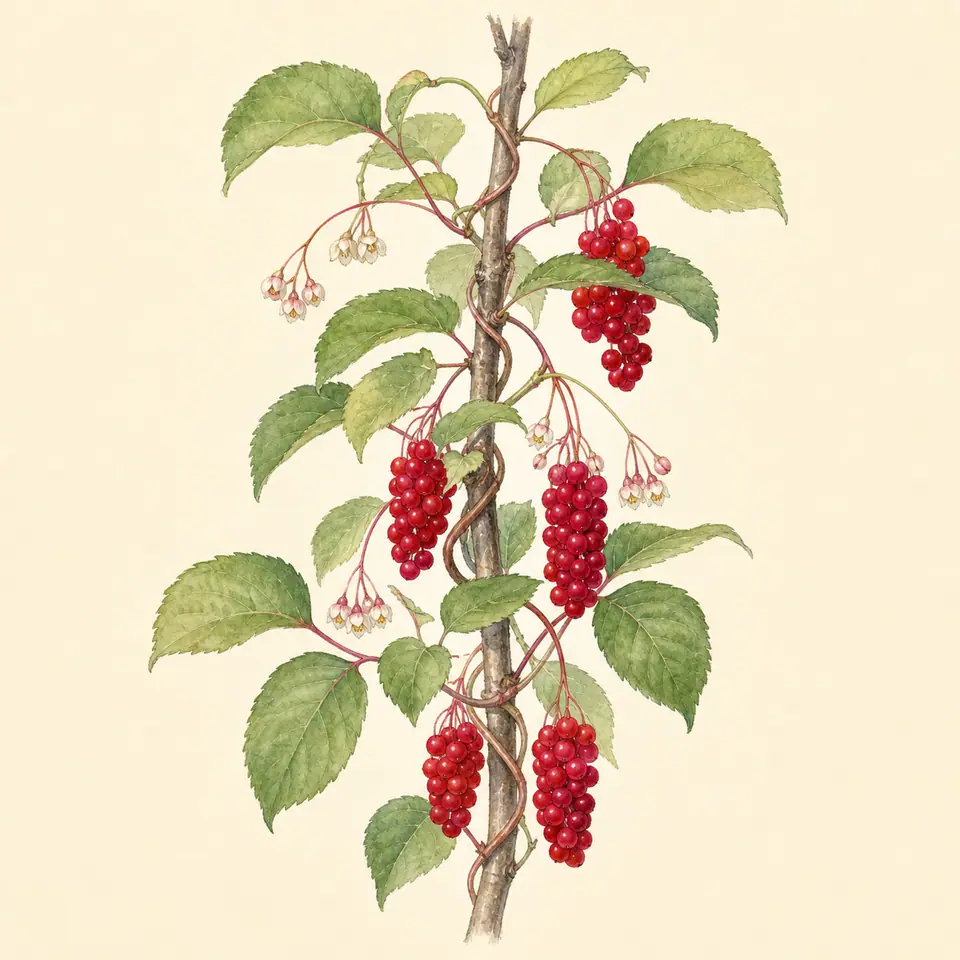
Omi (Five Flavors): A Berry Containing Five Tastes in One Grain
The origin of the name Omija (Schisandra berry) is recorded in the Bencao Gangmu as follows. “五味皮肉甘酸,核中辛苦,都有鹹味,此則五味具也.” It means that the skin and pulp have sweet and sour tastes, the seed has bitter and pungent tastes, and the overall berry includes a salty taste, possessing all five flavors, hence it is called 'Omija' (Five-Flavor Berry). In the Shennong Bencao Jing, it was listed as a first-grade herb, stating, *“It primarily benefits Qi, treats cough and rebellious Qi, addresses wasting and emaciation from overwork, supplements deficiencies, strengthens Yin, and benefits the essence of men.”* The Baopuzi even recounts the anecdote of Lee Mo-mun-ja, who consumed Omija for sixteen years. The imagination that all five tastes of the Five Elements are contained in a single berry suggests that this medicinal herb is more than just a 'sour berry'.
There is a common tendency to view Omija simply as a 'restorative medicine to boost energy and relieve fatigue.' However, the core point repeatedly emphasized in classical texts is 'astringency' (convergence). The Bencao Xinbian states, *“Omija astringes the dissipated Lung-Gold and nourishes the exhausted Kidney-Water,”* and the Bencao Jianyao Fang clearly warns, *“It must not be used if there is excess heat in the Lungs.”* It is a medicinal herb intended to gather scattered energy and replenish drying body fluids; if it is blindly perceived as simply 'boosting energy,' it may leave a feeling of oppression or congestion in individuals with incompatible constitutions.
The combination where this astringent power is most clearly demonstrated is Saengmaeksan. This prescription, found in the Uihak Gye-won and Naeoesang Byeonhok-ron, follows a structure of 'one supplement, one clearing, and one astringent': Ginseng supplements Qi, Ophiopogon japonicus cools heat, and Omija gathers scattered Qi and sweat. It has been traditionally used during hot summers or after prolonged coughing when energy is depleted, sweating does not stop, and dry mouth is severe.
However, this 'gathering power' is a double-edged sword. If the exterior syndrome has not been resolved, if there is excess heat in the lungs, or when measles are just beginning to appear, using Omija may instead pull the pathogenesis deeper inside the body. Modern research also suggests that the lignan components of Omija may affect CYP450 enzymes and P-glycoprotein, potentially altering the metabolism of Western medicines. Therefore, when using Omija, 'how much, for whom, and in what condition' must be considered as precisely as the five flavors of its name, and that is exactly what this page covers.
Summary at a Glance
Let us first establish a general outline of what kind of medicinal herb Omija is. The table below summarizes the core details, including origin, properties, main aliases, efficacy recorded in traditional literature, major component groups, and precautions for combination.
| Category | Content |
|---|---|
| Origin | Hanja Name 五味子 / Scientific Name Schisandra chinensis (Turcz.) Baill., Schisandraceae, Schisandra chinensis Schisandra chinensis Dried ripe berries of Baillon. |
| Properties and Meridian Tropism | Sour, sweet, and warm. Acts on the Lungs, Kidneys, and Heart. |
| Representative Aliases | Hyeongeup, Hoegup, Omaeja, Susin, Hongnaeso. |
| Efficacy Recorded in Literature | 《神農本草經》: “主益氣,咳逆上氣,勞傷羸瘦,補不足,強陰,益男子精.” 《本草綱目》: “養五臟,除熱,生陰中肌. 治中下氣,止嘔逆,補虛勞,令人體悅澤. 明目,暖水臟,壯筋骨.” |
| Main Ingredients | Lignan group, schizandrin, gomisin A, gomisin N, etc. The Korean Pharmacopoeia 11th Edition (KP 11) stipulates that the sum of these three components must be 0.7% or higher. |
| Combinations and Contraindications | When used with restorative medicines that have astringent or Yin-nourishing properties, caution is required in cases of unresolved exterior pathogens, excess heat, early stages of cough, or the onset of measles. When used concurrently with Western medicines, theoretical possibilities of interactions with CYP450 and P-gp substrate drugs exist; therefore, please be sure to mention any medications you are currently taking during your consultation. |
Is this medicinal herb right for me?
Omija is a medicinal herb that possesses both astringent and nourishing properties. Therefore, while it is used in states where energy and body fluids are leaking due to deficiency, it can conversely block the path when heat or pathogenic factors still remain in the body. Please check based on the following three criteria first.
- Generally suitable casesSuitable: Those who experience excessive sweating or shortness of breath, dry mouth, and a feeling of depleted energy; those who sweat at night or have difficulty falling asleep due to an unstable mind; those whose Lung Qi feels deficient after a long period of coughing. These states are traditionally explained as cases where energy and body fluids are consumed together, and prescriptions containing Omija may be considered.
- Cases requiring cautionCaution: Those taking Western medicines, especially substrate drugs for CYP3A4, CYP1A2, CYP2C9, or P-gp, should be cautious about concurrent use. This is because research indicates that the lignan components of Omija may affect these metabolic pathways. Additionally, please let us know if you have a sensitive stomach or experience digestive discomfort after intake.
- Cases to avoidAvoid: Those in the early stages of a cold or fever, those whose measles are about to break out, or those with excess heat in the lungs should avoid it. When exterior pathogens are not resolved or heat is blocked, astringent herbs can instead pull the progression of the disease inward. Consultation is also required for those who are pregnant, breastfeeding, or for children.
To make a final determination on whether this herb is right for you, it is important to look at the overall flow of your body. During your consultation at Baekrokdam Korean medicine clinic, please provide information on your symptoms, current medications, allergies, and medical history for more accurate guidance.
Practical Q&A
We have collected frequently asked questions about Omija from the clinic. The answers below are organized based on the criteria used during consultations at Baekrokdam Korean medicine clinic. Since the answer may vary depending on individual constitution and current medications, please make a decision only after consulting with a Korean medicine doctor.
What does Omija taste like?
As the name suggests, Omija is a berry that contains five tastes. According to the Bencao Gangmu, the skin and pulp are sweet and sour, the seed is bitter and pungent, and the overall berry includes a salty taste, possessing all 'five flavors.' In practice, when placed in the mouth, it is initially sour, followed by astringent and bitter tastes upon chewing, and finally leaves a mixed feeling of sweetness and saltiness. This unique taste has been traditionally linked to the astringent and nourishing actions of Omija.
Can I drink Omija tea or eat the berries regularly?
While Omija is used as a food, it has strong astringent properties as a medicinal herb. Therefore, in the early stages of a cold, when there is significant heat, when measles are just beginning to appear, or in situations where energy is blocked (such as constipation or poor urination), it may instead trap the symptoms inside. Conversely, it may be appropriate for states of energy and fluid deficiency where there is excessive sweating, coughing, dry mouth, and depleted energy. In conclusion, rather than consuming it unconditionally as a 'health food,' it is important to first verify if your current bodily state requires astringency.
Are there any precautions when taking Western medicines?
Research indicates that the primary lignan components of Omija (Schisandra chinensis) may affect the CYP450 enzyme system and P-glycoprotein (P-gp) activity. For example, in a study involving healthy adult males, Schisandra chinensis It was confirmed that after administering 300mg of the extract 2 times a day for 14 days, the internal exposure of talinolol (a P-gp substrate drug) increased. Theoretically, this suggests the possibility of fluctuations in blood concentration when used concurrently with Western medicines that are substrates of CYP3A4, CYP1A2, CYP2C9, or P-gp; however, the clinical significance for individuals with specific diseases or those using multiple medications requires further verification. If you are taking Western medicines, please be sure to share your medication list with your Korean medicine doctor.
In which prescriptions is Omija most representatively used?
The most iconic combination using Omija is found in the "Uihak Gyewon" and "Naeoesang Byeonhokron", known as SaengmaeksanIn this formula, Ginseng tonifies the energy (Qi), Ophiopogon root generates fluids, and Omija astringes the energy and sweat that leak out due to deficiency, a structure described as 'one tonifying, one clearing, and one astringing.' Additionally, it is included in various prescriptions covering the lungs, kidneys, and heart, such as Omija-san from "Seonghyebang", Insam-omija-san from "Dongui Bogam", and Omija-hwan from "Boncho Ganyoyang". However, as the indications in the original texts may differ from modern constitutions and symptoms, these should be selected based on a Korean medicine doctor's diagnosis rather than used as-is.
Can it be used during pregnancy or breastfeeding?
There is a lack of official evidence regarding the safety of using Omija during pregnancy and lactation. Traditionally, it is classified as a medicinal herb with strong astringent properties that acts on the nervous system, so particular caution is required during this period. Verification is necessary. Please inquire during your consultation.
Are there other medicinal herbs with names similar to Omija?
Omija refers specifically to the medicinal herb with the Chinese name 五味子, and the scientific name Schisandra chinensis. Herbs with similar names or uses, such as Nam-omija (Schisandra sphenanthera) or plants of the Kadsura genus, are different from the subject of this entry. When purchasing medicinal herbs, always verify the scientific and Chinese names, and for prescription purposes, it is safest to use those prescribed by a Korean medicine clinic.
Relationship with Other Medicinal Herbs (Yakdae/Pairing)
Omija is not used alone. Its characteristics become clear when paired with other herbs, a concept traditionally called "Yakdae" (medicinal pairs). In particular, because Omija has strong astringent power, its role changes between 'gathering energy' or 'protecting fluids' depending on which herb it is paired with. Here are some representative combinations.
- Ginseng + Ophiopogon root + Omija — Saengmaeksan: A prescription recorded in "Uihak Gyewon" and "Naeoesang Byeonhokron". It has been traditionally used with Ginseng to tonify energy, Ophiopogon root to generate fluids, and Omija to astringe leaking Qi and sweat. The core of this combination is the structure "One Tonifying, One Clearing, One Astringing."
- Omija + White Quartz + Cinnamon Bark + Aster root, etc. Omija-san, "Seonghyebang": A prescription traditionally used for cases of lung Qi deficiency resulting in chest tightness, coughing, and shortness of breath.
- Omija + Donkey-hide gelatin + Ginseng + Atractylodes macrocephala, etc. Bopye-agyo-san, "Seonghyebang": Recorded for use in cases where the lungs are weak, resulting in short breath and a weak cough.
- Ginseng + Omija Insam-omija-san, "Dongui Bogam": Traditionally utilized for cases where Qi and blood are damaged and depleted, resulting in coughing, bloody sputum, alternating chills and fever, and night sweats.
Contraindications based on combinations must also be kept in mind. According to records cited in "Boncho Gangmok", there are 'Seven Emotions' (compatibility) records stating that Omija uses Cistanche as a guiding herb, avoids Liriope longifolia, and is incompatible with Aconite. However, these are records from classical literature, and further verification is needed regarding direct interactions in modern clinical practice. Please be especially cautious when taking Western medications concurrently.
In what form is it consumed?
Omija is traditionally administered as a decoction (boiled herbal medicine)is the most common form of use, and in modern times, pills and powdersare also used. As recorded in the Bencao Gangmu, "use processed (cooked) for tonic medicine and raw for cough medicine," the processing state may vary depending on the purpose. In daily life, Omija teaI Omija syrup are common forms in which this medicinal herb is encountered.
- Tea/Beverage: drinking Omija teamade by boiling Omija in water, or drinking Omija syrupmade by preserving it in sugar or honey mixed with water is common. Due to its unique sour taste and aroma, it is also widely used as a fluid-replenishing drink in summer.
- Food/Cooking Ingredients: It can be used for pickles, preserves, or in seasonings and sauces, but it is not common for regular intake for medicinal purposes.
- Decoction (boiling in water): This is the most traditional form, where herbal medicine prescribed at a Korean medicine clinic is decocted and consumed. As noted in the Bencao Gangmu, "processed for tonics, raw for coughs," the use of raw or processed forms is distinguished by purpose.
- Professional Prescription: Saengmaeksanis used in combination with Ginseng and Ophiopogon japonicus, or Insam-omijasan as part of complex prescriptions under the direction of a doctor of Korean medicine. Since the duration and dosage must be adjusted according to individual conditions, please inquire during your consultation.
Interactions and Safety During Use
Since Omija possesses both astringent and nourishing properties, the timing of intake and the other herbs or medications used concurrently must be carefully considered. Below is a summary of the main contraindications and interactions identified in traditional Korean medicine literature and modern research.
- Unresolved exterior syndrome (pyosa), excess heat (sil-yeol), early stage of cough, or early stage of eruptive rashes In the early stages of a cold or febrile illness, when pathogenic factors still remain in the body, its astringent property may block the path of the illness, so it is traditionally avoided.
- Excess heat in the lung meridian It may also be unsuitable for those with excess heat in the lungs.
- Western medicines related to CYP450 and P-glycoprotein (P-gp) There are studies suggesting that the primary lignan components of Omija (such as schizandrin and gomisin) may inhibit CYP450 enzyme and P-gp activity. Theoretically, this may lead to fluctuations in blood concentration when taken concurrently with P-gp substrate Western medicines or drugs that are substrates for CYP3A4, CYP1A2, and CYP2C9. In related research, Schisandra chinensis a trend of increased systemic exposure to P-gp substrate drugs was observed after administering 300mg of extract twice daily for 14 days. However, as this was a single-drug trial conducted on healthy adults, further verification is required regarding the clinical significance in cases of specific diseases or complex drug administration.
- Pregnancy, lactation, children, elderly, and severe liver or kidney dysfunction Specific safety data regarding these groups has not been confirmed. Verification is necessary; please inquire during your consultation and provide a list of all medications you are currently taking.
Whether Omija is appropriate depends significantly on the overall composition of the prescription and the individual's constitution and symptoms. It is generally used as part of a prescription under the diagnosis of a Korean medicine doctor rather than taken alone. If you are taking Western medicines, please make a decision only after consulting with your attending Korean medicine doctor.
If you experience these symptoms
Omija is a medicinal herb that possesses both astringent and nourishing properties. Therefore, if the following signs appear during intake, it may mean that the astringent action is working excessively while heat or pathogenic factors (邪氣) inside the body have not yet been resolved. In such cases, it is safer to first notify your attending Korean medicine doctor, who can adjust the prescription, rather than reducing the dose or stopping the treatment on your own.
- Increased fever accompanied by phlegm and worsening cough When excess heat in the lung meridian (肺經實熱) or exterior pathogenic factors (表邪) from the early stages of a cold remain, the astringent property of Omija may block the exit path of the heat.
- Abdominal tightness, development of constipation, or persistent diarrhea accompanied by abdominal pain Omija may act by excessively tightening the movement of the intestines.
- New onset or worsening of headache, dizziness, insomnia, or heart palpitations Modern research suggests that Omija components may inhibit CYP450 enzyme and P-glycoprotein (P-gp) activity, theoretically raising the possibility of fluctuations in the blood concentration of concurrently taken Western medicines.
- Swelling of the lips or tongue, skin rash, or difficulty breathing Allergic reactions can occur in individuals even with plant-based medicinal herbs.
If any of the above symptoms occur, especially difficulty breathing, severe headache, dizziness, chest pain, or systemic rash, please visit an emergency medical institution.
Differences from other restorative medicines
Not all restorative medicines act in the same way. Omija differs from simple restorative medicines that only replenish energy, as it 'replenishes energy and protects body fluids while simultaneously acting as an astringent.' Traditional literature records Omija's actions as astringing the lungs and nourishing the kidneys (斂肺滋腎), generating fluids and astringing sweat (生津斂汗), binding essence and stopping diarrhea (澁精止瀉), and calming the mind and spirit (寧心安神), which is a structure where nourishment and astringency occur together.
Due to these characteristics, Omija is used differently from representative nourishing agents like Gongjindan or Gyeongokgo. While nourishing agents like Gongjindan or Gyeongokgo focus on broadly replenishing depleted energy and blood, Omija plays a role in astringing and nourishing specifically when the fluids and essence of the lungs and kidneys are leaking, for example, when sweat or semen cannot be properly controlled, or when a cough persists and both energy and fluids are consumed. This is the context of the expression in the "Boncho Sinpyeon" (本草新編): "Omija astringes the dissipated Lung-Gold and nourishes the exhausted Kidney-Water."
Additionally, as seen when used with Ginseng and Ophiopogon in Saengmaeksan (生脈散), Omija serves as the astringent axis between herbs that 'replenish energy' and those that 'clear heat.' In a prescription, if only nourishment is provided, fluids may be further consumed; if only heat is cleared and fluids generated, energy may scatter again. At this point, Omija works to gather and stabilize both energy and fluids.
Therefore, Omija is most appropriate not simply for general fatigue or lack of energy, but for cases where there are signs of energy and fluids leaking simultaneously. It is safest to determine which restorative medicine or prescription is right for you after a comprehensive review of your current symptoms, medications, and constitution. Please review this during your consultation at Baekrokdam Korean medicine clinic.
References
- Omija supporting evidence 1: Crude drug data from the National Institute of Food and Drug Safety Evaluation.
- Omija supporting evidence 2: koreantk.com evidence materials.
- Omija supporting evidence 3: encykorea.aks.ac.kr reference material.
- Omija supporting evidence 4: PubMed academic paper.
- Supporting evidence for Omija 5: PubMed academic paper.
- Supporting evidence for Omija 6: Korea Institute of Korean Medicine official data.
- Supporting evidence for Omija 7: Official data from the Ministry of Food and Drug Safety.
- Supporting evidence for Omija 8: GBIF plant classification data.
If you would like to check if this medicinal herb is right for you or which prescription it should be used with, please leave a medical inquiry. For those who find it difficult to visit the clinic, non-face-to-face consultations are available; we will provide guidance after first reviewing your current condition and current medications.

Medical Staff Review
Director Choi Yeon-seung
Chief Director of Baekrokdam Korean Medicine ClinicOmija Dictionary Entry, reviewed the safety of expressions and the scope of verification before administration.
Review Scope: Clinical Accuracy, Pharmacology, Contraindications, Combinations, QA · Last Reviewed 2026-08-16
- Graduated from Kyung Hee University College of Korean Medicine
- Providing Korean medicine treatment since 2010
- Consultations for Gongjindan, Gyeongokgo, Nokyong (Deer Antler) restorative medicine, and customized restorative herbal medicine