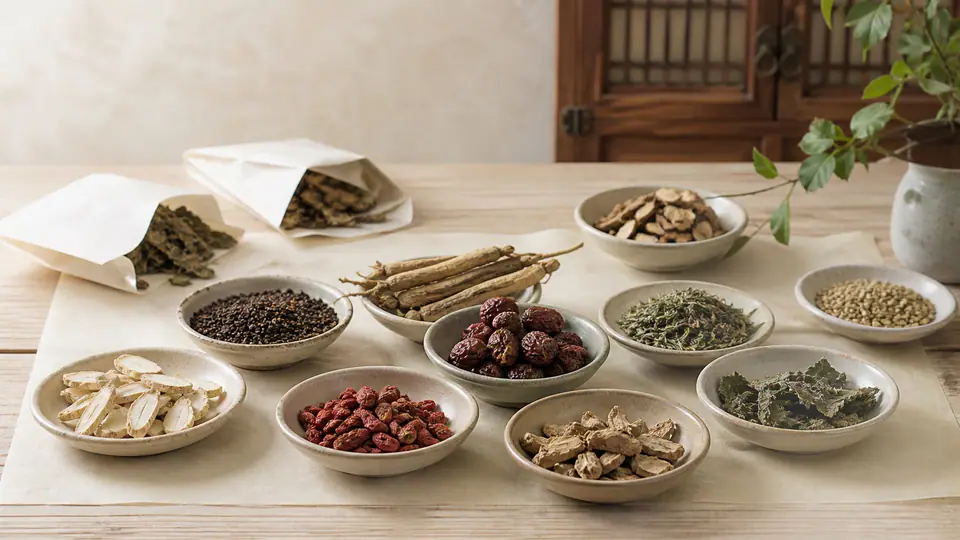
Red Poria, the medicine that opens the path of water
The Bencao Gangmu (Compendium of Materia Medica) describes Red Poria (Jeok-bokryeong) as follows: “Red Poria [Main Indications] breaks knotted qi... Heart, Small Intestine, Bladder...” It also states, *“it clears damp-heat from the heart, small intestine, and bladder, and promotes the flow of water through the orifices.”* In the Bencao Jing Jizhu (Collected Annotations on the Classic of Materia Medica) by Tao Hongjing, a shorter and more decisive statement was left. “Among Poria, those that are red are diuretic (promote water flow).” This means that among Poria, those with a reddish tint possess the power of 'li' (利), the ability to facilitate the flow of moisture. The classical distinction that the white part of the same sclerotium is closer to 'bu' (tonifying) and the red part is closer to 'li' (diuretic) remains a key key to understanding Red Poria today.
It is easy to remember Poria simply as a 'medicine for removing dampness.' However, Red Poria is not just 'Poria that removes dampness.' The Zhonghua Bencao (Chinese Pharmacopoeia) records the properties and flavor of Red Poria as sweet, bland, and neutral, acting on the Heart, Spleen, and Bladder meridians, and summarizes its core actions as promoting water flow, diuretic effect to transform dampness, and separating and draining damp-heat. In other words, Red Poria is a medicinal herb used to clear paths blocked by a mixture of water and heat. The Bencao Tongxuan makes this point clear. “Red Poria is only capable of clearing heat and promoting water flow; it does not possess as many diverse effects as White Poria.” This means that Red Poria is limited to clearing heat and facilitating water flow, and does not have the wide range of effects that White Poria does. While this is a limitation, it also means it is highly focused on the specific direction of 'draining damp-heat and promoting urination.'
Therefore, the dosage, the patient, and the method of use for Red Poria are particularly important. In classical prescriptions such as Wuling San from the Shanghan Lun (Treatise on Cold Damage), Huagai San from the Boji Fang and Taiping Huimin Heji Juku Fang, and Jeok-bokryeong-tang from the Jingyue Quanshu, Red Poria is paired with other diuretic and heat-clearing herbs. However, the Traditional Knowledge Portal of Korea and various materia medica records note that it should be used with caution or is contraindicated for those with kidney yin deficiency, those with deficiency-cold and slippery essence, or those with qi deficiency and sinking. The power to open the path of water clears the urinary tract where needed, but in a body that does not require such force, it may instead deplete the vital essence. The criteria discussed on this page address exactly that.
Summary at a Glance
Red Poria is a medicinal herb that uses only the reddish part of the Poria sclerotium; while white Poria is closer to tonifying (bu), Red Poria is closer to being diuretic (li). The core information is summarized in the table below.
| Category | Content |
|---|---|
| Origin | The red (pale red/pink) part of the Poria cocos sclerotium. Chinese name: 赤茯苓, Scientific Name Wolfiporia cocos. |
| Properties and Meridian Tropism | Sweet, bland; neutral. Acts on the Heart, Spleen, and Bladder meridians. |
| Representative Aliases | Jeok-bokryeong (赤茯苓), Jeok-ryeong (赤苓). |
| Efficacy Recorded in Literature | Bencao Gangmu: “Clears damp-heat from the heart, small intestine, and bladder, and promotes the flow of water through the orifices.” Bencao Jing Jizhu: “Among Poria, those that are red are diuretic.” Yaoxing Lun: “Breaks knotted qi.” Bencao Zaixin: “Tonifies and harmonizes the heart qi to make the spleen healthy, moistens the lungs, and dries dampness.” |
| Key Action | Promoting water flow, diuretic effect to transform dampness, separating and draining damp-heat. Traditionally used for urinary difficulty, edema, turbid urine, diarrhea, chest or flank tightness, and phlegm-dampness. |
| Precautions and Contraindications | Should be used with caution in constitutions or conditions characterized by kidney yin deficiency, deficiency-cold with slippery essence, or qi deficiency and sinking. As its properties differ from tonics that supplement yang or yin, the overall direction of the prescription must be considered when used together. Due to a lack of sufficient clinical evidence regarding safety during pregnancy and lactation, consultation with a specialist is required. |
Is this medicinal herb right for me?
Red Poria is a medicinal herb with a strong power to facilitate the flow of moisture. Therefore, it is helpful when water and heat are clumped together in the body, but conversely, it may worsen the situation in a state where energy (qi) or body fluids are already deficient. Please check the following three criteria first.
- Generally suitable cases: Those with a damp-heat constitution, experiencing decreased urine volume, a feeling of swelling in the body, tightness in the chest or flanks, and dry mouth. Traditionally, Red Poria has been used to resolve this state where water and heat are mixed.
- Cases requiring caution: Those with a deficiency-cold constitution who usually feel cold in the body and extremities, those who feel a loss of energy, or those who are pregnant. Since there is insufficient clinical evidence for safety during pregnancy and lactation, you must consult a Korean medicine doctor before use.
- Cases to avoid: Cases where urination is blocked due to a lack of body fluids and energy, such as kidney yin deficiency, deficiency-cold with slippery essence, or qi deficiency and sinking. Attempting to further drain moisture in this state may further damage energy and fluids, making it a contraindication.
Whether Red Poria is appropriate cannot be determined by 'lack of urination' alone. It is a medicinal herb that requires an evaluation of the body's overall heat and cold, as well as the sufficiency or deficiency of energy. We will confirm whether it is suitable for your specific constitution and symptoms during your consultation.
Practical Q&A
We have collected frequently asked questions about Red Poria from the clinic. The answers below are general information about the medicinal herb and may vary depending on an individual's specific condition; therefore, decisions regarding prescriptions or intake must be made through a consultation with a Korean medicine doctor.
What is the difference between Red Poria and White Poria?
Even within the same Poria cocos sclerotium, uses are distinguished by color. White Poria (Baek-bokryeong) is primarily used to tonify the spleen and stomach and stabilize the mind. In contrast, Red Poria (Jeok-bokryeong) refers to the reddish part of the Poria sclerotium and is more specialized for promoting the flow of fluids and separating damp-heat. The Boncho Tonghyeon states, "Red Poria only clears heat and promotes fluid flow, but does not reach the many functions of White Poria."
Does it help when urination is difficult?
Red Poria has traditionally been used for conditions where fluids and heat are congested, such as urinary difficulty (sobyeon-bulli), edema, and turbid urine (lim-tak). It is included in representative diuretic prescriptions such as Oryeong-san from the Sanghanron. However, since the causes of urinary problems vary, it is important to first identify the cause.
Can people with a weak stomach use it?
Because Red Poria has a strong power to promote fluid flow, it may actually aggravate symptoms in those with a deficient-cold (heohan) constitution, where energy or body fluids are lacking, or in states of qi deficiency with sinking (giheo-haham). In such cases, White Poria or other tonifying herbs may be more appropriate, so please accurately describe your constitution and condition during your consultation.
Can it be taken during pregnancy?
There is insufficient modern clinical evidence regarding the use of Red Poria during pregnancy. Traditionally, it is recommended to be used under a physician's guidance. If you are pregnant or breastfeeding, please consult a Korean medicine doctor before deciding.
Can I drink it as a tea normally?
Rather than boiling and drinking Red Poria alone as a tea, it is more often used as part of a prescription combined with other medicinal herbs. For example, it is used with Polyporus (jeoryeong) and Alisma (taeksa) when damp-heat is congested, or within the context of prescriptions like Hwagae-san when the lungs and chest feel tight. A Korean medicine doctor determines the combination that fits an individual's condition.
What is the dosage and duration of intake?
The dosage and duration of Red Poria vary depending on the individual's constitution, symptoms, and the combination with other herbs. While various dosages were used in classical prescriptions, the appropriate dose and duration for modern individuals must be determined by a Korean medicine doctor through direct evaluation. Long-term or high-dose intake specifically requires professional consultation.
Relationship with Other Medicinal Herbs (Yakdae/Pairing)
Red Poria's characteristics become clearer when used with other herbs rather than alone. In traditional medicine, such pairs are called "yakdae" (medicinal pairs). In the case of Red Poria, it frequently appears as a core combination herb in prescriptions dealing with the drainage of damp-heat. Below are representative examples found in classical texts.
- Oryeong-san A prescription from the Sanghanron, where Red Poria is used together with Polyporus, Atractylodes macrocephala, Alisma, and Cinnamon twig. It has been traditionally used for conditions of fluid accumulation, such as water reversal (suyeok), edema, urinary difficulty, and diarrhea.
- Hwagae-san A prescription recorded in the Taepyeong Hyemin Hwaje Gukbang, where Red Poria is combined with Perilla seed, Mulberry bark, Dried tangerine peel, Apricot kernel, Ephedra, and Licorice. It has been traditionally used when the lungs are weakened by cold pathogens, causing coughing and chest tightness.
- Jeokbokryeong-tang A prescription from the Gyeongak Jeonseo (1610). With Red Poria as the chief herb, it has been traditionally used together with Polyporus, Akebia stem, Dianthus, Plantago seed, Talcum, Scutellaria, Aurantii Fructus Immaturus, Brassica seed, and Licorice for urinary obstruction and dryness of the mouth caused by bladder heat (banggwang-silyeol).
- Jeoryeong-tang A prescription recorded in the Dongui Sasang Sinpyeon (1929), consisting of 3.75g each of Donkey-hide gelatin, Polyporus, Red Poria, Alisma, and Talcum. It has been traditionally used for vomiting, fever, jaundice, and diarrhea in the Soyang-in constitution.
Because Red Poria has a strong diuretic tendency, caution should be exercised when using it alone or in strong diuretic combinations for those with qi deficiency with sinking (giheo-haham), kidney yin deficiency (sin-eum-heohyu), or deficient-cold essence slippage (heohan-jeonghwal). Please ensure that specific prescriptions and whether to take them are decided through consultation with a Korean medicine doctor.
In what form is it consumed?
Red Poria is generally consumed in the form of decocted Korean herbal medicine. It is relatively rare for it to be used as food or tea, and its characteristics are most evident when combined with other herbs in professional prescriptions. Here are four summaries:
- Tea: Not common. Rather than steeping Red Poria alone, it is generally used in a decocted form together with other medicinal herbs.
- Food: Not common. While Poria itself is known to be edible, Red Poria is primarily used as a medicinal herb in prescriptions.
- Decoction: This is the most common form. Red poria is often boiled together with other herbal medicines in water and taken as a decoction. Typical examples include Oryeong-san (五苓散) and Jaegbokryeong-tang (赤茯苓湯), where this method is used.
- Professional Prescription: This is the most common and core method of use. Red Poria frequently appears as a key ingredient in prescriptions designed to treat water-dampness and heat (Isu-seupyeol). As specific prescriptions and dosages vary depending on the individual's condition, please determine them through a consultation with a Korean medicine doctor.
Interactions and Safety During Use
Because Red Poria has a strong power to promote the flow of fluids, it is helpful when water and heat are accumulated in the body; however, it may worsen the condition if energy (Qi) or body fluids (Jin-aek) are already deficient. Please keep this in mind and refer to the guidance below.
- Traditional Contraindications: It is traditionally known that Red Poria should be used with caution or avoided for those with kidney yin deficiency (Sin-eum-heo-hyu), deficiency-cold with slippery essence (Heo-han-jeong-hwal), or Qi deficiency with sinking (Gi-heo-ha-ham).
- Damage to body fluids due to urinary dysfunction: Caution is also required in cases where body fluids are already damaged because urine is not being excreted properly.
- Pregnancy and Breastfeeding: Use during pregnancy is recommended only under a doctor's guidance, as there is insufficient clinical evidence regarding safety during pregnancy and lactation.
- Concurrent Use with Western Medicine: Specific evidence regarding interactions with certain Western medicines is currently limited.
Whether a prescription containing Red Poria is appropriate varies greatly depending on an individual's constitution and current state. We strongly recommend that specific decisions regarding dosage or combination be made through a consultation with a Korean medicine doctor.
If you experience these symptoms
If these signs appear
Red Poria is a medicinal herb with a strong tendency to direct water and heat downward in the body. Therefore, if you feel excessive fluid loss or a decrease in energy while taking it, it may be a sign that the herb does not match your body's condition. In such cases, it is important to notify the prescribing Korean medicine doctor first rather than reducing the dose or stopping the medication on your own. This is especially true in the following cases:
- If you urinate too frequently or if the volume of urine increases to the point of waking up at night
- If you experience dry mouth, severe thirst, accompanied by fatigue or lethargy
- If the abdomen feels loose or diarrhea becomes frequent
- If you experience dizziness, vertigo, or a feeling of heart palpitations
These symptoms are traditional warning signs indicating that the diuretic effect (Isu) of Red Poria may be excessive, affecting the balance of body fluids or energy. Extra caution is required for those classified as having kidney yin deficiency (Sin-eum-heo-hyu), deficiency-cold with slippery essence (Heo-han-jeong-hwal), or Qi deficiency with sinking (Gi-heo-ha-ham) constitutions.
If symptoms are severe or accompanied by difficulty breathing, decreased consciousness, or severe dehydration, please visit an emergency medical institution. Adjustments to prescribed medication must be made through a consultation with a Korean medicine doctor.
Differences from other restorative medicines
Red Poria is a medicinal herb that is more about 'promoting flow' than 'tonifying.' Therefore, it differs in nature from restorative medicines like Gongjin-dan or Gyeongok-go, which fill up energy or body fluids. Gongjin-dan is designed to supplement Qi and blood through a complex blend of precious herbs, and Gyeongok-go is a prescription primarily used to treat blood deficiency (Hyeol-heo) and fluid damage in women. These focus on filling what is lacking in the body.
In contrast, Red Poria is used to guide water and heat remaining in the body downward to be excreted through urine. Rather than supplementing what is lacking, it acts more like releasing what is excessively accumulated or blocked. Therefore, for those with deficient energy or body fluids, it is not a restorative medicine but may instead worsen their condition.
Whether Red Poria is right for you, or if restorative medicines like Gongjin-dan or Gyeongok-go are more appropriate, depends on a comprehensive evaluation of complexion, urine volume, level of fatigue, and the presence of edema in the abdomen or lower body. It is safe to make this determination through a consultation with a Korean medicine doctor.
References
- Evidence material 1 regarding Red Poria: Supporting data from data.go.kr.
- Evidence material 2 regarding Red Poria: nikom.or.kr evidence materials.
- Evidence material 3 regarding Red Poria: Korea Institute of Korean Medicine official data.
- Evidence material 4 regarding Red Poria: GBIF plant classification data.
- Evidence material 5 regarding Red Poria: PubMed academic paper.
- Evidence materials for Red Poria 6: PubMed academic paper.
- Evidence materials for Red Poria 7: PubMed academic paper.
- Evidence materials for Red Poria 8: PubMed academic paper.
If you would like to check if this medicinal herb is right for you or which prescription it should be used with, please leave a medical inquiry. For those who find it difficult to visit the clinic, non-face-to-face consultations are available; we will provide guidance after first reviewing your current condition and current medications.

Medical Staff Review
Director Choi Yeon-seung
Chief Director of Baekrokdam Korean Medicine ClinicRed Poria Dictionary Entry, reviewed the safety of expressions and the scope of verification before administration.
Review Scope: Clinical Accuracy, Pharmacology, Contraindications, Combinations, QA · Last Reviewed 2026-08-16
- Graduated from Kyung Hee University College of Korean Medicine
- Providing Korean medicine treatment since 2010
- Consultations for Gongjindan, Gyeongokgo, Nokyong (Deer Antler) restorative medicine, and customized restorative herbal medicine