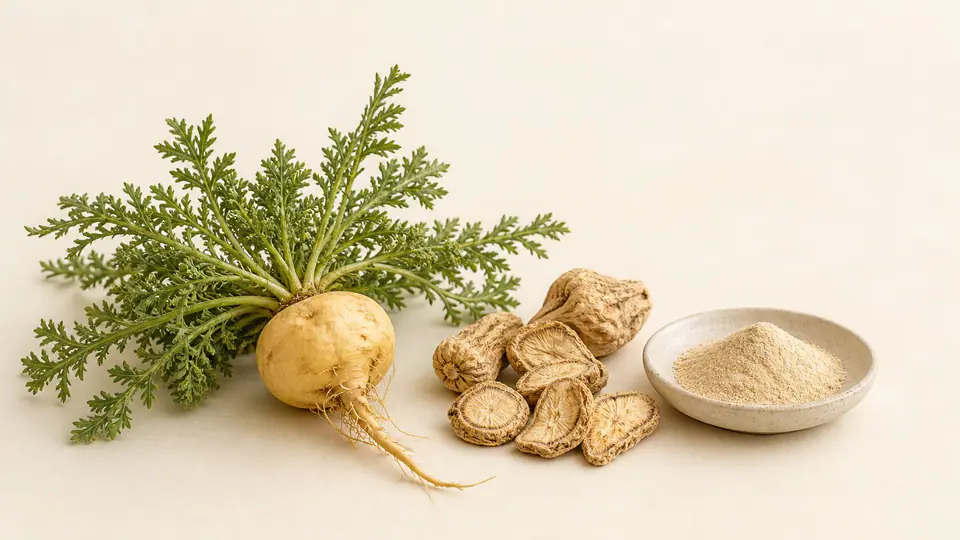
How an Andean edible plant became 'Peruvian Ginseng'
Can I take maca when I feel a drop in vitality or sexual function? This is the most common question from those encountering maca for the first time. In short, while it is known as an ingredient that is generally well-tolerated in the short term when taken alone, there is not yet sufficient evidence that it definitively improves vitality or sexual function. Furthermore, because the form used varies by maca product, the results of a single study cannot be applied directly to the product you purchased.
Maca is an edible plant grown in the Andean highlands and is a traditionally used ingredient. NIH LiverTox describes maca as a food and traditional herbal ingredient derived from the edible underground parts of Lepidium meyenii. In other words, maca is a plant with a history of being consumed as food, rather than starting as a supplement. However, as this food earned the nickname 'Peruvian Ginseng,' its image expanded to cover vitality, sexual function, and menopause all at once.
A nickname does not explain the ingredient
'Peruvian Ginseng' is merely a nickname; it does not mean that maca is the same plant as ginseng or contains the same components. The scientific name for maca is Lepidium meyenii, and it is a different plant from ginseng. Nicknames are good for stimulating the imagination, but they cannot replace the actual identity of the ingredient. It is certain that maca was used as an edible plant in the Andes. However, the fact that it has been eaten as food for a long time does not mean it improves specific symptoms. Traditional use can be a clue to understanding the background of an ingredient, but clinical evidence regarding the effects of modern supplements must be reviewed separately.
Examining the source of expectations
Human research results on maca are conflicting. Widely promoted effects such as libido, sperm quality, mood, memory, and vitality have not been proven through rigorous prospective trials. A systematic review of menopausal symptoms found positive signals in 4 randomized trials, but a definitive conclusion could not be reached because the number of trials, sample sizes, and methodologies were too limited. In a small crossover trial of 14 postmenopausal women, some psychological and sexual function indicators changed, but sex hormone levels did not. Observed changes do not immediately prove general effects or mechanisms of action.
Product form determines the research results
Maca products come in various forms, such as raw materials, dried powder, gelatinized products, and extracts. These differ in manufacturing and research conditions. There is no guarantee that the form used in a study is the same as the product you chose; therefore, the results of one study cannot be generalized to all commercial products or all genders and ages. Checking whether it is a powder, gelatinized product, or extract is not a simple distinction, but a matter of determining whether the evidence can be applied. If the form differs, what the research says and what the product can claim also differ.
| Category | Points to Check |
|---|---|
| Powder | Whether the research product and the commercial product are the same |
| Gelatinized product | Whether the trials used match the product labeling |
| Extract | Whether research results from a different form were applied directly |
When using with other supplements or treatments
Before using maca with other supplements or treatments, several things must be checked first. You should evaluate the cause of the decrease in vitality or changes in sexual function, check for reproductive or hormone-related diseases or treatments, and identify the form of the maca product. Those who are pregnant, breastfeeding, or have reproductive or hormone-related diseases and treatments should not take it arbitrarily and must consult a healthcare provider. Since there is no evidence that maca can replace other treatments, you should avoid arbitrarily stopping existing treatments to switch to maca.
Prioritize individual circumstances and safety signals
In small short-term trials, maca was generally well-tolerated, and gastrointestinal symptoms and headaches were mostly reported as mild. No convincing link to clinically significant liver injury has been reported, but experience and long-term data are limited. This means there appeared to be few problems in the short term, not a guarantee that it is safe for long-term use. It is important not to delay the evaluation of the cause of persistent fatigue, changes in sexual function, or menopausal symptoms by using maca. If symptoms are present, the process of finding the cause must come first.
Menopause, sexual function, and vitality are not the same thing
Menopausal symptoms, sexual function, and vitality are questions with different target populations and evaluation indicators. The menopausal research reviewed here targeted postmenopausal women; sexual function and vitality must be verified separately with different targets and indicators. Just because some psychological indicators changed for menopausal women in one study does not mean that sexual function or general vitality in other individuals will improve in the same way.
Maca and Ginseng follow different paths
Maca and ginseng are often grouped together because of their nicknames, but they are different plants. The expression 'Peruvian ginseng' does not replace maca's botanical identity or the evidence based on human studies. Misunderstandings arise when expectations for ginseng are applied directly to maca.
Realistic criteria to check today
What then should you look for? If you are considering maca, check the cause of the symptoms you wish to resolve, the product form, and the gaps in long-term safety and small, short-term human studies, rather than relying on nicknames and images of vitality. If symptoms persist, consulting medical staff is a priority over purchasing maca. While maca is an ingredient with a history as an edible plant from the Andes, that history does not guarantee the efficacy of modern supplements.
References
- NIH LiverTox: Maca.
- Maca for menopausal symptoms: systematic review.
- Maca in postmenopausal women: randomized crossover trial.
This text explains the origin of the raw materials, the scope of research, and precautions before consumption. As this cannot replace individual diagnosis or treatment, please consult a medical professional if you are taking medication or if symptoms persist. If sudden and severe symptoms such as difficulty breathing or decreased consciousness occur after consumption, seek help from 119 or the emergency room.

Medical Staff Review
Director Choi Yeon-seung
Chief Director of Baekrokdam Korean Medicine ClinicMaca Dictionary Entry, reviewed the safety of expressions and the scope of verification before administration.
Review scope: Ingredient origin, human subject research, concomitant medications, intake safety · Last reviewed 2026-08-16
- Graduated from Kyung Hee University College of Korean Medicine
- Providing Korean medicine treatment since 2010
- Consultations for Gongjindan, Gyeongokgo, Nokyong (Deer Antler) restorative medicine, and customized restorative herbal medicine