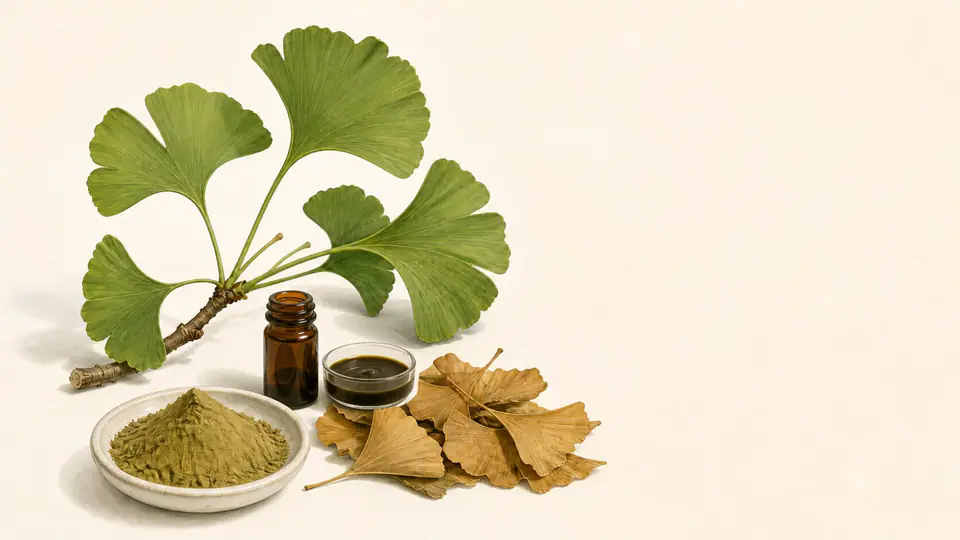
From the leaves of a living fossil to a memory supplement
Can my parents take ginkgo leaf extract, which is said to be good for memory and blood circulation? Is it okay to take it with aspirin?
There are a few things to check first. You must distinguish whether your parents are taking anticoagulants or antiplatelet agents, whether you are expecting memory enhancement for a healthy person or symptom relief for diagnosed dementia, and whether the product you have is a standardized leaf extract used in clinical trials. If these three factors are confused, the information about ginkgo leaves can easily be misinterpreted.
The ginkgo tree holds symbolic value as the last surviving species of an ancient plant lineage. However, that symbolism is not clinical evidence for preventing brain aging. In the process of a single fan-shaped leaf becoming a supplement, the paths diverge between raw materials and extracts, standardized preparations and general powders, small changes in cognitive tests and long-term dementia prevention, and blood flow indicators and actual cardiovascular events.
Which ginkgo leaf are you referring to?
Ginkgo leaf extract is a preparation made from the leaves of Ginkgo biloba. However, not all ginkgo leaf products on the market are the same. Specific preparations like the standardized extract EGb 761 used in clinical trials differ in ingredients and dosage from general powders, teas, and complex products. Furthermore, leaf extracts used in clinical trials must be distinguished from toxic raw ginkgo seeds or unprocessed plant materials.
While they all share the name 'ginkgo,' clinical evidence is limited to specific standardized extracts of the leaf. The results of standardized leaf extracts used in research cannot be applied directly to ginkgo leaf tea, powders, products with different ingredients, or ginkgo seeds. Therefore, rather than saying "ginkgo leaves are good," one should first ask, "which ginkgo leaf preparation is it?"
Why expectations for memory and blood circulation exist
The perception that ginkgo leaves help with memory and blood circulation is widespread. However, the NCCIH states that no decisive effect has been confirmed for any health condition studied with ginkgo leaves, and the evidence for cognitive enhancement in healthy individuals is uncertain.
The reason for the expectation and the strength of the evidence are different issues. Contexts such as the ancient plant, the unique leaf shape, and associations with cognitive ability may have created a commercial image. However, that image cannot replace clinical results. The conclusion that it improves memory in healthy people is not supported.
Dementia prevention vs. symptom support: different questions
In the GEM randomized trial, which followed 3,069 people aged 75 and older for a median of 6.1 years, ginkgo leaf extract taken at 120 mg twice daily did not reduce the incidence of overall dementia or Alzheimer's disease. This is the result of a long-term prevention study targeting healthy older adults.
On the other hand, there is a possibility that relatively high-dose standardized extracts may provide slight help for diagnosed dementia symptoms. However, research is inconsistent, and this is not the same as a conclusion regarding the prevention or inhibition of dementia progression. In other words, seeing a small change in a cognitive test is a different question from enhancing the memory of a healthy person or preventing the onset of dementia years later. When the question changes, the answer changes.
Between blood flow images and actual cardiovascular events
Claims that ginkgo leaves help blood circulation are often based on surrogate markers such as blood flow or blood viscosity. However, surrogate markers should not be misinterpreted as the prevention of clinical events. There is no supported evidence that ginkgo leaves help prevent tinnitus, hypertension, or heart disease.
Just because blood flow appears smooth does not mean that strokes or cardiovascular events are reduced. There is a gap in proof between the physiological indicators observed in research and the actual prevention of disease. If one says "circulation improvement" without filling this gap, expectations are exaggerated.
Standardized extracts vs. raw leaves, teas, powders, and complex products
Standardized extracts are preparations manufactured with specific ingredient ratios, but teas, powders, or complex products may not follow these standards. Therefore, even if "ginkgo leaf" is written in the product name, clinical trial results cannot be directly applied.
| Category | Applicability of Research Evidence |
|---|---|
| Standardized leaf extract | Clinical trial results may be referenced |
| Ginkgo leaf tea, powder, complex products | Same results cannot be expected due to different ingredients and dosages |
| Raw ginkgo seeds, unprocessed plants | Toxicity and serious adverse events reported; unrelated to the safety of leaf extracts |
This table is intended for simple comparison. It is dangerous to assume the same efficacy or safety simply because they fall under the name "ginkgo."
When taken with Aspirin
An analysis of average hemostasis indicators from 18 randomized trials did not confirm an increased risk of bleeding with standardized extracts. However, this does not guarantee the safety of combined use for individual anticoagulant users or those before surgery. A group average does not eliminate individual risk.
Ginkgo leaf extract may cause dizziness, gastrointestinal symptoms, and headaches, and may increase the risk of bleeding in users of anticoagulants such as warfarin. Do not take it arbitrarily with aspirin, clopidogrel, or anticoagulants, and do not use it as a substitute for prescription medication. You must inform your medical staff of the product and dosage before surgery or procedures. What should you check? You must consider the type of medication currently being taken, the procedure schedule, and whether the product is a standardized extract.
Raw ginkgo seeds and unprocessed plants are in a different category
Raw ginkgo seeds are toxic. Serious adverse events have also been reported with roasted seeds or unprocessed plants. The research safety of leaf extracts must not be applied to these.
Ginkgo seeds distributed for food consumption and the leaf extracts used in clinical trials differ starting from the raw materials. It is dangerous to assume the same safety under the name "ginkgo." The use of raw materials should follow separate toxicity and adverse reaction reports rather than clinical data.
Pregnancy, Breastfeeding, and Emergency Signals
Ginkgo leaf extract is avoided during pregnancy due to the possibility of preterm labor or delivery hemorrhage. Safety data during breastfeeding is also insufficient. For bleeding that does not stop, black stools, vomiting blood, sudden one-sided paralysis, slurred speech, or severe headaches, do not wait and see with supplements; you must call 119 or receive an evaluation at an emergency room.
Criteria to Check Today
Rather than the name "ginkgo," first verify whether the leaf extract is standardized, the purpose of intake, anti-thrombotic medications, surgery, and bleeding risk. The phrase "looking at the distance between short-term symptom scores and long-term dementia prevention results" means you should examine to what extent the expected effects have been proven in research.
Check if the product your parents intend to take is a standardized extract of Ginkgo biloba leaves, and verify the daily dose, complex ingredients, and product name. You must also know if they are taking aspirin, clopidogrel, warfarin, direct-acting anticoagulants, or anti-inflammatory analgesics, and if they have upcoming surgery or dental procedures. Observe whether they expect improvement in forgetfulness, diagnosed dementia, tinnitus, or peripheral circulation, and check for any sudden neurological symptoms. Only when these questions are gathered can a realistic judgment about ginkgo leaf extract be made.
References
- NCCIH: Ginkgo usefulness and safety.
- Ginkgo biloba for prevention of dementia: GEM randomized trial.
- Standardized Ginkgo extract and bleeding risk: systematic review and meta-analysis.
This text explains the origin of the raw materials, the scope of research, and precautions before consumption. As this cannot replace individual diagnosis or treatment, please consult a medical professional if you are taking medication or if symptoms persist. If sudden and severe symptoms such as difficulty breathing or decreased consciousness occur after consumption, seek help from 119 or the emergency room.

Medical Staff Review
Director Choi Yeon-seung
Chief Director of Baekrokdam Korean Medicine ClinicGinkgo Leaf Extract Glossary, reviewed the safety of expressions and the scope of verification before administration.
Review scope: Ingredient origin, human studies, concomitant medications, safety of intake · Last reviewed 2026-08-17
- Graduated from Kyung Hee University College of Korean Medicine
- Providing Korean medicine treatment since 2010
- Consultations for Gongjindan, Gyeongokgo, Nokyong (Deer Antler) restorative medicine, and customized restorative herbal medicine