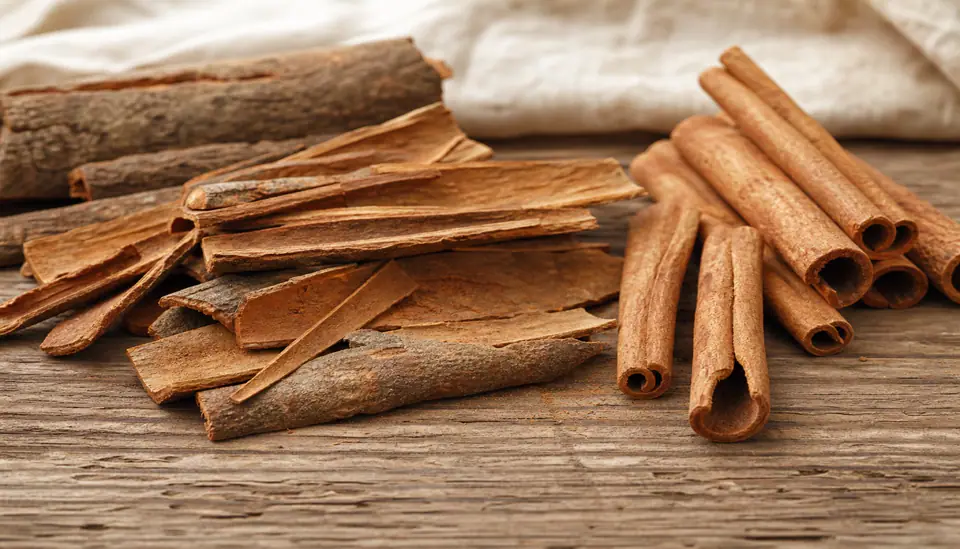
百藥之導, 寒痺之燈 — 桂皮
The Wood section of the Compendium of Materia Medica (Bencao Gangmu) contains this record. “性大熱,味甘辛,有小毒。主溫中,通血脈,利肝肺氣。治霍亂轉筋,宣導百藥,無所畏,能墮胎.” That is cinnamon, Gye-pi. The expression 'leads a hundred medicines (宣導百藥)' evokes the image of a torch opening the way for all other medicinal ingredients. However, this torch also comes with warnings: it is 'greatly hot (性大熱),' 'contains slight toxicity (有小毒),' and 'can induce abortion (能墮胎)' during pregnancy. This means it is a medicinal ingredient where warmth can lead to danger.
Common impressions of cinnamon often stop at its sweet and spicy scent as a spice or the warmth of a cup of winter tea. However, the original position of Gye-pi in Korean medicine is much deeper. In numerous prescriptions from the Miscellaneous Diseases section of the Dongui Bogam, such as Bokryung-tang, Cheongung-bokryung-tang, Sambi-tang, Gyechul-tang, and Gyeryung-tang, cinnamon is used as a core combination drug for symptoms involving cold (寒) and blockage (痺), such as wind-cold-dampness obstruction (風寒濕痺), stagnation of qi and blood, stomach-related nausea and vomiting, and cold asthma. It is not used for its fragrance, but as an ingredient that brings fire to cold and hardened areas.
However, this fire requires regulation. As noted in the Bencao Gangmu record 'can induce abortion,' the warming and blood-circulating effects of cinnamon can act in a negative direction in certain situations. Therefore, when we use cinnamon in a prescription, we first consider 'for whom, how much, and for how long.' Because its warmth is so strong, the core of using this ingredient lies in where and to what extent that power is applied. I will explain those criteria step by step below.
Summary at a Glance
First, let me summarize the key information about cinnamon. By looking at the table below, you can quickly understand the properties of this medicinal ingredient and the situations where caution is required.
| Category | Content |
|---|---|
| Origin | Hanja name Gye-pi, Scientific name Cinnamomum cassia (L.) J.Presl. The bark of the Lauraceae family plant is used medicinally. |
| Properties and Meridian Tropism | The taste is sweet and spicy (甘辛), and the property is very hot (大熱). Classical texts also record that it has slight toxicity (小毒). It primarily acts on the liver (肝), spleen (脾), kidney (腎), and heart (心); for Yuk-gye, the bladder (膀胱) is also mentioned. |
| Representative Aliases | Besides Gye-pi, it is sometimes called Yuk-gye. This entry covers Gye-pi, Cinnamomum cassia corresponding to (L.) J.Presl. |
| Efficacy Recorded in Literature | In the Bencao Gangmu, it is recorded as warming the center (溫中), clearing blood vessels (通血脈), benefiting liver and lung qi (利肝肺氣), treating cholera and muscle spasms (霍亂轉筋), and leading a hundred medicines (宣導百藥). On the Traditional Knowledge Portal, its actions are summarized as supplementing yang (補陽), dispersing cold (散寒), relieving pain (止痛), capturing qi (納氣), warming the spleen and stomach (暖脾胃), supplementing original yang (補元陽), and removing accumulated cold (除積冷). |
| Main Ingredients | Cinnamaldehyde is known as the representative aromatic component of cinnamon. |
| Combinations and Contraindications | It is often used with other ingredients in prescriptions for cold (寒), pain (痛), and obstruction (痺). Because its property is very hot, particular caution is needed for constitutions or symptoms with heat (熱), as well as during pregnancy. The Bencao Gangmu explicitly states the classical warning '能墮胎,' meaning it can induce abortion. When used with other restorative medicines for supplementing yang or yin, it must be carefully combined according to the patient's constitution and symptoms. |
The most important parts to notice in this table are ‘Great Heat’ (大熱), ‘Slight Toxicity’ (小毒), and ‘Ability to Induce Abortion’ (能墮胎). While cinnamon is a medicinal herb that provides warmth, its intense heat can disrupt the body's balance; therefore, the key is who uses it, how much, and with which other herbs.
Is this medicinal herb right for me?
Cinnamon is a medicinal herb that provides warmth, but due to its hot nature, it may add excessive heat to certain constitutions or conditions. Based on organized classical records and modern interpretations, we provide the following three categories so you can first check your own status.
-
Generally suitable cases: Those with cold hands and feet, or those who suffer from a cold abdomen; those with chronic stiffness or pain in the joints or muscles; those who feel digestion is slow due to a cold stomach. For these individuals, cinnamon has been traditionally used for its properties of warming the center (溫中) and promoting blood flow (通血脈).
-
Cases requiring caution: Those who easily feel overheated, experience facial flushing, or have a dry mouth; those with a sensitive stomach or frequent heartburn; those who may be pregnant or are currently pregnant. The Bencao Gangmu warns that cinnamon ‘can induce abortion’ (能墮胎), so in these cases, consultation with a Korean medicine doctor is essential.
-
Cases to avoid: Those who are pregnant; those with a tendency to bleed or those with hemorrhagic diseases; those with clear heat symptoms (such as fever or pyogenic infections). As it falls under the ‘Slight Toxicity’ (有小毒) specified in the Bencao Gangmu, excessive use or long-term use as a single agent should be avoided.
These three categories are merely guidelines for a rough self-assessment. Since prescriptions containing cinnamon are usually used in combination with other herbs, it is safest to determine whether to take it through a medical evaluation that comprehensively considers your constitution, symptoms, and current medications.
Practical Q&A
Cinnamon is familiar as a spice, but when used as Korean herbal medicine, its hot nature makes it crucial to determine when and for whom it is appropriate. We provide answers to frequently asked questions from consultations, based on classical records and actual prescription contexts. Since suitability varies depending on the individual's condition, the following content is for reference only; please ensure that the specific decision to take it is made through a consultation with a Korean medicine doctor.
For which constitutions or symptoms is cinnamon mainly used?
Cinnamon is traditionally Cold (寒), Obstruction (痺), and Pain (痛) used to treat conditions of these types. Looking at the prescriptions in the Miscellaneous Diseases section of the Dongui Bogam, cinnamon is a key component in cases where limbs are painful, stiff, or numb, such as painful obstruction (痛痺), adherent obstruction (着痺), or wind obstruction (風痺), as well as in cases of cold asthma (寒喘) where hands and feet are cold and breathing is short, or vomiting due to a cold stomach. The Bencao Gangmu records its primary actions as “warming the center (溫中), promoting blood flow (通血脈), and benefiting the Qi of the liver and lungs (利肝肺氣).” In other words, it is a medicinal herb traditionally used to relieve internal coldness and support the flow of Qi and blood.
Can it be used during pregnancy?
During pregnancy, The general rule is to avoid use. The Bencao Gangmu clearly warns that cinnamon "can induce abortion" (能墮胎). This is a classical record, and in modern clinical practice, extreme caution must be exercised regarding intake during pregnancy. If you are pregnant or there is a possibility of pregnancy, you must consult a Korean medicine doctor before consuming cinnamon, whether in the form of a prescription or as a food ingredient.
Is it okay to use if I usually feel hot or have a lot of internal heat?
It is likely that it may not be suitable for you. The Bencao Gangmu records the nature and flavor of cinnamon as "greatly hot" (性大熱). For those who already have internal heat or exhibit heat-related symptoms such as burning sensations, constipation, bad breath, or insomnia, it may result in adding more "fire" to the body. Since cinnamon is a medicinal herb based on the assumption that warmth is needed, you must inform your doctor during the consultation if your constitution or current symptoms tend toward heat.
Is cinnamon toxic?
The Bencao Gangmu records that it "has slight toxicity" (有小毒). However, this "slight toxicity" is a different concept from the strong toxicity discussed in modern medicine; it is based on the premise of being used under the guidance of a medical professional within appropriate dosages, constitutions, and durations of intake. It is important to distinguish that using it in small amounts as a spice is different in quantity and purpose from taking it as a Korean herbal medicine prescription.
How is it paired with other medicinal herbs?
The traditional meaning of cinnamon becomes clearer when it is used with other herbs rather than alone. In Bokryeong-tang from the Miscellaneous Diseases section of the Dongui Bogam, it treats Tong-bi (painful obstruction) along with red Poria, mulberry root bark, Saposhnikovia root, Cnidium rhizome, white peony root, and Ephedra. In Cheongung-bokryeong-tang, it addresses Chak-bi (fixed obstruction) along with Cnidium, Angelica root, and licorice. In Gyechul-tang, it is used for Gi-bun-jeung (Qi-level syndrome) with Atractylodes, Ephedra, Asarum, licorice, Aurantii Fructus Immaturus, and dried ginger. In Gumi-ijung-tang, it is used for Han-cheon (cold asthma) with Amomum, dried ginger, Perilla seed, Magnolia bark, citrus peel, licorice, agarwood, and Aucklandia root. In these combinations, cinnamon plays the role of relieving coldness and circulating Qi and blood, supporting other herbs to act in their respective directions.
Can I drink cinnamon as a tea on a daily basis?
Cinnamon tea is commonly sought as a warm beverage in winter, but from a Korean herbal medicine perspective, daily long-term consumption is not recommended. In particular, as mentioned above, extra caution is needed for those with a heat-prone constitution, those who are pregnant or breastfeeding, those with a tendency toward bleeding, or those taking other medications. Even in the form of a daily tea, it may worsen symptoms if it does not suit your condition, so consultation with a Korean medicine doctor is recommended before long-term or regular intake.
Relationship with Other Medicinal Herbs (Yakdae/Pairing)
Cinnamon is not used alone. The moment it is paired with other herbs, its hot nature shifts from concentrating in one direction to leading the flow of the entire prescription. In traditional medicine, this pairing relationship is called "Yak-dae" (medicinal pairs). Cinnamon frequently appears as a core pairing herb in prescriptions for Bi-jeung (obstruction syndrome) where wind, cold, and dampness are intertwined, or in Han-jeung (cold syndrome) prescriptions where the interior is cold and Qi is blocked. Based on the prescriptions recorded in the Miscellaneous Diseases section of the Dongui Bogam, we introduce the herbs that cinnamon is used with.
-
Cinnamon + Poria (茯苓) + Cnidium (川芎) + Saposhnikovia (防風) etc., Bokryeong-tang (茯苓湯) A prescription found in the Seonmyeong section of the Dongui Bogam, it treats Tong-bi (痛痺), a state where the limbs are painful and accompanied by stiffness and edema. In this prescription, cinnamon is used to resolve wind, cold, and dampness and to clear the blood vessels. Other constituent herbs include red Poria, mulberry root bark, white peony root, and Ephedra.
-
Cinnamon + Cnidium (川芎) + Angelica (當歸) + Licorice (甘草) etc., Cheongung-bokryeong-tang (川芎茯苓湯) A prescription recorded in the Ipmun section of the Dongui Bogam, it has been traditionally used for Chak-bi (着痺), a state where sensation in the limbs becomes dull and stiffness and edema appear. Cinnamon forms a combination with Cnidium and Angelica to circulate blood and Qi.
-
Cinnamon + Atractylodes (白朮) + Ephedra (麻黃) + Asarum (細辛) etc., Gyechul-tang (桂朮湯) A prescription appearing in the Jikji section of the Dongui Bogam, it treats Gi-bun-jeung (氣分證), a state where Qi is blocked by Yin, causing chest fullness, abdominal rumbling, and bone pain. The combination of cinnamon and Atractylodes is structured to warmly resolve cold and blocked energy.
-
Cinnamon + Poria (茯苓) + Angelica (當歸) + Red Peony (赤芍藥) etc., Gyeryeong-tang (桂苓湯) A prescription found in the Jikji section of the Dongui Bogam, it is used for Hyeol-bun-jeung (blood-level syndrome), a state where the meridians do not flow smoothly and blood clumps, causing the limbs to swell and ache. Cinnamon is paired with Angelica, Cnidium, and red peony to clear the blood vessels.
-
Cinnamon + Ginseng (人蔘) + Atractylodes (白朮) + Dried Ginger (乾薑) etc., Gagami-jung-tang (加減理中湯) A prescription recorded in the Hoechun section of the Dongui Bogam, it is used for states where the stomach is cold, leading to the vomiting of watery fluid or cold phlegm, and the pulse is deep and slow. Cinnamon is part of a composition that warms the stomach along with dried ginger, ginseng, and Atractylodes.
-
Cinnamon + Amomum (砂仁) + Dried Ginger (乾薑) + Magnolia Bark (厚朴) etc., Gumi-ijung-tang (九味理中湯) A prescription found in the Hoechun section of the Dongui Bogam, it treats Han-cheon (寒喘), asthmatic breathing difficulty where the hands and feet are cold and the pulse is deep and thin. Cinnamon works with Amomum, dried ginger, and Magnolia bark to resolve deep coldness.
As such, cinnamon is used for conditions such as wind-cold-dampness obstruction (風寒濕痺), cold asthma, stomach coldness, and Qi and blood stagnation (氣血凝滯) Cold (寒), Obstruction (痺), and Pain (痛) These appear repeatedly in prescriptions of this category. However, these combinations are all prepared using the decoction (boiling) method, and even in modern Korean medicine clinics, they are adjusted based on the patient's specific condition. Because cinnamon has a hot property, it is safest to determine its use only under the diagnosis of a Korean medicine doctor.
In what form is it consumed?
Since cinnamon is a medicinal herb with warm properties, the way it affects the body varies depending on the form in which it is consumed. We have summarized four forms, ranging from the familiar spice to the forms prescribed at a Korean medicine clinic.
- Tea/Decoction This is the form where cinnamon is steeped in boiling water and drunk. It is the most common method used by those with cold hands and feet or a cold body during winter to feel warmth. However, as the Bencao Gangmu records cinnamon as having 'great heat and slight toxicity,' it is safer to consult a Korean medicine doctor to determine the appropriate duration and concentration rather than consuming it daily for a long period.
- Food/Seasoning This is the form where it is used as a spice in steamed dishes, soups, meats, breads, and desserts. Using small amounts in daily meals is common, but it is not an amount sufficient to expect medicinal efficacy. Those who are pregnant or have a constitution with excessive heat should avoid excessive intake.
- Decoction This is the form where it is included in a Korean herbal medicine prescription and boiled in water. In prescriptions such as Bokryeong-tang, Cheongung-bokryeong-tang, Sambi-tang, Gumi-ijung-tang, Gyechul-tang, and Gyeryeong-tang found in the Miscellaneous Diseases section of the Dongui Bogam, cinnamon is used via the decoction (water-boiling) method along with other herbs. In these cases, cinnamon serves as a core ingredient in prescriptions for Cold (寒), Obstruction (痺), and Pain (痛), such as wind-cold-damp obstruction, cold-chill, stomach cold, and blood-qi stagnation.
- Professional Prescription This is the form where it is included in a prescription tailored to an individual's constitution and symptoms at a Korean medicine clinic. Considering the hot property of cinnamon and classical warnings regarding pregnancy (ability to cause abortion), it is not recommended to take it independently without professional judgment.
Interactions and Safety During Use
As cinnamon is a medicinal herb that provides warmth, it is important how its hot property interacts with the body's condition. Looking at both classical records and modern interpretations, a cautious approach is required especially in the following three situations.
- Pregnancy Period The Bencao Gangmu records that cinnamon 'can cause abortion.' If you are pregnant or there is a possibility of pregnancy, you must consult a professional before consuming cinnamon alone or as part of a Korean herbal medicine prescription.
- Bleeding Tendency or Menorrhagia (Heavy Menstrual Bleeding) Cinnamon is recorded as having the action of 'opening the blood vessels' (通血脈). Therefore, those who bleed frequently, have heavy menstrual flow, or are before or after surgery should not use prescriptions containing cinnamon indiscriminately.
- Heat-Toxin (熱毒) Constitution or Infectious Febrile Conditions The property of cinnamon is 'Great Heat' (大熱), meaning it is very hot. For those with excessive body heat, a red face, dry mouth, constipation, or inflammatory diseases, it may actually aggravate the symptoms.
Additionally, while cinnamon is familiar as a spice, the dosage for Korean herbal medicine and the dosage for dietary use are in entirely different contexts. A few sprinkles of cinnamon powder in daily life differ in concentration and combination from cinnamon included in a decoction prescribed at a Korean medicine clinic. In particular, those taking Western medications or those with hypertension, diabetes, liver, or kidney disease need to consult sufficiently with their attending Korean medicine doctor before starting a Korean herbal medicine prescription that includes cinnamon.
“性大熱,味甘辛,有小毒。主溫中,通血脈……能墮胎.” Bencao Gangmu, Wood Section, Cinnamon
The safety of cinnamon depends on 'who' uses it, 'how much' is used, and 'with which prescription' it is combined. It is a medicinal herb that should be started only after accurately knowing one's constitution, current medications, and pregnancy status. Please ensure that the specific use and dosage are determined through a consultation with a Korean medicine doctor.
If you experience these symptoms
While cinnamon is a medicinal herb that warms and relaxes the body, if its hot property is excessive, it may add too much heat or disrupt the body's balance. The following signs are known in classical texts and clinical practice as warnings related to cinnamon being unsuitable or taken in excessive amounts or for long periods. If these symptoms appear, do not adjust the dose yourself; please inform the attending Korean medicine doctor who provided the prescription.
- Dry mouth and severe thirst This is a common sign that the pungent (辛) and hot (熱) properties of cinnamon are adding heat to the body.
- Abdominal heat or heartburn This is a sign of heat accumulating in the stomach, which can occur if used when the patient does not have a 'stomach cold' (胃寒) condition.
- Headache or facial flushing This may occur when there is a tendency for heat to rise through the blood vessels.
- Insomnia, restlessness, or heart palpitations This occurs when heat-natured medicinal herbs overstimulate the mind and body.
- Accompanied by bleeding or abdominal pain during pregnancy The Bencao Gangmu records that it "can induce abortion" (能墮胎); therefore, immediate consultation is especially necessary during pregnancy.
- Skin rash or itching There is a possibility of a hypersensitivity reaction or that it is not suitable for your constitution.
If symptoms are severe or accompanied by difficulty breathing, decreased consciousness, severe abdominal pain, or bleeding, please visit an emergency medical institution (emergency room).
Differences from other restorative medicines
Cinnamon falls under the broad category of 'restorative medicine' (boyak), but its mechanism of action differs slightly from Qi-tonifying herbs such as ginseng or astragalus. Ginseng and astragalus primarily supplement and manifest Qi, while angelica or succinum focus on supplementing and lubricating the blood. In contrast, from the perspective of pharmacognosy, cinnamon is an herb geared toward supplementing Yang, warming the center, and clearing the blood vessels. In other words, rather than producing a large amount of Qi or blood itself, its strength lies in managing the warm energy and blood flow within the body.
Due to these properties, cinnamon differs from traditional restorative medicines like Gongjindan or Gyeongokgo. Gongjindan is a Yang-tonifying agent centered on deer antler and cornus officinalis, representing a restorative medicine used for overall recovery of vital energy and aging management. Gyeongokgo is a blood-tonifying agent centered on angelica and white peony, closer to treating symptoms caused by blood deficiency. Compared to these, cinnamon is an herb used more directly to resolve 'cold and frozen states.' It is particularly effective in the context of cold syndromes (han-jeung) or obstruction syndromes (bi-jeung), such as cold hands and feet, abdominal pain due to cold, or stiff and painful joints.
However, these differences change flexibly depending on the overall composition of the prescription. A prescription containing cinnamon does not always mean it is only 'for people who are cold.' For example, in prescriptions such as Bokryeong-tang or Sambi-tang from the Dongui Bogam, cinnamon is used as a key combined herb to resolve wind-cold-damp obstruction (pung-han-seup-bi), but it is used alongside other restorative, blood-harmonizing, and wind-expelling herbs. Therefore, it is best to determine whether cinnamon is right for you, or if Gongjindan or Gyeongokgo is more appropriate, after evaluating your overall constitution and the flow of your symptoms. Please confirm your specific choice through a medical consultation.
References
- Cinnamon Evidence Material 1: GBIF plant classification data.
- Cinnamon Evidence Material 2: GBIF plant classification data.
- Cinnamon Evidence Material 3: GBIF plant classification data.
- Cinnamon Evidence Material 4: Korea Citation Index academic paper.
- Cinnamon Evidence Material 5: Korea Citation Index academic paper.
- Cinnamon Evidence Material 6: Korea Citation Index academic paper.
- Cinnamon Evidence Material 7: PubMed academic paper.
- Cinnamon Evidence Material 8: PubMed academic paper.
If you would like to check if this medicinal herb is right for you or which prescription it should be used with, please leave a medical inquiry. For those who find it difficult to visit the clinic, non-face-to-face consultations are available; we will provide guidance after first reviewing your current condition and current medications.

Medical Staff Review
Director Choi Yeon-seung
Chief Director of Baekrokdam Korean Medicine ClinicCinnamon Dictionary Entry, reviewed the safety of expressions and the scope of verification before administration.
Review Scope: Clinical Accuracy, Pharmacology, Contraindications, Combinations, QA · Last Reviewed 2026-08-16
- Graduated from Kyung Hee University College of Korean Medicine
- Providing Korean medicine treatment since 2010
- Consultations for Gongjindan, Gyeongokgo, Nokyong (Deer Antler) restorative medicine, and customized restorative herbal medicine