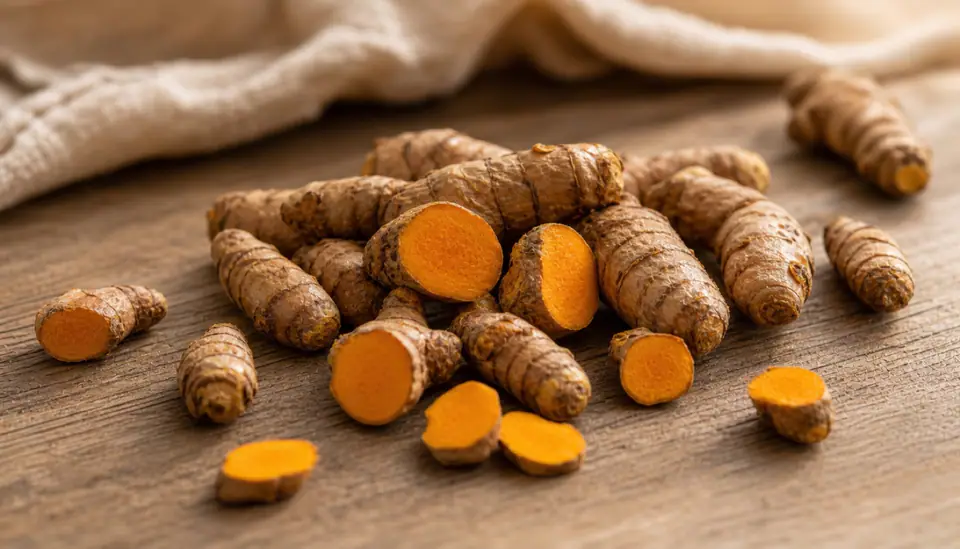
Yellow Blood, Dispersing Energy, Turmeric (Jiang Huang)
According to the 《Jeungryu Boncho (Classified Materia Medica)》, turmeric was recorded as having a "pungent and bitter taste, great cold property, and non-toxic." However, the pharmacologist of that era, Jin Jang-gi, corrected this, stating, "True turmeric is old ginger planted for more than three years that can produce flowers... its nature is warm, not cold. The 《Bon-gyeong》's claim of it being cold is an error." He viewed turmeric as a medicinal herb that "breaks blood and lowers qi," and Il-hwa-ja added that it "treats abdominal masses, blood clots, and carbuncles, regulates menstruation, and treats bruised blood from trauma." The 《Dogyeong Boncho (Illustrated Materia Medica)》 notes that "people of Shu used it to treat abdominal bloating and postpartum sepsis affecting the heart, with great effect," showing that turmeric was not a simple spice but a medicinal herb used to clear blockages of qi and blood.
Today, turmeric is primarily known as the spice responsible for the yellow color of curry powder. While familiar on the dining table, its position in herbal medicine is slightly different. In 《Boncho Gujin (Seeking Truth in Materia Medica)》, Hwang Gung-su explained that turmeric "breaks the qi and blood in the spleen to make them descend," describing it as a herb that governs the "blood within the qi" and simultaneously moves the "qi within the blood." In other words, turmeric does not just move blood; it possesses the property of releasing the energy that has stalled along with the blood. Therefore, the Traditional Knowledge Portal of Korea summarizes the effects of turmeric as "breaking blood and promoting the flow of qi (破血行氣), and clearing the meridians to stop pain (通經止痛)."
However, this power acts strongly in any direction. The Traditional Knowledge Portal of Korea specifies the contraindications for turmeric, stating that "those who have blood deficiency (血虛) and do not have qi stagnation and blood stasis (氣滯血瘀) should avoid taking it." If blood is inherently deficient, or if qi and blood are not in a blocked state, it may instead further empty an already void area. Additionally, high-dose curcumin supplements may interact with anticoagulants or blood thinners, and cases of liver damage have been reported; therefore, self-administration without consulting a medical professional is not recommended.
Ultimately, behind the friendliness of its yellow color, turmeric possesses a strong property that moves qi and blood. The safety of this medicinal herb is determined by how much is used, by whom, and in what condition. On this page, we will examine those criteria step by step.
Summary at a Glance
This table provides an overview of which plant turmeric comes from and how its properties and actions are recorded in traditional medicine. While combinations and contraindications will be covered in more detail later, knowing this in advance helps in understanding the prescription.
| Category | Content |
|---|---|
| Origin | Hanja Name 薑黃, Scientific Name Curcuma longa Linné. It is the dried rhizome of the turmeric plant, which belongs to the ginger family. |
| Properties and Meridian Tropism | Pungent and bitter, warm. It acts on the Liver Meridian and Spleen Meridian. |
| Representative Aliases | It is a medicinal herb distinct from Sim-hwang, Hwang-geo, and Ul-geum. |
| Efficacy Recorded in Literature | Breaking blood and promoting the flow of qi, clearing the meridians to stop pain. The 《Jeungryu Boncho》 mentions it treats accumulations in the heart and abdomen, qi stagnation, blood stasis, wind-heat, and carbuncles, while the 《Dogyeong Boncho》 reports its effectiveness for abdominal bloating and postpartum sepsis affecting the heart. |
| Main Ingredients | Curcuminoids, such as curcumin, are the most well-known components. |
| Combinations and Contraindications | Due to its action of breaking blood and promoting the flow of qi, those with blood deficiency (血虛) who do not have qi stagnation and blood stasis (氣滯血瘀) should avoid taking it. High-dose supplement intake during pregnancy is not recommended, and as the risk of bleeding may increase when used with anticoagulants or blood thinners, consultation with a medical professional is necessary. |
Is this medicinal herb right for me?
While turmeric is familiar as the spice that gives curry its yellow color, in Korean medicine, it is classified as a medicinal herb that clears blockages of qi (氣) and blood (血). Therefore, rather than being a food that is equally safe for everyone, it is important to view it distinctly based on constitution and concurrent medication. Below are the criteria to check first when encountering turmeric.
-
Generally suitable casesSafe: Cases of occasional intake at a food level, such as in curry or turmeric tea, or when used as a decoction prescribed by a Korean medicine doctor for conditions accompanied by pain or tightness caused by blocked qi and blood. When turmeric is used within a fixed prescription, such as O-bi-tang from the 《Taiping Huimin Heji Ju Fang》, it has traditionally been utilized according to its intended purpose.
-
Cases requiring cautionCaution: Cases where you are taking anticoagulants or blood thinners such as warfarin or aspirin, are before or after surgery, have a bleeding disorder, have abnormal liver function, or are taking liver-related medications. High-dose curcumin supplements can cause bleeding risks or changes in drug metabolism in these situations, so consultation with a medical professional is required before use. If you are pregnant or breastfeeding, it is advisable to avoid supplements and limit even food-level intake as much as possible due to a lack of sufficient safety research.
-
Cases to avoidContraindicated: Those who do not have symptoms of qi stagnation and blood stasis (氣滯血瘀), where qi is blocked and blood is awkward, while in a state of blood deficiency (血虛) must not take it. Caution is also required for those with yin deficiency and blood loss (陰虛失血者). If signs of liver damage, such as fatigue, nausea, or jaundice, appear after long-term use of high-dose turmeric or curcumin supplements, stop use immediately and visit a hospital.
Practical Q&A
Turmeric is familiar as curry or a health tea, but in Korean medicine, it is classified as a medicinal herb that clears blockages of qi (氣) and blood (血). Therefore, it is important to distinguish whether it is a "food that can be eaten" or a "medicinal herb that must be handled with caution depending on the situation." We provide answers based on research for the questions frequently asked in the clinic.
Are turmeric and curcumin supplements the same thing?
Turmeric (Jiang Huang, Curcuma longa Linné) is a medicinal herb made from the dried rhizome of a ginger family plant, and curcumin is one of the yellow components contained within it. The yellow color of curry powder also comes from turmeric. The actions of turmeric discussed in Korean medicine often refer to the entire rhizome, whereas commercial high-concentration curcumin extract supplements concentrate only a portion of the components; therefore, they cannot be viewed as the same thing.
Is the amount found in curry okay?
Turmeric used as food is generally considered safe. The NCCIH (National Center for Complementary and Integrative Health) also mentions its use for culinary purposes. However, since turmeric is a medicinal herb with the property of breaking blood and promoting the flow of qi, strongly clearing the flow of qi and blood, it is best to distinguish between the level of a food seasoning and the level of a high-concentration supplement.
What if I am taking anticoagulants or blood thinners?
Turmeric, especially high-dose curcumin supplements, may increase the risk of bleeding when taken with anticoagulants or antiplatelet agents such as warfarin or aspirin. Please consult your attending medical staff before use. If you have an upcoming surgery, it is safer to inform them about your schedule in advance.
What if I am pregnant or breastfeeding?
The intake of turmeric dietary supplements is not recommended during pregnancy. The NCCIH maintains the position that there is insufficient research on turmeric supplements during pregnancy and breastfeeding. If you are pregnant or breastfeeding, it is advisable to distinguish between consuming small amounts in food and taking supplements, and to decide on the latter after consulting a professional.
Is it true that it is harmful to liver health?
While it cannot be concluded that turmeric is unconditionally harmful to the liver, it is true that cases of liver injury have been reported following long-term use of high-concentration supplements. Between 2004 and 2022, 10 cases of turmeric-related liver injury were reported in the US, some of which required hospitalization; there was also a case of death from acute liver failure after taking turmeric extract for 14 months to treat arthritis. Additionally, there is a case report of a 53-year-old woman who was confirmed via biopsy to have drug-induced liver injury after starting turmeric supplements as an adjunct treatment for Behçet's disease. If symptoms such as fatigue, nausea, or jaundice appear, you must stop taking it and visit a hospital.
Which constitutions or conditions should avoid it?
According to the Traditional Knowledge Portal, turmeric is contraindicated for those who have blood deficiency (血虛) without Qi stagnation and blood stasis (氣滯血瘀). In simple terms, it is not suitable for those who lack blood and do not exhibit the excess pattern of blocked Qi and blood. Caution is also required for those with Yin deficiency and blood loss (陰虛失血者). If you are unsure if turmeric is right for you, it is important to first verify your constitution and current condition through a consultation with a Korean medicine doctor.
Relationship with Other Medicinal Herbs (Yakdae/Pairing)
Turmeric is not used alone. In Korean medicine, medicinal herbs are used to complement each other's properties or align their directions, which is called "Yak-dae (藥對)". Since turmeric has a strong power to break blood and move Qi (破血行氣), its characteristics become more distinct when paired with other herbs. Below are representative combinations of turmeric identified in classical and modern materials.
- Turmeric + Licorice (甘草) + Notopterygium (羌活) + Stephania (防己) + Atractylodes (白朮) — Obi-tang (五痺湯): A prescription listed in the "Taiping Huimin Heji Jufang (太平惠民和劑局方)"; turmeric is used to treat weakness and numbness (痲痹不仁) of the limbs and imbalance of Qi and blood (氣血失調). In this prescription, turmeric helps the flow of Qi and blood entangled with wind, cold, and dampness (風寒濕).
- Turmeric + Myrrh (沒藥) + Frankincense (乳香) A small prescription cited in "Boncho Gujin (本草求真)": There is a record of taking a mixture of 1 jeon of turmeric and 2 jeon each of myrrh and frankincense, kneaded with honey, when a fetus suffered from abdominal pain due to coldness.
- Turmeric + Cinnamon (桂) An empirical prescription cited in "Boncho Gujin": To treat heart pain (心痛), 3 nyang of cinnamon were added to 1 nyang of turmeric and taken as a vinegar decoction.
Since turmeric is a medicinal herb that clears areas where Qi and blood are blocked, it is not suitable for those who have blood deficiency (血虛) without Qi stagnation and blood stasis (氣滯血瘀). Additionally, those with a tendency to bleed or those taking anticoagulants or blood thinners should always consult medical staff before using turmeric or curcumin supplements.
In what form is it consumed?
Turmeric is most familiar as the spice that gives curry its yellow color, but in Korean medicine, it is used as a medicinal herb to clear blockages of Qi (氣) and blood (血). Therefore, the method of consumption goes beyond simply 'adding flavor'; the meaning changes depending on how much, in what form, and with whom it is used. The four forms listed below are all possible, but each has a different appropriate use.
- Tea/Beverage: Forms such as turmeric tea or turmeric lattes, where it is mixed into boiled water or milk, are possible for daily consumption. However, one must distinguish between spice-level amounts and high-concentration extracts.
- Food/Seasoning: It is used globally as a food ingredient in curry, mustard, and various seasonings. This form is the most common and is relatively less burdensome at daily intake levels.
- Decoction: In Korean medicine prescriptions, turmeric is used in a decoction form, where it is boiled in water with other medicinal herbs. A representative example is Obi-tang (五痺湯) from the "Taiping Huimin Heji Jufang (太平惠民和劑局方)".
- Professional Prescription/Supplement: High-dose curcumin extracts or turmeric supplements are not suitable for self-administration without consulting a medical professional due to potential interactions with blood thinners, anticoagulants, and antiplatelet agents, the possibility of liver damage, and contraindications during pregnancy.
Turmeric may seem like it only adds flavor and color, but in Korean medicine, it is a medicinal herb used to manage the flow of blood and Qi. Therefore, while it can be used freely as a food ingredient, it is important to first verify one's constitution and concurrent medication when using it as a medicinal herb or supplement.
Interactions and Safety During Use
While turmeric is familiar as a curry ingredient or health tea, in Korean medicine, it is classified as a medicinal herb that clears blockages of Qi and blood. Thus, it is important to distinguish whether it is a 'food that is safe to eat' or a 'medicinal herb that requires caution depending on the situation.' Below are items regarding interactions and safety identified through research.
- Caution when used with blood thinners, anticoagulants, and antiplatelet agents: High-dose turmeric or curcumin supplements may increase the risk of bleeding when taken with medications such as warfarin or aspirin. Please consult a medical professional before use.
- Potential inhibition of liver enzymes (CYP): There are concerns that curcumin may inhibit liver enzymes and alter the way drugs are metabolized. Since potential interactions with various Western medicines, including antidepressants, blood pressure medications, anticancer drugs, and antibiotics, have been raised, caution is required when used concurrently.
- Pregnancy and Breastfeeding: The intake of turmeric dietary supplements is not recommended during pregnancy. The NCCIH also maintains the position that there is insufficient research on turmeric supplements during pregnancy and lactation.
- Constitution and Contraindications: According to the Traditional Knowledge Portal, those with blood deficiency (血虛) who do not have Qi stagnation and blood stasis (氣滯血瘀) are prohibited from taking it. Caution is also required for those with Yin deficiency and blood loss (陰虛失血者).
- Warning Signs for Overdose or Long-term Use: If fatigue, nausea, or jaundice appear after high-dose or long-term intake, liver damage may be suspected, and an immediate hospital visit is necessary. Cases of liver damage related to turmeric intake have also been reported in the United States.
Turmeric is common as a food, but as a medicinal herb, it has a strong power to break blood and move Qi (破血行氣); therefore, it is important to distinguish its use appropriately based on constitution and concurrent medications. If you are currently taking Western medicine or are pregnant or breastfeeding, we recommend a consultation before use.
If you experience these symptoms
If these symptoms appear
Turmeric is a medicinal herb with the action of breaking blood and moving Qi (破血行氣) to clear blockages of Qi and blood. Because this power is strong, it is important not to miss the signals your body sends when taking it in amounts above a certain level or for a long period. The signals below are warning signs identified in relation to turmeric. If these symptoms appear, do not respond by simply reducing the dose or stopping on your own; if you are taking it, you must inform your attending Korean medicine doctor or medical professional.
- Fatigue, nausea, jaundice These are signals that liver function may be impaired. Extra caution is needed especially if you are taking high-dose turmeric extracts or supplements.
- Frequent bleeding, easy bruising, nosebleeds, or gum bleeding The risk of bleeding may increase if turmeric is taken together with blood thinners, anticoagulants, or antiplatelet agents.
- Abdominal discomfort, digestive disorders, diarrhea High doses or long-term use may irritate the gastrointestinal tract.
- Within 2 weeks before or after surgery Due to the risk of bleeding, turmeric supplement use must be reported and adjusted before and after surgery.
If symptoms are severe or progress rapidly, it is safe to visit an emergency medical institution (emergency room).
Differences from other restorative medicines
Turmeric is a medicinal herb with a character quite different from restorative medicines that 'tonify the body.' In Korean medicine, restorative medicines generally work to fill deficient energy or essence and blood (精血), whereas turmeric focuses on the action of breaking blood and moving Qi (破血行氣) to clear blockages. Therefore, its purpose of use differs from traditional restorative medicines such as Gongjindan or Gyeongokgo.
Gongjindan is a representative restorative medicine used to tonify the original Qi (元氣) of the kidneys and raise the energy of the entire body, tailored for constitutions that are fatigued, weak, or aged. Gyeongokgo is also a restorative medicine that supplements the Yin of the lungs and kidneys and fills essence and blood, traditionally used for dry coughs or weak constitutions. These share the commonality of 'filling what is deficient.'
Conversely, turmeric is closer to 'unblocking what is obstructed.' The classic text "Ben Cao Qiu Zhen" records that turmeric "enters the spleen to treat blood within the qi, and also addresses qi within the blood," while "Zheng Lei Ben Cao" explains that it "primarily treats accumulations in the heart and abdomen, and descends qi to break up blood stasis." In other words, turmeric is a medicinal herb that moves stagnation rather than filling a deficiency.
Therefore, if you are seeking restorative herbal medicine because you feel tired and lacking in energy, turmeric may not be suitable. In particular, there are records stating that it should be avoided for constitutions with blood deficiency (血虛) that do not exhibit qi stagnation and blood stasis (氣滯血瘀). Conversely, if you have symptoms caused by blocked qi and blood, such as pain in the shoulders or arms, abdominal tightness, or irregular menstruation, a prescription containing turmeric may be more appropriate.
Whether turmeric acts as a restorative medicine, or which restorative medicines it can be used with, depends on an individual's constitution and current symptoms. If you are unsure if this is the right direction for you, the most accurate way is to verify it together during your medical evaluation.
References
- Turmeric Evidence Material 1: GBIF plant classification data.
- Turmeric Evidence Material 2: Royal Botanic Gardens Kew Plant Classification Data.
- Turmeric Evidence Material 3: Official data from the Ministry of Food and Drug Safety.
- Turmeric Evidence Material 4: nccih.nih.gov evidence materials.
- Turmeric Evidence Material 5: PubMed academic paper.
- Turmeric Evidence Material 6: GBIF plant classification data.
- Turmeric Evidence Material 7: Korea Citation Index academic paper.
- Turmeric Evidence Material 8: Korea Citation Index academic paper.
If you would like to check if this medicinal herb is right for you or which prescription it should be used with, please leave a medical inquiry. For those who find it difficult to visit the clinic, non-face-to-face consultations are available; we will provide guidance after first reviewing your current condition and current medications.

Medical Staff Review
Director Choi Yeon-seung
Chief Director of Baekrokdam Korean Medicine ClinicTurmeric Dictionary Entry, reviewed the safety of expressions and the scope of verification before administration.
Review Scope: Clinical Accuracy, Pharmacology, Contraindications, Combinations, QA · Last Reviewed 2026-08-16
- Graduated from Kyung Hee University College of Korean Medicine
- Providing Korean medicine treatment since 2010
- Consultations for Gongjindan, Gyeongokgo, Nokyong (Deer Antler) restorative medicine, and customized restorative herbal medicine