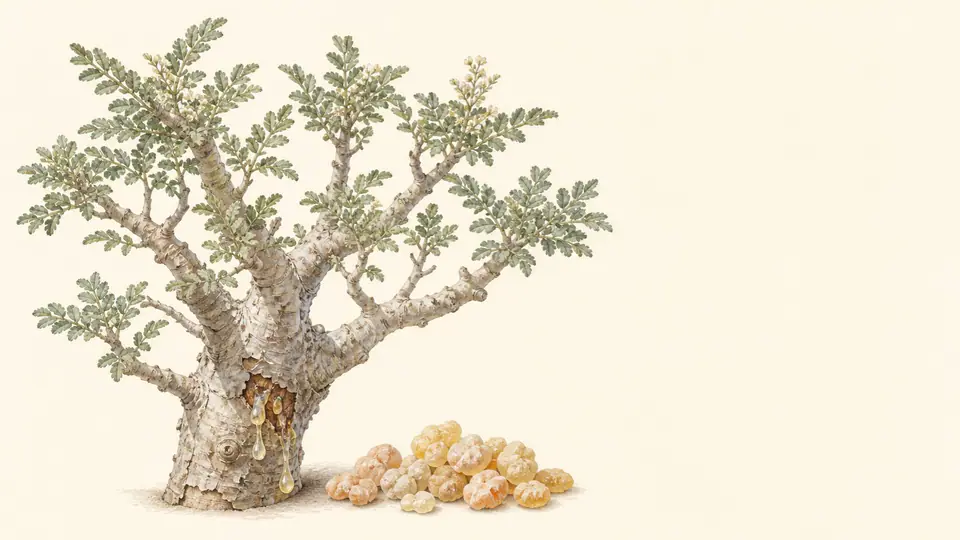
From a tree's wound that hardened to gain a name, to being called a joint capsule
Is Boswellia, which is said to be good for joints, the same as the Korean herbal medicine ingredient frankincense? In short, they belong to the same genus, but they are not the same raw material or product. While both are connected in that they come from the resin of trees in the Boswellia genus, the frankincense defined as a Korean herbal medicine and the Boswellia extracts found in joint health products differ in species, formulation, and supporting evidence.
The scientific genus name 'Boswellia' does not refer to a specific species, and the Korean herbal medicine name 'frankincense' refers to the raw resin obtained by wounding the stem. Because incense for burning, essential oils, oral capsules, and Korean herbal medicine prescriptions are all mixed under one term, the starting and ending points are confused. So, what has actually been verified under this name?
What kind of raw material is frankincense?
The standards of the National Institute of Food and Drug Safety Evaluation define frankincense as Boswellia carterii an aromatic resin obtained by wounding the stems of Birdwood or closely related plants of the same genus. It has standards for foreign substances, heavy metals, and extract content, which are the quality standards for raw resin handled as a Korean herbal medicine in Korea. The original form of frankincense is the resin that flows out from a crack in the bark and hardens in the air, and this state is the starting point for the Korean herbal medicine.
Why has Boswellia come to be expected to help joints?
Most joint research has been conducted on standardized extracts of Boswellia serrata. A 2020 meta-analysis on osteoarthritis reported the possibility of improving pain, stiffness, and function by gathering 7 trials and 545 people using B. serrata preparations. However, the formulations were heterogeneous, and these studies are not research on Korean frankincense raw resin. A 2018 systematic review of curcumin and Boswellia acknowledged the possibility but concluded that the size and quality of the studies were not sufficient to make clinical recommendations. Since the 2026 network meta-analysis also compares B. serrata alone versus curcumin-mixed preparations, the results of a specific standardized extract cannot be applied to frankincense, which differs in species and formulation.
In other words, while there is joint research under the name 'Boswellia,' that research is merely a short-term symptom study on a specific extract of a specific species.
Are raw resin, extracts, and capsules the same thing?
No. Korean frankincense standards cover the stem resin of B. carterii or related species, but most joint clinical trials evaluated standardized extracts of B. serrata. Although the osteoarthritis meta-analysis reported the possibility of short-term pain and function improvement, it cannot be expanded to raw resin decoctions or all Boswellia products because extraction methods, content per product, study scale, and interests differ. Oral extracts, resin in Korean herbal medicine prescriptions, topical products, and the inhalation of burning incense or essential oils have different exposure routes and safety profiles.
| Category | Characteristics | Limitations of evidence |
|---|---|---|
| B. carterii-based raw resin | Subject of Korean herbal medicine standards | Not the basis for joint clinical evidence |
| B. serrata standardized extract | Primary subject of joint research | Results of specific products/formulations |
| Essential oils, incense, topical agents | Exposure route differs from oral administration | Safety evaluation criteria differ |
Are incense for burning and capsules for ingestion different?
Even if the resin comes from the same tree, it is a different product if the use differs. Frankincense used as incense, essential oils, and B. serrata standardized extract or boswellic acid capsules for joint products do not share the same species, formulation, or evidence. As a basic rule, essential oils should not be ingested or applied to the skin or mucous membranes in concentrated form, and incense smoke should not be inhaled excessively for therapeutic purposes. While NIH LiverTox states that B. serrata extracts have not been convincingly linked to clinically distinct liver injury and that gastrointestinal symptoms were generally mild in trials, this does not imply the long-term safety of all raw resins, essential oils, or complex products.
What about using it with other medications or supplements?
If you are using anticoagulants, antiplatelet agents, nonsteroidal anti-inflammatory drugs (NSAIDs), or various joint supplements, it is necessary to inform your medical provider or pharmacist about potential bleeding, gastrointestinal symptoms, and overlapping ingredients. The important point here is not to rely solely on the name 'Boswellia' without considering the form of administration and dosage. You must first determine whether it is a Korean herbal medicine prescription, oral capsules, topical products, essential oils, or incense; whether it is raw resin from the B. carterii lineage or a B. serrata standardized extract; and whether the boswellic acid content and other ingredients can be verified.
What signs indicate I should stop?
If you experience a rash, swelling of the face or neck, or difficulty breathing, stop use immediately; severe reactions should be evaluated by 119. If diarrhea or abdominal pain persists, stop the product to verify the cause. Because there is insufficient safety data for pregnancy, lactation, children, long-term high doses, or use before and after surgery, self-administration should be avoided. If joints are swollen and hot, or if there is a sudden gait disturbance, medical evaluation takes priority. A diagnosis of joint pain should be confirmed along with gastrointestinal symptoms, allergies, possibility of pregnancy, and the use of medications such as anticoagulants or NSAIDs.
How is it different from Myrrh?
Frankincense (Boswellia resin) and Myrrh (Commiphora resin) come from different genera. They are easily confused in name or use, but they are not the same raw material. Within Frankincense itself, one must distinguish between B. carterii lineage raw resin and B. serrata standardized extract, between oral extracts and essential oils/incense/topical agents, and between short-term osteoarthritis symptom research and claims of cartilage regeneration or disease cure.
Then, what should I look for?
The final criterion for judgment is to verify the species, resin, extraction method, standardization, and administration route rather than relying on the single word 'Boswellia,' and to avoid applying short-term joint research on B. serrata capsules to domestic Frankincense raw resin or cartilage regeneration effects. While the resin starting from a wound in the tree became incense, medicinal material, and capsules, and the name remained the same, the way it contacts the body and the supporting evidence have continued to diverge. Verifying this divergence is the first thing to do when choosing this material.
References
- National Institute of Food and Drug Safety Evaluation Herbal Medicine Standards: Frankincense.
- Boswellia for osteoarthritis: systematic review and meta-analysis.
- Curcumin and Boswellia for knee osteoarthritis: systematic review.
- Boswellia and curcumin for knee osteoarthritis: network meta-analysis.
- NIH LiverTox: Boswellia serrata.
This text explains the origin of the raw materials, the scope of research, and precautions before consumption. As this cannot replace individual diagnosis or treatment, please consult a medical professional if you are taking medication or if symptoms persist. If sudden and severe symptoms such as difficulty breathing or decreased consciousness occur after consumption, seek help from 119 or the emergency room.

Medical Staff Review
Director Choi Yeon-seung
Chief Director of Baekrokdam Korean Medicine ClinicFrankincense Dictionary Entry, reviewed the safety of expressions and the scope of verification before administration.
Review scope: Ingredient origin, human studies, concomitant medications, safety of intake · Last reviewed 2026-08-17
- Graduated from Kyung Hee University College of Korean Medicine
- Providing Korean medicine treatment since 2010
- Consultations for Gongjindan, Gyeongokgo, Nokyong (Deer Antler) restorative medicine, and customized restorative herbal medicine