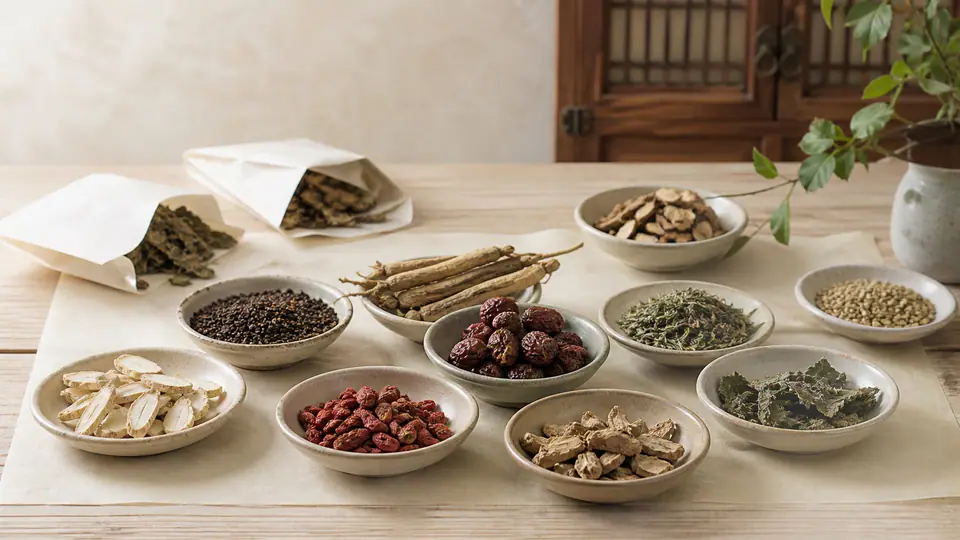
Fragrance embedded in the tree trunk: lowering Qi and warming the kidneys
The 《Myeong-ui Byeollok》 states that Agarwood (沈香) “treats swelling caused by wind-water and eliminates pathogenic factors.” Li Xun of the 《Haeyak Boncho》 provided more specific details, noting that it “treats abdominal pain, cholera, and symptoms contracted from corpses, and clears the mind,” adding that “it must be included in any ointment used to treat all boils and swellings.” The name ‘Agarwood’ comes from the way resin deposits in the tree trunk, allowing the fragrance to permeate, and it is also called ‘Simsuhyang’ (fragrance that sinks in water). This fragrance is not merely a scent, but an expression of its medicinal properties in Korean medicine, which are to ‘descend the Qi and warm the kidneys.’
Agarwood is commonly known only as a high-end perfume or incense for Buddhist rituals. Because of its pleasant scent, it is easy to view it simply as a way to relax the mind or manage one's 'mood.' However, records in verified materials overturn this perception. The OASIS Traditional Medicine Information Portal records the properties and flavor of Agarwood as acrid, bitter, and warm, with its meridian tropism being the kidney, spleen, and stomach, explaining that it “warms and tonifies the kidney, bladder, and Myeongmun (Gate of Life).” The 《Dongui Bogam》 also contains several prescriptions using Agarwood, such as Simhyang Banha-tang, Simhyang Ganggi-tang, and Simhyang Hobak-hwan, for cases where Qi is blocked, urination is difficult, or there is excessive phlegm. In other words, Agarwood is not simply a 'relaxing fragrance,' but a Qi-regulating medicine (理氣藥) that manages the flow of Qi, fluid metabolism, and the warmth of the lower burner (下焦).
However, this strong fragrance and energy are a double-edged sword. The Korea Traditional Knowledge Portal and Naver Encyclopedia warn that it should be used with caution for those with Yin deficiency and hyperactivity of fire (陰虛火旺) or those with Qi deficiency and sinking (氣虛下陷). As it is a Qi-regulating medicine with strong aromatic components, taking excessive amounts alone or long-term use may lead to headaches, dizziness, or digestive discomfort, and the possibility of burdening liver function has also been raised. Therefore, Agarwood is a medicinal herb where how much, who, and how it is used is particularly important, the core of this page is that clear constitutional types and dosage conditions follow its beautiful fragrance.
Summary at a Glance
Summary at a Glance
As the name suggests, Agarwood is a crude drug where the part of the tree trunk that has acquired fragrance through resin deposition is used medicinally. Classical texts record its role in regulating Qi and warming the Jungbu (the central area of the chest and abdomen); thus, it is important to use it according to the individual's properties and constitution.
| Category | Content |
|---|---|
| Hanja Name / Scientific Name | 沈香, Aquilaria agallocha Roxburgh |
| Origin | Agarwood tree Aquilaria agallochaTree trunk where resin has deposited |
| Representative Alias | Simsuhyang, Aloe wood |
| Properties and Tropism | Acrid, Bitter, Warm; Kidney, Spleen, Stomach |
| Efficacy recorded in literature | Descending Qi and warming the center, warming the kidney and receiving Qi, warming the center and stopping vomiting, circulating Qi and relieving pain |
| Main Direction of Action | Warms and tonifies the kidney, bladder, and Myeongmun (Gate of Life) |
| Precautions and Contraindications | Use with caution for those with Yin deficiency and hyperactivity of fire (陰虛火旺) or Qi deficiency and sinking (氣虛下陷); due to strong aromatic components, long-term or excessive intake may cause headaches, dizziness, and digestive discomfort |
Is this medicinal herb right for me?
Agarwood is a Qi-regulating medicine with warm and aromatic properties. While it has the power to regulate Qi and warm the Jungbu, its suitability varies clearly depending on the person's constitution and condition. Please check the following three criteria first.
- Generally suitable cases: In Korean medicine, it has been traditionally used for those diagnosed with a state where Qi does not ascend or descend properly, leading to chest tightness, or where the Jungbu is cold and digestion is slow. However, this refers to cases prescribed under the diagnosis of a Korean medicine doctor; self-diagnosis and consumption are not recommended.
- Cases requiring caution: As a medicinal herb with strong aromatic components, it may cause headaches, dizziness, or digestive discomfort. Additionally, while no official contraindications have been confirmed for pregnancy or lactation, you must consult a Korean medicine doctor before use due to its Qi-regulating action and aromatic properties.
- Cases to avoid: Those with Yin deficiency and hyperactivity of fire (陰虛火旺, a state of constitutionally high heat and lack of bodily fluids) or Qi deficiency and sinking (氣虛下陷, a deficiency state where Qi sinks downward) are subjects for cautious use. Furthermore, as long-term use may burden liver function, consultation with a specialist is necessary.
Practical Q&A
We have gathered frequently asked questions about Agarwood from the clinic. Because this herb has a unique fragrance and efficacy, it is easy to think of it only as a 'restorative tonic,' but it is actually a medicinal herb with a distinct constitution and usage. The following answers are general guides based on consultation and prescription and may vary depending on the individual's condition; please decide whether to take it after consulting with a Korean medicine doctor.
Is Agarwood a restorative tonic? Who is it suitable for?
Agarwood is traditionally classified as a Qi-regulating medicine that 'regulates Qi and warms the Jungbu.' The 《Dongui Bogam》 lists related prescriptions for cases where Qi does not ascend or descend properly, causing shortness of breath due to Qi rushing upward, or for resolving phlegm and improving the spleen. However, it is not a restorative tonic for everyone. Those who are constitutionally hot or have a deficiency state where Qi sinks downward need to be especially cautious.
Is it okay to drink Agarwood tea every day?
While there are cases of drinking Agarwood boiled as tea, it is a herbal medicine with pharmacological effects. Because it contains strong aromatic components, taking excessive amounts alone or long-term use may cause headaches, dizziness, or digestive discomfort. Unlimited consumption like general tea is not recommended, and it is safest to determine the dosage and duration through consultation with a Korean medicine doctor.
Can I take Agarwood together with Western medicine?
No systematic reports on specific interactions between Agarwood (Aquilariae Lignum) and Western medicines have been identified in official clinical drug interaction databases. However, since herbal medicines consist of multiple complex components, please inform your Korean medicine doctor of any Western medications you are currently taking and consult them regarding concurrent use.
Can Agarwood be used during pregnancy or breastfeeding?
No clear contraindications regarding pregnancy or breastfeeding for Agarwood have been identified in traditional herbal texts or modern official guidelines. However, as Agarwood has strong aromatic properties and Qi-regulating (理氣) effects, you must consult a Korean medicine doctor to determine its use during pregnancy or breastfeeding.
How is the quality of Agarwood verified?
The Korean Pharmacopoeia's herbal drug standards specify criteria for Agarwood, including heavy metal limits (lead 5 ppm or less, arsenic 3 ppm or less, mercury 0.2 ppm or less, cadmium 0.3 ppm or less), loss on drying of 8.0% or less, ash content of 2.0% or less, and dilute ethanol extract of 18.0% or more. Storage in airtight containers is recommended, and it is important to verify that the product meets these quality standards upon purchase.
Relationship with Other Medicinal Herbs (Yakdae/Pairing)
Agarwood is rarely used alone. In Korean medicine, the potency of a herbal ingredient is fully revealed when combined with others; such pairs are called 'Yak-dae' (藥對). As a warm and aromatic Qi-regulating medicine, Agarwood works with other herbs to balance Qi and warm the middle burner. Below are representative combinations found in classical texts.
-
Agarwood + Pinellia (半夏) + Ginseng (人蔘), etc., Chimhyang-banha-tang (沈香半夏湯) A prescription from the 'Jasaeng' text, traditionally used for stroke-related phlegm, resolving phlegm, improving the spleen, balancing Qi, and tonifying the heart. Agarwood is combined with Pinellia and Ginseng to organize phlegm and Qi.
-
Agarwood + Soft-shell Turtle Plastron (鼈甲) + Aconite (附子), etc., Chimhyang-byeolgap-san (沈香鼈甲散) A prescription from the 'Deokhyo' text, used for conditions where the body has become weak due to deficiency or exhaustion. Agarwood serves to organize the flow of energy among various tonic herbs.
-
Agarwood + Amber (琥珀) + Plantain Seed (車前子), etc., Chimhyang-hobak-hwan (沈香琥珀丸) A prescription recorded in the 'Byeon-ui' text, traditionally used for cases where urination is difficult due to edema.
-
Agarwood + Cyperus Rotundus (香附子) + Amomum (砂仁), etc., Chimhyang-ganggi-tang (沈香降氣湯) A prescription from the 'Jeong-jeon' text, used when Qi surges upward or when experiencing shortness of breath. Agarwood forms a core combination to evenly lower the Qi.
-
Agarwood + Amomum (砂仁) + Dried Ginger (乾薑), etc., Gumi-ijung-tang (九味理中湯) A prescription from the 'Hoichun' text, traditionally utilized for cold-type asthma accompanied by cold extremities and a deep, thin pulse.
Agarwood has strong properties for warming and circulating Qi. Therefore, caution is required for those with Yin deficiency and hyperactivity of fire (陰虛火旺, a state of constitutional heat and lack of fluids) or Qi deficiency with sinking (氣虛下陷, a deficiency state where Qi sinks). Using Agarwood alone or in excess for these constitutions may further stimulate symptoms; thus, it is advisable to use it as part of a prescription under the guidance of a Korean medicine doctor.
In what form is it consumed?
Since Agarwood is a crude drug with strong aromatic components, its efficacy and precautions vary depending on the method of consumption. We have summarized the forms, ranging from common daily use to professional prescriptions.
- Drinking as tea Some people boil Agarwood and drink it like tea. However, it is not recommended to drink it without limit as a simple tea. Because it is a Qi-regulating medicine with strong aromatic components, it may cause headaches, dizziness, or digestive discomfort.
- Adding to food While there are cases of use at a research level in the medifood or food service industries, its safety as a general food item has been limitedly verified. It is not common to prepare and eat it as a regular part of home cooking.
- Consumption as a decoction (煎服) This is the most traditionally used method. Most records in the 'Dongui Bogam' and herbal texts describe consumption in the form of decoctions or pills (丸劑).
- Consumption as a professional prescription Agarwood is an ingredient whose efficacy is revealed when combined with other herbs rather than when used alone. For example, classical texts record prescriptions such as Chimhyang-ganggi-tang (沈香降氣湯) for symptoms of Qi surging upward, and Chimhyang-hobak-hwan (沈香琥珀丸) for difficult urination due to edema. Such prescriptions are predicated on the diagnosis and prescription of a Korean medicine doctor.
Ultimately, rather than using Agarwood arbitrarily because it 'smells good' or is 'a restorative tonic,' it is important to consult with a professional to determine the appropriate form and dosage that fits your specific constitution and symptoms.
Interactions and Safety During Use
Because Agarwood has a strong fragrance and is a Qi-regulating medicine (理氣藥) that balances energy, its boundaries for use are as clear as its efficacy. Below are precautions identified in classical texts and modern safety data.
-
Use with caution for those with Yin deficiency and hyperactivity of fire (陰虛火旺) or Qi deficiency with sinking (氣虛下陷者). If you are in a weakened state where you have excessive body heat and chest tightness, yet feel your energy draining downward, the warm and aromatic properties of Agarwood may actually exacerbate these symptoms.
-
Strong aromatic components Taking excessive amounts alone or long-term use may lead to headaches, dizziness, or digestive discomfort. Even when consumed as a tea, unlimited intake is not recommended.
-
Potential burden on liver function Concerns have been raised that long-term use may place a burden on liver function; therefore, it is advisable to adjust the duration and dosage under professional consultation.
-
Pregnancy and Lactation Clear contraindications for the use of agarwood during pregnancy or breastfeeding have not been identified in traditional herbal texts or modern official guidelines. However, as it is a medicinal herb with strong aromatic properties and Qi-regulating (理氣) effects, please ensure you consult with a Korean medicine doctor before use during pregnancy or breastfeeding.
-
Interactions with Western Medicine Currently, no systematic reports on specific interactions between Agarwood (Aquilariae Lignum) and Western medicines have been identified in official clinical drug interaction databases. However, if you are taking Western medications prescribed by a hospital, it is safer to inform your doctor of Korean medicine before use.
As its name suggests, Agarwood is a medicinal herb with a heavy and deep fragrance. Just as its scent provides comfort, it is also a herb where the suitability is distinct depending on one's constitution and condition. Please ensure that the decision regarding whether to take it, as well as the dosage and duration, is made through consultation with a doctor of Korean medicine.
If you experience these symptoms
This section guides you through the signals that may appear when starting or while taking Agarwood. Since Agarwood is a Qi-regulating medicine (理氣藥) with strong aromatic components, body reactions can be as distinct as its effects. The following signals are generally known to occur in cases of overdose, long-term use, or when the herb does not suit the individual's constitution. If these symptoms appear, do not reduce the dose yourself or continue taking it; instead, be sure to notify the prescribing doctor of Korean medicine.
- Headache and Dizziness Because the aromatic components of Agarwood are strong, headaches or dizziness may occur with excessive or long-term use.
- Digestive Discomfort It may irritate the gastrointestinal tract, potentially causing abdominal discomfort or nausea.
- Loss of Energy and Lethargy For those whose constitution is not a match or who have Qi deficiency (氣虛), it may instead feel as though energy is draining further.
- Dry Mouth, Chest Tightness, and Sleep Disorders In constitutions with excessive heat (Yin deficiency and hyperactivity of fire), these symptoms may be exacerbated.
- Abnormal Signals Related to Liver Function As the possibility of burdening liver function during long-term use has been raised, if fatigue, jaundice, changes in urine color, or nausea occur, stop use and seek consultation.
Even if symptoms are mild, if they persist or worsen, or if severe systemic reactions such as chest pain, difficulty breathing, or decreased consciousness occur, please visit an emergency medical institution immediately.
Differences from other restorative medicines
Agarwood is often mentioned alongside the term 'restorative medicine' (boyak), but as we have explained, its essence is a warm and fragrant 'Qi-regulating medicine' (igiyak). Therefore, its use differs from traditional restorative formulations such as Gongjindan or Gyeongokgo. While Gongjindan and Gyeongokgo are traditionally used to supplement overall energy and achieve balance by combining various precious medicinal herbs, agarwood is a medicinal herb focused on smoothing the flow of Qi, warming the middle burner, and clearing the mind through its fragrance. In other words, it serves as a 'supplement' to the overall prescription rather than a standalone herb that 'replenishes everything'.
Furthermore, because agarwood has strong aromatic components and warm properties, it may be burdensome for individuals with a constitution that has excessive body heat or Qi that sinks downward. Conversely, for those who feel cold or experience a stifling sensation due to blocked Qi, it demonstrates its true value when properly blended with other restorative formulations. Therefore, the most accurate way to determine if agarwood is the right restorative for you, or if a different prescription is more appropriate, is through a consultation with a doctor of Korean medicine.
References
- Agarwood Evidence Material 1: Crude drug data from the National Institute of Food and Drug Safety Evaluation.
- Agarwood Evidence Material 2: Korea Institute of Korean Medicine official data.
- Agarwood Evidence Material 3: Korea Citation Index academic paper.
- Agarwood Evidence Material 4: Korea Citation Index academic paper.
- Agarwood Evidence Material 5: Korea Citation Index academic paper.
- Agarwood Evidence Material 6: terms.naver.com evidence material.
- Agarwood Evidence Material 7: koreantk.com evidence materials.
- Agarwood Evidence Material 8: k-health.com evidence material.
If you would like to check if this medicinal herb is right for you or which prescription it should be used with, please leave a medical inquiry. For those who find it difficult to visit the clinic, non-face-to-face consultations are available; we will provide guidance after first reviewing your current condition and current medications.

Medical Staff Review
Director Choi Yeon-seung
Chief Director of Baekrokdam Korean Medicine ClinicAgarwood Dictionary Entry, reviewed the safety of expressions and the scope of verification before administration.
Review Scope: Clinical Accuracy, Pharmacology, Contraindications, Combinations, QA · Last Reviewed 2026-08-16
- Graduated from Kyung Hee University College of Korean Medicine
- Providing Korean medicine treatment since 2010
- Consultations for Gongjindan, Gyeongokgo, Nokyong (Deer Antler) restorative medicine, and customized restorative herbal medicine