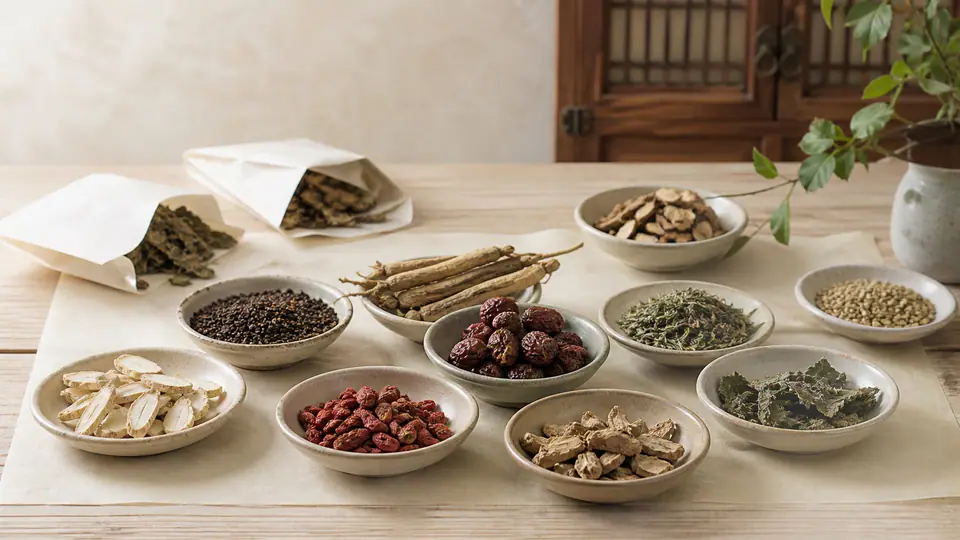
Calming the Spirit with Pine Roots, Baekboksin
'Jujak-hwan (朱雀丸)', listed in the Spirit section of the Internal Landscape chapter of the 《Dongui Bogam (東醫寶鑑)》, has ingredients as simple as its name. “白茯神二兩, 沈香五錢”, it consists of small pills made by grinding Baekboksin and agarwood into a powder and coating the exterior with cinnabar (硃砂). The same book states that these pills are used for “心神不定, 恍惚健忘, 火不下降, 時復振跳,” which refers to conditions where the mind is unsettled, the spirit is vacant and prone to forgetfulness, and the chest occasionally flutters. Here, Baekboksin is not a mere supplementary ingredient but serves as a central pillar in the structure of stabilizing the mind.
The name Baekboksin itself reveals its identity. It uses the part of the Poria (Wolfiporia cocos) sclerotium where a pine root has grown through it, which the Traditional Knowledge Portal of Korea records as “Hoelen cum Pini Radix.” ‘Boksin’ is a name referring to a special form of Poria, the part that embraces a tree root. While Poria is commonly known only as a ‘medicinal herb for removing dampness,’ Baekboksin has a slightly different character. In classical prescriptions, Baekboksin stands out less in roles for removing dampness from the spleen and more in the An-sin (spirit-calming) category, which nourishes the heart and spleen (Sim-bi) and stabilizes the mind.
Other prescriptions in the Dongui Bogam show the same direction. ‘Gwisin-dan’ is used when the heart energy (Sim-gi) is deficient, leading to an absent-minded spirit, epilepsy, mania, fright palpitations (Gyeong-gye), and sudden palpitations (Jeong-chung). ‘Sangpyocho-san’ addresses states where both urination and the spirit are disturbed, and ‘Yeongji-go’ (modified version) includes Baekboksin for cases where a woman cannot sleep due to anxiety after excessive blood loss. As such, Baekboksin takes the role of gathering the mind within a prescription when the body's energy is depleted or the mind cannot be anchored.
However, this calming power is not for everyone or for every situation. Prescriptions containing Baekboksin generally assume a state where the heart and spleen (Sim-bi) are deficient, and both the mind and spirit are exhausted. This means that the efficacy described in classical texts does not necessarily apply to all types of insomnia or anxiety in modern people. The criteria that determine the effectiveness of Baekboksin include the dosage, the patient, and the specific constitution, and that is exactly what this page covers.
Summary at a Glance
The form of Baekboksin is already revealed in its name. It is a medicinal herb that uses the part of the Poria sclerotium penetrated by a pine root, and in tradition, it has held a key role in prescriptions for managing the mind and the spleen/stomach. The table below summarizes its core identity.
| Category | Content |
|---|---|
| Origin | Hanja Name 白茯神, Scientific Name Wolfiporia cocos. It is used by drying the part of the Poria sclerotium penetrated by a pine root, and it is recorded in English as Hoelen cum Pini Radix. |
| Properties and Meridian Tropism | Verification required. Please inquire during your consultation. |
| Representative Aliases | 白茯神, Hoelen cum Pini Radix |
| Efficacy Recorded in Literature | Used as the sovereign herb (Gun-yak) in Jujak-hwan in the Spirit section of the Naegyeong-pyeon of the Dongui Bogam, addressing “unsettled mind, absent-mindedness and forgetfulness, failure of fire to descend, and occasional palpitations.” It also forms a core combination in prescriptions for heart-spleen deficiency and spirit-calming, such as Gami-gwibi-tang. |
| Main Ingredients | Verification required. Please inquire during your consultation. |
| Combination & Precautions | Mainly combined with prescriptions that nourish the heart and spleen (Sim-bi) and calm the spirit (An-sin). Whether it can be used concurrently with restorative medicines for nourishing yang or yin depends on the individual's constitution and the prescription composition, so verification is required. |
Is this medicinal herb right for me?
Baekboksin is a medicinal herb that has long been used in prescriptions that address both the mind and the spleen/stomach. However, this does not mean it is unconditionally suitable for everyone. We have summarized the suitability and unsuitability signals noted in traditional records and modern clinical practice into three stages.
-
Generally suitable cases: Prescriptions containing Baekboksin may be considered when the mind is frequently restless, concentration is poor, sleep is shallow, or there is a feeling of declining memory. This tendency is addressed in prescriptions such as Jujak-hwan, Gwisin-dan, and Sangpyocho-san from the Dongui Bogam. Additionally, it is used within prescriptions that nourish the heart and spleen (Sim-bi) in cases of loss of appetite, poor complexion, or when urine appears cloudy.
-
Cases requiring caution: For those with a constitution prone to a cold abdomen and frequent diarrhea, or those who experience chest tightness and frequent nausea due to excessive phlegm-fluid (Dam-eum), the combination with other herbs and a constitutional assessment are more important than using Baekboksin alone. As seen in Anjungjogi-hwan, where Baekboksin is used with Pinellia and Citrus aurantium, the balance of the entire prescription changes depending on the nature of the symptoms.
-
Cases to avoid: Those who are pregnant, breastfeeding, or currently taking Western medications must consult a Korean medicine doctor before use. Official academic evidence regarding the safety of Baekboksin during pregnancy and breastfeeding, as well as its interactions with Western medications, still requires verification. Furthermore, it may be inappropriate depending on specific constitutions or medications being taken, so self-administration is not recommended.
Practical Q&A
Inquiries about Baekboksin usually fall into three categories: “Does it help with insomnia?”, “How is it different from Poria?”, and “Can I drink it as a tea?”. Below are answers to frequently asked questions in the clinic, based on currently verified evidence. Please note first that individual constitutions and concurrent medication use must be verified through a consultation.
Are Baekboksin and Bokryeong the same medicinal herb?
They come from the same sclerotium, but different parts are used. Baekboksin refers to the part of the Bokryeong (Wolfiporia cocos) sclerotium where a pine root has penetrated. The Traditional Knowledge Portal of Korea records this as Hoelen cum Pini Radixa specific characteristic. In traditional prescriptions, this morphological uniqueness has been considered more suitable for stabilizing the mind. This is the same context in which Baekboksin is used in Ansin (mind-stabilizing) prescriptions, such as Jujakhwan or Gwisin-dan from the Dongui Bogam.
Can I take it directly for insomnia or anxiety?
Traditionally, Baekboksin has been used in prescriptions to address states of "unsettled mind, absent-mindedness and forgetfulness, and occasional heart palpitations." However, this record explains its role within a prescription; it does not mean an individual should take it alone based only on symptoms. The causes of sleep disorders or anxiety vary, such as Heart-Spleen Deficiency, Heart-Gallbladder Deficiency, or Yin Deficiency with Hyperactive Fire, meaning the prescription may differ even for the same symptoms. Self-administration without a consultation is not recommended.
Can I brew it as a tea or use it as a food product?
Classically, it was used in the form of powders for pills or powders, or decocted in herbal medicine. Official safety confirmation for modern use as a "tea" or as a "general food product" has not yet been secured. As this requires verification, please inquire about specific forms of intake during your consultation.
What should I be careful about when using it with other restorative medicines or Western medicines?
Prescriptions of the Gwibitang family containing Baekboksin are traditionally stable combinations, to the extent that they are covered in the Standard Korean Medicine Clinical Practice Guidelines. However, there is currently a lack of official evidence regarding interactions with Western medicines, pregnancy, breastfeeding, or specific disease states. Please decide whether to use them concurrently only after consulting with a Korean medicine doctor.
What are the representative prescriptions that include Baekboksin?
Jujakhwan, found in the Dongui Bogam, is the most symbolic example. It is structured to stabilize the mind by adding agarwood and subi to Baekboksin, and is used for "unsettled mind, absent-mindedness and forgetfulness, failure of fire to descend, and occasional heart palpitations." Additionally, Baekboksin is included in Gamigwibitang, which is commonly used in clinical practice to address palpitations, forgetfulness, and dizziness caused by Heart-Spleen Yang Deficiency. Neither of these prescriptions can be explained by the efficacy of Baekboksin alone; the overall combination is critical.
Relationship with Other Medicinal Herbs (Yakdae/Pairing)
Baekboksin is not used alone. Its power to stabilize the mind finds its place only when combined with other medicinal herbs, which is traditionally called "Yakdae" (medicinal pairs). Especially in prescriptions that care for both the heart and the spleen/stomach, Baekboksin pairs with other mind-stabilizing or heart-tonifying herbs to balance the prescription. Below are representative examples of classical prescriptions where Baekboksin forms a core combination.
- Baekboksin + Agarwood + Cinnabar — Jujakhwan: A prescription found in the Spirit section of the Inner Landscape chapter of the Dongui Bogam. Traditionally, Baekboksin is responsible for anchoring the mind and clearing the spirit, agarwood lowers the energy to stabilize it, and cinnabar serves to calm the mind and body. It is used for "unsettled mind, absent-mindedness and forgetfulness, failure of fire to descend, and occasional heart palpitations."
- Baekboksin + Sour Date Seed + Ginseng + Angelica Gigas — Gwisin-dan: A prescription recorded in the Dongui Bogam, traditionally used in cases where the heart energy is deficient, leading to an absent-minded state, easy forgetfulness, and severe anxiety or palpitations.
- Baekboksin + Polygala + Acorus + Dragon Bone — Sangpyochosan: A prescription found in the Dongui Bogam; in a structure that simultaneously addresses urinary abnormalities and a clouded mental state caused by Kidney Deficiency, Baekboksin plays the role of stabilizing the mind and spirit.
- Baekboksin + Pinellia + Poncirus Fruit + Koji — Anjungjogi-hwan: This is a prescription recorded in the Dongui Bogam, a combination designed to address banwi (stomach reflux) and damgi (phlegm-qi) while using Baekboksin to maintain stability.
- Baekboksin + Wonyuk + Sanjoin + Danggui + Baekchul + Baekjakyak + Jinpi + Wonji + Gamcho — Gamigwibitang: This is a prescription covered in the Korean Medicine Clinical Practice Guidelines. It has been traditionally used for cases of palpitations and forgetfulness caused by simbi-yangheo (deficiency of both heart and spleen), as well as for poor complexion, dizziness, and loss of appetite.
There is currently insufficient official or academic evidence regarding combination contraindications. Please inquire during your consultation regarding general precautions for Poria-type medicinal herbs or your individual concurrent medication status.
In what form is it consumed?
Baekboksin has traditionally been powdered to be consumed as pills or powder, or decocted by adding it to a herbal teaform. In prescriptions such as Jujak-hwan or Gwisin-dan from the Dongui Bogam, Baekboksin is frequently powdered with other herbs and kneaded with honey or glutinous rice cake to form pills. Modern Korean medicine clinics use these traditional formulations as they are or in improved versions.
- Possible as tea: Not common. Consuming Baekboksin alone by boiling it as a tea is uncommon in both traditional prescriptions and modern Korean medicine clinics.
- Possible as food: Not common. Baekboksin is classified as a herbal medicine, and there is no confirmed evidence for its use as a daily food ingredient.
- Decoction required: Used classically. It is included in decoction form in prescriptions such as Sangpyochosan or Anjungjogi-hwan from the Dongui Bogam.
- Self-administration not recommended: Verification required. Please inquire during your consultation.
Interactions and Safety During Use
Baekboksin is a type of Poria and has been used relatively stably in prescriptions that treat the heart, spleen, and stomach. However, this does not mean it is "unconditionally safe for everyone." The safety information that can be summarized within currently confirmed official and academic evidence is as follows.
- Interactions with Western medicine: Official evidence is insufficient. If you are taking Western medicine, please be sure to inform your attending Korean medicine doctor.
- Pregnancy and breastfeeding: Official evidence is insufficient. If you are pregnant or breastfeeding, please be sure to mention this before the prescription.
- Specific constitutions and contraindications: Official evidence is insufficient. If you usually have weak digestion or easily experience abdominal bloating, please inform the medical staff before the prescription.
- Overdose and long-term use: There is a lack of confirmed official evidence. Long-term use without a prescription from a Korean medicine doctor is not recommended.
If you are considering a prescription containing Baekboksin, it is safest to first consult regarding your current medications and health status. This is because suitability may vary depending on an individual's constitution and concurrent medication use.
If you experience these symptoms
If abnormal signals appear in your body while taking a prescription containing Baekboksin, it is important to notify your attending Korean medicine doctor first rather than reducing the dose or removing ingredients on your own. While it is a medicinal herb traditionally used to supplement the heart and spleen and stabilize the mind, unexpected reactions may occur depending on an individual's constitution or concurrent medication use. Within currently confirmed official and academic evidence, specific warning signals related to the overdose or long-term use of Baekboksin have not been separately secured. Therefore, the following items provide guidance on signals that should generally be monitored carefully during intake, and further verification is required for definitive evidence-based information.
- If new digestive discomfort or abdominal pain occurs or worsens after intake: Prescriptions containing Baekboksin are used in connection with the function of the spleen and stomach, but discomfort may occur depending on the user's digestive state. If symptoms persist, stop intake and consult your attending Korean medicine doctor.
- If allergic reactions such as severe hives, difficulty breathing, or facial swelling occur: It cannot be concluded that there are absolutely no allergic reactions to Poria-type herbs. If such reactions occur, stop intake immediately and visit an emergency medical institution or call 119.
- If symptoms worsen or change in an unexpected direction: If symptoms related to the purpose of intake, such as insomnia, forgetfulness, or palpitations, do not improve and instead worsen, the prescription may not be suitable for your current condition. Please request a re-evaluation from your attending Korean medicine doctor.
- If you are pregnant, breastfeeding, or taking Western medicine concurrently: There is currently a lack of confirmed official evidence regarding the safety of Baekboksin during pregnancy and breastfeeding, as well as its interactions with Western medicine. In these situations, you must decide whether to take it after consulting with a Korean medicine doctor.
Verification is required. Specific warning signals requiring a hospital visit for the overdose or long-term use of Baekboksin have not been secured in current official or academic evidence. The above content provides general principles for intake precautions; please inquire about your individual situation during your consultation.
Differences from other restorative medicines
Baekboksin is a medicinal herb with strengths in 'supplementing both the mind and the spleen and stomach.' Therefore, its target area is different from the start compared to representative restorative medicines such as Gongjindan or Gyeongokgo. Gongjindan has been traditionally used mainly to supplement the original qi of the kidneys, and Gyeongokgo to fill the fluids of the lungs and kidneys. In contrast, Jujak-hwan or the Gui-pi-tang series, where Baekboksin is a core ingredient, focus on 'deficiency of heart qi and instability of the mind.'
In other words, the type of restorative medicine close to Baekboksin is one that 'soothes the mind and digestion simultaneously' rather than the type that 'sturdily fills the entire body.' Even within the same mind-stabilizing and heart-supplementing category, Wonji focuses on opening and clearing phlegm, while Sanjoin focuses on supplementing the blood of the liver to aid sleep. Baekboksin can be seen as playing the role of a link that supplements the energy of the heart, spleen, and stomach while stabilizing the mind.
However, official or academic evidence regarding specific concurrent use or mutual blending with Gongjindan or Gyeongokgo is currently difficult to verify. Since the concurrent use of prescriptions containing Baekboksin or other restorative medicines varies depending on your constitution, current symptoms, and medications you are taking, it is most accurate to decide with a Korean medicine doctor during a consultation.
References
- Baekboksin related evidence material 1: koreantk.com evidence material.
- Baekboksin related evidence material 2: nikom.or.kr evidence material.
- Baekboksin related evidence material 3: oak.chosun.ac.kr evidence material.
If you would like to check if this medicinal herb is right for you or which prescription it should be used with, please leave a medical inquiry. For those who find it difficult to visit the clinic, non-face-to-face consultations are available; we will provide guidance after first reviewing your current condition and current medications.

Medical Staff Review
Director Choi Yeon-seung
Chief Director of Baekrokdam Korean Medicine ClinicBaekboksin dictionary entry, reviewed the safety of expressions and the scope of verification before administration.
Review Scope: Clinical Accuracy, Pharmacology, Contraindications, Combinations, QA · Last Reviewed 2026-08-16
- Graduated from Kyung Hee University College of Korean Medicine
- Providing Korean medicine treatment since 2010
- Consultations for Gongjindan, Gyeongokgo, Nokyong (Deer Antler) restorative medicine, and customized restorative herbal medicine