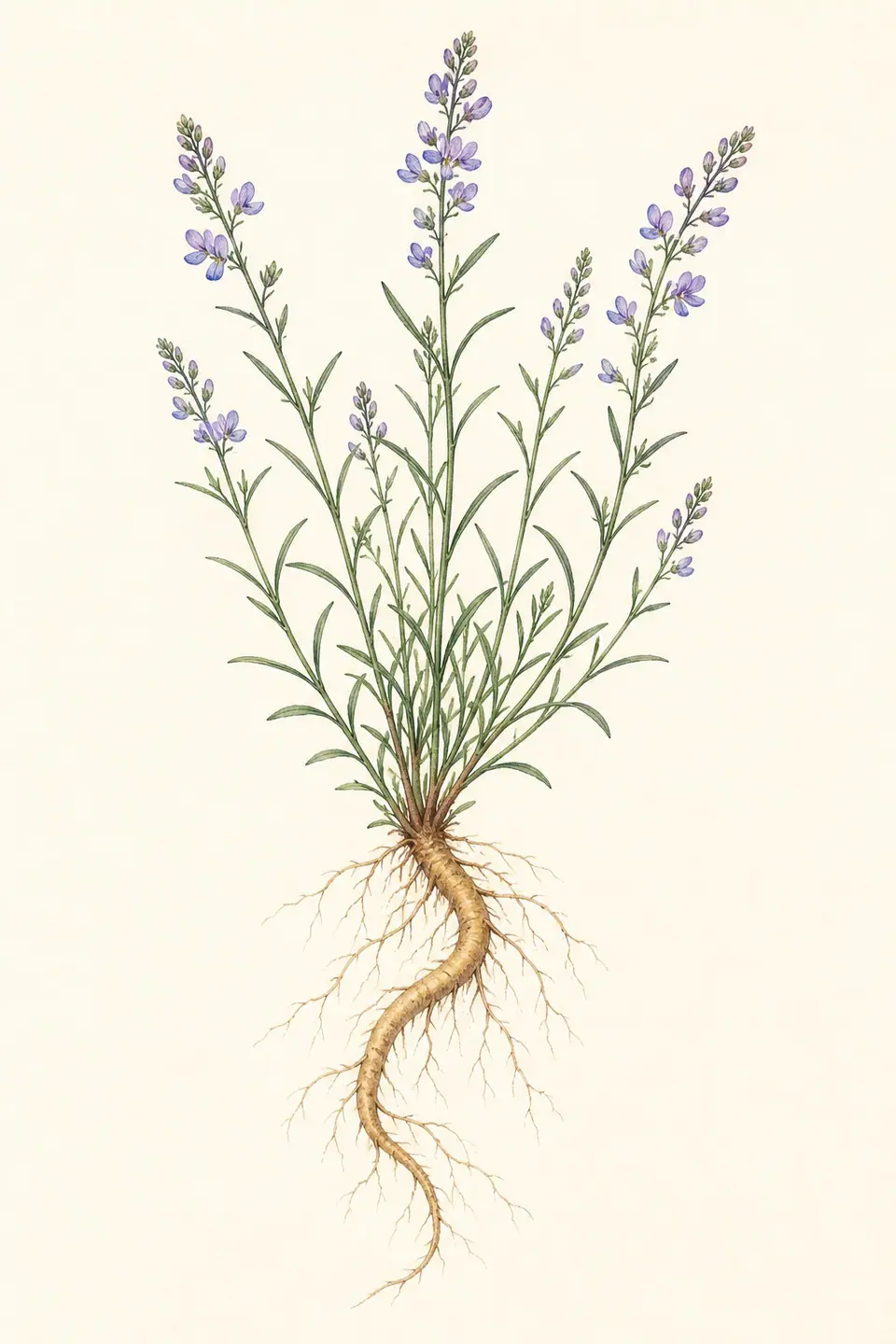
A heart that reaches far: Yuanzhi (遠志)
The Compendium of Materia Medica (本草綱目) records the origin of Yuanzhi (遠志) as follows: "Taking this herb can increase wisdom and strengthen the heart, which is how it came to be called Yuanzhi." 'Yuan (遠)' means far, and 'zhi (志)' is the same zhi (志) as in "aspiration" or "will." Together, it signifies the ability to extend one's mental reach far and wide. The Mingtong Medical Journal (《明通醫藥》) explains this again in "Origin of the Name Yuanzhi and Its Mechanism of Enhancing Knowledge": "The 'zhi' in Yuanzhi's name fundamentally connotes memory; the herb's name suggests it is a plant capable of improving memory and extending wisdom far." In other words, Yuanzhi was regarded not merely as a simple "memory aid" but as an herb that broadens and expands the "place of the heart" so that the spirit does not scatter.
However, if one dismisses Yuanzhi merely as a "memory supplement," it is easy to miss its true nature. The New Compilation of Materia Medica (《本草新編》) describes Yuanzhi as "bitter in taste, warm in nature, non-toxic" while also calling it "an exquisite remedy for connecting the heart and kidneys," yet it warns that it "adds fire and increases flame," stating "Yuanzhi should be used sparingly and must never be overused." This means that because Yuanzhi has the power to connect the heart and kidneys, in a body already experiencing internal heat or in a state of yin deficiency with yang hyperactivity (陰虛陽亢), it may actually add more fire. Behind the familiar image of "good for memory" lies the strict discipline of traditional medicine that requires precise assessment of one's constitution and condition before use.
Therefore, the dosage, combination, and method of use are especially important with Yuanzhi. When used together with ginseng, astragalus, angelica, longan flesh, poria with hostwood, and spina date seed as in the Guipi Decoction (歸脾湯) from the Ji Sheng Fang (《濟生方》), it takes its place as a tonic. When combined with acorus, dragon bone (龍骨), and turtle shell (龜甲) as in the "Confucius Great Sage's Formula for Supplementing Heart Deficiency, Forgetfulness, and Assisting the Spirit (孔子大聖智補心虛健忘助神枕中方)" from the Taiping Shenghui Formula (《太平聖惠方》), it is used to calm the heart. Yuanzhi is not an herb meant for heavy single-handed use; it only fulfills its role fully within its relationships with other herbs. On this page, we will carefully examine everything from the origin of Yuanzhi's name, classical formulas, preparation methods, to cautions.
Summary at a Glance
Yuanzhi is an herb used, as its name suggests, to "broaden and expand the place of the heart." Looking at the table below, you can get an at-a-glance understanding of this herb's identity and key characteristics.
| Category | Content |
|---|---|
| Origin | Hanja Name 遠志, Scientific Name Polygala tenuifolia Willd., family Polygalaceae, genus Polygala. The part used is the root (根). |
| Properties and Meridian Tropism | Bitter and pungent, slightly warm (苦辛微溫). The meridians entered are the Lung (肺), Heart (心), and Kidney (腎). |
| Representative Aliases | Geokwan (極菀), Kuyuanzhi (苦遠志), Xiao Cao (小草), Lingshen Cao (靈神草), Yuanzhi Tong (遠志筒), Yuanzhi Rou (遠志肉), among others. |
| Efficacy Recorded in Literature | Calming the heart and enhancing wisdom (安神益智), forgetfulness and poor concentration (健忘·驚忌), mental confusion and dizziness (神志恍惚), insomnia and excessive dreaming (失眠·多夢), restlessness and anxiety (心神不安), breast swelling and pain (乳房腫痛). |
| Key components and quality standards | Powdered Yuanzhi root (Pulvis Polygalae Radicis) must contain not less than 2.0% tenuifolin. |
| Combinations, Contraindications, and Precautions | Prepared Yuanzhi with licorice juice (製遠志), made by baking in licorice juice, is commonly used for calming the heart and enhancing wisdom. It is contraindicated for those with internal heart-kidney heat (心腎有火) or yin deficiency with yang hyperactivity (陰虛陽亢) constitutions; those with ulcers or gastritis should use with caution. |
Is this medicinal herb right for me?
Although Yuanzhi is used to manage the heart and memory, its appropriateness varies significantly depending on constitution and symptoms, it may be suitable in some cases and should be avoided in others. You can first review it based on the three criteria below.
-
Generally suitable cases: This is an herb traditionally considered for individuals who feel mentally scattered, sleep lightly, or perceive their memory declining. The New Compilation of Materia Medica (《本草新編》) describes Yuanzhi as a remedy that "calms the heart's qi and settles the spirit to enhance wisdom," and it was used in formulas such as "Confucius Great Sage's Formula for Supplementing Heart Deficiency, Forgetfulness, and Assisting the Spirit (孔子大聖智補心虛健忘助神枕中方)" from the Taiping Shenghui Formula (《太平聖惠方》) as part of a combination that supports memory and mental stability. However, this refers to cases where it is included in a prescription after assessing the individual's constitution, it does not mean it should be taken alone.
-
Cases requiring caution: Individuals with weak stomachs or gastritis/ulcers may experience stomach burden due to Yuanzhi's bitter taste and irritant properties. Additionally, Yuanzhi is often used in the form of proper decoction extraction or as prepared Yuanzhi baked with licorice juice (製遠志), so the form and dosage are best left to the judgment of a Korean medicine doctor. While some drink it as a tea, the strong bitter taste and throat irritation typically lead to it being prepared with licorice or honey.
-
Cases to avoid: It is not suitable for individuals with internal heart-kidney heat (心腎有火) or yin deficiency with yang hyperactivity (陰虛陽亢) constitution or symptoms. Yuanzhi possesses a bitter, pungent, and slightly warm nature; in cases where there is already internal heat or yang is in a state of excess due to yin deficiency, it may actually worsen symptoms. Additionally, those who are pregnant, breastfeeding, or currently taking Western medicine should confirm potential interactions and must consult before use.
Yuanzhi is an herb that, as its name suggests, broadens the place of the heart, but its effects vary depending on the constitution, the prescription it is used in, and the dosage. If you find it difficult to judge on your own, please let us know during your appointment.
Practical Q&A
We have gathered the questions we frequently hear about Yuanzhi in the clinic. Given that this herb addresses the heart and memory, questions range from "Will it make me smarter?" to "Can I take it for a long time?" Below, we will address actual questions based on verified information, with the understanding that consultation is recommended.
Will taking Yuanzhi improve my memory?
The reason Yuanzhi is perceived as a "memory herb" stems from its name and classical records. The Compendium of Materia Medica (《本草綱目》) states that it "increases wisdom and strengthens the heart," and the New Compilation of Materia Medica (《本草新編》) records "settles the spirit and enhances wisdom; prolonged use strengthens memory." However, in the context of Korean medicine, this means "calming the place of the heart so that the spirit does not scatter." Modern clinical research evidence showing improved memory test scores has not been established. For those hoping for improvements in learning efficiency or concentration, it is necessary to first examine specific goals and constitution during consultation.
Can it help with insomnia as well?
Yuanzhi has traditionally been used for insomnia (失眠), excessive dreaming (多夢), and restlessness of heart and spirit (心神不安). OASIS data also records "calming the heart and settling the spirit (寧心安神)" as its primary efficacy. However, the causes of insomnia are not limited to heart imbalance, they can also be related to other organs such as the stomach, liver, and kidneys. Yuanzhi is primarily suitable for those who tend to feel mentally scattered, sleep lightly, and have many dreams. Rather than taking it alone without a clear pattern identification, it is more common to include it in a prescription through consultation with a Korean medicine doctor.
Can I drink Yuanzhi as a tea?
While Wonji-cha (Polygala tea) is used in folk medicine, it is often combined with licorice or honey due to its strong bitter taste and throat irritation. Wonji is managed as a Korean herbal medicine ingredient; the Korean Herbal Pharmacopoeia specifies it in the form of a decoction or as processed Wonji-gamcho-ja (processed Polygala with licorice juice). Even when prepared as a tea, a method of heating and extracting for 30 minutes is mentioned, which differs from simply steeping it in boiled water. It is safer to use under a prescription and professional guidance rather than self-administering.
Does Wonji (Polygala tenuifolia) irritate the stomach?
Wonji is a medicinal herb with a strong bitter taste. The "Boncho Sinpyeon" warns that it can "add fire and increase heat" (添火增炎), meaning that overuse may actually increase heat in the mind. Additionally, some data suggests it should be used with caution in individuals with gastric ulcers or gastritis. For these reasons, when prescribing Wonji, practitioners may use Wonji-gamcho-ja (Wonji processed with licorice juice) or combine it with other herbs to reduce irritation.
Can I take Wonji together with Western medicine?
Official evidence regarding interactions between Wonji and specific Western medicines has not been confirmed through research. However, as Wonji is a herb traditionally used in relation to the central nervous system, if you are taking sedatives, antidepressants, or sleeping pills, you must inform both your Korean medicine doctor and your primary physician and seek consultation. Whether it can be used concurrently must be determined based on the individual's medications and health condition.
Can I take it during pregnancy or breastfeeding?
Evidence regarding the safety of using Wonji during pregnancy or breastfeeding has not been confirmed through research. As a Korean herbal medicine ingredient, Wonji is classified as an over-the-counter drug to be used appropriately via prescription, and extra caution is required during special physiological states. If you are pregnant, breastfeeding, or planning to be, please be sure to mention this during your consultation.
Relationship with Other Medicinal Herbs (Yakdae/Pairing)
Wonji is not used alone. Its characteristics become more distinct when paired with other herbs, a concept traditionally called "Yak-dae" (medicinal pairs). Wonji, which governs the mind and memory, often sets the overall direction of a prescription when used with tonic herbs or herbs that calm the mind. Here are some representative combinations.
- Wonji + Ginseng, Baekchul, Boksin, Sanjoin, Yonganyuk, Hwanggi, Danggui, Mokhyang, Gamcho — Gwibitang: A prescription found in the "Jesaengbang," and Wonji is also included in the "Tangdu Gagyeol" as "Chul-Sam-Gi, Gwi-Cho-Boksin-Wonji-Sui." It has been traditionally used for mental instability, forgetfulness, anxiety, and hemorrhagic diseases, where Wonji is combined to nourish the mind and settle the spirit.
- Wonji + Turtle shell, Longgu (Dragon bone), Seokchangpo — Gongja Daeseong Ji Boshim Heogang Jo-sin Chimjung-bang: A prescription found in the "Taepyeong Seonghye-bang." Wonji was used for the purpose of nourishing the heart and stabilizing the will (補心定志) and enhancing intelligence and improving vision (益智明目).
- Wonji + Ginseng, Seokchangpo, Bokryeong, Gyeolmyeongja, Sanyak, Gyesim, Sukjihwang — Wonji-san-bang: A prescription from the "Taepyeong Seonghye-bang," where Wonji harmonizes with other herbs to nourish the heart and clear the mind.
- Wonji + Gamcho — Wonji-gamcho-ja (Processed Wonji): A processing method (po-je) where Wonji is roasted in licorice juice. The "Korean Pharmacopoeia and Herbal Medicine Standards" describes a method of decocting 6kg of licorice with 100kg of Wonji and simmering it over low heat until the moisture is absorbed. This is a traditional processing method to reduce the irritancy of Wonji and enhance its effect of calming the mind and improving intelligence.
Because Wonji has a warm nature and acts to connect the heart and kidneys, it may not be suitable for constitutions with heat in the heart and kidneys (心腎有火) or yin deficiency with hyperactivity of yang (陰虛陽亢). Additionally, those with a weak stomach or those with ulcers or gastritis should use it with caution. As such, Wonji is a medicinal herb whose efficacy and safety vary greatly depending on who uses it, how much is used, and how it is administered.
In what form is it consumed?
Due to its taste and properties, Wonji is generally not consumed as a light cup of tea, but is typically used by decocting it thoroughly (煎湯) or as part of a prescription with other herbs. The facts for each form of consumption are summarized below.
- Tea: While Wonji tea exists in folk medicine, it is often used with licorice or honey due to its strong bitter taste and throat irritation. When brewing Wonji tea, a method of heating and extracting for about 30 minutes is common.
- Food: Since Wonji managed as a Korean herbal medicine ingredient has no confirmed official evidence as an approved food raw material, using it in the form of general food ingredients is not recommended.
- Decoction: This is the most common form of intake in classics and standards. It may be used in decoctions in the form of Wonji-gamcho-ja (processed with licorice juice), and the processing method (po-je) varies depending on the purpose, such as calming the spirit and improving intelligence or transforming phlegm and relieving cough.
- Professional Prescription: Wonji is used appropriately as a Korean herbal medicine via prescriptions, and customized prescriptions are necessary according to constitution and contraindications. In particular, those with a constitution of heat in the heart and kidneys, yin deficiency with hyperactivity of yang, or gastrointestinal diseases must consult a Korean medicine doctor before use for safety.
Interactions and Safety During Use
Wonji (Polygala tenuifolia) is used to manage the mind and memory, but because its properties are strong and may not suit certain constitutions, there are important points to check before taking it. Below are the confirmed contraindications and precautions.
- Simsin-yuhwa (Fire in the Heart and Kidney) or Eumheo-yanghang (Yin deficiency and Yang hyperactivity): Wonji is a medicinal herb with warm properties, so it may not be suitable for individuals with these constitutions or symptoms.
- Gastrointestinal disorders: Those with ulcers or gastritis should use it with caution. Wonji can irritate the stomach, and taking it on an empty stomach or when the stomach is weak may cause discomfort.
- Bitter taste and throat irritation: Since Wonji has a strong bitter taste and tends to irritate the throat, it is often used in the form of Wonji-gamcho-ja (Processed Wonji) which is processed by heating it with licorice juice. This traditional processing method (po-je) is used to reduce irritation and enhance its ability to calm the mind and improve cognitive function.
- Pregnancy, Lactation, Children, and the Elderly: Based on available data, specific safety evaluations for these special populations have not been confirmed. Verification is required. Please inquire during your consultation.
- Interactions with Western Medicine: Based on available data, official or academic evidence regarding interactions between Wonji and specific Western medicines has not been confirmed. If you are taking Western medication, you must consult with a Korean medicine doctor.
As its name suggests, Wonji is a medicinal herb where the direction of the prescription is crucial for aiding 'memory and the mind.' Rather than choosing it alone based on its name, the combination with other herbs, the duration of intake, and the dosage are determined by examining your sleep, tension, palpitations, digestion, and current medications.
If you experience these symptoms
If the following changes occur during intake, the dosage of Wonji may be inappropriate or it may not suit your constitution. Rather than reducing or stopping the dose on your own, it is important to first notify the attending Korean medicine doctor who provided the prescription.
- Heartburn or stomach discomfort: Wonji is a medicinal herb with a strong bitter taste that can irritate the stomach. If discomfort or pain in the stomach area occurs after intake, pause use temporarily and seek a consultation.
- Worsening of dry mouth or dry tongue: Because Wonji has warm properties, symptoms may be aggravated in individuals who naturally have internal heat or an Eumheo-yanghang (Yin deficiency and Yang hyperactivity) constitution.
- Worsening of insomnia or palpitations: Although it is a medicinal herb used to stabilize the mind, excessive doses or use in an unsuitable constitution may instead stimulate the nervous system.
- Increased throat irritation or coughing: When consumed as Wonji tea, irritation of the throat mucosa may occur; those with sensitive bronchial tubes need to be especially cautious.
If symptoms are severe or accompanied by systemic adverse reactions such as difficulty breathing, chest pain, or decreased consciousness, visit an emergency medical institution immediately and inform them of the medicinal herbs you were taking.
Differences from other restorative medicines
Because of its reputation for 'supplementing the mind and memory,' many people seek Wonji thinking it is similar to restorative medicines like Gongjindan or Gyeongokgo. However, rather than being a nutrient-type herb with strong supplementing power, Wonji is closer to a medicinal herb that helps communication between the mind and the kidneys and stabilizes the spirit. Even within the context of 'calming the mind,' Wonji is used not simply to sedate, but to organize a state where memory and concentration are scattered.
Gongjindan and Gyeongokgo are prescriptions focused on supplementing overall Qi and blood and supporting constitutions that are aging or deficient (Heo). They aim for the recovery of vital energy or long-term nourishment. In contrast, prescriptions containing Wonji, such as Gwibitang or Yangsimtang, are focused on directly addressing a 'state of a distracted mind, shallow sleep, and blurred memory.' In other words, if Gongjindan and Gyeongokgo are broad restorative agents that supplement the overall constitution and energy, prescriptions containing Wonji are narrow and deep prescriptions that organize the functions of the mind and memory.
Additionally, when Polygala is roasted in licorice juice, it is used as Wonji-gamcho-ja (Processed Polygala) There are many forms, and it is characterized by receiving the harmonizing effect of licorice to reduce gastrointestinal irritation and enhance the efficacy of calming the mind and improving cognitive function (Ansim-ikji). This demonstrates its role within a prescription, which differs from that of a standalone tonic.
Ultimately, whether Polygala is necessary or if Gongjindan or Gyeongokgo is more appropriate must be decided based on your constitution and the primary tendency of your current symptoms. If the main discomfort is a distracted mind and blurred memory, a prescription containing Polygala may be used; if overall energy, complexion, or aging are greater concerns, other restorative herbal medicines may be considered first. It is best to make an accurate determination through a consultation.
References
- Evidence material related to Polygala 1: Korea Institute of Korean Medicine official data.
- Evidence material related to Polygala 2: GBIF plant classification data.
- Evidence material related to Polygala 3: Korea Citation Index academic paper.
- Evidence material related to Polygala 4: Korea Citation Index academic paper.
- Evidence material related to Polygala 5: PubMed academic paper.
- Evidence material related to Polygala 6: PubMed academic paper.
- Evidence material related to Polygala 7: PubMed academic paper.
- Evidence material related to Polygala 8: PubMed academic paper.
If you would like to check if this medicinal herb is right for you or which prescription it should be used with, please leave a medical inquiry. For those who find it difficult to visit the clinic, non-face-to-face consultations are available; we will provide guidance after first reviewing your current condition and current medications.

Medical Staff Review
Director Choi Yeon-seung
Chief Director of Baekrokdam Korean Medicine ClinicPolygala Dictionary Entry, reviewed the safety of expressions and the scope of verification before administration.
Review Scope: Clinical Accuracy, Pharmacology, Contraindications, Combinations, QA · Last Reviewed 2026-08-16
- Graduated from Kyung Hee University College of Korean Medicine
- Providing Korean medicine treatment since 2010
- Consultations for Gongjindan, Gyeongokgo, Nokyong (Deer Antler) restorative medicine, and customized restorative herbal medicine