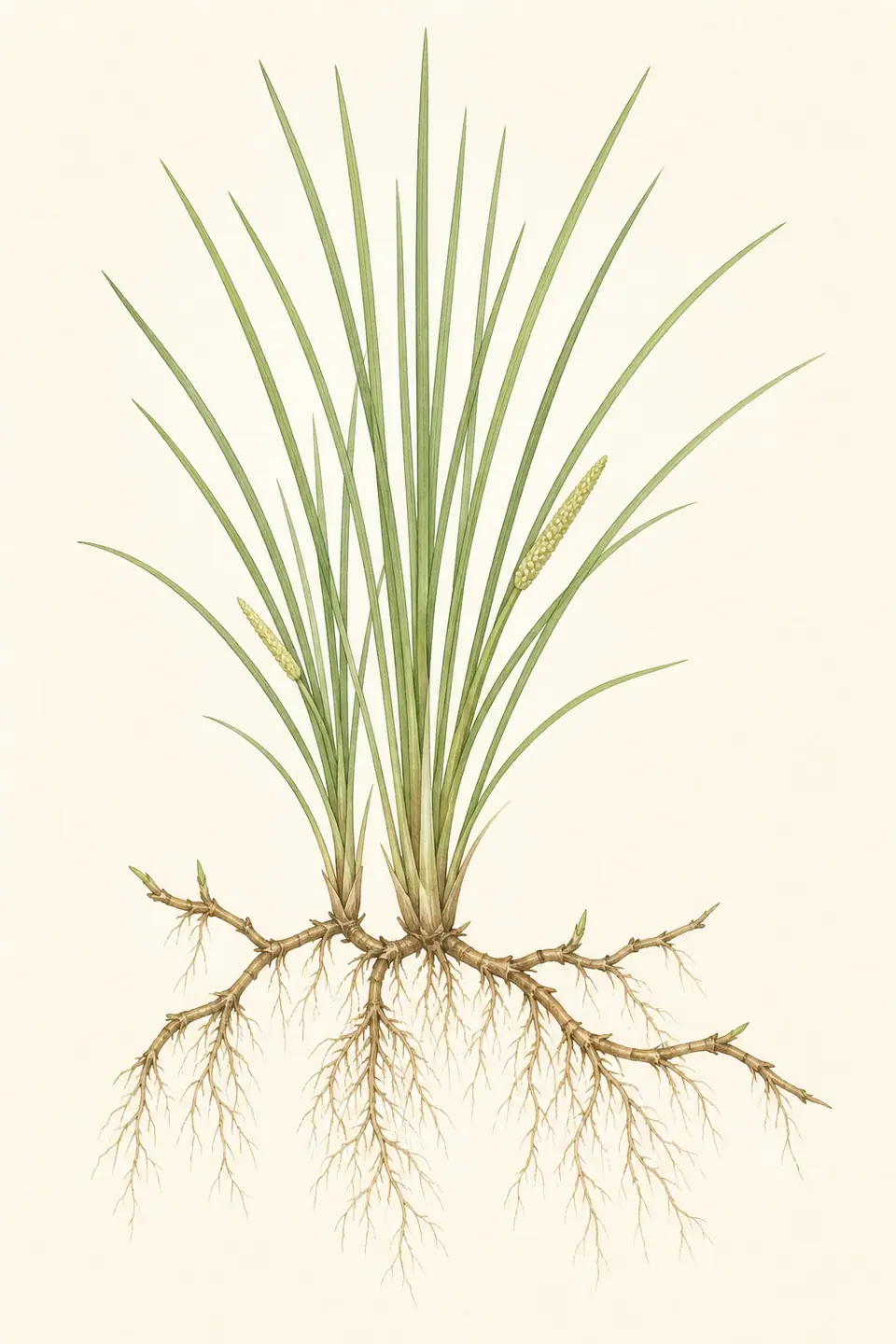
Leaves sharp as a sword, a herb that cuts through water
The Bencao Gangmu (Compendium of Materia Medica) explains the origin of the name Seokchangpo (Acorus calamus) as follows: “Changpo is the most flourishing among the reeds, hence it is called Changpo.” This means the character ‘Chang’ (昌), meaning flourishing, was added because it is a plant that grows vigorously and stands out among other grasses. Additionally, the Lüshi Chunqiu states, “Fifty-seven days after the winter solstice, Changpo begins to grow. Changpo is the first among a hundred grasses to emerge.” Because it is the first plant to break through the ground around 57 days after the winter solstice, it was called ‘Changyang.’ It also earned the nickname ‘Sugeomcho’ (Water Sword Grass) because its leaves resemble swords cutting through the water, and it was sometimes called ‘Seok-okgong’ (Stone Centipede) or ‘Mul-okgong’ (Water Centipede) because its rhizomes resemble centipedes. Even in a single name, the way people perceived this medicinal herb is fully preserved.
However, there is a point that differs slightly from the impression these names give. While the nickname 'grass sharp as a sword' often brings to mind strong stimulation or insect-repelling properties, the core role of Acorus calamus in traditional prescriptions is actually much deeper inside. The Naegyeong section of the Dongui Bogam records that “Acorus calamus is excellent for improving voice whether taken as a decoction or powder,” and the Gihyo Ryangbang contains a prescription combining Acorus calamus, Polygala tenuifolia, Poria cocos, and Ginseng. In other words, it is used to enhance the voice, stabilize the mind, and resolve phlegm to open the orifices, opening the internal areas where the mind and senses are blocked, rather than acting on the surface of the body.
Therefore, this medicinal herb possesses properties different from the 'stimulating grass' one might typically imagine. Its nature is pungent and bitter, and warm, acting on the heart and stomach. The Traditional Knowledge Portal of Korea lists its primary indications as forgetfulness, deafness, mental confusion/epilepsy, lockjaw with diarrhea, and epigastric fullness without hunger. This shows that it is not simply a 'grass that boosts energy,' but a medicinal herb that resolves states where dampness and phlegm are entangled and blocking the mind and stomach.
However, these internal effects of Acorus calamus also serve as a basis for caution. According to data from the Dongui Medical Center Pharmacy Department, Acorus calamus water extracts have been reported to have sedative effects in mice, reducing spontaneous movement and prolonging pentobarbital sleep time, and the possibility of GABAA receptor activity has been raised. Additionally, there is currently a lack of official academic evidence regarding the long-term toxicity and carcinogenicity of β-asarone, the main component of its essential oil. Therefore, Acorus calamus is a medicinal herb where 'how much, who, and how it is used' is particularly important. Lightly enjoying a cup of tea is clearly different from medicinal use to treat symptoms; the latter must be done under the prescription of a Korean medicine doctor.
Summary at a Glance
Acorus calamus has a unique appearance, as its name suggests, and its uses are equally distinct. The table below summarizes everything from its core identity to its efficacy and precautions at a glance.
| Category | Content |
|---|---|
| Origin | Hanja name: 石菖蒲. The origin species is verified in the raw material list of the actual prescription; it consists of the rhizomes of plants in the Araceae family collected in autumn and winter and then dried. |
| Properties and Meridian Tropism | Pungent and bitter taste with a warm nature. Acts on the Heart Meridian and Stomach Meridian; some literature also includes the Liver Meridian. |
| Representative Aliases | Changpo, Changbon, Changyang, Su-geom-cho, Seok-ok-gong, Mul-ok-gong, Yo-gu, etc. |
| Efficacy Recorded in Literature | Opening the orifices and stabilizing the mind (opening the mind's gate and calming the spirit), resolving dampness and harmonizing the stomach (clearing dampness and comforting the stomach), and resolving phlegm and opening the orifices (dissolving phlegm and opening sensory channels). |
| Main Ingredients | The main component of the essential oil is reported as β-asarone (63.2~81.2%), along with α-asarone, γ-asarone, etc. |
| Combinations and Contraindications | Avoid consumption in cases of Yin deficiency and Yang hyperactivity, or if experiencing restlessness/agitation, cough, hematemesis (vomiting blood), spermatorrhea, or excessive sweating. Consultation with a physician or Korean medicine doctor is necessary when used with central nervous system depressants or alcohol, as excessive sedation is a concern. |
Is this medicinal herb right for me?
In Korean medicine, Acorus gramineus acts on the heart and stomach, and is used primarily for opening the orifices and stabilizing the mind, resolving dampness and harmonizing the stomach, and resolving phlegm and opening the orifices. However, due to its warm, pungent, and bitter nature, it may cause discomfort in those with internal heat or deficiency syndromes. Please check the following three criteria first.
- Generally suitable cases: It may be applicable for short-term use under the prescription of a professional Korean medicine doctor in cases of chest tightness, a feeling of mental cloudiness, slow digestion, or loss of appetite. The Dongui Bogam records Acorus calamus as a means to produce voice, taken in the form of a decoction or powder.
- Cases requiring caution: Those taking sleeping pills, sedatives, or anti-anxiety medications, or those likely to consume it with alcohol; those who are pregnant, breastfeeding, or have liver or kidney disease. Acorus calamus extracts have been reported to have central nervous system sedative effects in animal experiments, and theoretically, excessive drowsiness is a concern when used with Western medicines. Additionally, the effects of essential oil components such as β-asarone on fetuses and infants still require verification.
- Cases to avoid: Those with irritability, cough, hematemesis, spermatorrhea, or excessive sweating due to Yin-blood deficiency or Yin deficiency with Yang hyperactivity should avoid consumption. These are Korean medicine contraindications specified in the Traditional Knowledge Portal of Korea.
In conclusion, there is a difference between lightly enjoying Acorus calamus as a tea and using it as a medicine. If the purpose is symptom treatment, it is safe to consult a Korean medicine doctor and follow their prescription.
Practical Q&A
We have gathered the most frequently asked questions about Acorus calamus from the clinic. Since its uses are as clear as its name and appearance, the questions generally fall into a few categories. We will answer based on verified facts, while clearly stating the parts that require consultation and prescription.
Does drinking it as a tea clear the mind?
Acorus calamus has traditionally been used in the form of a decoction (boiled water) or powder. The Naegyeong section of the Dongui Bogam even records, “It produces voice; both decoction and powder are excellent.” However, this is a method of use within the context of a Korean medicine prescription; drinking it like a tea in daily life does not produce the same effect for everyone. In particular, those who are pregnant, breastfeeding, or taking central nervous system depressants should avoid self-administration and decide through consultation for safety.
Does it help with sleep?
Water extracts of Acorus gramineus have shown sedative effects in animal studies, such as reduced spontaneous movement and prolonged pentobarbital sleep time, and the possibility of GABA_A receptor activity has been suggested. However, these are animal-level data, and there is insufficient clinical evidence to confirm the extent or conditions under which it improves sleep in humans. If taking this for sleep disorders, it is appropriate to receive a prescription after consulting a doctor of Korean medicine.
Can it be used for colds or coughs?
The primary effects of Acorus gramineus are opening the orifices and calming the spirit (開竅寧神), transforming dampness and harmonizing the stomach (化濕和胃), and transforming phlegm and opening the orifices (化痰開竅). While it may be used when phlegm (痰) and dampness (濕) are intertwined, it is not a medicinal herb used unconditionally for general colds or coughs. In particular, it may worsen symptoms in cases of febrile colds, dry coughs, or Yin deficiency (陰虛) constitutions, so a professional prescription is necessary.
Can I take it if I have a weak stomach?
Acorus gramineus enters the stomach meridian and has a dampness-transforming and stomach-harmonizing (化濕和胃) effect, so it can be used for gastrointestinal discomfort caused by dampness (濕). However, the expression 'weak stomach' can take many forms in Korean medicine, and simply having a weak stomach does not mean Acorus gramineus is appropriate. It may not be suitable for those with heat in the stomach or stomach Yin (胃陰) deficiency.
Can children use it?
The Hyangyak Jiseongbang records a method of bathing children in water boiled with Acorus gramineus when a fever does not subside. However, this is only a classical record, and the safety of oral administration for children has not been sufficiently verified today. When using it for children, you must consult a doctor of Korean medicine to receive a prescription suited to the child's constitution and age.
Can I take it for a long period of time?
It is known that β-asarone accounts for a high proportion of the essential oil components of Acorus gramineus. As direct original texts regarding the long-term toxicity and carcinogenicity of β-asarone have not been secured from official domestic academic sources, this part requires verification. Since it is a medicinal herb containing a component that is theoretically concerning, it is advisable to use it according to the period and dosage determined by a doctor of Korean medicine rather than taking it long-term. If nausea, vomiting, skin rash, excessive drowsiness, jaundice, decreased urine output, or edema occur during use, stop taking it and seek medical evaluation.
Relationship with Other Medicinal Herbs (Yakdae/Pairing)
Acorus gramineus is not used alone. Its utility becomes clearer when paired with other medicinal herbs, which is traditionally called "Yakdae (藥對)". Especially in roles of stabilizing the mind or resolving dampness (濕) and phlegm (痰), Acorus gramineus acts as a link that gathers the strength of other herbs. We will introduce it focusing on verified combination cases.
- Cheonwangbosim-dan This is a prescription found in the Spirit (1613) section of Volume 1, Internal Landscapes, of the 《Dongui Bogam》. With 37.5g of Acorus gramineus blended among heart-tonifying medicinal herbs such as Rehmannia glutinosa (fresh), Coptis chinensis, Ophiopogon japonicus, Angelica gigas, Panax ginseng, and Polygala tenuifolia, it has been traditionally used to treat heart-qi deficiency, insomnia, and forgetfulness caused by deficiency-fatigue. Traditional Knowledge Portal, Cheonwangbosim-dan
- Cheongyeonbang (Cheongsimyeonja-tang) Ex Granule A modern Korean herbal medicine preparation approved on 2002-04-08 as a medical professional product by Hanjung Pharmaceutical, combining Nelumbo nucifera, Asparagus cochinchinensis, Ophiopogon japonicus, Polygala tenuifolia, Acorus gramineus, and Chrysanthemum indicum. comedi.kr, Cheongyeonbang (Cheongsimyeonja-tang) Ex Granule
- 加減補心湯 A prescription in the Naegyeong section of the Dongui Bogam used to treat forgetfulness caused by various weaknesses, consisting of 12g each of Panax ginseng, Atractylodes macrocephala, Acorus gramineus, and Glycyrrhiza uralensis. HanScope
km-dongui-naegyeong::sec-001-26 - 妙應丸 A prescription in the Naegyeong section of the Dongui Bogam used to treat red and white turbidity (赤白濁), combining Acorus gramineus and Poria cocos. HanScope
km-dongui-naegyeong::sec-001-111 - 桂星散 This is a prescription found in Volume 21 of the 《Injae Jikji Bangron》, which addresses tinnitus and hearing loss caused by wind-deficiency and contains refined Acorus gramineus. HanScope
km-theqi-oldbook-book81::sec-028-01
Combination Contraindications: Since Acorus gramineus is warm and has acrid and bitter properties, those with irritability, cough, hematemesis, seminal emission, or excessive sweating due to Yin deficiency and blood deficiency (陰虧血虛) or Yin deficiency and Yang hyperactivity (陰虛陽亢) should refrain from taking it. Traditional Knowledge Portal, Acorus gramineus
In what form is it consumed?
Acorus gramineus is a medicinal herb with a use as clear as its appearance, but its role is strictly determined by its form. We will summarize the verified facts, from the most common encounters in daily life to prescriptions received at a Korean medicine clinic.
- Brewing as tea: There are records of it being traditionally boiled as a tea or consumed as a powder. The Naegyeong section of the Dongui Bogam also records that "Acorus gramineus enables the voice, and it is good to eat it boiled or powdered." However, self-administration for medicinal purposes is not recommended.
- Food/Health Functional Food: No evidence was found that Acorus gramineus is approved as a food ingredient in Korea. It is not common.
- Decoction: This is the most common form in Korean medicine. In the Dongui Bogam and Gihyo Ryangbang, it has been used in the form of decoctions, pills, or powders in prescriptions such as Cheonwangbosim-dan and Acorus gramineus pills.
- Professional Prescription: Acorus gramineus is more often used in pairs with other herbs within a prescription than taken alone. Representatively, it is used with Rehmannia glutinosa, Coptis chinensis, Panax ginseng, Ophiopogon japonicus, and Polygala tenuifolia in Cheonwangbosim-dan, and is also found in medical professional products such as Cheongyeonbang (Cheongsimyeonja-tang) Ex Granule.
Overall, Acorus gramineus (Seokchangpo) is “Decoction required / Self-administration not recommended”a medicinal herb that falls under this category. While it can be enjoyed lightly in the form of tea, consumption for the purpose of treating symptoms must be done under the prescription of a Korean medicine doctor.
Interactions and Safety During Use
Acorus gramineus is a medicinal herb with warm, pungent, and bitter properties. It is used to open the mind, stabilize the spirit, and resolve dampness and phlegm; however, due to these properties, it may exacerbate symptoms in certain constitutions or conditions. Below are the confirmed contraindications and modern precautions.
- Yin deficiency with blood deficiency (Eumhyuhyeolheo) and Yin deficiency with Yang hyperactivity (Eumheoyanghang): In states where Yin and blood are deficient in the body, or where Yang energy rises due to Yin deficiency, consumption should be avoided as it may cause restlessness, coughing, vomiting blood, seminal leakage, or excessive sweating.
- Concurrent use with central nervous system depressants: In animal experiments, water extracts of Acorus gramineus have been reported to decrease spontaneous movement, prolong pentobarbital sleep time, and potentially act on GABA_A receptors. Therefore, when used with sleeping pills, sedatives, anti-anxiety medications, or alcohol, there is a theoretical concern regarding excessive sedation or drowsiness. Clinical interaction trials require further verification.
- Pregnancy and Breastfeeding: While official Korean herbal medicine data does not specify particular contraindications for pregnancy, the effects of volatile components such as β-asarone on fetuses and infants need to be verified. Please avoid self-administration during pregnancy or breastfeeding.
- Excessive or long-term consumption: International academic original texts regarding the long-term toxicity or carcinogenicity of β-asarone, the main component of the volatile oil, were not obtained in this search. Consumption for the purpose of treating symptoms must be managed with appropriate duration and dosage under the prescription of a Korean medicine doctor.
If persistent nausea, vomiting, abdominal pain, skin rash, itching, excessive drowsiness, dizziness, jaundice, decreased urine output, or edema occur after consumption, stop use and visit a Korean medicine doctor or a medical institution for a consultation.
If you experience these symptoms
If these symptoms appear
Acorus gramineus is a medicinal herb with warm, pungent, and bitter properties. In an appropriate prescription, it helps stabilize the mind and resolve dampness and phlegm, but depending on the constitution or consumption status, it may place a burden on the body. The following signals are candidate symptoms that may require caution regarding the use of Acorus gramineus. If these symptoms appear, do not reduce the dose or stop on your own; it is important to first inform the prescribing Korean medicine doctor.
- Persistent nausea or vomiting
- Abdominal pain
- Skin rash or itching
- Excessive drowsiness, dizziness, or decreased concentration
- Yellowing of the eyes or skin (jaundice), decreased urine output, or edema
- Coughing, blood-streaked sputum, or vomiting blood
However, the above signals are not official warnings based on clinical trials, but are candidate symptoms that require verification. In particular, those who are pregnant, breastfeeding, have liver or kidney disease, or are taking sleeping pills, sedatives, anti-anxiety medications, or alcohol should seek a consultation more promptly. In severe cases that may affect life or safety, such as difficulty breathing or decreased consciousness, please visit an emergency medical institution.
Differences from other restorative medicines
While Acorus gramineus is used to manage the mind and resolve dampness and phlegm, its prescription purpose differs from traditional restorative medicines such as Gongjindan or Gyeongokgo. Gongjindan focuses on supplementing the original energy of the kidneys, and Gyeongokgo focuses on supplementing the fluids of the lungs and kidneys. No records were found of Acorus gramineus being used directly in these prescriptions; rather, prescriptions where Acorus gramineus primarily appears, such as Cheonwangbosimdan, emphasize 'supplementing the heart and stabilizing the spirit.' In other words, unlike restorative medicines that supplement the energy of the entire body, Acorus gramineus is closer to stabilizing the mind and spirit and clearing blockages of dampness and phlegm.
Therefore, whether Acorus gramineus is necessary or if restorative medicines of the Gongjindan or Gyeongokgo type are more appropriate depends on the primary nature of the symptoms. The direction of the prescription will inevitably differ between cases where the mind is unstable or accompanied by a feeling of tightness or a foreign body sensation, and cases where general energy depletion or weakness is felt. It is advisable to determine the specific choice through a consultation with a Korean medicine doctor.
References
- Evidence material 1 regarding Acorus gramineus: koreantk.com evidence materials.
- Evidence material 2 regarding Acorus gramineus: koreantk.com evidence materials.
- Supporting evidence for Acorus calamus 3: Korea Citation Index academic paper.
- Supporting evidence for Acorus calamus 4: Korea Citation Index academic paper.
- Supporting evidence for Acorus calamus 5: Korea Citation Index academic paper.
- Supporting evidence for Acorus calamus 6: herba.kr evidence.
- Supporting evidence for Acorus calamus 7: docs.waglewagle.net Evidence.
- Supporting evidence for Acorus calamus 8: comedi.kr supporting data.
If you would like to check if this medicinal herb is right for you or which prescription it should be used with, please leave a medical inquiry. For those who find it difficult to visit the clinic, non-face-to-face consultations are available; we will provide guidance after first reviewing your current condition and current medications.

Medical Staff Review
Director Choi Yeon-seung
Chief Director of Baekrokdam Korean Medicine ClinicAcorus calamus Dictionary Entry, reviewed the safety of expressions and the scope of verification before administration.
Review Scope: Clinical Accuracy, Pharmacology, Contraindications, Combinations, QA · Last Reviewed 2026-08-16
- Graduated from Kyung Hee University College of Korean Medicine
- Providing Korean medicine treatment since 2010
- Consultations for Gongjindan, Gyeongokgo, Nokyong (Deer Antler) restorative medicine, and customized restorative herbal medicine