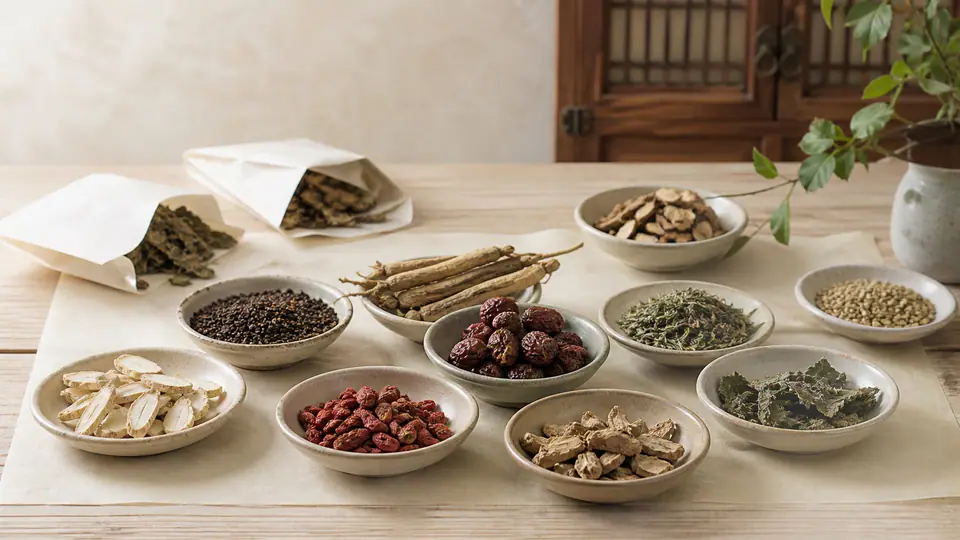
Clearing Heat-Toxins to Break Down the Mountain, Forsythia (Yeongyo)
The 'Taiping Sheng Hui Fang', compiled by Wang Huaiyin and others during the Song Dynasty, contains the following prescription in Volume 66: 'For the treatment of painful nodules and swelling of the lymph nodes (scrofula), with alternating chills and fever, use the Forsythia Powder Formula.' This is the Forsythia Powder Formula used when hard lumps around the neck are painful and chills and fever occur alternately. In this prescription, Forsythia (Yeongyo) is used the most at 1 liang and serves as the chief herb (Gun-yak) to clear heat-toxins and disperse swelling, alongside Ophiopogon, Scrophularia, Red Peony Root, Aucklandia, Mirabilite, Cimicifuga, and Rhubarb. While the name 'Forsythia' seems to derive from the appearance of berries hanging in succession and soaring toward the tips, in herbal medicine, its form is said to symbolically represent the action of unraveling pathological states where heat and toxins are clumped together.
It is easy to view Forsythia simply as 'an ingredient for cold medicine used when there is heat in the throat.' However, classical records describe its role much more broadly. In Ding Yi's 'Yi Fang Ji Yi' from the Ming Dynasty, there are numerous formulas such as Cheong-sang-yeongyo-eum, Yeongyo-baekpi-tang, and Yeongyo-eum for the throat, as well as Ohyang-yeongyo-eum, Chaihu-yeongyo-tang, Yeongyo-san-gyeon-tang, and San-jong-goe-gyeon-tang for scrofula and carbuncles. In Zhu Ji's 'Pu Ji Fang' from the Ming Dynasty, Chaihu-yeongyo-tang is used for 'carbuncles in men and women,' and Yeongyo-bangpung-tang is used for 'itchy skin, sores under the armpits, sores on the back, deafness, and tinnitus.' As such, Forsythia is not just a medicine for 'throat heat,' but a core herb for clearing heat and detoxifying (Cheong-yeol-hae-dok) and reducing swelling and dispersing nodules (So-jong-san-gyeol) to resolve swelling, skin diseases, and infectious febrile conditions caused by accumulated heat-toxins.
However, the fact that it is powerful means that side effects may occur if it is not applied in the right direction. Records of Forsythia in the Traditional Knowledge Portal of Korea describe its nature as bitter (Go) and slightly cold (Mi-han), entering the gallbladder, small intestine, heart, and lung meridians. It clearly states that administration should be avoided for those with weak spleen and stomach (Bi-wi-heo-yak), those with fever due to qi deficiency (Gi-heo-bal-yeol), or those whose boils have already ruptured (Ong-jeo-i-goe) and the pus is clear and pale. In other words, while it is effective in breaking down heat that is clumped as an excess condition (Sil-jeung), it may further harm the body in deficiency conditions (Heo-jeung) or when an ulcer has already burst.
Therefore, when using Forsythia, 'how much, for whom, and how' are always considered together. Depending on the ratio in which it is combined with herbs such as Bupleurum, Scutellaria, Phellodendron, Angelica, Safflower, Saposhnikovia, and Notopterygium, the direction of Forsythia diverges into releasing the exterior, clearing heat, invigorating blood, or dispersing. You must consult a medical professional during pregnancy, breastfeeding, or when taking Western medications; in particular, verification is necessary when used with anticoagulants or drugs related to liver metabolic enzymes. The power of Forsythia comes from the organizational structure of the prescription, and it is the role of the Korean medicine doctor to determine that structure.
Summary at a Glance
Forsythia is a representative heat-clearing and detoxifying medicine used to treat swelling and inflammatory diseases caused by accumulated heat-toxins. The table below summarizes the identity and core characteristics of this herbal medicine.
| Category | Content |
|---|---|
| Origin | Hanja Name 連翹, Scientific Name Forsythia suspensa (Thunb.) Vahl. According to the Traditional Knowledge Portal of Korea and the GBIF classification system, the Forsythia commonly used in Korean medicine is Forsythia the (mainly F. suspensa and F. koreana) dried fruit. |
| Properties and Meridian Tropism | Bitter (Go), Slightly Cold (Mi-han), Non-toxic (Mu-dok). Acts on the gallbladder, small intestine, heart, and lung meridians. |
| Representative Aliases | Forsythia (Yeongyo), Forsythia Shell (Yeongyo-gak), Green Forsythia (Cheong-gyo), Old Forsythia (No-gyo), etc. Depending on the harvest time, immature green fruits are classified as Green Forsythia and fully ripe yellow fruits as Old Forsythia. |
| Efficacy Recorded in Literature | Clearing heat and detoxifying (Cheong-yeol-hae-dok), reducing swelling and dispersing nodules (So-jong-san-gyeol), draining pus (Bae-nong), and removing white parasites (Geo-baek-chung). In 'Taiping Sheng Hui Fang', it is used as the chief herb (Gun-yak) in the Forsythia Powder Formula to treat nodules, pain, and alternating chills and fever of the lymph nodes (scrofula). |
| Main Ingredients | Confirmed data: Specific standards for main components and content are limited. Verification is required. Please inquire during your consultation. |
| Combinations and Contraindications | Because of its bitter and cold (Go-han) nature, weak spleen and stomach (Bi-wi-heo-yak)individuals, fever due to qi deficiency (Gi-heo-bal-yeol)individuals, ruptured boils (Ong-jeo-i-goe)cases where pus is clear and pale require caution. Combined use with restorative medicines for supplementing yang or yin should be handled carefully depending on the constitution and symptoms. |
Is this medicinal herb right for me?
Forsythia is a heat-clearing and detoxifying medicine used to treat swelling and inflammatory diseases caused by accumulated heat-toxins. Accordingly, there is a clear distinction between those for whom it is suitable and those who should avoid it, depending on constitution and pathology. These are summarized in three points below.
-
Generally suitable cases: It is used under the prescription of a Korean medicine doctor when the neck area is swollen and painful, when febrile boils or abscesses occur on the skin, or during the early stages of heat-toxin infection with alternating chills and fever. Traditional prescriptions where Forsythia is used as the chief herb (Gun-yak), such as the Forsythia Powder Formula in 'Taiping Sheng Hui Fang', are designed with these situations in mind.
-
Cases requiring caution: For those with weak digestion, frequent heartburn, or a tendency toward diarrhea, or those with fever due to chronic fatigue or deficiency conditions (Heo-jeung), the bitter and cold (Go-han) nature of Forsythia may further irritate the stomach or worsen symptoms. Additionally, if you are taking Western medications or are pregnant or breastfeeding, you must consult a medical professional to avoid overlapping use of cold medicines or herbal preparations containing Forsythia.
-
Cases to avoid: If a boil has already burst and the pus is clear and pale, or if the body is severely weak and has a cold constitution, heat-clearing and detoxifying treatments may have the opposite effect. Particular caution is required during pregnancy. Sources such as Drugs.com record the possibility of uterine contractions or the induction of menstruation; as official clinical data supporting safety during pregnancy has not been secured, consultation with medical staff is essential.
Practical Q&A
When explaining prescriptions containing Forsythia (Yeongyo) in the clinic, several questions are repeatedly asked. For example, "Can I drink it as a tea?", "Is it okay during pregnancy?", or "Can I take it with cold medicine?" These questions arise because Forsythia has strong properties as a heat-clearing and detoxifying agent, making the timing and method of use critical. We have compiled the most frequently asked questions below.
Can I consume Forsythia like a tea or a food product?
While there are folk usages of drinking Forsythia (Yeongyo) as a tea, in Korea, it is managed only as a Korean herbal medicine ingredient and is not registered as a general food ingredient. In traditional prescriptions, it is used via the decoction method (Jeontang), where it is boiled in water; the 'Yeongyo-san-bang' in the 《Taiping Sheng Hui Fang》 also records that it should be decocted and consumed, stating, “Use one medium cup of water and decoct until 6 parts remain.” Therefore, it is not recommended to consume Forsythia over a long period like a daily tea or health food; as a rule, it should be used short-term under the prescription of a Korean medicine doctor.
Can it be taken during pregnancy or breastfeeding?
It is safer not to self-administer Forsythia during pregnancy and lactation. Some commercial summary materials record that Forsythia has effects that cause uterine contractions or induce menstruation, and specify that its use should be avoided during pregnancy. However, independent official clinical trial papers supporting this have not been secured. Epidemiological and clinical data regarding safety during lactation have also not been confirmed. If you are pregnant or breastfeeding, please decide only after consulting with a Korean medicine doctor or an obstetrician-gynecologist.
Can I take it with cold medicine?
Caution is required. Forsythia is a common ingredient in various Korean herbal cold remedies used to treat colds, flu, and febrile infections. Taking two or more types of cold medicine together may result in overlapping ingredients like Forsythia, increasing the daily exposure amount. In particular, since clinical research on concurrent use with Western medicines such as antibiotics, anticoagulants, immunosuppressants, diabetes medications, or hypertension medications has not been secured, you must inform your medical staff and consult them before using it with Western medicine.
Is it suitable for those with a weak digestive system?
The properties of Forsythia are close to being bitter and cold (Go-han), which may cause gastrointestinal discomfort in people with a weak stomach or those who frequently experience diarrhea, abdominal pain, or loss of appetite. Additionally, if fever stems from deficiency (Heo), for example, low-grade fever due to chronic fatigue or malnutrition, heat-clearing medicines may worsen the symptoms. Therefore, if you have a weak digestive system or suspect a Qi-deficiency (Gi-heo) constitution, please inform your Korean medicine doctor before receiving a prescription containing Forsythia.
Can it be used for boils or ulcers that have already burst?
If an ulcer has already burst and the pus is clear and pale, Forsythia may not be suitable. Forsythia plays a role in clearing heat, detoxifying, reducing swelling, and dispersing nodules during the swelling stage where heat-toxins are concentrated, specifically, the stage that is swollen, hot, and painful. Conversely, clear and pale pus suggests the possibility of a deficiency syndrome (Heo-jeung) or cold syndrome (Han-jeung), and using the cold-natured Forsythia at this time may slow recovery. If a boil or ulcer has already progressed, it is necessary to confirm the stage through an evaluation by a Korean medicine doctor.
Relationship with Other Medicinal Herbs (Yakdae/Pairing)
Forsythia is not used alone. Its power to resolve heat-toxins and disperse swelling finds its proper place only when combined with other medicinal herbs, which is traditionally called "Yak-dae" (medicinal pairs). We introduce representative classical prescriptions where Forsythia forms a core combination.
- Yeongyo-san-bang "Taiping Sheng Hui Fang" Volume 66: Used with 1 liang of Forsythia, along with BelamCaroline (Sagan), Scrophularia (Hyeonsam), Red Peony Root (Jeok-jagyak), Aucklandia (Mokhyang), Glauber's salt (Cheon-mangcho), Cimicifuga (Cheon-seungma), and Rhubarb (Cheon-daehwang). This is a prescription to resolve heat-toxins and disperse swelling when boils clustered around the neck are painful and chills and fever alternate. Here, Forsythia serves as the sovereign herb (Gun-yak) for clearing heat, detoxifying, reducing swelling, and dispersing nodules.
- Ohyang-yeongyo-eum "Uibang-jibu": Used when there is sweating and fever due to tuberculosis (scrofula) between the neck and nape. Forsythia is combined with five aromatic herbs (Ohyang, such as Aucklandia and Agarwood) to assist in detoxification and reducing swelling.
- Siho-yeongyo-tang "Boje-bang": Used with Bupleurum (Siho), Anemarrhena (Jimo), Scutellaria (Hwanggeum), Phellodendron (Hwangbaek), Rehmannia (Saeng-jihwang), Angelica (Dang-gwi), and Arctium (Ubanggja) to treat "carbuncles (Mado-chang) in men and women." Forsythia acts to neutralize heat-toxic swelling between Bupleurum, which opens the Shao Yang meridian, and Scutellaria and Phellodendron, which clear heat.
- Yeongyo-bangpung-tang "Boje-bang": Used in combination with Ephedra (Mahwang), Cinnamon twig (Gye-ji), Angelica root tail (Dang-gwi-mi), Safflower (Honghwa), Notopterygium (Gang-hwal), and Saposhnikovia (Bangpung) to treat "itchy skin, axillary boils, back boils, deafness, and tinnitus." Forsythia manages heat-toxic skin conditions together with herbs that dissipate wind-heat.
As shown, Forsythia handles the axis of clearing heat, detoxifying, reducing swelling, and dispersing nodules, forming a prescription when combined with herbs that dissipate wind-heat, activate blood, or open the Shao Yang meridian. Since the direction of the effect changes depending on the combination, prescriptions containing Forsythia must be formulated by a Korean medicine doctor to match the individual's constitution and symptoms.
In what form is it consumed?
Forsythia is generally used as a herbal medicine in the form of decoctions (Jeontang) or professional prescriptions. General consumption as a tea or food ingredient is not recommended; since it has strong properties depending on the constitution and symptoms, dosage and concurrent use are important. We summarize this in four forms below.
- Drinking as tea Not common. While folk uses of drinking Forsythia berries or leaves as tea have been mentioned in academic papers, these are subjects of traditional medicinal extract research, not food. In Korea, Forsythia is managed as a herbal medicine and there is no basis for it being registered as a general food ingredient, so self-use as a tea is not recommended.
- Adding to food Not common. Forsythia is a herbal medicine intended for clearing heat, detoxifying, reducing swelling, and dispersing nodules; no tradition or official standard for using it as a daily food ingredient has been confirmed.
- Consumption as a decoction (boiled herbal tea) Yes, this applies. It is recorded in classical prescriptions such as the Yeon-gyo-san-bang from the 《Taiping Sheng Hui Fang》 as a form to be boiled in water and consumed; it is prepared as a decoction at a Korean medicine clinic according to the prescription.
- Taking via professional prescription (prescribed by a Korean medicine doctor) Yes, this applies. Yeon-gyo is used as a core ingredient in various classical prescriptions such as Yeon-gyo-san-bang, Oh-hyang-yeon-gyo-eum, Sa-hu-yeon-gyo-tang, and Yeon-gyo-bang-pung-tang. Even now, the most common method is for a Korean medicine doctor to prescribe it after evaluating the patient's constitution and symptoms.
Interactions and Safety During Use
Yeon-gyo is a medicinal herb with a strong tendency to clear heat and detoxify. Therefore, understanding when it is effective must go hand-in-hand with understanding who should avoid it. Below, we have summarized the precautions confirmed in three aspects: pregnancy/breastfeeding, constitution/symptoms, and concurrent use of Western medicine.
-
Pregnancy and lactation period Yeon-gyo is a medicinal herb traditionally recorded as having a tendency to promote uterine contractions and menstruation. As a rule, you should not self-administer Yeon-gyo alone or prescriptions containing Yeon-gyo during pregnancy. Since sufficient clinical data to support safety during breastfeeding has not been secured, please be sure to consult a medical professional before use.
-
Contraindications based on constitution and symptoms Yeon-gyo, which has a bitter and slightly cold nature, requires particular caution in the following cases:
- Those with a weak digestive system: Gastrointestinal discomfort such as abdominal pain, diarrhea, or loss of appetite may occur.
- Cases of fever due to Qi deficiency: For example, in the case of fever caused by chronic fatigue or malnutrition, heat-clearing herbs may actually worsen the symptoms.
- Cases where a tumor has already ruptured and the pus is clear and pale in color: This is a deficiency or cold state where heat-clearing and detoxifying are not appropriate.
-
Concurrent Use with Western Medicine Systematic clinical research supporting interactions between Yeon-gyo and specific Western medicines has not been confirmed at this time. However, since some cold medicine formulations contain Yeon-gyo, using two or more formulations together may increase exposure due to overlapping ingredients. If you are taking anticoagulants, drugs related to liver metabolic enzymes, pregnancy-related medications, or have a scheduled surgery, please inform your attending medical professional before starting a Korean medicine prescription including Yeon-gyo.
While the efficacy of Yeon-gyo is strong, it is a medicinal herb that works best when the target patient and situation are clearly defined. Since the specific decision to use it and the dosage vary depending on an individual's constitution, symptoms, and current medications, we recommend deciding through a consultation.
If you experience these symptoms
While Yeon-gyo exerts power in clearing heat, detoxifying, and reducing swelling and nodules, its strong nature means that certain signals from the body must not be ignored. The signals below are known warnings suggesting that Yeon-gyo or a prescription containing it may not be suitable for your current constitution or symptoms. If these symptoms appear, it is important to inform the prescribing Korean medicine doctor first rather than reducing the dose or stopping the medication on your own.
- When new abdominal discomfort or diarrhea occurs or worsens Because the nature of Yeon-gyo is bitter and cold, digestive symptoms may appear in those with a weak spleen and stomach.
- When appetite drops sharply or the mouth feels dry This may be a signal that heat-clearing and detoxifying herbs are suppressing the normal function of the spleen and stomach.
- When fatigue increases or the feeling of the body becoming cold intensifies In constitutions closer to Qi deficiency or cold patterns rather than heat patterns, adverse effects may occur.
- When the wound area becomes more painful or the color of the pus becomes clear and the amount does not decrease In a state where an ulcer has already ruptured, heat-clearing and detoxifying may slow down wound healing.
- When irregular menstruation or lower abdominal pain occurs Some data record that Yeon-gyo has uterine contracting or menstruation-inducing effects, so particular caution is needed for female patients.
If these symptoms are mild, they can often be resolved by adjusting the prescription or changing the timing and method of administration, but Severe abdominal pain, persistent diarrhea, bleeding, difficulty breathing, or decreased consciousness If these symptoms occur, please visit an emergency medical institution. The effect of Forsythia (Yeongyo) depends on the balance with other medicinal ingredients within the prescription; therefore, it is safer to have it adjusted through a medical consultation rather than judging on your own.
Differences from other restorative medicines
Due to the friendly image of 'forsythia fruit,' Forsythia (Yeongyo) is sometimes mistaken for a restorative tonic or a tea ingredient. However, in traditional medicine, the role of Forsythia is almost the exact opposite of a restorative tonic (Boyak). While restorative tonics focus on filling depleted energy or supplementing weak areas, Forsythia is a medicinal ingredient used for 'draining and resolving' (Sa-Hae), meaning it releases heat-toxins accumulated in the body and disperses swelling or lumps.
Traditional restorative agents such as Gongjindan or Gyeongokgo are used long-term to nourish Qi and blood and replenish essence (Jeong). Forsythia is a heat-clearing and detoxifying medicine that stands on a different axis from these restorative groups. In fact, if a prescription containing Forsythia is used carelessly for someone with deficient Qi or a weak stomach, it may produce the opposite effect of what is needed. Therefore, it is important to first verify if a prescription containing Forsythia is appropriate for cases where 'heat-toxins have accumulated, causing swelling and pain.'
Ultimately, whether Forsythia is necessary or if a restorative prescription like Gongjindan or Gyeongokgo is more appropriate must be determined by evaluating the individual's constitution and current symptoms. It is most accurate to decide this through a consultation with a Korean medicine doctor.
References
- Evidence material related to Forsythia 1: Korea Institute of Korean Medicine official data.
- Evidence material related to Forsythia 2: Crude drug data from the National Institute of Food and Drug Safety Evaluation.
- Evidence material related to Forsythia 3: GBIF plant classification data.
- Evidence material related to Forsythia 4: GBIF plant classification data.
- Evidence material related to Forsythia 5: GBIF plant classification data.
- Evidence material related to Forsythia 6: Korea Citation Index academic paper.
- Evidence material related to Forsythia 7: PubMed academic paper.
- Evidence material related to Forsythia 8: PubMed academic paper.
If you would like to check if this medicinal herb is right for you or which prescription it should be used with, please leave a medical inquiry. For those who find it difficult to visit the clinic, non-face-to-face consultations are available; we will provide guidance after first reviewing your current condition and current medications.

Medical Staff Review
Director Choi Yeon-seung
Chief Director of Baekrokdam Korean Medicine ClinicForsythia Dictionary Entry, reviewed the safety of expressions and the scope of verification before administration.
Review Scope: Clinical Accuracy, Pharmacology, Contraindications, Combinations, QA · Last Reviewed 2026-08-16
- Graduated from Kyung Hee University College of Korean Medicine
- Providing Korean medicine treatment since 2010
- Consultations for Gongjindan, Gyeongokgo, Nokyong (Deer Antler) restorative medicine, and customized restorative herbal medicine