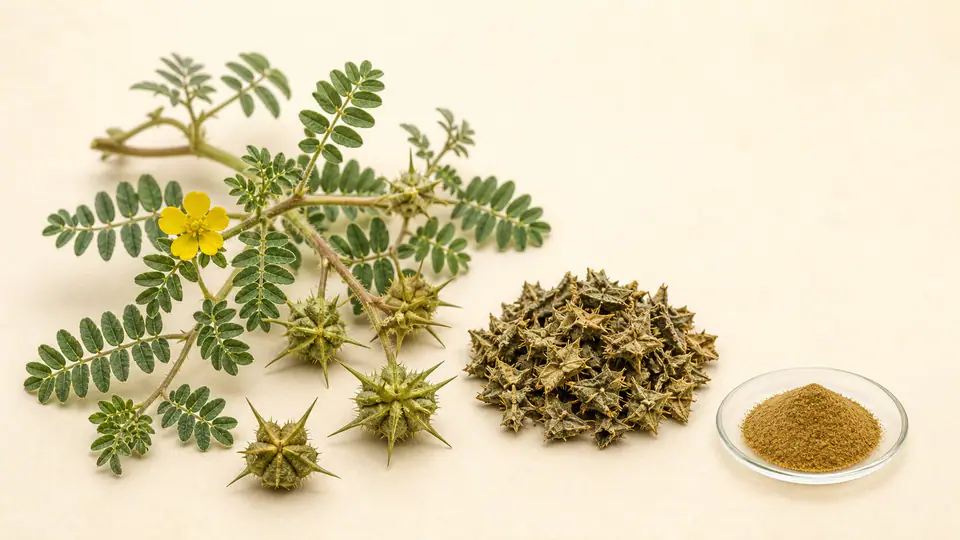
Four Divergent Paths Behind a Thorny Name
Will taking Tribulus increase testosterone and improve muscle mass, libido, and erectile function? In short, the clinical evidence reviewed to date is inconsistent. While some sexual function survey scores showed low-level signals of improvement, total blood testosterone did not differ distinctly from the placebo. Claims that it increases muscle mass or athletic performance are not supported by sexual function research. Therefore, this ingredient has a much more complex identity than the simple label of a 'male hormone booster.'
This article calmly explores what kind of plant ingredient Tribulus is, why different products are mixed under the same name, and how to measure the distance between expectations and evidence.
One Question, Four Different Answers
The representative question about Tribulus actually asks four things at once. First, does libido increase? Second, does erectile function improve? Third, does testosterone rise? Fourth, do muscle and athletic performance improve? These four paths have received different clinical results. A 2025 systematic review of 10 clinical trials evaluated some signals of erectile function as low-level evidence and found no evidence that it robustly increases testosterone. A randomized trial meta-analysis from the same year also reported improvements in some erectile function scores, but total testosterone showed no significant difference from the placebo.
The important point here is that 'changes in sexual function survey scores do not imply an increase in testosterone or muscle mass.' A slight improvement in survey scores does not mean hormone levels changed or muscle was gained. However, common narratives in the market often bundle these four together.
Identity of the Ingredient: A Scientific Name Is Not Everything
Tribulus is a plant ingredient using the aerial parts and fruits of Tribulus terrestris from the Zygophyllaceae family. It is also called 'Tribulus extract.' However, having the same scientific name, Tribulus terrestris, does not make them the same ingredient. The actual components vary depending on whether the aerial part or fruit is used, the origin, the solvent used for extraction, and how the saponin composition is standardized.
Products may highlight furostanol saponin or protodioscin content, but they are not equivalent based on name alone because the extraction part, solvent, and standardization differ. It is difficult to assume that another product exactly replicates a specific extract used in a study. Therefore, it is not easy to apply a single study stating 'Tribulus was effective' directly to the product you are purchasing.
Why Expectations Exist: Sexual Function Surveys and Hormones Follow Different Paths
Expectations regarding sexual function played a large role in establishing Tribulus as a male health supplement. However, a detailed look at clinical results shows that cases of partial improvement in erectile function surveys coexist with cases where testosterone did not rise. While these results alone cannot explain the mechanism of action, sexual function scores and male hormone levels should not be read as the same outcome.
Furthermore, claims that it increases muscle mass, strength, and athletic performance in healthy athletes are not supported by sexual function research. The status as an athletic supplement and the status as a sexual function ingredient require different evidence; mixing the two in an explanation exaggerates expectations.
Differences in Product Form: Raw Materials and Standardized Extracts Speak Different Languages
Tribulus raw materials and standardized extracts start from the same plant but speak different languages. Raw materials may be in a form where dried parts are simply ground up, whereas standardized extracts are concentrated and purified to target a specific saponin content. The phrase 'Tribulus extract' alone does not reveal this difference.
When choosing, you must check if the scientific name, part used, extraction ratio, solvent, and actual protodioscin or saponin standardization are indicated. Without these, there is no basis to compare what is identical to the products used in research. This is not simply a matter of whether the content is high or low, but a matter of which component was used as the standard for standardization.
When Using with Other Medications or Supplements
Particular caution is needed when using Tribulus with other supplements or medications. There have been reports of severe jaundice and acute kidney injury, so individuals with liver or kidney disease and those using multiple athletic supplements should be cautious. Those who are pregnant, breastfeeding, have hormone-sensitive conditions, or are undergoing treatment for blood pressure, blood sugar, or anticoagulation should avoid arbitrary use and confirm with their medical team.
Signals of adverse reactions must not be ignored. Symptoms such as jaundice, dark urine, decreased urine output, severe muscle pain, or symptoms during sexual activity accompanied by chest pain require prompt medical evaluation. The fact that adverse reactions were similar to the placebo in short-term trials does not guarantee the long-term safety of commercial blended products.
Why Checking Your Individual Situation Comes First
Before considering Tribulus, it is important to first categorize your situation. The approach differs depending on whether it is a decrease in libido or erectile issues, confirmed low testosterone via testing, or an ongoing infertility evaluation. Since erectile dysfunction can be a signal of vascular disease, diabetes, medication, hormones, or psychological factors, it is necessary not to delay a professional evaluation by relying on supplements.
In particular, taking it with the expectation that 'testosterone will increase' without checking hormone levels may lead to missing the actual cause. Using supplements and receiving medical evaluation for hypogonadism or erectile dysfunction are different pathways.
The gap between evidence and expectation
The EMA concluded that the efficacy and safety of certain extracts have not been sufficiently proven by long-term distribution alone. Due to a lack of public data supporting recognized efficacy and acceptable safety, an EU monograph for traditional or established use could not be established. This means that rather than simply saying 'it is ineffective,' it means 'it cannot be officially recognized based on currently available public data.'
Then, what should be looked at? Improvements in some erectile function questionnaires are merely observed possibilities, not proven therapeutic effects. An increase in testosterone is not clear in current evidence. Improvements in muscle mass or athletic performance are not supported. Distinguishing between these three is key to evaluating this ingredient.
Similar Names, Different Results
Tribulus raw materials and standardized extracts, sexual function questionnaires and blood testosterone levels, athletic performance and muscle mass, and supplement use versus medical evaluation for hypogonadism or erectile dysfunction are compared, but they are not the same. These comparisons serve as reference points for readers when contrasting product labels with their own goals.
For example, if a product promotes itself as a 'testosterone booster,' remember that evidence showed testosterone levels were no different from a placebo. If it promotes 'muscle growth,' verify that there is insufficient evidence for claims targeting healthy athletes.
Criteria to Check Today
When evaluating Tribulus, check the plant identity, part used, extract standardization, and actual medical goals before considering the term 'male hormone booster.' It is important not to mistake limited signals of sexual function for therapeutic effects on testosterone, muscle, or infertility.
When checking the label, verify if the scientific name, part used, extraction ratio, solvent, and protodioscin or saponin standardization are indicated. Distinguish whether your condition is low libido, erectile issues, test-confirmed low testosterone, or if you are undergoing an infertility evaluation. Consult a healthcare provider if you have liver or kidney disease, or if you are taking medication for blood pressure, blood sugar, anticoagulants, or statins. Additionally, seek medical evaluation immediately if symptoms such as jaundice, dark urine, decreased urine volume, or severe muscle pain or chest pain occur during sexual activity.
References
- EMA final public statement on Tribulus terrestris herb.
- Tribulus, erectile dysfunction and testosterone: systematic review.
- Tribulus for erectile dysfunction: systematic review and meta-analysis.
- Severe liver and renal injury from Tribulus terrestris: case report.
This text explains the origin of the raw materials, the scope of research, and precautions before consumption. As this cannot replace individual diagnosis or treatment, please consult a medical professional if you are taking medication or if symptoms persist. If sudden and severe symptoms such as difficulty breathing or decreased consciousness occur after consumption, seek help from 119 or the emergency room.

Medical Staff Review
Director Choi Yeon-seung
Chief Director of Baekrokdam Korean Medicine ClinicTribulus Dictionary Entry, reviewed the safety of expressions and the scope of verification before administration.
Review scope: Ingredient origin, human studies, concomitant medications, safety of intake · Last reviewed 2026-08-17
- Graduated from Kyung Hee University College of Korean Medicine
- Providing Korean medicine treatment since 2010
- Consultations for Gongjindan, Gyeongokgo, Nokyong (Deer Antler) restorative medicine, and customized restorative herbal medicine