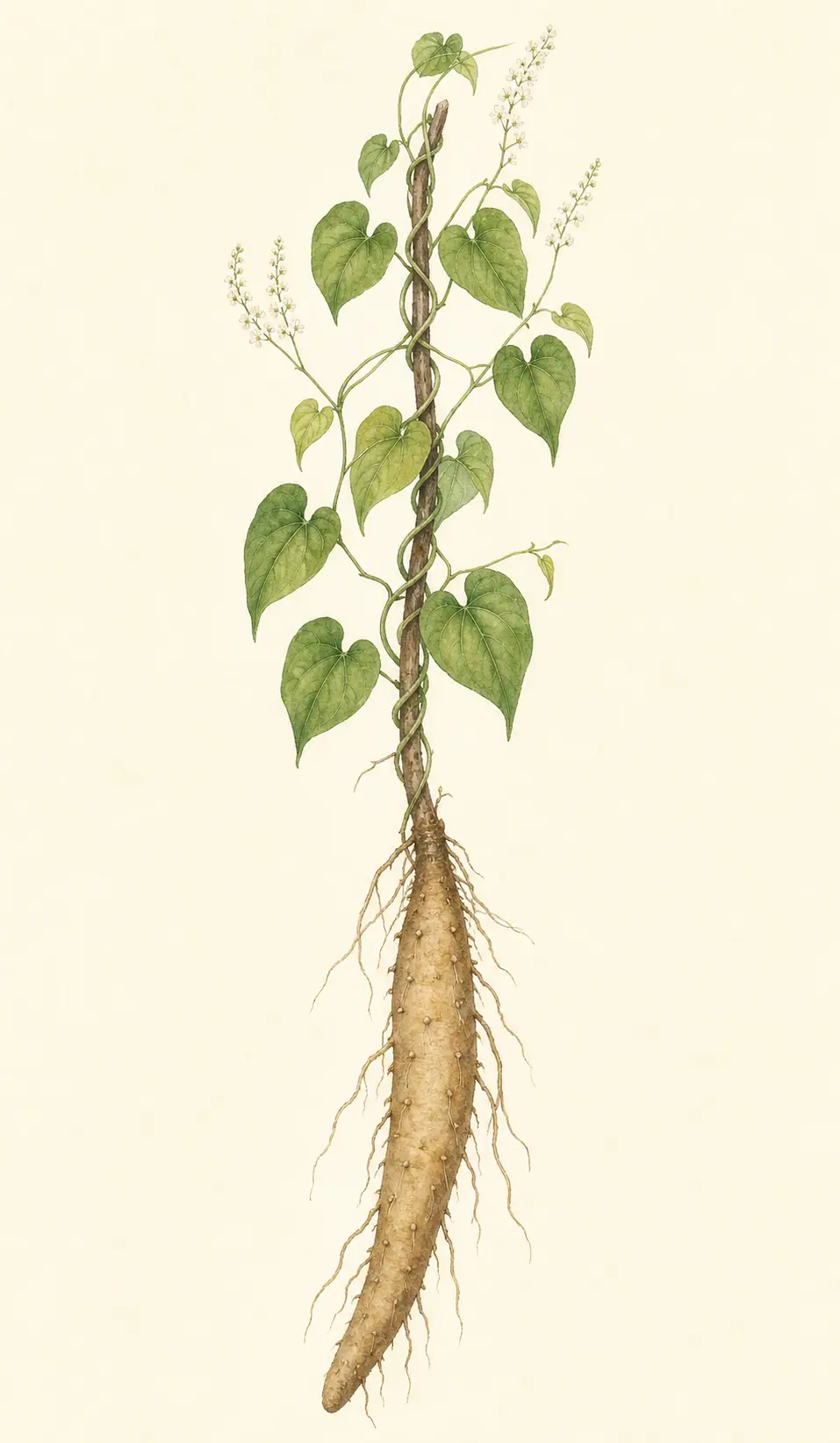
From Seoye to Sanyak, A Name Born of Respect, a Root that Tonifies
According to the Compendium of Materia Medica, Sanyak was originally called 'Seoye'. However, during the Tang Dynasty, it was changed to 'Seoyak' to avoid the name of the Emperor 'Yu'. Later, during the Song Dynasty, the Ben Cao Chong Yuan records that it became today's 'Sanyak' because the character 'Seo' was associated with the Emperor's name. In essence, the name changed twice to avoid imperial taboos. Just as the Emperor's name was embedded in each character, this medicinal herb has long been regarded as something 'so precious it had to be avoided'.
Perhaps because of this origin, Sanyak is often lightly regarded as simply a 'healthy tonic'. Since it frequently appears on dining tables and is easily found in health food sections, there is a strong perception of it as a 'harmless supplement'. However, in classical texts, the role of Sanyak is more sophisticated. The Ben Cao Xin Bian explains that in the Palmi-jihwang-tang (Eight-Flavor Rehmannia Decoction), Sanyak performs the 'guiding function' (Jeopyin-ji-gong) that "harmonizes the two fires of the heart and kidney and allows the Qi of the spleen and stomach to move smoothly and healthily." In other words, Sanyak is not merely a herb that adds nutrients, but one that helps smooth the connection between other organs and meridians.
Therefore, the nature of Sanyak changes significantly depending on 'for whom, how much, and in what combination' it is used. Because its tonifying power is strong, it should be avoided in states of excess heat (Sil-yeol), dampness-induced fullness in the middle (Seup-seong-jung-man), or stagnation (Jeok-che). Furthermore, as academic studies have reported blood glucose control effects, caution is required when used concurrently with Western diabetes medications. Just as its name avoided the Emperor twice, we believe the criteria for using this herb should be equally cautious. On this page, we will guide you through those criteria step by step.
Summary at a Glance
As its name suggests, Sanyak is not just a simple 'medicinal herb from the mountains'. The table below summarizes the identity and core characteristics of this herb at a glance.
| Category | Content |
|---|---|
| Origin | Hanja Name 山藥, Scientific Name Dioscorea batatas Decne. (Tuber of the Dioscorea genus, Yam family) |
| Properties and Meridian Tropism | Sweet and neutral (Gam-pyeong), non-toxic; primarily acts on the Spleen, Lung, and Kidney |
| Representative Aliases | Seoye, Seoyak, Changed to avoid the names of the Tang and Song imperial families |
| Efficacy Recorded in Literature | 《本草綱目》: “補中, 益氣力, 長肌肉, 強陰. 久服耳目聰明, 輕身不飢, 延年” |
| Main Ingredients | Starch, mucilage, saponins, proteins, etc. (characterized by dietary fiber and mucilage components) |
| Combinations and Contraindications | Tonic for supplementing Yang and Yin; contraindicated in cases of excess heat (Sil-yeol), dampness-induced fullness in the middle (Seup-seong-jung-man), or stagnation (Jeok-che) |
The first thing that likely catches your eye in this table is the word 'tonic'. However, the 'tonifying' (Bo) effect of Sanyak is not simply about boosting energy. The Ben Cao Xin Bian explains that Sanyak "harmonizes the two fires of the heart and kidney and allows the Qi of the spleen and stomach to move smoothly and healthily," meaning the core of this herb lies in the harmony of 'tonifying without causing blockage'. In the next section, we will examine in which prescriptions Sanyak is used, what role it plays, and how it differs from other tonics.
Is this medicinal herb right for me?
Sanyak is a tonic, but as with all tonics, 'for whom' and 'in what state' are critical. The phrase "supplementing the center and increasing Qi" (Bo-jung-ik-gi) in the Compendium of Materia Medica means supplementing the center of a person who is deficient. In other words, since it is a herb that fills a deficient state, it can actually be a burden in a state that is already excessive or blocked.
- Generally suitable cases: Traditionally considered for those who generally lack energy, have weak digestion, or frequently feel lethargy in the waist or knees. This aligns with the context of "increasing Qi strength, growing muscle, and strengthening Yin" mentioned in the Compendium of Materia Medica.
- Cases requiring caution: Caution is required for those taking diabetes medication or blood glucose regulators. As there are studies suggesting that Sanyak extracts may affect blood glucose control, consultation with a professional is recommended when used concurrently. Additionally, there have been reported cases of allergic reactions to Sanyak, so it is advisable to start with a small amount when first using it.
- Cases to avoid: You should avoid it if you have excess heat (Sil-yeol) or excess pathogenic factors (Sil-sa), or if you are in a state of dampness-induced fullness in the middle (Seup-seong-jung-man) where you feel chest tightness and slow digestion due to excess dampness, or a state of stagnation (Jeok-che) where food or Qi has accumulated. The strong tonifying action of Sanyak may exacerbate symptoms in these states.
Practical Q&A
Sanyak is a herb that appears frequently both on the dining table and in the pharmacy. Perhaps for this reason, many people think, "Can't I just eat it?" However, a tonic is a tonic. The following questions summarize common inquiries from actual clinical consultations; it is best to confirm whether it is right for you through a consultation with a Korean medicine doctor.
Can I drink Sanyak as a tea on a regular basis?
Sanyak has a neutral and sweet property, and the Compendium of Materia Medica records its action as "supplementing the center and increasing Qi strength." Therefore, it may be appropriate for those with a deficient constitution or weak digestion. However, the Compendium of Materia Medica and Ben Cao Chong Yuan also convey that as it is a tonic, it should be avoided in cases of "excess heat (Sil-yeol)," "dampness-induced fullness in the middle (Seup-seong-jung-man)," or "stagnation (Jeok-che)." In other words, it can be a burden if you already have excessive heat or blocked digestion, so long-term consumption without consultation is not recommended.
I have diabetes; can I take Sanyak?
Modern academic research on Sanyak has reported experimental results related to blood glucose control. For example, the Journal of Korean Medicine (2010) and the Journal of the Korean Society of Food and Nutrition (2013) have discussed the blood glucose-lowering effects of Sanyak extracts through animal experiments or pre-clinical subject studies. However, these are merely research results and are not a basis for uniform application without considering an individual's medical history, current Western medications, and dietary status in a clinical setting. Especially if you are taking diabetes medication, using Sanyak preparations together may affect blood glucose fluctuations, so you must decide after consulting with a Korean medicine doctor.
Is it possible to have an allergy to Sanyak?
Yes, it is possible. In the Journal of Korean Medical Science (2008), Dioscorea batatasthere was a study identifying it as an inhaled and oral allergen, and Clinical & Experimental Allergy (1994) reported cases where Sanyak and Pinellia used as Korean herbal medicine induced occupational asthma. Those using it for the first time should start with a small amount, and if difficulty breathing or skin reactions occur, stop immediately and seek consultation.
In which prescriptions is Sanyak most commonly used?
Sanyak (Chinese yam) is a medicinal herb that both nourishes yin (滋陰) and supplements qi (補氣). It is a core component of representative formulas found in the "Uifangron," such as Yukmi-jihwang-hwan, Bugye-palmi-hwan, and Jibaek-palmi-hwan. Additionally, it is included in formulas such as Maekdong-sanyak-tang and Yangsim-dan from the "Gyebong-boje-bang," as well as formulas in the Bojung-ikgi-tang and Samryeong-baekchul-san families cited in the "Sibi-gyeong-bosa-onryang-ingeok-yakga." However, as each of these formulas is applied to distinct constitutions and symptoms, it is safer to receive a diagnosis from a Korean medicine doctor rather than taking them based on the formula name alone.
Can I take this while pregnant or breastfeeding?
There is insufficient official or academic evidence to confirm the safety of taking sanyak during pregnancy or breastfeeding. Verification is required. Please inquire during your consultation.
What is the difference between fresh sanyak and dried sanyak?
The "Bencao Gangmu" records that "dried sanyak" was used in Junggyeong-palmi-hwan. Fresh and dried sanyak may differ in water content and the stability of their medicinal properties, and their use is distinguished depending on the formula. Generally, dried sanyak is more commonly used in Korean herbal medicine formulas, but the appropriate form and dosage for you depend on your constitution and symptoms. During your consultation, a Korean medicine doctor will guide you while considering both the form and the combination of herbs.
Relationship with Other Medicinal Herbs (Yakdae/Pairing)
The role of sanyak becomes clearer when it is used with other medicinal herbs rather than alone. In traditional medicine, such pairs are called "yakdae (medicinal pairs)." Sanyak is frequently positioned to gather the strength of other herbs and provide balance, especially in supplementing (補) formulas. Below are representative formulas from classical texts where sanyak forms a core combination.
- Yukmi-jihwang-hwan A formula from the "Uifangron," consisting of 8 liang of Sukji, 4 liang of Sanjuyu, 山藥 4兩, and 3 liang each of Bokryeong, Danpi, and Taeksa. The "Uifangron" explains that "sanyak collects the spleen meridian," meaning sanyak gathers the spleen meridian and governs the three yin of the liver, kidney, and spleen together.
- Bugye-palmi-hwan A formula from the "Uifangron," which adds 1 liang each of Buja and Yukgye to Yukmi-jihwang-hwan 山藥 4兩and uses it as is. Sanyak plays a harmonious supplementing role, helping the fire of the heart and kidney to communicate with the energy of the spleen and stomach.
- Jibaek-palmi-hwan A formula recorded in the "Uifangron," which adds 2 liang each of Jimo and Hwangbaek to Yukmi-jihwang-hwan 山藥 4兩and uses it. This composition is used temporarily to nourish yin and control fire (滋陰制火).
- Palmi-hwan (Geumgwol-sin-gi-hwan) A Junggyeong formula mentioned in the "Bencao Gangmu" and "Bencao Xinbian," which includes dried sanyak. The "Bencao Xinbian" explains that sanyak has a "guiding effect (接引之功)" that harmonizes the "two fires of the heart and kidney" and allows the "qi of the spleen and stomach to function healthily and calmly."
- Maekdong-sanyak-tang A formula from the "Gyebong-boje-bang," combining Maekmundong and 山藥 2 liang each of sanyak, etc., used for palpitations due to heart deficiency (補心虛驚悸) and tremors due to deficiency wind (虛風顫掉).
- Yangsim-dan A formula from the "Gyebong-boje-bang," including 1 liang of sanyak (薯蕷), etc., used to supplement heart qi and calm the mind (安神).
- Samryeong-baekchul-san / Bojung-ikgi-tang family A combination cited in the "Sibi-gyeong-bosa-onryang-ingeok-yakga" where Ginseng, Hwanggi, Baekchul, Yeonja,山藥· A formula that includes Poria (茯苓) and other herbs, designed to 'support the spleen and boost qi' (strengthening spleen function and raising energy).
“有山藥收攝脾經,即有茯苓之淡滲脾濕以和之。藥止六味,而大開大合,三陰並治.” 《醫方論》
“使腎之氣通於心,而心之氣通於腎,使脾胃之氣安然健運于不息,皆山藥接引之功也.” 《本草新編》
Regarding contraindications, the Bencao Gangmu records it as "supplementing the middle and augmenting Qi." Therefore, it is avoided in conditions involving excess heat (Sil-yeol), excess pathogenic factors (Sil-sa), dampness-induced fullness in the middle (Seup-seong-jung-man), or accumulation and stagnation (Jeok-che), as its strong tonic effect may instead place a burden on the body. This same principle applies when taking prescriptions containing Sanyak (Chinese yam).
In what form is it consumed?
Sanyak is a Korean herbal medicine where the rhizome itself is used medicinally. The most common method is to decoct the dried rhizome for consumption, and it has long been used as a food ingredient. However, please note that the quantity and purpose differ between its use as a food and its use in a medical prescription.
- Tea Sanyak tea, made by boiling dried Sanyak, is a common form. While it is perceived as mild and gentle for everyone, the dosage and duration of intake are critical when viewed from a medicinal perspective.
- Food Sanyak has long been used as a food ingredient. It is often consumed in porridge, steamed dishes, stir-fries, or soups. However, these dietary forms are more for general nourishment than medicinal efficacy and differ from the dosages used for therapeutic purposes.
- Decoction (boiled herbal medicine) The traditional method involves taking dried Sanyak decocted with other herbal ingredients as prescribed by a Korean medicine clinic. The Bencao Gangmu also provides examples of using dried Sanyak in prescriptions, stating, "Zhongjing's Bawei Wan uses dried Sanyak."
- Professional Prescriptions (pills, powders, etc.) Sanyak has 六味地黃丸, 附桂八味丸, 知柏八味丸 also been traditionally used in the form of pills (Wan-je). The Uifangron records the inclusion of 4 liang of Sanyak in these prescriptions. In modern times, Sanyak is included as a raw pharmaceutical ingredient meeting KP (Korean Pharmacopoeia) standards in over-the-counter medicines such as Kwangdong Woohwang Chungsimwon (containing civet substitute) registered in the Ministry of Food and Drug Safety's Integrated Pharmaceutical Information System.
Regardless of the form, Sanyak is a medicinal herb with strong tonic properties, so it is necessary to first verify if it is suitable for your constitution and current symptoms. In particular, those taking Western medications for diabetes or blood glucose control should exercise caution when using it concurrently, as research indicates that Sanyak may affect blood glucose levels.
Interactions and Safety During Use
While Sanyak is familiar as a food, there are precautions to consider when using it as a Korean herbal medicine. It is highly recommended to consult a Korean medicine doctor, especially if using it alongside other medications or if you have a specific constitution or symptoms.
- In cases of excess heat (Sil-yeol) or excess pathogenic factors (Sil-sa) When heat or pathogenic excess remains in the body, Sanyak, which is a tonic, may place a burden on the system.
- Dampness-induced fullness in the middle (Seup-seong-jung-man) In a damp constitution where the abdomen feels bloated and digestion is slow, the tonic effect may actually worsen the fullness.
- Accumulation and stagnation (Jeok-che) It is also avoided when food or pathological substances are stagnating in the body.
- Blood glucose lowering effects and concurrent use with Western medicine Since research suggests that Sanyak extracts may influence blood glucose regulation, those using diabetes medications or insulin require consultation with a professional.
- Allergies and occupational asthma — Dioscorea batatasThere have been academic reports of inhalation and oral allergies, as well as cases of occupational asthma related to exposure to Korean herbal medicines.
Please consult a Korean medicine doctor to confirm if this medicinal herb is right for you and how it interacts with your current Western medications or health status.
If you experience these symptoms
If these symptoms appear
Sanyak is a medicinal herb with a distinct tonic (supplementing) tendency. While it helps fill deficiencies, it may exacerbate symptoms if there is remaining heat or pathogenic excess (Sil-sa) in the body, or if dampness has accumulated causing discomfort in the middle burner. The following are known warning signs that may appear during the intake of Sanyak. In such cases, do not attempt to adjust the dose or stop the treatment on your own; instead, please notify the prescribing Korean medicine doctor first.
- The abdomen feels bloated and digestion is poor For those with excessive dampness and fullness in the middle burner (seupseong-jungman), restorative herbal medicine may further block the energy of the middle burner.
- Dryness of the mouth and tongue, or worsening constipation In individuals with a constitution of excess heat (sil-yeol) or those experiencing pathological heat symptoms, tonic herbs may increase the heat.
- New onset of nausea or a decrease in appetite In cases of accumulation and stagnation (jeok-che), restorative herbal medicine may increase stagnation.
- Occurrence of hives, itching, difficulty breathing, or swelling of the lips after administration Allergic reactions to Sanyak (Chinese yam) have been academically reported.
- Excessive drop in blood sugar or dizziness while taking diabetes medication or blood glucose regulators The blood glucose-lowering effect of Sanyak extract may overlap with the effects of Western medicine.
If these symptoms appear severely or are accompanied by difficulty breathing, severe allergic reactions, or decreased consciousness, please visit an emergency medical institution immediately.
Differences from other restorative medicines
Even under the general term 'restorative herbal medicine,' each medicinal herb tonifies different areas. Sanyak has a relatively calm and mild tonic property, focusing on tonifying the Spleen, Lung, and Kidney together. The description in the Bencao Gangmu, 'tonifies the middle and augments qi, grows muscle, and strengthens yin,' suggests that Sanyak is used to gradually fill in a deficient foundation rather than abruptly boosting energy. Therefore, rather than being in the same category as precious tonics like Gongjindan or Gyeongokgo, Sanyak is closer to a 'foundation stone' that subtly supports the body within daily meals or herbal prescriptions.
Gongjindan is a representative tonic centered on deer antler and musk, which a Korean medicine doctor tends to prescribe when deficiency symptoms are clear or significant energy recovery is needed. Gyeongokgo is also a representative tonic paste based on deer antler, used for chronic exhaustion or recovery. These differ from Sanyak in purpose, dosage, and duration of use. Rather than being used to strongly boost energy in a short period, Sanyak is a medicinal herb better suited for strengthening the foundation over the long term or balancing a prescription by harmonizing with other herbs.
Sanyak commonly seen on the dining table follows the same context. Sanyak tea or porridge can be used as daily health foods, but this does not mean they produce the same tonic effects as Gongjindan or Gyeongokgo. Whether a specific restorative medicine is right for you, or if a prescription including Sanyak is appropriate, depends on your symptoms, constitution, and current medications. It is best to make a specific choice through a consultation with a Korean medicine doctor.
References
- Sanyak Evidence Material 1: doi.org evidence.
- Sanyak Evidence Material 2: Korea Citation Index academic paper.
- Sanyak Evidence Material 3: Korea Institute of Korean Medicine official data.
- Sanyak Evidence Material 4: Official data from the Ministry of Food and Drug Safety.
- Sanyak Evidence Material 5: Korea Citation Index academic paper.
- Sanyak Evidence Material 6: Korea Citation Index academic paper.
- Sanyak Evidence Material 7: PubMed academic paper.
- Sanyak Evidence Material 8: PubMed academic paper.
If you would like to check if this medicinal herb is right for you or which prescription it should be used with, please leave a medical inquiry. For those who find it difficult to visit the clinic, non-face-to-face consultations are available; we will provide guidance after first reviewing your current condition and current medications.

Medical Staff Review
Director Choi Yeon-seung
Chief Director of Baekrokdam Korean Medicine ClinicSanyak Dictionary Entry, reviewed the safety of expressions and the scope of verification before administration.
Review Scope: Clinical Accuracy, Pharmacology, Contraindications, Combinations, QA · Last Reviewed 2026-08-16
- Graduated from Kyung Hee University College of Korean Medicine
- Providing Korean medicine treatment since 2010
- Consultations for Gongjindan, Gyeongokgo, Nokyong (Deer Antler) restorative medicine, and customized restorative herbal medicine