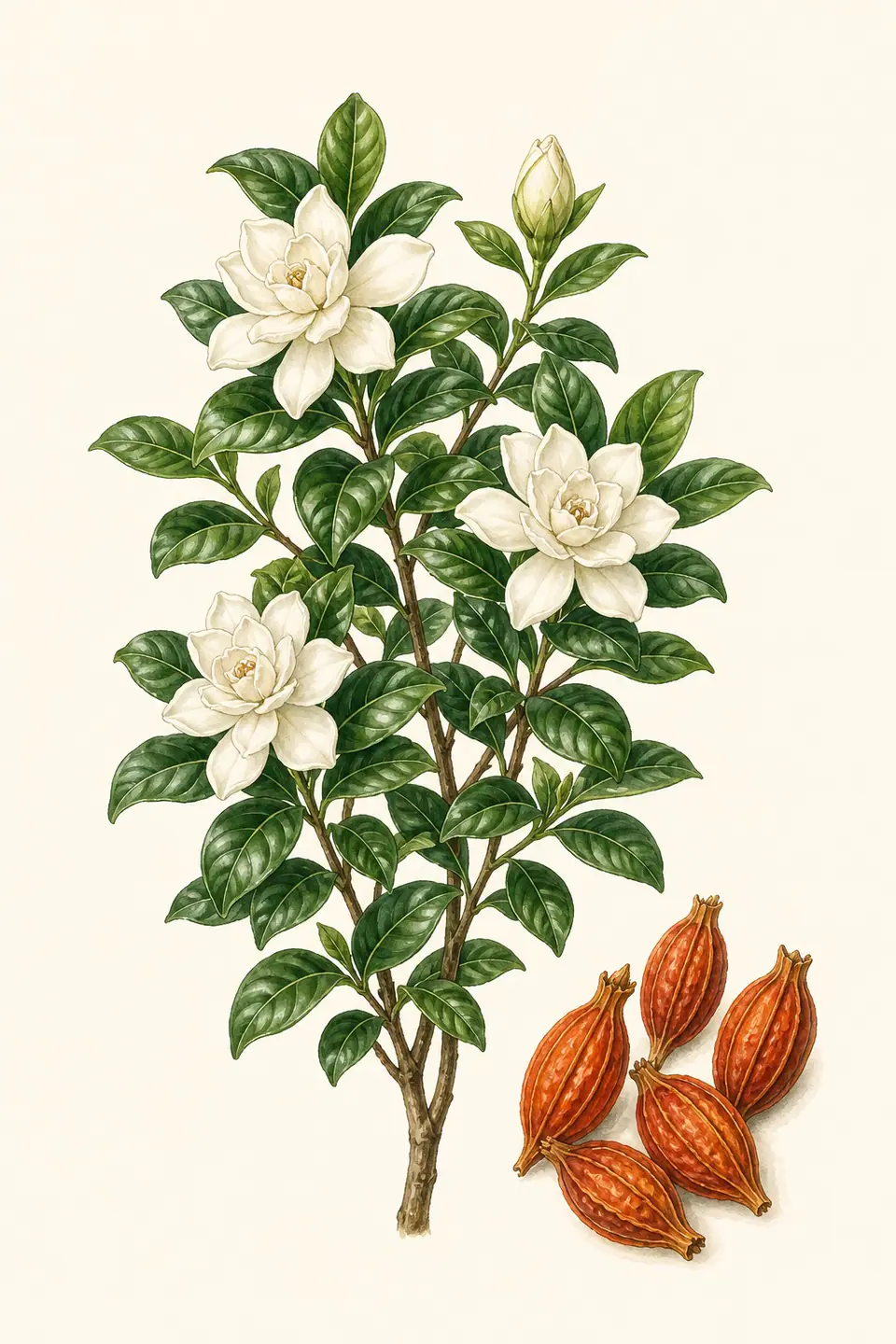
Wol-do (越桃), the yellow fruit that falls toward heat
The Bencao Gangmu assigns several names to the fruit of the gardenia tree. Muk-dan, Wol-do, and Seon-ji, among these, the alias 'Wol-do' gives a hint as to what this small yellow fruit represented. 'Wol' means to cross over, and 'do' refers to a peach, so the name itself carries the image of 'a fruit that ripens like a peach and crosses over to somewhere.' The original text of the Bencao Gangmu describes the properties and flavor of this fruit as 'bitter, cold, and non-toxic,' explaining that it enters the Heart, Lung, and Sanjiao (Triple Burner) to reduce heat. In other words, this is a medicinal herb with a directionality that guides heat rising within the body downward and outward.
However, it is dangerous to assume that 'it can be drunk lightly like tea' simply because of the classical record of being 'non-toxic.' Gardenia fruit (Sanchija) is a medicinal herb with a cold nature and a strong power to drain fire (Sahwa). As explained in the Traditional Knowledge Portal of Korea, draining fire is appropriate for excess heat-fire syndromes (Sil-yeol-hwa-jeung), whereas deficiency fire (Heo-hwa) requires supplementing water (Bosu), meaning it must not be used indiscriminately. This cold and bitter fruit does not treat all 'fire syndromes'; rather, if used incorrectly, it can damage the spleen and stomach and induce diarrhea. The OASIS Herbal Encyclopedia also warns that 'those with a weak spleen and stomach or loose stools should be cautious when taking it.'
Therefore, how much, who, and how it is used are critical. Gardenia fruit is a Korean herbal medicine ingredient used within a prescription through decoction; it is not an everyday tea or a fruit for self-administration. Modern research has also reported potential hepatotoxicity of a component called geniposide and concerns regarding interactions with statin-class Western medicines. The 'non-toxic' description in classical texts refers to records under appropriate usage; if those standards are not met, the cold fruit may instead harm the body. This page covers exactly those standards.
Summary at a Glance
Sanchija is another name for the Korean herbal medicine Gardenia fruit, which consists of the dried ripe fruit of the gardenia tree. This table summarizes the core details, from its origin to its properties, flavor, meridian tropism, and ingredients to be cautious of when combining.
| Category | Content |
|---|---|
| Origin | Hanja Name 山梔子, Scientific Name Gardenia jasminoides J.Ellis A Korean herbal medicine made from the dried ripe fruit of the gardenia tree (Rubiaceae). The herbal medicine name is Chija (梔子)·Gardeniae Fructusand Sanchija is its alias. |
| Properties and Meridian Tropism | Bitter, Cold, Non-toxic, Enters the Heart, Lung, and Sanjiao (Triple Burner) to reduce heat. |
| Representative Aliases | 《本草綱目》: 木丹、越桃、鮮支 / OASIS: 川揀子、山梔子、黃梔子、越桃、鮮支、木丹 等 |
| Efficacy Recorded in Literature | Bencao Gangmu: Epistaxis (external use), urinary obstruction, heat-toxic dysentery, cholera with muscle cramps, gastric fire pain, childhood restlessness, wind-phlegm headache, erysipelas, etc. / Dongui Bogam: Combined in prescriptions for liver excess heat (Gan-sil-yeol) such as Sageong-hwan, Seogan-san, and Dang-gwi-yong-hoe-hwan / Gihyo Ryangbang: Used in Sanchija-tang to treat wheal eruptions and spotted toxins. |
| Main Ingredients | The iridoid glycoside geniposide(京尼平苷)is representative. |
| Combinations and Contraindications | Since it has a strong cold nature and fire-draining (Sahwa) tendency, restorative medicines for supplementing yang or warming the bodymay have conflicting effects when used together. Caution is required for those with a weak spleen and stomach, frequent diarrhea, or a deficiency fire (Heo-hwa) constitution. |
Is this medicinal herb right for me?
Sanchija is a cold-natured medicinal herb that guides heat within the body downward. Due to this directionality, it is used for heat rising upward or heat syndromes in the skin, eyes, and urine; however, conversely, it can be a burden for those prone to coldness or those with weak digestion. Please evaluate based on the following three criteria first.
- Generally suitable cases: This herb has been traditionally considered for those who tend to have heat accumulating upward, such as those whose faces redden easily, those with frequent bad breath or stomatitis, or those whose urine is yellow or feels hot. The Bencao Gangmu discusses it in situations for reducing heat, such as nosebleeds, urinary obstruction, and heat-toxic dysentery.
- Cases requiring caution: Those who usually have cold hands and feet, frequent diarrhea, or weak digestion should be cautious, as the cold nature of Sanchija may further damage the spleen and stomach. The OASIS Herbal Encyclopedia also advises that those with loose stools (Spi-wei-bian-tang-zhe) should avoid taking it. Additionally, it is important to distinguish whether the body's heat is actual excess fire (Sil-hwa) or deficiency fire (Heo-hwa) resulting from weakness. Since supplementing water (Bosu) takes priority for deficiency fire, using Sanchija, which has a fire-draining (Sahwa) tendency, indiscriminately may complicate the symptoms.
- Cases to avoid: Those taking statin-class Western medicines or those with abnormal liver function should be cautious about using Sanchija. In a 2021 Frontiers in Pharmacology study, Gardenia jasminoidesconcerns about hepatotoxicity were reported in animal experiments combining it with simvastatin, and a 2012 study indicated that geniposide, a major component of gardenia, has the potential for liver damage at high doses. Since clinical safety data is insufficient for those who are pregnant, breastfeeding, or have a tendency to bleed, you must decide after consulting with a Korean medicine doctor.
Practical Q&A
Sanchija is a name that sounds familiar, but it is a medicinal herb that can cause hesitation when deciding whether to take it, as constitution, combination, and interactions are all intertwined. We provide answers based on confirmed facts, selecting questions that frequently arise during medical consultations.
Can I drink Sanchija tea at home?
While tea brewed with Sanchija is occasionally introduced in folk remedies, No regulations have been identified from official institutions, such as the Ministry of Food and Drug Safety (MFDS), that permit dried gardenia fruit to be used as a daily food or tea. Gardenia fruit (Sanchija) is classified as a herbal medicine, and it is traditionally common to consume it as a decoction (boiled extract). As it is a cold-natured herb with a distinct fire-clearing (heat-reducing) effect, it may cause burdens such as indigestion or diarrhea if it does not match your constitution or symptoms. Long-term or high-dose consumption is not recommended even in tea form, and it is safest to use it under the prescription of a Korean medicine doctor.
Can I take this if I have a weak stomach and frequent diarrhea?
The herbal encyclopedia of the OASIS Traditional Medicine Information Portal states, "Avoid use in those with a weak spleen and stomach and loose stools." 'Loose stools' refers to a state where the stool is soft; since gardenia fruit is cold-natured, it may actually aggravate symptoms in individuals whose gastrointestinal tract is naturally cold or who have weak digestion. If you have this constitution, a consultation is absolutely necessary before use.
Are there any precautions if I am taking statin-class Western medications?
In an animal study published in Frontiers in Pharmacology (2021), Gardenia jasminoidesconcerns regarding hepatotoxicity were reported when used in combination with simvastatin. However, this study showed a higher risk in healthy rats and a relatively lower risk in rats with NASH (non-alcoholic steatohepatitis), indicating a 'disease-state dependent' interaction. As direct evidence from human clinical trials has not been confirmed, you must inform your attending Korean medicine doctor of your current medications when receiving a Korean herbal medicine prescription that includes gardenia fruit while taking statins.
Can I take this during pregnancy or breastfeeding?
Regarding the root of the gardenia plant (Chijahwageun)there are records stating, "It cannot be used for pregnant women." However, contraindications regarding pregnancy or breastfeeding for the fruit, gardenia (Sanchija), have not been directly confirmed in official or academic sources. Since safety data is insufficient, it is best to decide whether to take it through a consultation if you are pregnant or breastfeeding.
Is gardenia fruit suitable for 'Excess Fire (Sil-hwa)' or 'Deficiency Fire (Heo-hwa)'?
According to the description on the Traditional Knowledge Portal, the fire-clearing effect of gardenia fruit is suitable for Excess Heat-Fire Syndrome (Sil-yeol-hwa-jeung).In cases of Deficiency Fire (Heo-hwa), where the body feels hot but the cause stems from a deficiency of Yin, simply lowering the heat does not resolve the root cause and may instead further damage the body. Since Deficiency Fire requires supplementing fluids (Bo-su), gardenia fruit should not be used indiscriminately. A Korean medicine diagnosis is required to determine whether the nature of the heat is Excess Fire or Deficiency Fire.
What signs should I look for that indicate I need to visit a hospital?
In animal toxicity studies on geniposide, a major iridoid glycoside of gardenia fruit, the possibility of liver damage at high concentrations was reported. Additionally, concerns about hepatotoxicity were raised in combination studies with simvastatin. If the following signs appear during use, it is recommended to stop use immediately and visit a hospital: persistent fatigue, jaundice, dark urine, pain in the upper right abdomen, nausea, or vomiting. Furthermore, as gardenia fruit has a blood-cooling (Yang-hyeol) effect, there is a theoretical concern that excessive doses may lead to bleeding tendencies, such as menorrhagia or skin bruising. However, as direct human case reports for these symptoms have not been confirmed, it is appropriate to make a judgment through consultation if abnormal symptoms occur.
Relationship with Other Medicinal Herbs (Yakdae/Pairing)
Gardenia fruit's characteristics become more distinct when used with other herbal ingredients rather than alone. As it is a cold-natured herb that guides heat downward in the body, the specific pathway and depth of heat management vary depending on the combination, even if the direction of treating heat is the same. In traditional medicine, such pairs are called "Yak-dae," and they are understood as a relationship that tunes each other's properties rather than simply adding effects. Here are a few representative combinations of gardenia fruit.
-
Gardenia Fruit + Aconite Root (Daebuja), Chibutang This is a prescription found in the External Form section of the Dongui Bogam. 49 gardenia fruits are half-charred, 1 aconite root is processed (po-su) and finely sliced, then decocted with 1 cup of water and half a cup of alcohol, and consumed with a pinch of salt. It has been traditionally used for cases where cold hernia (Han-san) enters the abdomen causing stabbing pain, or for severe pain in the small intestine or bladder. The Dongui Bogam explains this combination as "Gardenia clears damp-heat, and Aconite breaks cold-stagnation," adding that gardenia fruit pulls the properties of aconite downward so that it acts quickly without lingering in the stomach. Dongui Bogam, External Form section
-
Gardenia Fruit + Angelica Gigas, Gentiana Scabra, Cnidium Officinale, Rheum Palmatum, Astragalus Taiwanense, Saposhnikovia Divaricata, Sacheong-hwan This is a prescription recorded in the Naegyeong section of the Dongui Bogam, used to treat conditions where the liver is in a state of excess (實) and heat has risen. In this prescription, Gardenia Fruit serves to guide the excess heat of the liver downward. Dongui Bogam, Naegyeong section
-
Gardenia Fruit (Gardenia Seed) + Dictamnus Dasycarpus, Red Peony Root, Cimicifuga Rhizoma, Alum, Licorice Root, Sanchija-tang This is a prescription found in the Gigyo Ryangbang. It has been traditionally used for toxic rashes that resemble mosquito or flea bites, particularly when the rash appears dark in color. 《奇效良方》
-
Gardenia Seed + Fermented Soybean, Pediatric Agitation Formula This is a simple formulation recorded in the 《Bencao Gangmu》. Boil 7 pieces of Gardenia fruit and 5 jeon of douchi (fermented black soybean) in 1 cup of water and take the decoction. It has been traditionally used for children who have heat in the lower body, feeling hot and restless, with clouded consciousness and a loss of appetite. 《本草綱目》
Precautions for Combination Gardenia Fruit is a medicinal herb with distinct cold properties and heat-clearing (瀉火) tendencies. Therefore, when used with other restorative medicines that have Yang-tonifying (補陽) or warming (溫補) properties, there is a concern that their natures may conflict. However, since confirmed research or classical records of combined use with specific restorative medicines such as Gongjin-dan or Gyeongok-go are currently unavailable, this must be verified during a consultation based on the individual's constitution and purpose of intake.
In what form is it consumed?
Because Gardenia Fruit is classified as a Korean herbal medicine ingredient, it differs in nature from ingredients consumed casually as everyday foods. I will summarize this in the following four categories, and I will be transparent about categories that do not apply.
- Tea Official approval standards for use as an everyday tea have not been confirmed. While methods for brewing Gardenia tea are introduced in folk remedies or commercial blogs, there is currently no evidence that official institutions, such as the Ministry of Food and Drug Safety, have approved it as a tea for daily consumption. For medicinal purposes, the principle is to decoct it under the prescription of a Korean medicine doctor.
- Food (Food Coloring) Consuming the fruit itself as a food ingredient is not common. However, yellow pigment extracted from Gardenia is researched and used as a food coloring, with examples of use in processed foods such as instant noodles. Please distinguish this from the direct ingestion of the Gardenia Fruit.
- Decoction (煎湯, boiled form) This is the traditional and general method of intake as a Korean herbal medicine. The OASIS Traditional Medicine Information Portal guides the decoction and intake of 9 to 15g based on Gardenia root, and the Gardenia fruit is also decocted and consumed in a similar manner.
- Professional Prescription Gardenia Fruit has distinct heat-clearing, heat-reducing, and cold properties. Modern research has reported concerns regarding hepatotoxicity and potential interactions with statin-class Western medicines. Therefore, long-term or high-dose self-administration without a prescription is not recommended; it is safe to use according to the diagnosis and prescription of a Korean medicine doctor.
Interactions and Safety During Use
Although Gardenia Fruit is recorded as 'non-toxic' in classical pharmacopeias, modern research reports that high-concentration extracts or specific components may place a burden on the liver. Therefore, rather than assuming it is safe simply because it is a 'natural medicine,' it is important to first consider who should use it, in what condition, and how. Below are the currently identified interactions and precautions.
- Combined use with statin-class Western medicines When simvastatin is taken together with Sanchi, animal studies have reported a possible risk of liver toxicity. The risk appears higher in healthy individuals, whereas it is relatively lower in people with existing liver disease, a pattern described as a 'disease-state-dependent' interaction. If you are currently on a statin, please be sure to discuss with your healthcare provider before using Sanchi.
- Hepatotoxicity of geniposide Geniposide, a major iridoid glycoside in Gardenia Fruit, has been reported in animal experiments to have potential for acute toxicity and liver damage. This is a point of caution regarding high-concentration extracts or long-term/excessive intake.
- Constitution with weak spleen/stomach or frequent diarrhea Gardenia Fruit is a cold-natured (寒性) medicinal herb. For those with weak digestion, loose stools, or an abdomen that easily becomes cold, it may instead place a burden on the digestive system.
- Deficiency-Heat (虛火) state Gardenia Fruit is suitable for treating excess heat (實熱). For deficiency-heat that appears when the body is weak, supplementing fluids (補水) takes priority; therefore, it is not appropriate to use it without distinguishing between excess heat and deficiency-heat.
- Pregnancy and Breastfeeding While there are records stating that the root of Gardenia jasminoides (Gardenia root) should not be used for pregnant women, the safety of the fruit (Gardenia fruit) during pregnancy and lactation has not been directly confirmed in official or academic sources. If you are pregnant or breastfeeding, please be sure to mention this during your consultation.
- Bleeding tendency Gardenia fruit has blood-cooling properties; therefore, there is a theoretical concern that excessive intake may lead to bleeding symptoms such as menorrhagia (excessive menstrual bleeding) or skin bruising. However, direct human case reports have not been confirmed.
If any of the following signs appear, it is recommended to stop taking the medicine and seek medical evaluation at a hospital.
- Signs of abnormal liver function, such as fatigue, jaundice, dark urine, pain in the upper right abdomen, nausea, or vomiting
- Persistent abdominal pain or diarrhea
- Allergic reactions such as rash, itching, or difficulty breathing
- Bleeding tendencies, such as menorrhagia or easy bruising
In principle, Gardenia fruit should be used as a decoction under the prescription of a Korean medicine doctor; long-term or high-dose self-administration without a prescription is not recommended. Since the decision to use it must consider your current Western medications, health status, and whether you are pregnant or breastfeeding, please review your specific situation during the consultation.
If you experience these symptoms
Gardenia fruit is a cold-natured medicinal herb that guides heat in the body downward. Due to this property, it is used to treat heat symptoms, but excessive or long-term use, or use unsuitable for one's constitution, may place a burden on the digestive system, liver, or bleeding tendencies. The signs below are symptoms for which concerns have been raised theoretically or in animal studies regarding the intake of Gardenia fruit. Even for mild discomfort, it is safer to notify the prescribing Korean medicine doctor first rather than reducing the dose or stopping the medicine on your own.
-
Fatigue, jaundice, dark urine, upper right abdominal pain, nausea, vomiting → Potential hepatotoxicity has been reported for geniposide, a primary component of Gardenia fruit, and in high-concentration extracts. Particular caution is required when used in combination with Western medications of the statin class.
-
Persistent abdominal pain, diarrhea, indigestion → Gardenia fruit is cold-natured and has a strong fire-draining effect, which may impair digestive function in individuals with a weak spleen and stomach. Herbal medicine texts also record it as 'forbidden for those with a weak spleen and stomach'.
-
Bleeding tendencies such as menorrhagia, skin bruising, or gum bleeding → Because Gardenia fruit has blood-cooling properties, there is a theoretical concern that excessive intake may cause bleeding symptoms. Direct human cases have not been confirmed.
-
Rash, itching, difficulty breathing → This is a possibility of an allergic reaction. If systemic adverse reactions occur after the first dose, stop use immediately and consult your doctor.
-
Abdominal pain, bleeding, or other abnormalities after intake during pregnancy → The pregnancy safety of the Gardenia fruit itself has not been officially confirmed. You must consult a Korean medicine doctor before use during pregnancy or lactation; if abnormalities occur during intake, visit an obstetrics and gynecology clinic or an emergency medical institution.
If any of the above symptoms, especially jaundice, decreased consciousness, severe abdominal pain, difficulty breathing, or massive bleeding, occur, it is appropriate to visit an emergency medical institution immediately without waiting for a consultation with your Korean medicine doctor.
Differences from other restorative medicines
Gardenia fruit is a medicinal herb with fire-draining and heat-clearing properties that lower heat and guide damp-heat in the body downward. Therefore, its prescription direction differs from typical restorative medicines intended for Qi supplementation, warm supplementation, or Yang supplementation. While restorative medicines like Gongjindan or Gyeongokgo focus on supplementing energy, nourishing the blood, and warming the body, Gardenia fruit conversely plays a role in releasing excessive accumulated heat and dampness. Theoretically, caution is needed when using Gardenia fruit (cold/fire-draining) together with restorative medicines (warm/Yang-supplementing), as the pharmacological directions may conflict.
However, research on interactions between Gardenia fruit and specific restorative medicines such as Gongjindan or Gyeongokgo, or direct records of combined use in classical prescriptions, has not been confirmed at this time. Therefore, to determine whether to use Gardenia fruit with restorative medicine, or whether your condition requires Gardenia fruit or restorative medicine, it is best to consult a Korean medicine doctor.
References
- Evidence material 1 regarding Gardenia fruit: Crude drug data from the National Institute of Food and Drug Safety Evaluation.
- Evidence material 2 regarding Gardenia fruit: GBIF plant classification data.
- Supporting evidence for Gardenia fruit 3: GBIF plant classification data.
- Supporting evidence for Gardenia fruit 4: PubMed academic paper.
- Supporting evidence for Gardenia fruit 5: PubMed academic paper.
If you would like to check if this medicinal herb is right for you or which prescription it should be used with, please leave a medical inquiry. For those who find it difficult to visit the clinic, non-face-to-face consultations are available; we will provide guidance after first reviewing your current condition and current medications.

Medical Staff Review
Director Choi Yeon-seung
Chief Director of Baekrokdam Korean Medicine ClinicGardenia fruit dictionary entry, reviewed the safety of expressions and the scope of verification before administration.
Review Scope: Clinical Accuracy, Pharmacology, Contraindications, Combinations, QA · Last Reviewed 2026-08-16
- Graduated from Kyung Hee University College of Korean Medicine
- Providing Korean medicine treatment since 2010
- Consultations for Gongjindan, Gyeongokgo, Nokyong (Deer Antler) restorative medicine, and customized restorative herbal medicine