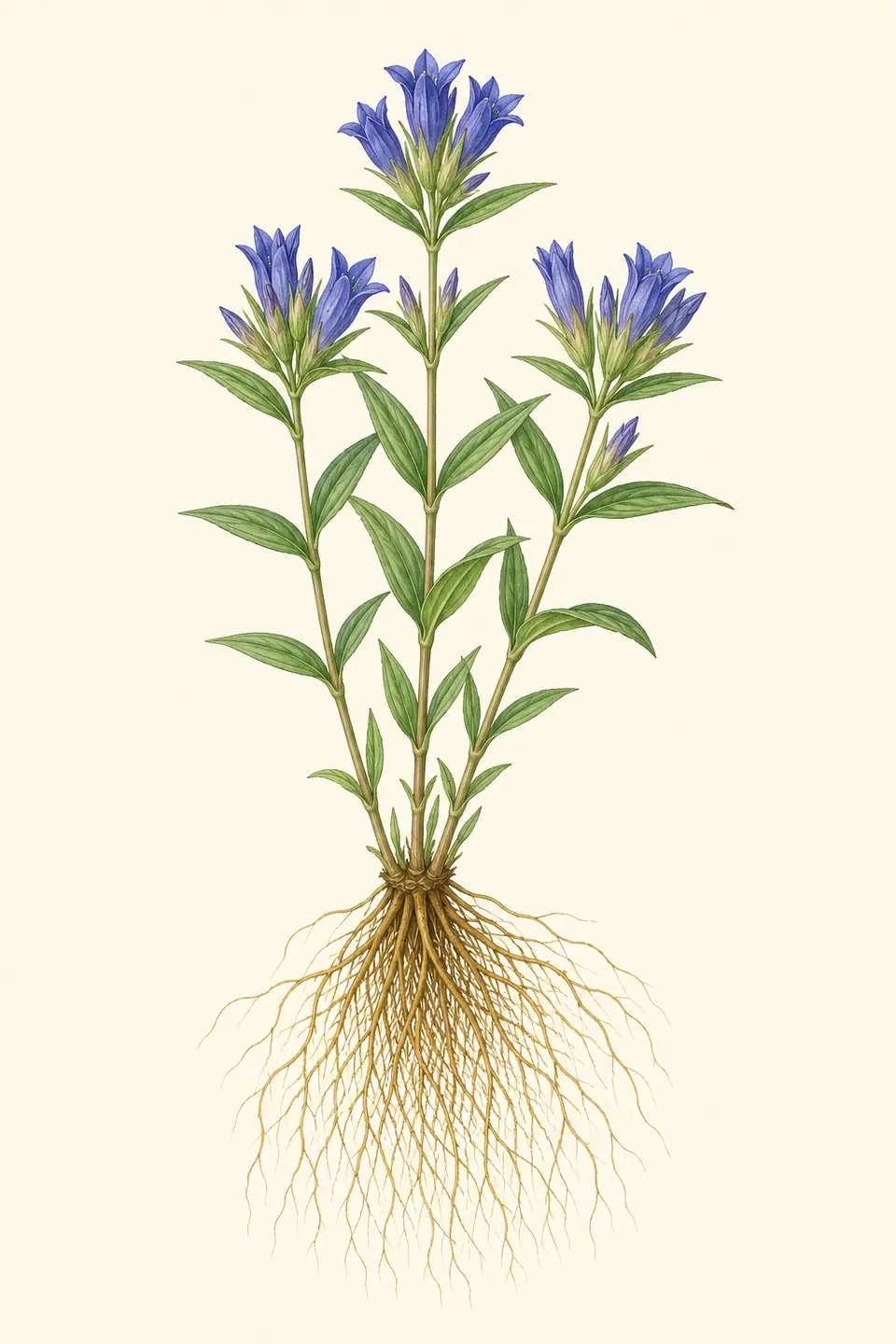
Dragon's Gallbladder, Neungyu, The Weight of Bitterness that Extinguishes Fire
The name of Gentiana scabra (Yongdamcho, Gentiana scabra) as described in the Bencao Gangmu and Dongui Bogam, fully reflects its medicinal properties. It was called 'Yongdam' because its leaves resemble those of Solanum nigrum and its taste is as bitter as a gallbladder. In classical texts, it was known by various aliases such as Neungyu, Godam, and Gwaneumcho. It was a widely known medicinal herb even during the Joseon Dynasty, as recorded in the 'Geography' section of the Annals of King Sejong, noting its production as a local product in Chungcheong, Gyeongsang, Hamgil, Hwanghae, and Pyeongan provinces. According to the Dongui Bogam and Bencao Gangmu, it was harvested in the 2nd, 8th, 11th, and 12th lunar months, and the roots were soaked in a decoction of licorice overnight before being dried in the sun.
Many believe that 'bitter medicine damages the stomach,' but the bitterness of Gentiana scabra is not a simple irritant; it is the key pathway for draining excess heat (Sil-hwa) from the liver and gallbladder. The Traditional Knowledge Portal of Korea records its properties as bitter, cold, and non-toxic, acting on the liver, gallbladder, and stomach meridians, summarizing its efficacy as 'draining liver and gallbladder fire' and 'clearing heat and drying dampness.' In other words, Gentiana scabra is a medicinal herb that dries excessive heat and dampness in the body and extinguishes the 'fire' of the liver and gallbladder. Therefore, it has been traditionally used for symptoms such as red, bloodshot, and painful eyes; tinnitus or dizziness; and liver meridian excess heat accompanied by constipation and difficulty urinating.
However, this strong potency is a double-edged sword. While the Danbo Myeongui Bangron explains Danggui Yonghoe-hwan by stating, 'Gentiana scabra enters the liver meridian directly to drain its fire,' it simultaneously warns, 'However, it must not be used lightly if it is not excess heat.' Classical texts and subsequent guides consistently point out that it may impair digestion in those with a deficient and cold spleen and stomach, and long-term or excessive intake may lead to headaches, facial flushing, and digestive disorders. Therefore, the key is how much, for whom, and within which prescription Gentiana scabra is used. This page will guide you through those criteria step by step.
Summary at a Glance
First, we have summarized the core identity and precautions for Gentiana scabra. This table alone will help you understand what kind of medicinal herb it is, where it acts, and what to be cautious of.
| Category | Content |
|---|---|
| Origin | Hanja name: 龍膽草, Scientific name: Gentiana scabra Bunge (Gentianaceae) |
| Medicinal Part | Root and rhizome (Yongdam, 龍膽) |
| Properties and Meridian Tropism | Bitter, Cold, Non-toxic; acts on the Liver, Gallbladder, and Stomach meridians |
| Representative Aliases | Yongdam, Godam, Neungyu, Choyongdam, Gwaneumcho |
| Efficacy Recorded in Literature | Draining liver and gallbladder excess heat, clearing heat and drying dampness |
| Key Combinations | Sacheong-hwan, Danggui Yonghoe-hwan, Samul Yongdam-tang, Haengin Yongdamcho-posan, etc. |
| Combinations and Contraindications | Contraindicated for those with a deficient and cold spleen and stomach constitution or symptoms that are not excess heat; simultaneous use with tonic medicines for supplementing Yang or Yin requires a professional diagnosis of the condition |
Is this medicinal herb right for me?
Gentiana scabra is a cold and bitter medicinal herb whose primary actions are draining liver and gallbladder fire and clearing heat and drying dampness. Because its properties are strong and cold, it is important to consider whether the constitution and symptoms are 'excess' (Sil) or 'deficient' (Heo) before taking it. You can first gauge this based on the following three criteria.
- Generally suitable cases: Patterns appearing as liver and gallbladder excess heat, bloodshot and hot eyes, dizziness and tinnitus, a feeling of tightness and heat in the chest and sides, or cases accompanied by difficulty urinating or constipation. In such states, a prescription containing Gentiana scabra may be considered when a Korean medicine doctor diagnoses it as an 'excess pattern' (Sil-jeung).
- Cases requiring caution: Even if symptoms are present, those who usually have a weak stomach with frequent diarrhea, or those with cold hands and feet and a lack of energy, may have a tendency toward a deficient and cold spleen and stomach from a Korean medicine perspective. Since Gentiana scabra has strong cold and bitter properties that may damage the gastrointestinal tract, it requires a professional judgment to adjust the dosage or combine it with other herbs. You must also consult a professional if you are pregnant, breastfeeding, or taking Western medications.
- Cases to avoid: A state of deficient and cold spleen and stomach, or cases appearing as a 'deficiency pattern' (Heo-jeung) rather than excess heat. Records indicate that using Gentiana scabra when there is no actual 'fire' can cause digestive disorders, headaches, and facial flushing, and in severe cases, may even lead to a tendency toward coma. Therefore, as a rule, Gentiana scabra should be used under the prescription of a Korean medicine doctor rather than through self-administration.
Practical Q&A
The Practical Q&A is organized around topics you might search for or be curious about before a consultation. These answers are intended to help you determine in which situations it is best to consult a Korean medicine doctor, rather than encouraging use without a prescription.
Can Gentiana scabra be brewed as a tea?
No. Gentiana scabra is a decoction herb where the root and rhizome are used medicinally. Rather than a simple tea, the principle is to decoct it according to a prescription or, as in classical methods, soak it in a licorice decoction before cutting and drying it. Self-administration is not recommended.
Can I use it when my eyes are bloodshot and feel hot?
It is true that Gentiana scabra is used in prescriptions related to the eyes. Haengin Yongdamcho-posan from the Jeungchi Junseung · Yuibang is an external agent used to wash the eyes by soaking Gentiana scabra, Coptis chinensis, and apricot kernels in a white decoction, used for wind-heat attacking the upper body and dry, red itching. Additionally, Samul Yongdam-tang from the Insul Pyeonnam was sometimes formulated for acute congestion and pain in the eyes. However, a diagnosis by a Korean medicine doctor is necessary to determine if the cause of the eye symptoms is liver meridian excess heat or another cause.
Can people with weak digestion take this?
Caution is required. Gentiana scabra has a strong cold nature and bitter taste, making it unsuitable for those with Spleen and Stomach Deficiency-Cold (脾胃虛寒). The 'Danbo Myeongui Bangron' also warns, “然非實火不可輕投”, meaning it should not be used lightly unless there is Excess Fire. If you experience abdominal pain, vomiting, or diarrhea after intake, stop immediately and visit a hospital.
Can I take it together with restorative medicines like Gongjindan or Gyeongokgo?
Direct official evidence has not been confirmed. According to Korean medicine theory, Gentiana scabra is a cold-natured herb used to drain fire and clear heat and dry dampness, while Gongjindan and Gyeongokgo are restorative medicines with warming and tonifying properties. Therefore, if the symptoms are Excess Fire or Damp-Heat, the simultaneous use of restorative medicine requires the judgment of a Korean medicine doctor. If you wish to use them together, please be sure to mention this during your consultation.
Can it be used during pregnancy?
Official clinical studies or official Korean guidelines supporting safety during pregnancy and lactation have not been secured. As it is a medicinal herb with a strong cold nature and bitter taste, consultation with a healthcare provider is essential during pregnancy and lactation, and it is advisable not to take it based on your own judgment.
What symptoms may appear if taken in excess?
While official clinical reports have not been confirmed, a Korean medicine column in commercial media records that “when taken in large quantities, it may cause digestive disorders leading to headaches, facial flushing, and a tendency to fall into a coma, so caution is required during intake.” Since this is from a commercial media source, it cannot be used as a sole diagnostic criterion; however, if headaches, dizziness, facial flushing, decreased consciousness, or acute digestive disorders occur after intake, an immediate visit to a hospital is necessary.
Relationship with Other Medicinal Herbs (Yakdae/Pairing)
Gentiana scabra is rarely used alone. In Korean medicine, pairing herbs with different properties is called 'Yakdae' (藥對). Since Gentiana scabra has a strong power to drain fire and clear heat and dry dampness, its effect becomes more distinct when used with other herbs. Below are representative combinations found in classical texts.
- Gentiana scabra + Angelica gigas + Cnidium officinale + Gardenia jasminoides + Rheum palmatum + Oshada rhizome + Saposhnikovia divaricata Sacheong-hwan (瀉靑丸, also known as Ryanggan-hwan): A prescription recorded in the 'Dongui Bogam' and 'Bencao Gangmu'. It is formulated so that Gentiana scabra drains Excess Fire in the Liver Meridian, Angelica gigas and Cnidium officinale support blood and qi, Gardenia jasminoides and Rheum palmatum direct heat downwards, and Notopterygium incisum and Saposhnikovia divaricata release wind-heat. It is traditionally administered by kneading the powder with honey or dissolving it in Bamboo Leaf Decoction (竹葉湯).
- Gentiana scabra + Angelica gigas + Coptis chinensis + Phellodendron amurense + Scutellaria baicalensis + Gardenia jasminoides + Rheum palmatum + Aloe + Indigo Naturalis + Aucklandia lappa + Musk Danggui Yonghoe-hwan (當歸龍薈丸): A prescription listed in 'Bencao Gangmu' and compiled in 'Danbo Myeongui Bangron'. It has been traditionally used for dizziness, tinnitus, spasms, constipation, urinary difficulty, and hypochondriac pain caused by Excess Fire in the Liver Meridian, with Gentiana scabra serving as the chief herb that “enters the Liver Meridian directly to drain its fire.”
- Gentiana scabra + Angelica gigas + Cnidium officinale + Paeonia lactiflora + Rehmannia glutinosa + Oshada rhizome + Saposhnikovia divaricata + Stephania tetrandra Samul Yongdam-tang (四物龍膽湯): A prescription in 'Insul Pyeonnam', traditionally used when the eyes suddenly become red and swollen with cloud-like opacities (雲翳) and there is severe pain due to blood stasis (瘀血).
- Gentiana scabra + Angelica gigas (tail) + Coptis chinensis + Phellodendron amurense + Apricot kernel + Red Paeonia lactiflora Haengin Yongdamcho Po-san (杏仁龍膽草泡散): An external medication listed in 'Jeungchi Junseung · Yuifang'. It is used by soaking the herbs in boiled water to wash the eyes, with Gentiana scabra and Coptis chinensis acting as the chief herbs to “remove heat toxins through bitterness and coldness.”
As Gentiana scabra is a medicinal herb with a clear direction of draining fire and clearing heat, the distinction between Excess and Deficiency (實虛) of symptoms must be accurately determined when used with restorative or warming-tonifying prescriptions. Use is contraindicated for those with a Spleen and Stomach Deficiency-Cold (脾胃虛寒) constitution or in cases that are not Excess Fire; the 'Danbo Myeongui Bangron' also warns, “然非實火不可輕投”, meaning it should not be used lightly unless there is Excess Fire.
In what form is it consumed?
Gentiana scabra is a medicinal herb where the root and rhizome are used. Because of its strong taste and cold nature, the principle is to take it as a decoction or according to a Korean medicine doctor's prescription, rather than consuming it lightly like tea or food. Explanations for each form are provided below.
- Drinking as tea: Not common. Gentiana scabra is a root herb, and it is more common to consume it as a decoction prepared according to a prescription rather than as a simple boiled tea.
- Adding to food: Not common. In the Traditional Knowledge Portal of Korea and classical records, Gentiana scabra is classified as a medicinal herb, and no cases of consumption in food form have been confirmed.
- Consumption as a decoction (jeontang): Correct. The basic premise in classical texts is to soak Gentiana scabra in licorice decoction juice, cut it into small pieces and decoct it, or use it as a herbal medicine decoction according to a prescription.
- Take only with a professional prescription: Correct. Since it is necessary to distinguish whether there is Spleen and Stomach Deficiency-Cold (脾胃虛寒) and whether the fire is Excess Fire (實火) or Deficiency Fire (虛火), it should be used under the prescription of a Korean medicine doctor rather than through self-administration.
Interactions and Safety During Use
Gentiana scabra is a cold-natured, bitter-tasting herb whose primary actions are draining Liver and Gallbladder fire and clearing heat and drying dampness. Because its properties are strong and cold, it is important to consider the constitution and the Excess or Deficiency (實虛) of symptoms before intake. You can first gauge this based on the following three criteria.
- In case of Excess Fire (實火): If the face is flushed red, the eyes are bloodshot, accompanied by headaches or tinnitus, or if constipation, urinary difficulty, and hypochondriac pain (胸脇痛) appear together, Liver and Gallbladder Excess Fire may be suspected from a Korean medicine perspective. In such situations, prescriptions containing Gentiana scabra have been used in classical texts.
- Deficiency patterns (虛證) or Spleen and Stomach Deficiency-Cold (脾胃虛寒) constitution: It is not suitable for individuals with cold hands and feet, weak digestion, frequent diarrhea, or those who fatigue easily. According to records in the Traditional Knowledge Portal, it is contraindicated for those with deficiency-cold of the spleen and stomach.
- Pregnancy and lactation period: Official clinical epidemiological studies or official Korean guidelines supporting the safety of Gentiana scabra during pregnancy or breastfeeding have not been identified. As it is a medicinal herb with strong cold properties and a bitter taste, please be sure to consult a Korean medicine doctor during pregnancy or breastfeeding.
Regarding interactions between Gentiana scabra and Western medicines, direct evidence of specific interactions has not been secured from official drug interaction databases such as the Ministry of Food and Drug Safety, Korea Pharmaceutical Safety Information Center, or PubMed. However, from a Korean medicine perspective, it is a medicinal herb with strong cold properties and a distinct fire-draining effect; therefore, the concurrent use of current Western medications or other restorative herbal medicines (Boyak) requires the judgment of a Korean medicine doctor. In particular, when used simultaneously with restorative medicines of a warming and tonifying nature, such as Gongjindan or Gyeongokgo, it is recommended to consult a professional to accurately distinguish whether the symptoms are due to excess-fire or damp-heat.
There are commercial media records stating that excessive intake may lead to digestive disorders, headaches, facial flushing, or a tendency toward coma; however, as these are not official clinical reports, please use them for reference only. If you experience abdominal pain, vomiting, diarrhea, headache, dizziness, facial flushing, a tendency toward decreased consciousness, or weight loss, decreased appetite, and increased fatigue during long-term use, please stop taking the medicine and visit a hospital.
As a rule, Gentiana scabra should be used after a Korean medicine doctor confirms whether the patient has an excess pattern (Sil-jeung) requiring fire-draining, whether the spleen and stomach are not deficient, and whether concurrent use with other medications is appropriate, rather than being self-administered without a prescription. If you provide information about your current medications, constitution, and symptoms during the consultation, we will determine if a prescription containing Gentiana scabra is appropriate.
If you experience these symptoms
Gentiana scabra is a medicinal herb with cold properties and a bitter taste, possessing the effects of draining liver and gallbladder fire and clearing heat and drying dampness. Because its properties are strong and cold, taking it based on a wrong judgment of the excess or deficiency (Sil-Heo) of one's constitution or symptoms may instead affect digestive function and general systemic condition. The following signals are known warning signs that may appear when Gentiana scabra is taken in excessive or inappropriate amounts. If these symptoms occur, do not reduce the dose or stop on your own; please notify the prescribing Korean medicine doctor first.
- Acute digestive disorders such as abdominal pain, vomiting, and diarrhea
- Headache, dizziness, facial flushing
- Decreased consciousness or tendency toward coma
- Weight loss, decreased appetite, and increased fatigue during long-term use
In particular, those who are pregnant or breastfeeding, those with a weak spleen and stomach, or those who appear to have a deficiency pattern (Heo-jeung) rather than excess-fire (Sil-hwa) must be more cautious in using Gentiana scabra. If the above symptoms appear severely or progress rapidly, it is safe to visit an emergency medical institution.
Differences from other restorative medicines
When trying to understand in which situations Gentiana scabra is appropriate, many people compare it with Gongjindan or Gyeongokgo, which are commonly known as 'restorative medicines' (Boyak). Gentiana scabra is a medicinal herb with cold properties and a bitter taste intended for draining liver and gallbladder fire and clearing heat and drying dampness. In other words, rather than having a tonifying (Bo) nature that fills deficiencies, it is closer to a draining (Sa) and clearing (Cheong) nature that lowers and organizes excess-fire and damp-heat of the liver and gallbladder. Gongjindan and Gyeongokgo are prescriptions with a strong warming and tonifying nature for supplementing Qi and Blood, which can be seen as having the opposite direction of action compared to Gentiana scabra.
For this reason, according to Korean medicine theory, one must be cautious about using restorative medicines and Gentiana scabra together when excess-fire or damp-heat is present. This is because the choice differs depending on whether the current symptoms are an excess pattern (Sil-jeung) characterized by high heat and oppression, or a deficiency pattern (Heo-jeung) characterized by lack of energy and coldness. However, official literature or clinical research supporting the concurrent use or antagonistic relationship between Gentiana scabra and restorative medicines such as Gongjindan and Gyeongokgo requires further verification. If you mention your symptoms and any restorative medicines you are taking during the consultation, we will evaluate the excess or deficiency (Sil-Heo) of your constitution and symptoms to guide you in the appropriate direction.
References
- Evidence material 1 regarding Gentiana scabra: GBIF plant classification data.
- Evidence material 2 regarding Gentiana scabra: PubMed academic paper.
- Evidence material 3 regarding Gentiana scabra: PubMed academic paper.
- Evidence material 4 regarding Gentiana scabra: PubMed academic paper.
- Evidence material 5 regarding Gentiana scabra: PubMed academic paper.
- Evidence material 6 regarding Gentiana scabra: NCBI original academic data.
If you would like to check if this medicinal herb is right for you or which prescription it should be used with, please leave a medical inquiry. For those who find it difficult to visit the clinic, non-face-to-face consultations are available; we will provide guidance after first reviewing your current condition and current medications.

Medical Staff Review
Director Choi Yeon-seung
Chief Director of Baekrokdam Korean Medicine ClinicGentiana scabra Dictionary Entry, reviewed the safety of expressions and the scope of verification before administration.
Review Scope: Clinical Accuracy, Pharmacology, Contraindications, Combinations, QA · Last Reviewed 2026-08-16
- Graduated from Kyung Hee University College of Korean Medicine
- Providing Korean medicine treatment since 2010
- Consultations for Gongjindan, Gyeongokgo, Nokyong (Deer Antler) restorative medicine, and customized restorative herbal medicine