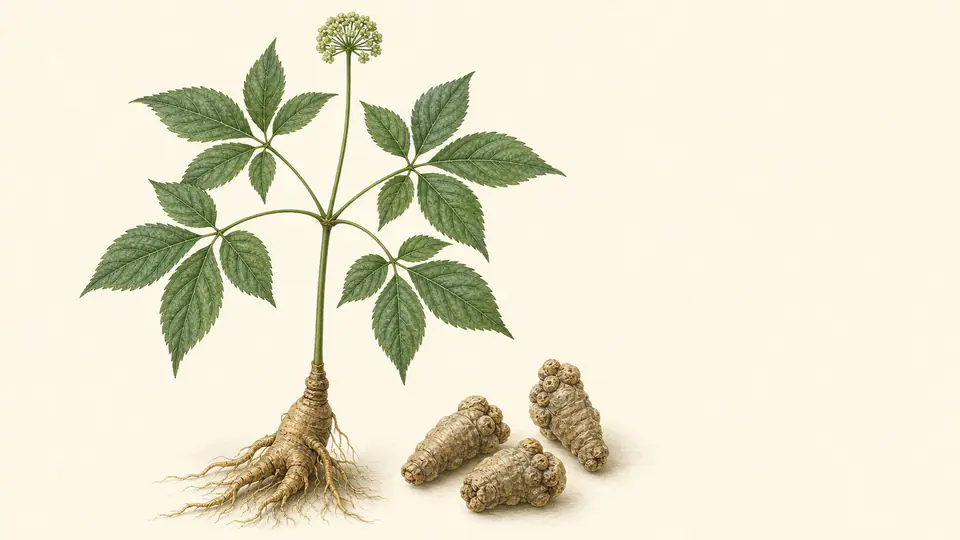
A root resembling ginseng: three stories under one name
Can I take Sanqi powder with medication for blood circulation or vascular health? In short, you must consult a medical professional before combining them. Although Sanqi sounds similar to ginseng, it is not the same raw material, and commercially available powders are not the same as total saponin preparations studied in hospitals. In particular, because of the expectation that it aids blood flow, it may be inadvertently taken alongside anticoagulants or antiplatelet agents; the impact on bleeding when used in combination must be verified first.
Then, under the single name of Sanqi, in what order should we distinguish between species, formulation, and bleeding risk?
What exactly is Sanqi?
The herbal medicine standards of the Ministry of Food and Drug Safety define Sanqi as the root and rhizome of Panax notoginseng. It is also called Jeonchil or Sanqigen. The important point is that while it belongs to the Panax genus like ginseng (P. ginseng) and American ginseng (P. quinquefolius), it is a different species. Therefore, experiences with ginseng or American ginseng cannot be directly applied to Sanqi.
Furthermore, raw roots/powders, Sanqi total saponin tablets/injections, and isolated Notoginsenoside R1 components do not all share the same raw materials or evidence base.
Hemostasis and blood flow: seemingly opposite images
Traditionally, Sanqi carries both images of hemostasis (stopping bleeding) and promoting blood flow. At first glance, this may seem contradictory. However, what is important regarding this material is not the image itself, but how that image has been handled in modern research. A significant portion of human studies involves adding Sanqi total saponin preparations to existing treatments in Chinese clinical settings. This cannot be interpreted as having the same effect as taking commercially available powder alone.
Powder and total saponin preparations are different paths
The first thing to distinguish when encountering Sanqi is the product form. Raw roots or powders are in the form of the crude herbal medicine. In contrast, Sanqi total saponins are formulations where specific component groups are concentrated and purified, and have been studied in the form of injections or tablets. A 2024 pharmacological and toxicological review notes that while preclinical activity is diverse, there are few clinical trials confirming therapeutic characteristics, and it is primarily summarized as an adjuvant therapy for standard cardiovascular treatment.
Meta-analyses of oral Sanqi total saponins for unstable angina also collected studies where it was added to existing treatments; due to trial quality and reporting limitations, it is difficult to translate these results to the effect of general powder alone. Meta-analyses of acute ischemic stroke also occur within the context of specific total saponin preparations and hospital treatment, and do not replace emergency care.
Reviews of Notoginsenoside R1 indicate that evidence remains primarily in cell and animal studies, and high-quality clinical trials are necessary. In other words, expectations for a single component have not yet been established in humans.
When taking with anticoagulants or antiplatelet agents
Due to expectations regarding blood flow, there is a risk of arbitrarily combining Sanqi with anticoagulants, antiplatelet agents, or nonsteroidal anti-inflammatory drugs (NSAIDs). Human data on the effect on bleeding for each specific product must be verified when used in combination, and if surgery or a procedure is pending, the product must be disclosed to the medical staff.
If new one-sided paralysis, slurred speech, chest pain, cold sweats, or difficulty breathing occur, this is not a situation for taking Sanqi; an immediate 119 evaluation takes priority. If unstoppable bleeding, vomiting blood, bloody stools, black stools, severe headache, or changes in consciousness occur, stop use and receive an emergency evaluation.
Which personal circumstances should be checked first?
It is recommended to check the following before considering Sanqi.
| Checklist Item | Reason |
|---|---|
| Whether it is a raw root/powder, or a total saponin tablet/injection | Different formulations and evidence exist under the same name. |
| Whether it is mixed with ginseng or American ginseng | Other species of the Panax genus are not the same raw material as Sanqi (Notoginseng). |
| Whether anticoagulants, antiplatelet agents, or NSAIDs are being taken | The risk of bleeding may increase. |
| Scheduled surgery or procedure | You must inform your medical staff about the product in advance. |
| Bruising, nosebleeds, gum bleeding, bloody stools, or black stools | You must check for signs of bleeding. |
| Symptoms of stroke or angina | You must first determine if it is an emergency situation. |
Human safety data regarding pregnancy, lactation, children, long-term high-dose use, and concomitant use of multiple medications are insufficient. This should also be considered when making a choice.
The Gap Between Human Evidence and Expectations
Expectations for Sanqi are high, but evidence in humans is still limited. According to a 2024 review, while preclinical activity is diverse, there are few clinical trials confirming therapeutic characteristics. Meta-analyses were also conducted within the context of specific preparations and hospital-centered settings. Therefore, it is difficult to assume that commercially available powders will replace medications for cardiovascular and cerebrovascular diseases or replicate their effects exactly.
Differences from Ginseng and American Ginseng
Sanqi belongs to the Panax genus, like ginseng and American ginseng, but it is a different species. This difference is not merely a taxonomic issue. The three materials each have different evidence and contexts of use. If you base your understanding of Sanqi on the image of ginseng or American ginseng, you may miss key points such as the formulation, total saponin content, and drug interactions related to bleeding.
Realistic criteria to check today
When choosing Sanqi, it is more important to verify the exact species, formulation, total saponin content, and bleeding-related medications than to rely on the familiarity of it being a type of ginseng. The standard for handling this material is to avoid equating clinical trials of combined use with the therapeutic effects of self-administered powders.
Ultimately, Sanqi is a material where several different narratives coexist under one name. The way to clarify that name is simple: first distinguish whether it is the raw root or a total saponin preparation, which medications are being taken with it, and whether your current symptoms are an emergency.
References
- Ministry of Food and Drug Safety Crude Drug Standard: Sanqi.
- Panax notoginseng pharmacology and toxicology review.
- Oral Panax notoginseng saponins for unstable angina: systematic review.
- Panax notoginseng saponins for acute ischemic stroke: systematic review.
- Notoginsenoside R1 pharmacology systematic review.
This text explains the origin of the raw materials, the scope of research, and precautions before consumption. As this cannot replace individual diagnosis or treatment, please consult a medical professional if you are taking medication or if symptoms persist. If sudden and severe symptoms such as difficulty breathing or decreased consciousness occur after consumption, seek help from 119 or the emergency room.

Medical Staff Review
Director Choi Yeon-seung
Chief Director of Baekrokdam Korean Medicine ClinicSanqi Dictionary Entry, reviewed the safety of expressions and the scope of verification before administration.
Review scope: Ingredient origin, human studies, concomitant medications, safety of intake · Last reviewed 2026-08-17
- Graduated from Kyung Hee University College of Korean Medicine
- Providing Korean medicine treatment since 2010
- Consultations for Gongjindan, Gyeongokgo, Nokyong (Deer Antler) restorative medicine, and customized restorative herbal medicine