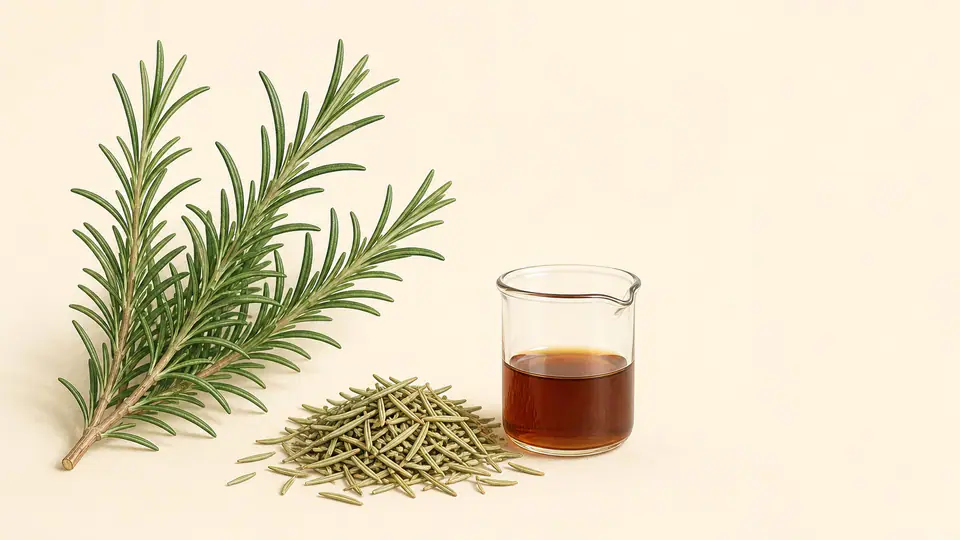
Three diverging paths behind the name 'Herb of Remembrance'
Should rosemary, which is said to be good for memory or digestion, be consumed as a tea, inhaled as a scent, or taken as a capsule? In short, even if they come from the same raw material, they are often not the same. Tea brewed from leaves, the experience of inhaling the scent, and concentrated essential oils or capsules each have different components and delivery methods to the body, making it difficult to apply the results of one study directly to another formulation.
Rosemary is an evergreen shrub in the Lamiaceae family; its scientific name has changed from the old Rosmarinus officinalis to Salvia rosmarinus. Both scientific names appear together in data and labels, and you will soon see that this is not just a matter of nomenclature. This is because leaves and essential oils, food-grade and product-grade, and traditional use and clinical evidence follow different paths even under the same name.
Rosemary: Multiple exposure routes, not a single type
There are many ways to encounter rosemary: leaves in food, herbal teas, leaf powder, extracts, rosemary water, essential oils, scent inhalation, and bath products. These differ in their main components, dosages, and exposure routes. Rosmarinic acid or carnosic acid are the focus in leaves, while 1,8-cineole or camphor are highlighted in essential oils. However, these are not the same formulations, and research on inhaling the scent cannot be applied to oral capsules. In other words, when someone says 'rosemary is good,' you must first ask which type of rosemary they are referring to.
Where did the nickname 'Herb of Remembrance' come from?
The reason rosemary is called the 'Herb of Remembrance' is due to a combination of cultural symbolism and fragrance experiments. As some studies on inhaling the scent reported changes in certain cognitive task scores, this easily expanded into claims of memory improvement or dementia prevention. However, the experience of inhaling a scent differs from ingestion and absorption. A change in a single task score is on a different level from treating memory impairment. This nickname is the start of a question, not the conclusion.
What cognitive studies have shown, and what have they not?
In a single trial of 80 healthy adults, small signals in certain cognitive and cerebral blood flow indicators were observed after using a specific rosemary water. However, this was merely an acute result from among several tasks and does not imply long-term memory improvement or dementia prevention. In a one-month trial of 68 college students, changes in memory and mood questionnaires were reported with a specific leaf powder, but the scale was small and difficult to generalize to other ages, diseases, or formulations. Rather than concluding that these are 'effective,' it is more accurate to read these two studies as observing small signals under specific conditions.
What the EMA recognizes and what it does not
Recognition of traditional herbal medicines in Europe is limited to specific leaf tea and bath formulations based on long-term use. The EMA recognizes that rosemary leaf tea has been traditionally used for dyspepsia and mild gastrointestinal spasms, and bath additives for mild muscle and joint pain. However, it explicitly states that this does not mean there is sufficient evidence from clinical trials. Furthermore, this recognition is not an approval for memory improvement. This is why it is important to remember the gap between traditional use and clinical proof.
Leaf tea, essential oils, or capsules: Which one to choose?
The choice depends on the purpose. If the goal is digestive discomfort, there is the context of leaf tea, which is subject to EMA traditional recognition; for mild muscle or joint pain, bath additives fall within the scope of traditional use. On the other hand, if you choose capsules or essential oils expecting memory or concentration benefits, the evidence consists only of small-scale studies limited to products other than leaf tea or bath formulations. Because the absorption and exposure differ between inhaling the scent, eating leaves, and applying essential oils to the skin, one result cannot be grouped as the overall efficacy of rosemary.
How to consider concurrent medications and individual circumstances
Small amounts used in food must be distinguished from extracts and essential oils. There is insufficient data on drug interactions for long-term, high-dose products. EMA guidelines for traditional herbal medicines advise against use during pregnancy, lactation, and in children under 12, and suggest avoiding oral use if there is bile duct obstruction, cholecystitis, gallstones, or liver disease. Since allergies to rosemary leaves or fragrances, and contact dermatitis from essential oils or cosmetics can occur, do not ingest concentrated essential oils or apply them to damaged skin. If you are taking multiple medications, it is better to organize the purpose and formulation of your medications first and then consult a professional.
At what signs should you stop and seek medical evaluation?
If severe abdominal pain, jaundice, persistent vomiting, difficulty breathing, or systemic allergic symptoms appear, stop use and seek medical evaluation. If memory decline progresses rapidly, or if you experience getting lost, decline in daily functioning, or sudden confusion, do not simply monitor the situation with supplements. Because the causes of memory decline are diverse, including sleep, depression, medication, thyroid issues, nutrition, and neurological diseases, it is important not to delay evaluation and treatment by relying on rosemary.
Rosmarinus officinalis and Salvia rosmarinus: The Blurred Boundary of Names
Rosemary's classification has changed from the old scientific name Rosmarinus officinalis to the genus Salvia, so both scientific names appear together in data and on labels. You may encounter products where the scientific name is written differently even though they refer to the same plant. This is not simply a matter of having two names, but a signal that labels and research papers must be cross-referenced to verify the identity of the raw material.
Realistic criteria to check today
Rather than relying on the nickname 'herb of remembrance,' verify the plant part, formulation, route of exposure, and purpose of use. First, consider the gap between signals from small short-term tasks and the treatment of diseases, as well as the safety of essential oils regarding the bile duct, liver, and pregnancy. In other words, shouldn't we ask which type of rosemary is being used, through which route, what the expectations are, and whether it is safe for one's specific health condition?
References
- EMA: Rosmarini folium herbal medicinal product.
- Kew Plants of the World Online: Salvia rosmarinus.
- Acute rosemary water and cognition in healthy adults: randomized trial.
- Rosemary and memory, mood and sleep in university students: randomized trial.
This text explains the origin of the raw materials, the scope of research, and precautions before consumption. As this cannot replace individual diagnosis or treatment, please consult a medical professional if you are taking medication or if symptoms persist. If sudden and severe symptoms such as difficulty breathing or decreased consciousness occur after consumption, seek help from 119 or the emergency room.

Medical Staff Review
Director Choi Yeon-seung
Chief Director of Baekrokdam Korean Medicine ClinicRosemary Dictionary Entry, reviewed the safety of expressions and the scope of verification before administration.
Review scope: Ingredient origin, human studies, concomitant medications, safety of intake · Last reviewed 2026-08-17
- Graduated from Kyung Hee University College of Korean Medicine
- Providing Korean medicine treatment since 2010
- Consultations for Gongjindan, Gyeongokgo, Nokyong (Deer Antler) restorative medicine, and customized restorative herbal medicine