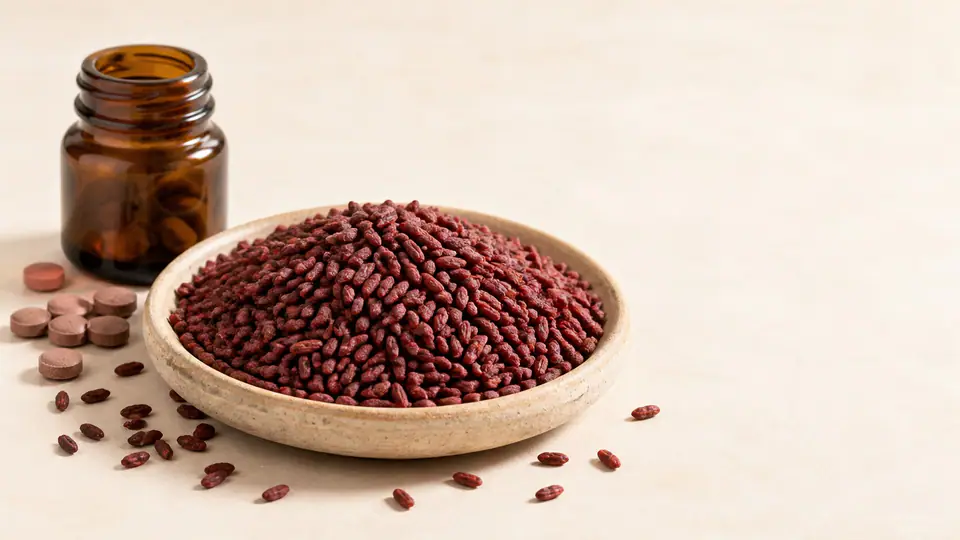
When Rice Turns Red and the Same Molecule Is Called by a Different Name
I experienced muscle pain while taking statins; if I switch to red yeast rice, which is called natural, can I lower my cholesterol more safely?
In short, it is not that simple. While red yeast rice may seem accessible as a 'food,' Monacolin K, the key ingredient that lowers cholesterol, is structurally the same molecule as the prescription drug lovastatin. It blocks the same target, carries the same potential for side effects, and requires the same precautions.
There are three gaps between the fermentation that turns rice red and the capsules that lower cholesterol. Traditional fermented foods versus concentrated extracts, the raw material weight on the label versus the actual Monacolin K content, and the reduction of LDL levels versus long-term cardiovascular outcomes are each different issues.
Why Red Yeast Rice Becomes Attractive After Experiencing Statin Intolerance
Muscle pain is one of the common complaints during statin use. However, is all muscle pain necessarily caused by statins? Various causes, such as thyroid function, interactions with other medications, changes in exercise levels, and dosage, must be evaluated first. Switching to red yeast rice without consulting a healthcare provider is not recommended.
In these situations, red yeast rice feels like a 'natural alternative.' This is because the image of a food made red by fermenting rice with filamentous fungi feels gentle. However, looking at the identity of the raw material, this image is only partially correct.
What Red Yeast Rice Is: Fermented Rice and the Monacolin K Within
Red yeast rice is Monascus purpureus a food or raw material made red by fermenting rice with the same filamentous fungi. Traditional fermented foods consumed historically are not the same as modern concentrated red yeast rice extracts. The latter is intentionally produced to obtain specific ingredients in much higher concentrations.
Among these, Monacolin K is a substance that blocks the cholesterol synthesis enzyme. The NCCIH explains that Monacolin K is structurally identical to lovastatin and that red yeast rice with sufficient content can lower cholesterol. At the same time, it points out that it is difficult for consumers to know the actual content from the label alone.
'Red yeast rice' sounds like a food, but 'Monacolin K' sounds like a drug ingredient. Both names coexist within the same raw material.
What the Term 'Natural Statin' Does and Does Not Mean
Red yeast rice containing sufficient Monacolin K is not a mild food ingredient separate from statins. It is the same molecule as lovastatin and shares the same target, potential side effects, and potential interactions. However, the modifier 'natural' can obscure this fact.
Being natural does not mean the risks disappear. Red yeast rice containing Monacolin K can cause muscle pain, liver damage, and in rare cases, rhabdomyolysis and kidney damage, just like statins. Therefore, it should not be taken concurrently with statins.
Actual Pharmacological Ingredients Varied by More Than 60 Times Despite Same Raw Material Weight
Even if the weight of the red yeast rice raw material is the same, the monacolin K content can vary significantly or be completely absent depending on the strain, fermentation, and processing. In an analysis of 28 products sold in the US, the monacolin K content per 1,200 mg of red yeast rice varied by more than 60 times, ranging from undetectable to 5.48 mg, and none of the labels indicated the actual amount.
This is the core challenge in choosing red yeast rice. The 'red yeast rice raw material mg' that consumers see is different from the actual 'monacolin K mg'. It is impossible to know how strong the effect will be based solely on the raw material weight listed on the label.
In other words, some products may have almost no effect, while others may correspond to an unintended drug dosage.
Research on lowering LDL is not the same as commercially available products
A 2024 meta-analysis of 14 double-blind trials reported that LDL decreased by an average of approximately 35.8 mg/dL over 4 to 24 weeks using a specific extract. However, this result was derived from a specific extract. Product standardization and long-term cardiovascular outcomes are separate issues.
Research on specific standardized extracts that lowered cholesterol cannot be applied directly to commercial products that have different monacolin content and contamination tests. A decrease in LDL levels does not automatically guarantee the prevention of myocardial infarction or stroke.
Active ingredients and contaminants produced by fermentation coexist
Fermentation does not produce only the desired components. A byproduct called citrinin can be produced during the fermentation of red yeast rice. The NCCIH explains that citrinin in some red yeast rice products can damage the kidneys.
Rather than relying solely on 'citrinin not detected' labels, it is advisable to check independent test results and manufacturing lot information. However, a test report does not substitute for whether the monacolin dose is appropriate for actual intake. It is possible for a product to be free of contamination but have a pharmacological dose that is too low, or conversely, have a high pharmacological dose but lack other safety data.
When taking with or instead of statins
Taking red yeast rice together with statins increases the risk due to overlapping effects. If statin intolerance is suspected, it is safer to discuss alternative statin or non-statin treatments with your prescriber rather than arbitrarily switching to red yeast rice.
Do not use if you are pregnant, breastfeeding, or planning pregnancy. Arbitrary intake should also be avoided if you have liver or kidney disease or consume significant amounts of alcohol. If you are taking other prescription medications such as lipid-lowering drugs or immunosuppressants, you must confirm with a healthcare provider.
What signals indicate you should stop
If you experience severe systemic muscle pain, decreased muscle strength, dark brown urine, decreased urine output, jaundice, or persistent vomiting, stop use immediately and seek evaluation at an emergency room or from a healthcare provider. These signals apply equally to those taking statins as well as red yeast rice.
Selection Criteria: What should you check?
When choosing a product, you should look for the total amount of monacolin and monacolin K, and whether citrinin test results are disclosed, rather than the daily red yeast rice raw material mg. You should also review the name and dose of current or past statins, the presence of muscle pain, CK levels, liver function tests, and whether the diagnosis of statin intolerance was accurate.
A safety meta-analysis of 53 randomized trials found no increase in muscle or serious adverse reactions in short-term trials; however, the EFSA stated that it could not determine a safe monacolin intake level due to the possibility of serious side effects. The FDA maintains that red yeast rice products fortified with or containing lovastatin cannot be sold as dietary supplements in the US.
Final Decision Criteria
Red yeast rice earned the name 'natural statin' because the fermentation that turns rice red produces molecules that block cholesterol synthesis enzymes. However, food and pharmacological extracts, label raw material weight and actual lovastatin-equivalent amounts, LDL levels and cardiovascular events, and fermentation active ingredients and citrinin contamination do not all move in tandem.
Rather than the name 'natural statin', the realistic criteria for evaluating this material are checking actual monacolin K and citrinin tests, reviewing previous statin side effects and current medications, and distinguishing between the LDL reduction of a specific extract and the long-term cardiovascular outcomes of an arbitrary product.
References
- NCCIH: Red yeast rice.
- FDA: Using carbon isotope ratios to detect adulteration in red yeast rice.
- Red yeast rice extract for hypercholesterolemia: systematic review and meta-analysis.
- Safety of red yeast rice: meta-analysis of randomized trials.
- Monacolin and citrinin variability in commercial red yeast rice products.
This text explains the origin of the raw materials, the scope of research, and precautions before consumption. As this cannot replace individual diagnosis or treatment, please consult a medical professional if you are taking medication or if symptoms persist. If sudden and severe symptoms such as difficulty breathing or decreased consciousness occur after consumption, seek help from 119 or the emergency room.

Medical Staff Review
Director Choi Yeon-seung
Chief Director of Baekrokdam Korean Medicine ClinicRed Yeast Rice Glossary, reviewed the safety of expressions and the scope of verification before administration.
Review scope: Ingredient origin, human studies, concomitant medications, safety of intake · Last reviewed 2026-08-17
- Graduated from Kyung Hee University College of Korean Medicine
- Providing Korean medicine treatment since 2010
- Consultations for Gongjindan, Gyeongokgo, Nokyong (Deer Antler) restorative medicine, and customized restorative herbal medicine