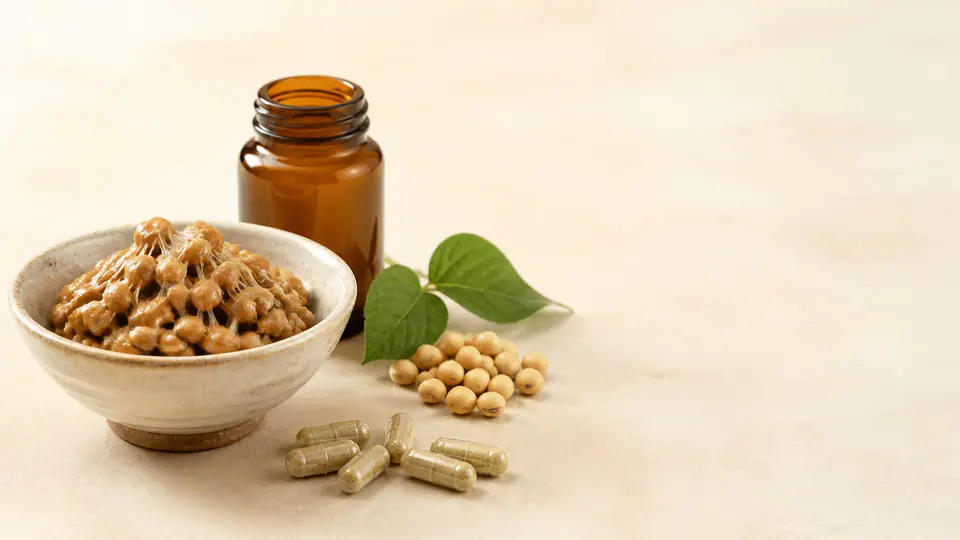
Enzymes derived from the stringy texture of natto
Can nattokinase, which is said to be good for preventing blood clots, be taken instead of or together with aspirin or anticoagulants? In short, it is correct not to do so. Nattokinase is a Bacillus subtilis proteolytic enzyme produced by a specific group of microorganisms; it is not an ingredient proven to be safe for replacing or using in combination with prescribed antithrombotic agents.
Because of its name and the way it breaks down fibrin in test tubes, it is easy to view it as a capsule that 'cleans' blood clots. However, a plate of fermented soybeans and a purified enzyme, FU and mg, changes in coagulation test markers and the actual prevention of myocardial infarction or stroke follow different paths. This article explores that point of divergence.
The distance held within the name
Nattokinase is a proteolytic enzyme discovered in the stringy viscosity of natto. Bacillus subtilis It is produced during the process where specific bacteria ferment soybeans. In test tubes, it was observed to break down fibrin, a fibrous mass, which led to the intuitive belief that it 'dissolves blood clots.'
However, there is a gap between the image suggested by the name and its actual role in the human body. The fact that it breaks down fibrin in a test tube or that coagulation and fibrinolysis markers changed for a few hours after a single dose is different from clinical results showing that it selectively dissolves clots in the body to prevent stroke or myocardial infarction. A shift in markers does not mean a reduction in events.
A plate of natto and one capsule
The term 'nattokinase' makes natto food and purified enzymes seem like the same thing.
A plate of natto contains various components such as soy protein, fermentation bacteria, and vitamin K2. In contrast, purified nattokinase products are formulations where the enzyme is isolated and purified to meet a specific enzyme activity. Because their compositions differ, research on natto food and research on supplements cannot be read as the same.
Additionally, the FU indicated on products stands for fibrinolytic units, which is a unit of enzyme activity. It cannot be read as a simple mg weight. The number 2,000 FU is merely an activity unit and is not automatically equal to the mg of raw material, the amount of natto intake, or the activity of products from other companies.
Small blood pressure signals and the void beyond
Many studies involving humans have focused on blood pressure. In a single crossover trial of 12 healthy men, some coagulation and fibrinolysis markers changed for a few hours after taking 2,000 FU, but this trial did not examine whether it treated blood clots or prevented events.
In a trial tracking 86 adults with prehypertension or stage 1 hypertension for 8 weeks, it was reported that systolic and diastolic blood pressure decreased slightly with 2,000 FU. However, the number of participants was small, and these are not long-term results that could replace therapeutic drugs. A meta-analysis of 546 people across 6 trials showed a signal that blood pressure decreased by an average of about 3.5/2.3 mmHg, but no improvement in lipids was confirmed, and the number of studies and products was limited.
Despite these small signals, trials involving more people over longer periods did not support the expectations. In a randomized trial tracking 265 low-risk adults for approximately 3 years, 2,000 FU did not improve carotid intima-media thickness, arterial stiffness, blood pressure, or coagulation and inflammation markers more than a placebo. This is where short-term marker changes and long-term arterial health outcomes diverged.
Why it cannot be placed alongside aspirin or warfarin
Then, what should be considered? The first thing to look at is the medication you are currently taking.
Nattokinase should not be used arbitrarily in combination with aspirin, clopidogrel, warfarin, or direct-acting anticoagulants, nor should it be used instead of prescribed medications. There is one reported case of cerebellar hemorrhage in a patient with cerebral microbleeds who was taking aspirin. While a single case cannot determine causality or incidence rates, it demonstrates that the safety of concurrent use with antithrombotic agents has not been established.
Natto foods are high in vitamin K, which presents separate issues when taken with warfarin. Whether purified products contain K2 must be verified via the label or testing. If you have a history of bleeding disorders, cerebral hemorrhage, or gastrointestinal bleeding, or if you have a scheduled surgery or procedure, notify your medical staff about the product and FU; do not arbitrarily decide when to stop use.
Concurrent Use, Surgery, and Individual Circumstances that Narrow Your Choices
In principle, those with soy allergies, or those who are pregnant, breastfeeding, or pediatric patients, should not use this without medical instruction due to insufficient safety data on long-term, high-dose use.
If you experience a sudden severe headache, one-sided paralysis, slurred speech, black stools, vomiting blood, or bleeding that does not stop, you must immediately call 119 or seek evaluation at an emergency room. Regardless of concurrent use, these must be treated as bleeding signals.
Axis of Comparison: What Cannot Be Placed on the Same Level
When evaluating this ingredient, three sets of distinctions are important.
| Category | Why they cannot be placed on the same level |
|---|---|
| Natto foods vs. Purified nattokinase | Foods containing soy, fermentation bacteria, and vitamin K2 together differ in composition from products where only the enzyme is isolated |
| FU vs mg | FU is a unit of enzyme activity, while mg is the weight of the raw material |
| In vitro fibrinolysis/coagulation markers vs. Thrombosis, stroke, and myocardial infarction | Changes in markers do not prove the prevention of clinical events |
This table is not simply for formatting, but to show where expectations originate and where they should stop.
Realistic criteria to check today
Returning to the final point: if you are considering nattokinase, you must first check three things. First, whether it is a natto food or a purified enzyme, and how the daily FU, raw material mg, strain, and activity tests are labeled. Second, whether you are taking aspirin, clopidogrel, warfarin, direct-acting anticoagulants, anti-inflammatory analgesics, or blood pressure medication. Third, whether your goal is thrombosis prevention, blood pressure, or cholesterol, and whether you have bleeding disorders, cerebral microbleeds, scheduled surgery, or soy allergies.
Rather than the name 'an enzyme that dissolves blood clots,' you should first verify whether it is natto or a purified enzyme, the FU, current antithrombotic medications, surgery, and bleeding risks, and recognize the gap between marker changes and actual cardiovascular prevention results.
References
- Natto and nattokinase structural background.
- Nattokinase cardiovascular risk factors: systematic review and meta-analysis.
- Nattokinase and atherothrombotic prevention: 3-year randomized trial.
- Nattokinase and blood pressure: randomized trial.
- Single-dose nattokinase and coagulation markers: randomized crossover trial.
- Cerebellar hemorrhage with nattokinase and aspirin: case report.
This text explains the origin of the raw materials, the scope of research, and precautions before consumption. As this cannot replace individual diagnosis or treatment, please consult a medical professional if you are taking medication or if symptoms persist. If sudden and severe symptoms such as difficulty breathing or decreased consciousness occur after consumption, seek help from 119 or the emergency room.

Medical Staff Review
Director Choi Yeon-seung
Chief Director of Baekrokdam Korean Medicine ClinicNattokinase Dictionary Entry, reviewed the safety of expressions and the scope of verification before administration.
Review scope: Ingredient origin, human studies, concomitant medications, safety of intake · Last reviewed 2026-08-17
- Graduated from Kyung Hee University College of Korean Medicine
- Providing Korean medicine treatment since 2010
- Consultations for Gongjindan, Gyeongokgo, Nokyong (Deer Antler) restorative medicine, and customized restorative herbal medicine