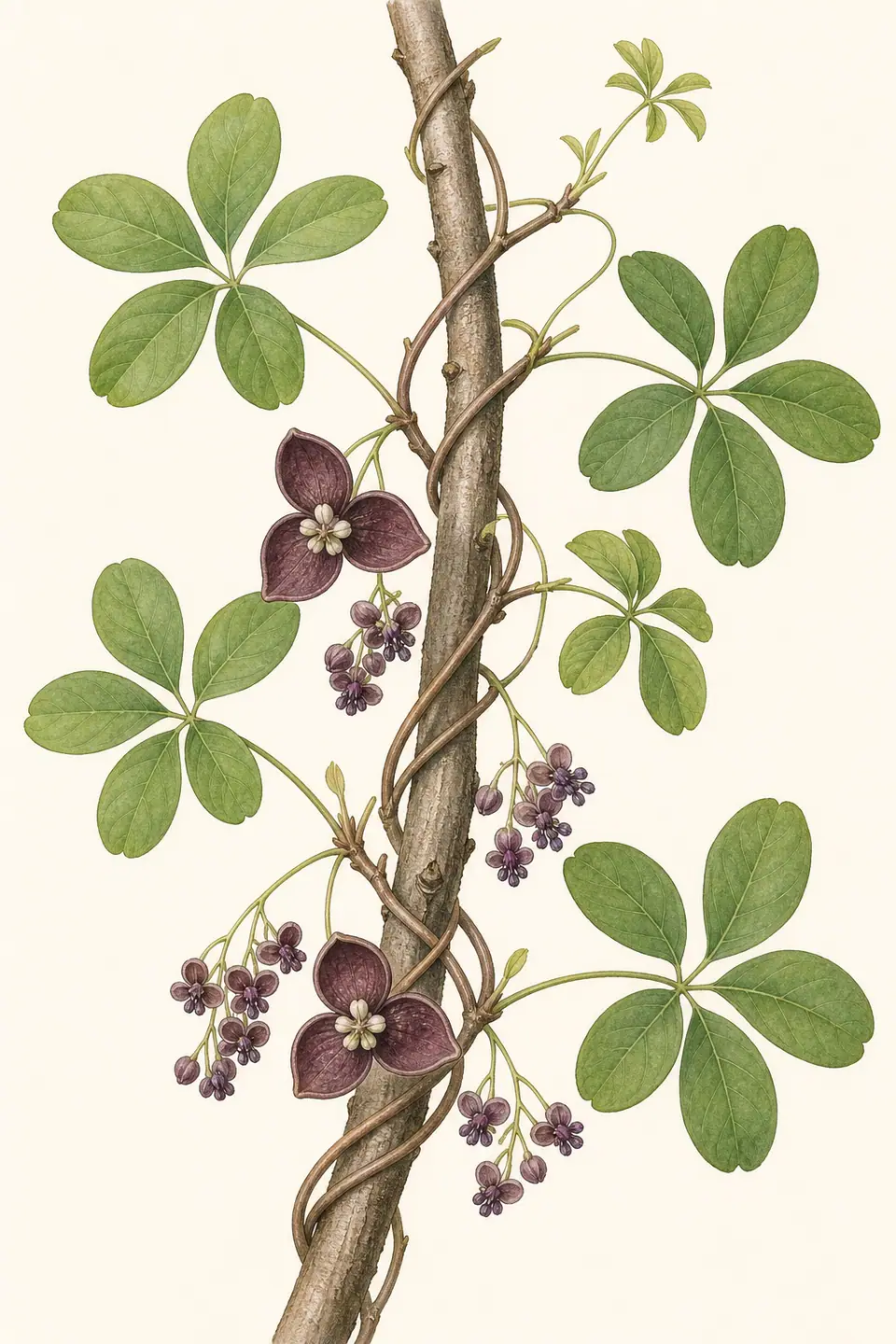
The Tree Stem that Opens the Waterway, Modern Precautions for a Classical Herb Used to Promote Urination
The Naegyeong section of the Dongui Bogam records Moktong (木通) concisely. “木通 通小腸, 下水. 水煎服之. 《本草》” This means that Moktong promotes the function of the small intestine and helps eliminate fluids (water/urine). As the name suggests, it is a medicinal herb that 'uses wood (木) to make the waterway flow (通)'. The OASIS Traditional Medicine Information Portal summarizes this action as *“性寒滯可寧 小腸熱閉及通經”*, and the Korea Traditional Knowledge Portal organizes it as a way to lower heart fire (心火), ease urination, and cool lung heat.
Often known only as a 'herb that helps urination,' Moktong has a cold nature and a strong bitter taste, meaning the target users must be clearly defined. The Korea Traditional Knowledge Portal states that “because its draining and descending action (泄降通利) is strong,” it is forbidden for pregnant women, people with a weak and cold spleen and stomach, people without damp-heat in the body, and those who experience leakage of essence (精) or frequent urges to urinate. In other words, the efficacy of 'promoting urination' is predicated on the condition that 'heat and dampness are actually present in the body.'
Therefore, at Baekrokdam Korean Medicine Clinic, we only use prescriptions containing Moktong after first verifying the individual's constitution and symptoms. Considering the contraindications for pregnancy and weak/cold spleen and stomach, as well as the fact that it is not designated as a health functional food ingredient by the Ministry of Food and Drug Safety (MFDS), the standards for safety depend on 'how much,' 'who,' and 'within which prescription' it is used. We will guide you through those standards step by step below.
Summary at a Glance
Moktong is a medicinal herb whose role is as intuitive as its name. The table below is organized so that those encountering this herb for the first time can understand its core identity, use, and precautions at a glance.
| Category | Content |
|---|---|
| Origin | Hanja name: 木通, Scientific name: Akebia quinata The stem of Akebia quinata Decne. (Lardizabalaceae family) with the outer bark removed. This is the authentic product as defined by the Korean Pharmacopoeia and the National Crude Drug Information. |
| Properties and Meridian Tropism | Cold and bitter (苦寒). Acts on the heart, small intestine, and bladder (心小腸膀胱); drains the gallbladder, kidney, and bladder, and cools the Triple Energizer (三焦). |
| Representative Aliases | Besides Moktong (木通), there are regional names such as Chuan-moktong (川木通), but this entry Akebia quinatadeals only with the Moktong corresponding to the specified standard. |
| Efficacy Recorded in Literature | Dongui Bogam, Naegyeong section: “木通 通小腸, 下水. 水煎服之.” Promotes the small intestine and eliminates fluids (urine). OASIS Summary: “性寒滯可寧 小腸熱閉及通經.” |
| Main Application Direction | Direction of lowering heart fire (心火), easing urination, and cooling lung heat. Traditionally used to resolve heat and blood stasis in the small intestine and bladder, and to clear meridian blockages. |
| Combination & Precautions | Combined in prescriptions dealing with damp-heat and urinary obstruction, such as Yongdamsagan-tang, Jachomoktong-tang, and Gami-jakyakgamcho-tang. Forbidden for pregnant women; those with a constitution of spleen-stomach deficiency-cold (脾胃虛寒) or lacking damp-heat, and those with essence leakage (精滑) or frequent urination due to fluid deficiency and weak qi (津虧氣弱) should avoid it. |
Is this medicinal herb right for me?
While Moktong is used to facilitate urination and lower heat, it is not a herb used in the same dosage for everyone because its nature is cold and its descending power is strong. Depending on the constitution and symptoms, it may be suitable for some, while it may worsen the condition for others. Please check the following three criteria first.
-
Generally suitable cases: Cases where urination is difficult, urine color is dark, or stinging occurs during urination; cases where heart heat rises, causing dry mouth or feelings of anxiety; cases where damp-heat in the lower burner causes the genital area to be damp and itchy. These states are traditionally understood as 'heat and dampness accumulated in the small intestine and bladder.'
-
Cases requiring caution: Those who usually have a weak stomach and experience diarrhea or abdominal discomfort after eating cold foods; those who urinate well but fatigue easily and lack energy; those taking other Western medications. Theoretically, there are research hints that Moktong may affect CYP3A/P-gp related metabolic enzymes, so potential interactions must be checked when used concurrently with Western medicine.
-
Cases to avoid: Pregnant women must avoid use. Those with a deficient and cold spleen and stomach without damp-heat, those unable to control semen or urine, those with frequent urges to urinate but not a small volume of urine, and since it is a herb designated by the MFDS as one that cannot be used as a health functional food ingredient, self-diagnosis and self-administration must be avoided. In principle, this herb should be used through a Korean medicine doctor's prescription and decoction.
Practical Q&A
When I guide patients on prescriptions containing Moktong in the clinic, the first questions they usually ask are things like, “How does this herb work in my body?” or “Can I take it with other medications?” Below are answers based only on currently verified information, focusing on the questions that require particular verification.
Can I take this if I am pregnant or planning to become pregnant?
As a general rule, it should not be taken during pregnancy. Moktong is a medicinal herb with a strong effect on lowering the energy of the body and promoting urination; both the Traditional Knowledge Portal and domestic pharmaceutical manuals list it as contraindicated for pregnant women. Please be sure to inform us if you suspect you may be pregnant.
If it is a medicine that helps with urination, can people who normally urinate well also take it?
No. Moktong is a medicinal herb suitable for cases where urination is blocked or uncomfortable due to the accumulation of damp-heat in the body. For those who already urinate well, it may act too strongly in draining the body. In particular, it may not be suitable for those with a cold and weak digestive system (spleen and stomach), those lacking energy and body fluids, or those who urinate frequently at night.
I am taking Western medicine; can I take this concurrently?
To date, there is insufficient evidence in official domestic pharmaceutical manuals or academic literature to confirm specific interactions between Moktong and Western medicines. However, in animal studies, Akebia quinata it has been suggested that the extract may affect the CYP3A enzyme and P-glycoprotein in the liver, so caution is required when taking it concurrently with Western medicines that utilize this pathway. If you are currently taking any Western medicine, please inform us before the prescription.
Can I consume this in the form of health functional foods or tea?
According to the Ministry of Food and Drug Safety (MFDS) notification, Moktong is designated as a plant-based raw material that cannot be used in health functional foods. Furthermore, there is no official evidence recommending its consumption as a general tea. In principle, Moktong should be prescribed and used in the form of a decoction (boiled herbal medicine) at a Korean medicine clinic, and self-administration is not recommended.
I heard there are several types of 'Moktong' with similar names; are they the same medicinal herb?
No. The Moktong referred to in this section is the medicinal herb with the Hanja 木通 and the scientific name Akebia quinata Decne. Guan-moktong (關木通, Aristolochia manshuriensis) or Cheon-moktong (川木通, Clematis spp.) have similar names but are entirely different plants. In particular, Guan-moktong contains aristolochic acid, which raises concerns regarding nephrotoxicity and carcinogenicity, and has been excluded from the Chinese Pharmacopoeia. The Moktong used at Baekrokdam Korean medicine clinic Akebia quinata please confirm its origin.
If Moktong is included in the prescription, how many times should I take it?
The specific dosage and duration of administration vary depending on your constitution, symptoms, and the combination with other medicinal herbs. While records such as OASIS indicate it is used in decoction form in a range of 4–12 g per day, this is only a general reference range; the dosage suitable for an individual must be determined by a doctor of Korean medicine. If you experience any abnormal symptoms during administration, stop immediately and contact us.
Relationship with Other Medicinal Herbs (Yakdae/Pairing)
Moktong's effects become more distinct when used with other medicinal herbs rather than alone. In Korean medicine, such pairs are called 'Yak-dae' (medicinal pairs). Depending on how other herbs complement or concentrate the power of Moktong to facilitate urination and lower heat, the nature of the prescription changes. Below are examples of classical prescriptions where Moktong forms a core combination.
- Yongdam-sagan-tang (龍膽瀉肝湯) A prescription found in the "Ui-jong-geum-gam." It combines Moktong, Plantain seed, Albi Cortex, Rehmannia root, Angelica root, Gardenia, Scutellaria, Licorice, with Gentiana, Bupleurum, and Alisma. It has been traditionally used to clear and drain excess fire from the liver and gallbladder and damp-heat from the lower burner, for symptoms such as headache, bloodshot eyes, tinnitus, flank pain, insomnia, dark urine, or lower burner damp-heat symptoms like painful urination, frequent urination, genital eczema, and yellow vaginal discharge.
- Jacho-moktong-tang (紫草木通湯) A prescription recorded in the Miscellaneous Diseases section of the "Dongui Bogam." It consists of Lithospermum root, Moktong, Ginseng, Red Poria, Licorice, and Nami, and was traditionally used when there is chest tightness, fever, and poor urination due to smallpox.
- Gami-jagyak-gamcho-tang (加味芍藥甘草湯) A prescription found in the "U-su-gyeong-heom-bang-jip." It combines Peony root, Licorice, Poria cocos, Moktong, Polyporus, Alisma, Talcum, Phellodendron, Fennel, and Donkey-hide gelatin glue, and has been traditionally used for 'Saseok-rim' (symptoms where sand or small stones are excreted in urine) or gallbladder stones.
Since Moktong (Akebia quinata) is a medicinal herb with a cold nature and a strong downward-draining effect, combining it with individuals who have a deficient and cold spleen and stomach, a constitution lacking damp-heat, or those with deficient qi and body fluids may worsen their condition. It is contraindicated for those who are pregnant. As specific prescriptions and dosages vary depending on an individual's constitution and symptoms, it is safest to decide after consulting with a Korean medicine doctor.
In what form is it consumed?
Moktong is a medicinal herb that is not typically used as a general health tea or food ingredient. Because its nature is cold and its downward-draining force is strong, it should in principle be used under professional judgment after considering the individual's constitution and symptoms. The confirmed forms of intake are as follows:
-
Drinking as tea, Not common There is no officially recommended evidence for drinking Moktong as a general tea brewed separately.
-
Intake as food/food products, Not common The Ministry of Food and Drug Safety (MFDS) designates Moktong as a plant-based raw material that cannot be used in health functional foods.
-
Decoction (Korean herbal medicine tea), Applicable Moktong is commonly used in the form of a decoction, where it is boiled in water for consumption. Records indicate it is administered in the form of decoctions, powders, or pills at a dose of 4–12 g per day, and in actual prescriptions, it is used as a decoction combined with other medicinal herbs.
-
Professional prescription, Applicable Moktong is more often used within a complex prescription prescribed by a Korean medicine doctor rather than taken alone. Representative examples include its combination in Yongdamsagan-tang, Jachomoktong-tang, and Gami-jakyakgamcho-tang.
Since intake is contraindicated for pregnant women, those with a deficient spleen and stomach, or those without damp-heat in the body, it is safest to decide on prescriptions containing Moktong only after consulting with a Korean medicine doctor.
Interactions and Safety During Use
Moktong is used to facilitate urination and lower heat, but because its nature is cold and its downward-draining force is strong, it is not a herb that is used in the same dosage for everyone. In principle, those who are pregnant, have a deficient constitution, or are taking other medications must consult a Korean medicine doctor before use. Below are the currently confirmed interactions and contraindications.
- Pregnancy: Contraindicated. Both official Korean pharmaceutical manuals and traditional medicine records prohibit intake during pregnancy.
- Breastfeeding: Some English traditional medicine resources recommend caution, but a dedicated breastfeeding contraindication has not been confirmed in official Korean pharmaceutical manuals. As verification is needed, please mention this during your consultation.
- Spleen and Stomach Deficiency-Cold (脾胃虛寒) constitution: Contraindicated for those whose stomach and spleen are cold and weak. Its cold nature and strong downward force may worsen symptoms.
- Absence of damp-heat in the body: If there is no internal damp-heat, applying a neck compress could further damage your vital energy.
- Spermatorrhea due to Fluid Deficiency and Weak Qi (津虧氣弱), or frequent urge to urinate: Contraindicated for those who experience spontaneous leakage of semen or frequent urges to urinate.
- Concurrent Use with Western Medicine: Confirmed interactions with specific Western medicines have not been directly identified in official Korean pharmaceutical manuals or academic original texts. However, in animal studies, Akebia quinata it has been suggested that extracts may affect CYP3A and P-glycoprotein; therefore, consultation is essential if you are taking related Western medications.
Additionally, since Moktong is designated by the Ministry of Food and Drug Safety as a raw material that cannot be used in health functional foods, self-administration as a general tea or food ingredient is not recommended. If you provide information regarding pregnancy, current medications, your general constitution, and your urinary and digestive status, we can more accurately determine the prescription and combination.
If you experience these symptoms
Please inform your attending Korean medicine doctor in these cases
Moktong is used to facilitate urination and lower heat, but it has a cold nature and a strong downward-draining force. Therefore, if the following changes occur during intake, it is important to inform the prescribing Korean medicine doctor first rather than reducing the dose or stopping on your own. This is especially true if you are pregnant, have a deficient spleen and stomach constitution, or are taking other medications.
- If urine volume increases excessively after intake, or if new pain or discomfort occurs during urination
- If diarrhea occurs or if the feeling of the abdomen being frequently cold and chilled worsens
- If fatigue accumulates and there is a feeling of dryness in the mouth and body
- If general weakness occurs, such as headaches, dizziness, or severe lethargy
These signals may be linked to tendencies noted in traditional medicine literature as precautions regarding overdose or incompatibility with a person's constitution. However, as there is insufficient evidence in official Korean pharmaceutical manuals or academic original texts specifying concrete warning signs for overdose or long-term use of Moktong, further detailed criteria need to be verified.
If symptoms are severe or if there are sudden changes such as difficulty breathing, decreased consciousness, severe dehydration, or hematuria (blood in urine), please visit an emergency medical institution (119 or the nearest emergency room) and simultaneously contact the Korean medicine clinic that provided the prescription.
Differences from other restorative medicines
Moktong is a medicinal herb that is closer to the direction of 'promoting flow (通)' rather than 'tonifying (補)'. Since its nature of action differs from restorative medicines (Boyak) that fill what is lacking in the body, it is important to distinguish it from traditional tonics such as Gongjindan or Gyeongokgo.
Gongjindan and Gyeongokgo are representative tonics traditionally used to supplement Qi and Blood (氣血) and fill the Essence (精). In contrast, as recorded in the Dongui Bogam, Moktong 'opens the small intestine and lets water flow down,' making it closer to 'purgation and promotion of flow (瀉·通)' to open blockages and lower heat. For those with a deficient and cold constitution, or those who need tonification due to weak energy, prescriptions containing Moktong may not be suitable.
Additionally, Moktong is a medicinal herb designated by the Ministry of Food and Drug Safety (MFDS) as an ingredient that cannot be used in health functional foods. Therefore, it is not appropriate to take it as a daily supplement or health food; it is most often prescribed in combination with other herbal medicines. It is safest to decide whether your constitution requires a tonic or needs to clear blockages of heat and dampness after consulting with your attending Korean medicine doctor.
References
- Moktong Evidence Material 1: Crude drug data from the National Institute of Food and Drug Safety Evaluation.
- Moktong Evidence Material 2: Korea Institute of Korean Medicine official data.
- Moktong Evidence Material 3: koreantk.com evidence materials.
- Moktong Evidence Material 4: koreantk.com evidence materials.
- Moktong Evidence Material 5: koreantk.com evidence materials.
- Moktong Evidence Material 6: PubMed academic paper.
- Moktong Evidence Material 7: Crude drug data from the National Institute of Food and Drug Safety Evaluation.
- Moktong Evidence Material 8: Crude drug data from the National Institute of Food and Drug Safety Evaluation.
If you would like to check if this medicinal herb is right for you or which prescription it should be used with, please leave a medical inquiry. For those who find it difficult to visit the clinic, non-face-to-face consultations are available; we will provide guidance after first reviewing your current condition and current medications.

Medical Staff Review
Director Choi Yeon-seung
Chief Director of Baekrokdam Korean Medicine ClinicMoktong Dictionary Entry, reviewed the safety of expressions and the scope of verification before administration.
Review Scope: Clinical Accuracy, Pharmacology, Contraindications, Combinations, QA · Last Reviewed 2026-08-16
- Graduated from Kyung Hee University College of Korean Medicine
- Providing Korean medicine treatment since 2010
- Consultations for Gongjindan, Gyeongokgo, Nokyong (Deer Antler) restorative medicine, and customized restorative herbal medicine