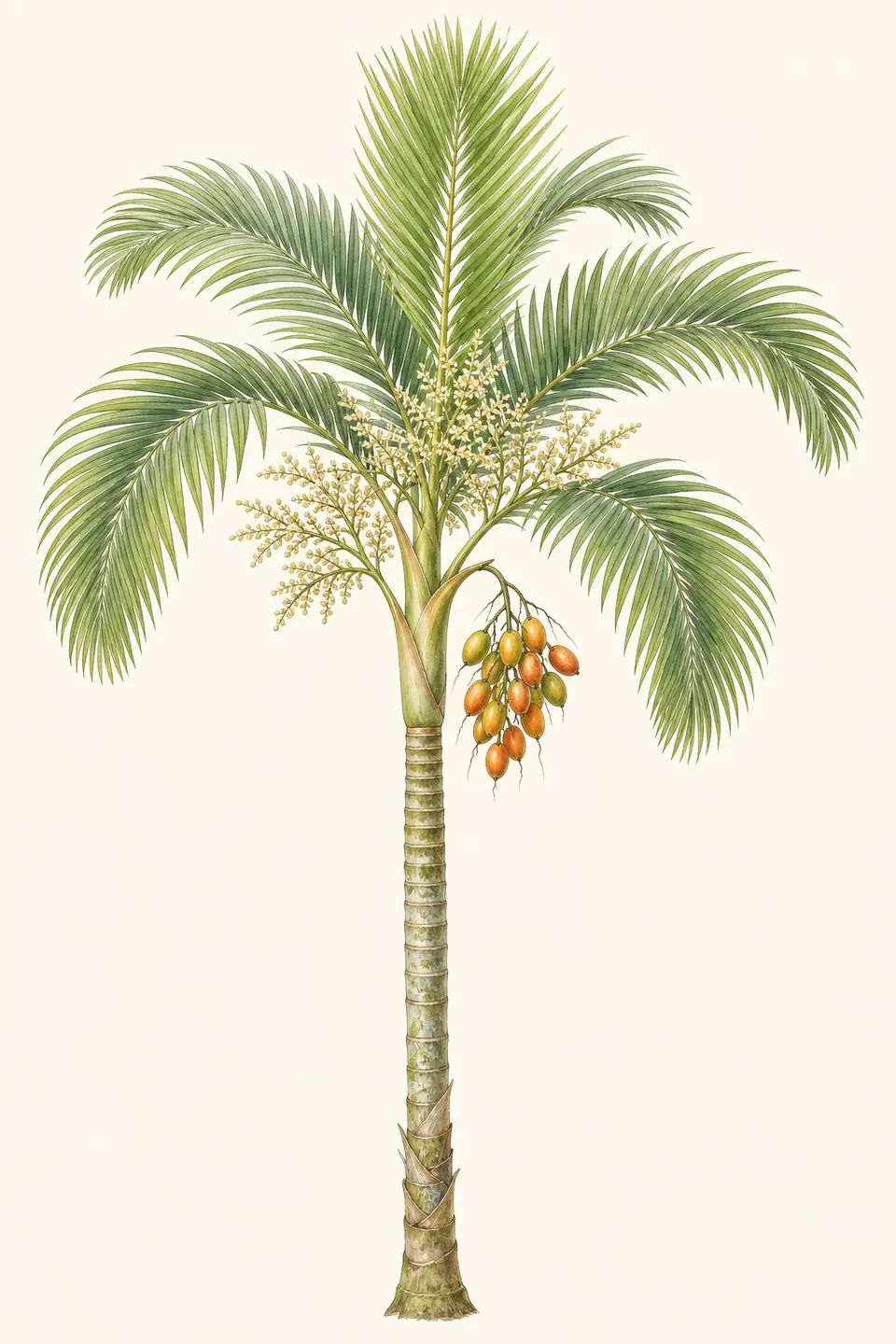
The Coat of Binrang (Areca Nut), Daebokpi
The 'Kaibo Ben Cao' records Daebokpi as "slightly warm, non-toxic," and the 'Bencao Gangmu' echoes this description. As the name suggests, meaning 'large belly skin', it is the dried pericarp of the Areca palm fruit, split vertically. Those obtained from unripe fruits are classified as Daebokpi, while those from ripe fruits are called Daebokmo. The Korea Traditional Knowledge Portal describes its shape as a "hollow spindle to a long ellipsoid," and the meaning in its name is reflected in its form, appearing as if a belly has been cut across.
It is easy to dismiss Daebokpi as merely a 'by-product of Binrang.' Some may think that because it comes from the same plant, the only precautions needed are those associated with the habit of chewing Binrang seeds. However, the actual application of Daebokpi in classical texts is quite distinct. Daebokpi-san from 'Jeungchi Junseung · Ryubang' was used for "wind-toxin of beriberi, edema of the face and knees, and abdominal tightness," and 'Boje-bang' combined Daebokpi for symptoms where "the Qi of the lungs is blocked, causing limb swelling and shortness of breath," as well as cases of "discomfort in urination and defecation and edema during pregnancy." In other words, Daebokpi is not a simple by-product, but a medicinal herb that has served as a pillar in prescriptions for lowering Qi and promoting the flow of fluids.
However, just as its role is clear, its boundaries for use are also distinct. Because Daebokpi has properties that lower Qi and resolve water-dampness, it should be used with caution in those with Qi deficiency and physical weakness. As it originates from the same plant as Areca nut, the general rule is not to use it during pregnancy or lactation without consulting a medical professional. Therefore, the dosage, the patient, and the body constitution are critical, this page provides those standards.
Summary at a Glance
First, let us summarize what kind of medicinal herb Daebokpi is, where it comes from, and how it acts. The table below will provide the core outline of this herb.
| Category | Content |
|---|---|
| Origin | Hanja Name 大腹皮, Scientific Name Areca catechu L. Pericarp of the Areca palm (Palmae/Arecaceae). Those obtained from unripe fruits are classified as Daebokpi, while those from ripe fruits are called Daebokmo. |
| Properties and Meridian Tropism | Acrid, slightly warm, non-toxic. Acts on the Spleen, Stomach, Large Intestine, and Small Intestine meridians. |
| Representative Aliases | Daebokmo, Daebokpimo, Binrangpi. |
| Efficacy Recorded in Literature | Lowering Qi and relaxing the middle (Hagi-gwanjung): Lowers the Qi of the middle burner to relieve abdominal bloating. Promoting water flow and reducing swelling (Haengsu-sojong): Promotes the flow of water to reduce edema and swelling. |
| Main Ingredients | Alkaloids related to the Areca palm, such as arecoline, may be detected; caution is required during pregnancy and lactation. |
| Combinations and Contraindications | Due to its properties of lowering Qi and resolving water-dampness, it should be used with caution in those with Qi deficiency and physical weakness. It may not be compatible with restorative medicines intended to supplement Yang or Yin, so consultation is necessary when used together. |
Is this medicinal herb right for me?
Daebokpi is a medicinal herb that works to lower Qi and resolve water and dampness in the abdomen. Due to these properties, it may be appropriate for some constitutions and inappropriate for others. Please review the following three criteria first.
- Generally suitable casesAppropriate: Traditionally considered for cases where the abdomen feels bloated and dull, or where there is leg swelling and some discomfort in urination or defecation. Daebokpi-san from 'Jeungchi Junseung' is a prescription used to treat edema and abdominal tightness caused by beriberi, and it is used in this context.
- Cases requiring cautionCaution: Caution is required if the person has weak energy (Qi deficiency) or if abdominal bloating stems from a deficiency pattern (Heo-jeung). KTKP and herba.kr record that it "should be used with caution in those with Qi deficiency and physical weakness," as its property of lowering Qi and resolving water-dampness may further exacerbate Qi deficiency. Additionally, the general rule is not to use it during pregnancy or lactation without consulting a medical professional.
- Cases to avoidAvoid: It should be avoided during pregnancy or lactation, and in cases where the cause of abdominal bloating or edema is unclear. The Ministry of Food and Drug Safety (MFDS) safety letter (2022) also states that a human risk assessment for arecoline contained in Binrang seeds and Daebokpi is underway, which serves as a basis for caution as they are herbs derived from the same plant.
Practical Q&A
The most common questions from those encountering Daebokpi for the first time are: "Is it safe if it's from the same plant as Binrang?", "Is it only used for abdominal bloating?", and "Is it okay during pregnancy?" We will address these based on confirmed facts, provided that a medical consultation takes place.
Are Daebokpi and Binrang (Areca nut) the same thing?
They are obtained from the same plant, but the parts used and their purposes differ. Daebokpi is the driedAreca catechufruit pericarpof the Areca palm, while Binrang is the seedrefers to. Both the Korea Traditional Knowledge Portal and herba.kr make this distinction clear: the peel of unripe fruit is classified as Daebokpi, while the peel of ripe fruit is classified as Daebokmo. Even for the same plant, different parts can lead to different discussions regarding active ingredient content and safety; therefore, it is difficult to view these two as the same medicinal herb.
Is it used for things other than abdominal bloating?
The traditional use of Daebokpi focuses on descending Qi (energy) and resolving water-dampness. Daebokpi-san from the 《Jeungchi Junseung》 was used for swelling of the head, face, and knees, as well as tightness in the chest and abdomen caused by beriberi. In the 《Boje-bang》, it was combined in prescriptions to treat shortness of breath and swelling of the limbs due to blocked lung Qi, or edema and difficulty with urination and bowel movements during pregnancy. However, these are merely records of traditional prescriptions; the current application must be determined by a doctor of Korean medicine based on an individual's symptoms.
Can it be used during pregnancy?
As a rule, it should not be used during pregnancy or lactation without consulting a medical professional. The betel nut entry on Drugs.com records adverse reactions related to pregnancy and mentions potential fetal toxicity and teratogenicity. While this data primarily concerns the habit of chewing betel nuts, caution is required as Daebokpi is derived from the same plant and arecoline may be detected in it. Additionally, a 2022 safety letter from the Ministry of Food and Drug Safety (MFDS) specifies that arecoline contained in betel nut seeds and Daebokpi is classified as an IARC Group 2B possibly carcinogenic substance.
Can I take this along with Western medicine?
Drug interactions for Daebokpi are not "well documented" in official literature. No clear interaction records were found on Drugs.com or RxList. However, since arecoline has parasympathomimetic effects, caution may theoretically be needed when used concurrently with anticholinergic drugs, cholinesterase inhibitors, gastrointestinal motility inhibitors, or medications related to the heart and respiration. Since clinical interaction studies on Daebokpi decoctions have not been confirmed, please be sure to inform your doctor of any medications you are currently taking during your consultation.
Should people with weak Qi avoid it?
Records in KTKP, herba.kr, and 《Chinese Materia Medica》 commonly state that those with Qi deficiency and physical weakness should use it with caution. Because Daebokpi has the property of descending energy and resolving water-dampness, it may not be appropriate if the Qi is already deficient or if abdominal bloating stems from a deficiency pattern (Heo-jeung). Even if there is a feeling of abdominal bloating, a doctor of Korean medicine must distinguish whether the cause is an excess pattern (Sil-jeung) or a deficiency pattern through pulse and tongue diagnosis.
Can I take Daebokpi alone?
In classical texts, rather than using Daebokpi alone, it was used in Qi-Water prescriptions combined with herbs such as Mulberry Bark, Red Poria, Ulmus Seed, Akebia Stem, Betel Nut, Aurantii Fructus Immaturus, Perilla Leaf, and Aucklandia Root. It acted as a core ingredient, most notably in prescriptions of the Daebokpi-san family. In Korean medicine, the efficacy of a medicinal herb is generally determined by the combination, dosage, and the context of the individual's constitution and symptoms; therefore, it is common to determine use through consultation as part of a full prescription rather than taking it alone.
Relationship with Other Medicinal Herbs (Yakdae/Pairing)
Daebokpi is not used alone. The moment it is paired with other herbs, its property of managing both Qi (energy) and Water becomes more distinct, which is traditionally called "Yak-dae" (medicinal pairs). Especially when abdominal bloating and fluid retention must be resolved simultaneously, Daebokpi plays a centering role between herbs that descend energy and herbs that circulate fluids.
Here are representative prescriptions from classical texts where Daebokpi forms a core combination.
- 大腹皮散(《證治準繩·類方》) Composed of Daebokpi, Mulberry Bark, Red Poria, Ulmus Seed, Betel Nut, Aurantii Fructus Immaturus, Perilla Leaf, Saposhnikovia Root, Aucklandia Root, Notopterygium Root, Akebia Stem, and Antelope Horn powder. This is a traditionally used prescription for cases where the head, face, and knees are swollen and the chest and abdomen feel tight or bloated due to wind-toxins caused by beriberi. It was traditionally prepared by boiling one and a half cups of water with five slices of ginger down to one cup, and taken warm before meals.
- 大腹皮散(《普濟方》) Composed of Daebokpi, Stephania Root, Mulberry Bark, Akebia Stem, Red Poria, Ulmus Seed, Arabidopsis, Lacquer Tree Sap, Cinnamon Bark, Lily Bulb, and Dried Tangerine Peel. It was traditionally used for cases where the Qi of the lungs is blocked, causing shortness of breath and swelling of the limbs.
- Daebokpi-san (《Boje-bang》), Beriberi-induced swelling Composed of Daebokpi, Betel Nut, Aucklandia Root, Akebia Stem, Mulberry Bark, and Ulmus Seed. It was traditionally used for cases where the abdomen is bloated and urination or bowel movements are uncomfortable due to beriberi.
- Pregnancy Edema Prescription (《Boje-bang》) Chigak, Daebokpi, Licorice (甘草), and Jeokbokryeong were each powdered in equal amounts; 2 don (2錢) of this mixture was then taken dissolved in a strong decoction of green onion stalks (蔥白). This is a prescription traditionally used for cases of edema and discomfort with urination and bowel movements during pregnancy.
As shown, Daebokpi has been used as a core ingredient in prescriptions managing Qi and Water along with Mulberry Bark, Poria Peel, Ulmus Seed, Akebia Stem, Betel Nut, Aurantii Fructus Immaturus, Perilla Leaf, and Aucklandia Root. It frequently appears in cases where dampness and Qi are stagnant, such as beriberi edema, abdominal bloating, and urinary difficulty.
As there are no confirmed official records regarding combination contraindications, please be sure to consult a doctor of Korean medicine when using it with other medicinal herbs.
In what form is it consumed?
Since Daebokpi is a Korean herbal medicine in the form of dried fruit peel, it is not common to eat it as a general food or brew it as a tea. Traditionally, it is consumed as a decoction (tang-je) by boiling it with other herbs in water, or used through professional prescriptions that are concentrated or formulated. Based on confirmed facts, I will summarize this into four forms.
- Brewed as a tea Not common. Classical records indicate that rather than brewing Daebokpi alone as a tea, it is used by decocting it with other herbs within a prescription.
- Use as a food ingredient This is uncommon. It is not used as a spice or a common culinary ingredient, and there are no confirmed cases of consumption for food purposes due to the specific properties of the fruit peel.
- Decoction (boiling in water to extract essence) This is a traditional method of use. For example, the Daebokpi-san in the 《Jeongchi Junseung · Ryu-bang》 is recorded as being prepared by splitting Daebokpi and boiling it in water with five slices of ginger, then taken lukewarm before meals.
- Professional prescription (Korean medicine clinic decoctions, pills, powders, etc.) This is the most common method. Rather than being used alone, Daebokpi is used as a key medicinal ingredient in prescriptions like Daebokpi-san to treat abdominal bloating, edema, and difficulty urinating. It is still used in Korean medicine clinics, formulated and blended according to the patient's constitution and symptoms.
Since the form of administration and dosage vary depending on the individual's condition, the general rule is to use it as part of a prescription after consulting with a Korean medicine doctor rather than consuming it directly.
Interactions and Safety During Use
Daebokpi is a medicinal herb used to lower Qi and resolve water and dampness. It must be prescribed after verifying current symptoms and other medications being taken; the following sections explain concurrent medications and precautions before use.
- Caution for those with Qi deficiency and weak constitution: If energy is deficient or if abdominal bloating is caused by a deficiency pattern (Heo-jeung), the Qi-lowering and water-moving actions of Daebokpi may be inappropriate.
- Pregnancy and lactation period: Daebokpi is derived from the peel of the areca palm fruit. Data on areca nut from the same plant has reported adverse reactions related to pregnancy. Furthermore, the Ministry of Food and Drug Safety (MFDS) safety letter (2022) classifies arecoline, contained in areca nut and Daebokpi, as a possibly carcinogenic substance (Group 2B) and states that a human risk assessment is underway. Therefore, as a rule, it should not be used during pregnancy or lactation without consulting medical staff.
- Concurrent Use with Western Medicine: No clinical interaction studies targeting Daebokpi extracts or decoctions have been confirmed in official literature. However, since arecoline may be detected in Daebokpi, caution may theoretically be required when used concurrently with anticholinergic drugs, cholinesterase inhibitors, gastrointestinal motility inhibitors, or medications related to the heart and respiration. Please confirm specific concurrent use through a consultation.
- Long-term or high-dose use: Special caution is required for long-term or high-dose consumption regarding its classification as a possibly carcinogenic substance. It is advisable not to take it long-term without a prescription or overuse it in the form of health functional foods.
In summary While Daebokpi is a medicinal herb used for dampness and Qi stagnation such as abdominal bloating and edema, caution is necessary for those with Qi deficiency and weak constitution and during pregnancy or lactation. Since clinical evidence for concurrent use with Western medicine or long-term consumption is insufficient, it should be used based on professional consultation.
If you have questions about interactions, your constitution, or medications you are currently taking, please be sure to mention them during your appointment. We will determine the appropriateness of use while reviewing the composition and dosage of the prescription.
If you experience these symptoms
If these signs appear
Daebokpi is a medicinal herb that works to lower Qi and resolve water and dampness in the abdomen. Due to these properties, warning signs from the body may appear if taken long-term or in excessive amounts beyond the prescribed dose and period, or if used when not suited to one's constitution. The signals below are warnings known from traditional records and modern safety information that require caution regarding Daebokpi consumption. If these symptoms appear, it is important to notify the prescribing Korean medicine doctor first rather than reducing or stopping the dose on your own.
- If abdominal pain or diarrhea worsens: Daebokpi has strong properties for lowering Qi and resolving water and dampness. If used in excess or when not suited to the constitution, gastrointestinal irritation may worsen abdominal pain or diarrhea.
- If severe abdominal bloating or nausea persists: Using herbs that lower Qi and water while in a state of energy deficiency may actually worsen abdominal discomfort. In particular, caution is required for those with Qi deficiency and weak constitution.
- If headache, dizziness, or general weakness is felt: This is a deficiency signal (Heo-jeung) that may appear when the body's energy is excessively depleted.
- If abdominal discomfort or edema occurs during pregnancy, or if existing symptoms worsen: Since Daebokpi is derived from the same plant, arecoline may be detected; therefore, as a rule, it should not be used during pregnancy or lactation without consulting medical staff.
- If existing heart, respiratory, or digestive diseases become unstable: Because the parasympathetic stimulating (cholinergic) action of arecoline may interact with related medications or conditions, particular caution is required for those with underlying diseases or those taking concomitant medications.
Even if these symptoms are mild, if they persist, or if they are accompanied by severe abdominal pain, vomiting, difficulty breathing, abnormal heartbeat, or decreased consciousness, please visit an emergency medical institution immediately. Since Daebokpi is a medicinal herb that is meaningful when used in appropriate doses and durations within the context of a prescription, please be sure to consult your prescribing Korean medicine doctor regarding any abnormal signals during intake.
Differences from other restorative medicines
One of the common questions from those encountering Daebokpi for the first time is, “Does this herb also replenish energy like a restorative herbal medicine (Boyak)?” To answer first, Daebokpi is a medicinal herb that acts in the opposite direction of restorative medicines. While restorative medicines have a 'supplementing (Bo)' property to fill what is lacking, Daebokpi has properties closer to 'draining (Sa)' and 'resolving (So)' to clear blockages and move them downward. In traditional medicine, the core effects of Daebokpi are 'lowering Qi and relaxing the middle (Hagi-gwanchung)' and 'promoting water metabolism and reducing edema (Haengsu-sojong)', aiming to lower the energy of the middle burner (Jung-cho) and facilitate the flow of moisture and dampness in the abdomen.
In this regard, it occupies a completely different position from traditional restorative tonics such as Gongjindan or Gyeongokgo. Gongjindan is a prescription to supplement the organs and stabilize vital energy, and Gyeongokgo is a prescription to replenish blood and moisturize the complexion; both follow the 'supplementing (Bo)' direction of filling deficiencies. Conversely, Daebokpi is a medicinal herb used when 'stagnated things' such as abdominal bloating, urinary difficulty, or edema must be resolved. For those whose energy is weak or whose abdominal bloating stems from a deficiency state (Heo-jeung), it may further deplete their energy; thus, sources such as KTKP and herba.kr record that it should be 'used with caution in those with Qi deficiency and weak constitutions'.
Therefore, whether Daebokpi is necessary or whether a restorative medicine like Gongjindan or Gyeongokgo is more appropriate depends on first distinguishing the individual's constitution and the nature of the symptoms. The direction differs based on whether there is a tendency toward an excess state (Sil-jeung), characterized by abdominal bloating, poor urination, and a general feeling of blocked energy, or a tendency toward a deficiency state (Heo-jeung), characterized by lack of energy, easy fatigue, and coldness. Since this distinction is often difficult to make alone, we strongly recommend consulting a Korean medicine doctor before intake to confirm if the prescription is right for you.
References
- Evidence material 1 regarding Daebokpi: koreantk.com evidence materials.
- Evidence material 2 regarding Daebokpi: GBIF plant classification data.
- Evidence material 3 regarding Daebokpi: Korea Citation Index academic paper.
- Evidence material 4 regarding Daebokpi: PubMed academic paper.
- Evidence material 5 regarding Daebokpi: PubMed academic paper.
- Evidence material 6 regarding Daebokpi: herba.kr evidence material.
- Evidence material 7 regarding Daebokpi: yibian.hopto.org evidence material.
- Evidence material 8 regarding Daebokpi: cht.a-hospital.com evidence material.
If you would like to check if this medicinal herb is right for you or which prescription it should be used with, please leave a medical inquiry. For those who find it difficult to visit the clinic, non-face-to-face consultations are available; we will provide guidance after first reviewing your current condition and current medications.

Medical Staff Review
Director Choi Yeon-seung
Chief Director of Baekrokdam Korean Medicine ClinicDaebokpi Dictionary Entry, reviewed the safety of expressions and the scope of verification before administration.
Review Scope: Clinical Accuracy, Pharmacology, Contraindications, Combinations, QA · Last Reviewed 2026-08-16
- Graduated from Kyung Hee University College of Korean Medicine
- Providing Korean medicine treatment since 2010
- Consultations for Gongjindan, Gyeongokgo, Nokyong (Deer Antler) restorative medicine, and customized restorative herbal medicine