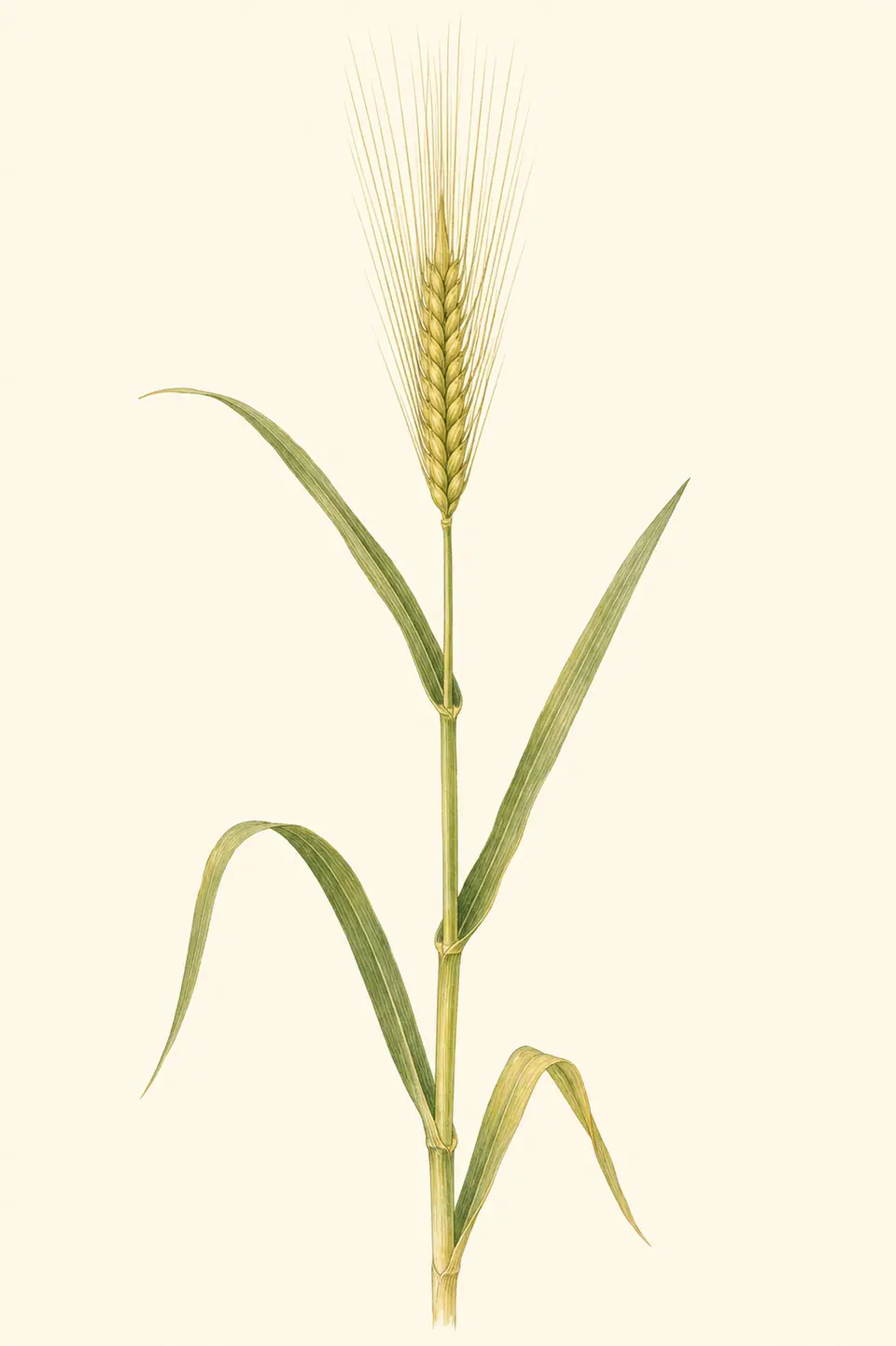
Sprouts of Grain, the Key to the Spleen and Stomach, Maega (Malted Barley)
The 《Boncho Biyo》 states of Maega, “Daemaega opens the stomach and strengthens the spleen, moves Qi and resolves accumulation.” This medicinal herb is made by soaking barley grains in water to sprout them and then drying them; as the name suggests, it is simply ‘barley sprouts (Maega).’ The medicinal song in the same book is even more concise and clear: “Maega is sweet and warm, digesting old food, moving blood, dispersing stagnation, and relieving abdominal bloating.” This means that with its sweet and warm-neutral properties, it digests old food and calms the bloating sensation in the abdomen where Qi feels blocked. The 《Uifang Jiphae》 and 《Tangdu Gagyul》 distinguish the role of Maega within the formulas Geonbi-hwan and Bohwa-hwan in one line: “Sansha digests meat, while Maega digests grains.” In other words, Sansha is the herb for digesting meat, and Maega is for digesting grains.
There is a tendency to view Maega as 'just a digestive aid.' However, traditional records show that Maega does more than simply 'helping digestion.' The 《Dongui Bogam》 mentions in the Hubak-jeon formula that “Maega digests alcohol and food well,” and in the section on external forms, it records the use of Maega in Hoe-yu (lactation cessation) prescriptions to treat breast edema and milk stasis in nursing mothers. In the 《Boncho Biyo》, there are contrasting records side by side: “Tongnyu Hatae”, the action of promoting milk flow and inducing abortion, and “Gubok Sohsin-gi”, the warning that long-term use consumes the energy of the kidneys. Thus, while Maega is a mild herb that opens the spleen and stomach and digests grains, it also carries strong signals regarding the induction of abortion and the depletion of kidney Qi.
Therefore, Maega is a medicinal herb where 'how much, who, and how it is used' is particularly important. It is treated as contraindicated for pregnant and breastfeeding women in both traditional records and modern pharmaceutical inserts, and it may not be suitable for those who have a deficient spleen and stomach without any food accumulation. Below, we provide a step-by-step guide on the primary combination prescriptions of Maega, precautions by constitution, and the forms available in daily life.
Summary at a Glance
If you would like to quickly understand what kind of medicinal herb Maega is, please refer to the table below first. We have summarized the core points, from the origin of the name to its properties, primary uses, and precautions.
| Category | Content |
|---|---|
| Origin | Hanja Name 麥芽, Scientific Name Hordeum vulgare L., the germinated, dried, fully ripened fruits of plants of the rice family, genus Hordeum. In the Korean Pharmacopoeia for non‑Pharmacopoeial herbal medicines (crude drug) standards. Hordeum vulgare Linné var. hexastichon it is defined as the sprouted fruit of Aschers. |
| Properties and Meridian Tropism | Properties: Sweet, Neutral. Meridian Tropism: Spleen, Stomach, Liver. |
| Representative Aliases | Daemaega, Malted Barley. |
| Efficacy Recorded in Literature | Opens the stomach and strengthens the spleen, moves Qi and resolves accumulation, digests food and relieves abdominal bloating. The 《Boncho Biyo》 records the action of promoting milk flow and inducing abortion (Tongnyu Hatae). |
| Main Ingredients | Starch-degrading enzymes such as α·β-amylase (characteristic of malted barley). |
| Combinations and Contraindications | Mainly used for the digestion of food accumulation from grains and starches. When combined with restorative medicines for supplementing Yang or Yin, care must be taken so that the digestive action does not interfere with the supplementary effect. It is contraindicated for pregnant and breastfeeding women and is not suitable for those with a deficient spleen and stomach without food accumulation. Caution is required as long-term use may consume kidney Qi. |
Is this medicinal herb right for me?
Maega is classified as a digestive herb (Soshik-yak) and has been traditionally used especially when grains or starches remain undigested, causing bloating or abdominal discomfort. However, because of its 'digestive' characteristic, it may be inappropriate for those who have nothing to digest or are in a deficient state. Please check based on the following three criteria first.
-
Generally suitable cases: It can be traditionally prescribed when there is a feeling of slow digestion after starch-heavy meals (such as grains, bread, or noodles), or when the abdomen feels tight or bloated with gas. As seen in Geonbi-hwan from 《Uifang Jiphae》 or Bohwa-hwan from 《Tangdu Gagyul》, Maega is combined to resolve food accumulation from grains.
-
Cases requiring caution: Those without specific food accumulation or those with a deficient spleen and stomach should avoid taking Maega indiscriminately. The 《Boncho Biyo》 contains a classical warning that “long-term use consumes kidney Qi.” Additionally, if you are taking digestive enzyme supplements or antacids, caution is needed when using them together as they may theoretically affect the activity of enzymes like α·β-amylase found in Maega.
-
Cases to avoid: Pregnant and breastfeeding women should avoid use. The Korean Traditional Knowledge Portal (koreantk) prohibits use during pregnancy, and records in 《Boncho Biyo》 stating that it 'promotes lactation and induces abortion' (通乳下胎), as well as lactation-suppressing (Hoe-yu/退乳) prescriptions in 《Dongui Bogam》, link it to abortifacient and milk-suppressing effects. For breastfeeding women, it is also explicitly listed as contraindicated in the drug inserts for Maega extract powder. Furthermore, since Maega extract powder preparations contain lactose hydrate, those with galactose intolerance, Lapp lactase deficiency, or glucose-galactose malabsorption should avoid these preparations.
Practical Q&A
Because Maega is known only as a digestive aid, many people easily think, 'Can't I just take it when I have indigestion?' However, in traditional medicine, Maega is a 'digestive herb (Soshik-yak)' used when there is a specific target to digest; it is not a simple tonic for the gastrointestinal tract. Therefore, we have gathered frequently asked questions from actual consultations. The answers are organized based on the perspective used during consultations at Baekrokdam Korean medicine clinic, and whether it is suitable for an individual must be decided after consulting with a Korean medicine doctor.
When is Maega used?
Maega has been traditionally used especially when grains or starches remain undigested, causing the abdomen to feel bloated or as if food is lingering. In Geonbi-hwan from 《Uifang Jiphae》 and Bohwa-hwan from 《Tangdu Gagyul》, Maega is paired with Sansha; there is a distinction where Sansha is used for food accumulation caused by meat, and Maega is used for food accumulation caused by grains. There are also records of its use in Hubak-jeon from 《Dongui Bogam》 when digestion is impaired due to a mixture of alcohol and food.
Can anyone take it if they have indigestion?
No. According to the guidance from the Korean Traditional Knowledge Portal (koreantk), “it is not appropriate for those who have no food accumulation and have a deficient spleen and stomach.” If Maega is used when there is no food left to digest, it may instead irritate the stomach or consume deficient energy. Maega is closer in meaning to 'resolving something that remains to be digested' rather than simply 'helping digestion.'
Can pregnant or breastfeeding women take it?
As a rule, pregnant and breastfeeding women should not take it. The 《Boncho Biyo》 records the action of promoting milk flow and inducing abortion (Tongnyu Hatae), and the Korean Traditional Knowledge Portal also specifies that pregnant women should not take it. For breastfeeding women, the pharmaceutical inserts for Maega extract powder also state that “breastfeeding women are contraindicated.” Since 《Dongui Bogam》 also records the use of Maega in Hoe-yu (lactation cessation) prescriptions to stop breastfeeding, extreme caution is required during lactation.
Is it okay to take this for a long period of time?
The 'Boncho Biyo' contains a warning stating, 'Long-term use consumes kidney qi.' This means that taking it for too long may deplete the kidney qi (energy of the kidneys). Maega (malt) is a medicinal herb to be used for a short duration while symptoms persist, not a restorative tonic to be taken daily. If indigestion recurs, it is more important to identify why it is repeating rather than taking Maega for a long time.
Can I consume it as Maega tea or through food?
Maega is widely used as a food ingredient. The Rural Development Administration has developed and transferred technology for producing Maega tea using sprouted barley, and Maega is also utilized in the production of beer, whisky, and various foods. However, the dosage and purpose differ between consuming it as food and receiving it as a prescription for Korean herbal medicine. If you have symptoms, rather than relying solely on Maega tea in food form, it is appropriate to consult a doctor of Korean medicine to determine if a prescription is necessary.
Are there any precautions when taking it with Western medicine?
No evidence of direct interactions between malt and specific Western medicines has been confirmed in official literature available to date. Since malt contains digestive enzymes such as α·β-amylase, there is a theoretical concern that it may affect enzyme activity when used concurrently with digestive enzyme supplements or antacids, but clinical evidence is lacking. When using Korean herbal medicine alongside Western medicine prescribed by a hospital, you must inform your Korean medicine practitioner, and it is safer to adjust the dosing intervals.
Relationship with Other Medicinal Herbs (Yakdae/Pairing)
Maega is a medicinal herb that performs its role within a prescription combined with other herbs rather than being used alone. In traditional medicine, such pairs are called 'Yakdae.' In the case of Maega, it is particularly effective at the intersection of restorative tonics and digestive herbs. In a state where the spleen and stomach are deficient yet food is stagnant, providing only restoration (Bo) may not resolve the bloating, and providing only digestion (Soshik) may further deplete energy. Maega serves to open the path between these two directions.
The prescriptions introduced below are representative examples showing how Maega is combined with other medicinal herbs. We have summarized the source of each prescription and the role Maega plays.
- Geonbihwan A prescription found in 'Uibang Jiphae.' While Ginseng and Baekchul restore the spleen and stomach, Sansa digests meat, and Maega digests grainsand performs that role. The distinction 'Sansa digests meat, Maega digests grains' originates from this prescription. It is structured to resolve stagnant grains without interfering with the supplementary effects of the restorative tonic.
- Bohwahwan A basic digestive prescription that started in 'Dansim Simbeop' and is also included in 'Tangdu Gagyeol.' It combines Sansa, Singok, Bokryeong, Banha, Jinpi, Rabokja, and Yeongyo, and the pill is taken with Maegatang (Maega decoction)to help digest grains.
- Jeoksilsopihwan A prescription originating from 'Nansil Bijang' that treats bloating caused by a deficiency in the spleen leading to poor energy circulation. It combines restorative herbs such as Ginseng, Baekchul, and Gamcho with digestive herbs such as Jeoksil, Hubak, Banha-gok, Maega (roasted) and others to provide both restoration (Bo) and digestion (So).
- Hubak-jeon A prescription found in the Internal Medicine section of 'Dongui Bogam.' Hubak, Ginger, Baekchul, Singok, Maega, and Omija are used roasted, and Maega performs the role of 'digesting alcohol and food well.'
- Lactation suppressant (回乳劑) According to the External Medicine section of the Dongui Bogam, there is a record of roasting 2 nyang (approx. 80g) of malt, grinding it into powder, and dividing it into 4 doses to be mixed with baektang (boiled water) when weaning a child. This is used to dissipate edema of the breast or milk stasis in lactating women.
A point of caution when combining treatments is that malt contains digestive enzymes. Theoretically, using it with digestive enzyme supplements or antacids may affect enzyme activity; however, there is currently insufficient clinical evidence to directly prove interactions between malt and specific Western medicines. If you are taking Western medicine, please be sure to mention it during your consultation.
In what form is it consumed?
Since malt is germinated barley, it is easily encountered in daily life as tea or a food ingredient. However, the malt used in prescriptions at a Korean medicine clinic differs in purpose and application from commercial malt tea or food products. The differences for each form are explained below.
- Drinking as tea Yes, it is possible. The Rural Development Administration has developed and transferred technology for manufacturing 'malt tea' made from roasted germinated barley. It is common to drink it daily in the form of barley tea.
- Consumption as food Yes, it is possible. Malt is a food ingredient widely used in beer, whisky, and processed germinated barley foods. However, when consuming it as food, keep in mind that the quantity and purpose differ from the efficacy of malt used as a medicinal herb.
- Consumption as a decoction (jeontang) This is the most common form in Korean medicine. Traditional prescriptions include decocting malt with other medicinal herbs in water or administering it as a pill made from malt decoction.
- Professional Prescription (Prescribed by a Korean Medicine Doctor) Yes, it is necessary. Representative prescriptions containing malt include Geonbi-hwan, Bohwa-hwan, Jeoksil-sobi-hwan, Hubak-jeon, and Goksinn-won. There are also traditional prescriptions that use malt as a lactation suppressant (退乳劑) when weaning is necessary. Since it is contraindicated for pregnant and lactating women, a decision must be made after consulting with a Korean medicine doctor.
Interactions and Safety During Use
Because of its image as a familiar food, malt is often perceived as solely safe, but in traditional medicine, it is a medicinal herb with clear contraindications and constitutional incompatibilities. Particular caution is required during pregnancy, lactation, and for long-term use.
Pregnancy and Breastfeeding
- Pregnant women: It is recommended not to take it. The Traditional Knowledge Portal (koreantk) specifies it as contraindicated for pregnant women, and the Boncho Biyo also contains the record "通乳下胎" (promotes milk flow and induces abortion), which is linked to abortifacient and premature birth-inducing effects.
- Lactating women: Contraindicated. In the drug information leaflet for malt extract powder, it is also listed as contraindicated for lactating women, which is consistent with the Dongui Bogam's record that "if there is no child, the milk should be eliminated," referring to its use as a lactation suppressant.
Contraindications by Constitution and Symptom
- Those with a deficient spleen and stomach and no accumulation (積滯): Since malt is a digestive medicine, it is not suitable for deficiency syndromes where there is nothing to digest. koreantk advises that "it is not appropriate for those who have no accumulation and have a deficient spleen and stomach."
- Long-term use: The Boncho Biyo records that "long-term use consumes kidney qi," so it is advisable to avoid continuous long-term consumption.
Concurrent Use with Western Medicine
To date, no direct evidence regarding pharmacokinetic or pharmacodynamic interactions between malt and specific Western medicines has been confirmed in official or academic literature. However, since malt contains digestive enzymes such as α·β-amylase, there are theoretical concerns that it may affect enzyme activity when used concurrently with digestive enzyme supplements or antacids, though clinical evidence is lacking.
Allergy and Additive Cautions
Over-the-counter preparations such as malt extract powder contain lactose hydrateis added. This product is contraindicated for individuals with galactose intolerance, Lapp lactase deficiency, or glucose-galactose malabsorption; please be sure to check the ingredients when selecting a product.
Malt is a useful medicinal herb when used for a short period to treat stagnant digestion, but caution is required during pregnancy, breastfeeding, in cases of deficiency syndromes, or for long-term use. If you are currently taking Western medicine or are pregnant or breastfeeding, please consult a professional to confirm if it is appropriate for you.
If you experience these symptoms
While malt is well-known as a herb that aids digestion, traditional medicine also records clear limitations and warnings. In particular, you should be aware that long-term use or excessive dosage may deplete kidney qi (腎氣), and during pregnancy or breastfeeding, it may be linked to inducing abortion (下胎) or suppressing lactation (退乳). The following are known warning signs that may appear in relation to the intake of malt. If these symptoms occur, it is important to notify your attending Korean medicine doctor or medical institution first rather than adjusting the dose or stopping the medication on your own.
- When abdominal discomfort worsens or bloating persists even when there is no food to digest Malt is a digestive herb (消食藥) used when there is something to be digested. If taken when there is no food stagnation (積滯) or when the spleen and stomach are deficient, the symptoms may not be resolved.
- If you are pregnant Malt is traditionally recorded as "通乳下胎" (promoting lactation and inducing abortion), so it is recommended that pregnant women do not take it.
- If you are breastfeeding Malt has a lactation-suppressing (退乳) effect and is contraindicated for breastfeeding women. Even if it is used intentionally to manage breast edema or milk stasis (乳汁鬱積), it must be used only after consultation with a Korean medicine doctor.
- If you feel a loss of strength or weakness in your lower back and knees after long-term use This refers to the warning in the "Boncho Biyo" (本草備要) that "long-term use depletes kidney qi" (久服消腎氣).
- If you are taking digestive enzymes or antacids concurrently Malt contains digestive enzymes such as α·β-amylase, which theoretically may affect enzyme activity when used together. Consultation is required regarding concurrent use.
- If you are taking preparations such as malt extract powder and have lactose intolerance or galactose malabsorption These preparations contain lactose hydrate, which may make them contraindicated.
If symptoms are severe or accompanied by difficulty breathing, decreased consciousness, severe abdominal pain, vomiting, or bleeding, please visit an emergency medical institution (emergency room).
Differences from other restorative medicines
As the name suggests, malt is sprouted barley. Because of this, some people associate it with the idea that "barley = restorative medicine." However, in traditional medicine, malt is not classified as a restorative tonic but as a digestive herb (消食藥), a medicinal herb used to resolve food stagnation. Although there are records of it supporting the spleen (脾) and it is often used alongside restorative medicines, its essence is closer to "digestion and control" than to "supplementation."
Restorative tonics such as Gongjindan or Gyeongokgo are used to fill deficient energy or supplement essence and blood (精血). In contrast, malt is used to resolve states where food or breast milk has accumulated excessively, and there are warnings that long-term use or excessive dosage may deplete kidney qi (腎氣). In other words, it is a medicinal herb with a different purpose and different precautions than restorative medicines used when the body is weak and needs replenishment.
Furthermore, malt is often used in combination with other herbs in prescriptions such as Geonbihwan, Bohwahwan, or Jeoksilsobihwan, rather than being used alone. In prescriptions containing both restorative and digestive herbs, malt plays the role of resolving the "state where bloating does not subside if only supplementation (補) is provided."
Therefore, whether malt is necessary or whether a restorative tonic like Gongjindan or Gyeongokgo is more appropriate must be determined based on the individual's condition. Rather than unconditionally choosing malt for indigestion or a restorative tonic for deficiency, it is recommended to confirm the right direction for your current symptoms and constitution through a consultation at a Korean medicine clinic.
References
- Malt-related evidence 1: Korea Institute of Korean Medicine official data.
- Malt-related evidence 2: GBIF plant classification data.
- Malt-related evidence 3: GBIF plant classification data.
- Malt-related evidence 4: PubMed academic paper.
- Evidence for Malt 5: PubMed academic paper.
- Evidence for Malt 6: PubMed academic paper.
- Evidence for Malt 7: PubMed academic paper.
- Evidence for Malt 8: docs.waglewagle.net Evidence.
If you would like to check if this medicinal herb is right for you or which prescription it should be used with, please leave a medical inquiry. For those who find it difficult to visit the clinic, non-face-to-face consultations are available; we will provide guidance after first reviewing your current condition and current medications.

Medical Staff Review
Director Choi Yeon-seung
Chief Director of Baekrokdam Korean Medicine ClinicMalt Dictionary Entry, reviewed the safety of expressions and the scope of verification before administration.
Review Scope: Clinical Accuracy, Pharmacology, Contraindications, Combinations, QA · Last Reviewed 2026-08-16
- Graduated from Kyung Hee University College of Korean Medicine
- Providing Korean medicine treatment since 2010
- Consultations for Gongjindan, Gyeongokgo, Nokyong (Deer Antler) restorative medicine, and customized restorative herbal medicine