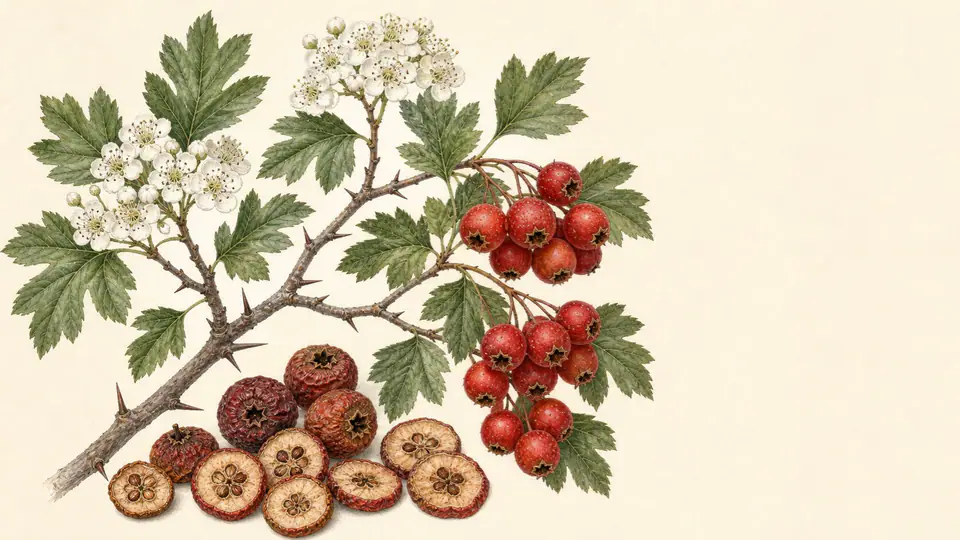
A Maze of Names Linked to Small Red Berries
Can I take Sansayu berries or extracts for digestion, cholesterol, or heart health? To start with the conclusion, you must first identify which type of Sansayu it is before taking it. Under the same name 'Sansayu', Korean dried berries, European leaf and flower extracts, fresh fruit, juices, vinegars, and other Crataegus species are all mixed together.
This confusion over names is not a recent phenomenon. Sansayu has long been remembered as a medicinal herb used when feeling bloated after eating meat. As people interested in heart health or cholesterol management began seeking Sansayu extracts, they started asking if the dried berries used for digestion and the extracts mentioned for cardiovascular health are the same raw material. While the starting point of the question is simple, the answer requires first distinguishing the identity of the raw material.
Where the questions begin
Questions about hawthorn generally fall into two categories. One is the traditional use for post-meal digestive discomfort, and the other is modern expectations regarding heart failure, blood pressure, and cholesterol. Are these two questions directed at the same raw material? Items based on the Standard Korean Medicine Terminology define hawthorn as C. pinnatifidathe ripe fruit of the species and its variants. This definition pertains to one axis of the question: the dried berries. However, the evidence frequently cited in cardiovascular clinical practice often does not refer to these berries.
Identity of the Raw Material: A Different Story if Not the Fruit
As a medicinal herb in Korea, Sansayu consists of the ripe berries of the Rosaceae family's Crataegus species Crataegus pinnatifidaand its variants, which are sliced and dried. Fresh fruit, juices, vinegars, powders, berries from other Crataegus species, and the standardized leaf and flower extract WS 1442 used in European cardiovascular clinical trials are not the same raw material or formulation. This distinction is not merely a difference in form. Different species result in different components, different plant parts result in different components, and different extraction methods result in different concentration levels and component profiles. Therefore, even if they are called by the same name 'Hawthorn', they are different raw materials.
Reason for Expectations: Imbalance of Components
Procyanidins are dominant in the berries, while flavonol glycosides and C-glycosyl flavones are more abundant in the leaves. Because differences based on species, ripeness, and extraction methods are significant, comparative research is difficult. In other words, if the plant part changes, the components change, and if the components change, the evidence also changes. Most human clinical trials frequently cited regarding heart failure and blood pressure Crataegus studied standardized extracts of leaves and flowers. However, it is common to apply these results directly to Korean dried berries or food products. This is the gap between expectation and evidence.
Difference in Product Form: Same Name, Different Body
| Category | Characteristics |
|---|---|
| Dried berries of Korean medicinal herbs | C. pinnatifida Ripe berries, traditional use for digestion |
| Leaf and flower extracts from European clinical trials | Standardized products such as WS 1442, subjects of cardiovascular research |
| Fresh fruit, juice, vinegar | Food form, evidence differing from medicinal herbs or standardized extracts |
| Other Crataegus Species | Components and evidence vary by species |
Reviews summarizing cardiovascular clinical trials of standardized Hawthorn extracts state that almost all clinical trials were conducted using hydro-alcoholic extracts of leaves and flowers, rather than the fruit. 2024 Crataegus Comprehensive literature reviews from that period summarize the potential for food and medicine dual-use and various preclinical activities, but they do not confirm the therapeutic effect of domestic Korean Hawthorn fruit across different species, parts, and formulations. This also means it is difficult to conclude that it is 'effective'.
Sansa and Hawthorn: What to check regarding concomitant medications?
Various Crataegus In safety reviews for humans using single agents, they were generally well-tolerated, but dizziness, gastrointestinal discomfort, headache, and pulsating sensations were reported. These results are also not based solely on a single formulation of domestic Korean Hawthorn fruit. In particular, blood pressure medications, heart failure medications, angina medications, or arrhythmia medications must not be arbitrarily reduced or replaced with Hawthorn. When adding concentrated products, it is necessary to inform medical staff or pharmacists of the species, part used, and content.
If you do not know whether a product called 'Hawthorn' is the Korean fruit or a European leaf/flower extract, the risks of concomitant use also differ. You must first distinguish between simple post-meal bloating and cardiac warning signs such as chest pain, shortness of breath, edema, or fainting.
Individual Circumstances and Safety Signals: Distinguish First
Chest pain, shortness of breath, fainting, newly developed severe palpitations, or rapidly increasing edema require immediate cardiac evaluation over the use of Hawthorn. If dizziness, gastrointestinal discomfort, headache, palpitations, or rashes occur, stop use and monitor progress; if symptoms are severe or persist, you must be evaluated. There is insufficient data on long-term use and drug interactions of domestic Korean Hawthorn fruit concentrates for pregnancy, lactation, and children. Therefore, a more cautious approach is required in these cases.
The Gap Between Human Evidence and Expectations
In other words, expectations for heart health are mostly based on research using standardized extracts of leaves and flowers. The same human clinical evidence does not exist for dried Korean fruit. This is why the 2024 comprehensive literature review only summarized preclinical activities and did not confirm the therapeutic effect of domestic Korean Hawthorn fruit. One must look at what the research subject was, how consistently the results appeared, and what the limitations were.
Differences from similar raw materials
The following targets should be compared: ripe fruit of Korean medicinal herbs versus leaf/flower extracts from European clinical trials, C. pinnatifidaand other Crataegus species, fresh fruit/tea/vinegar versus standardized concentrated extracts, and traditional use for digestion versus clinical results for heart failure and blood pressure. Checking these four axes simultaneously can reduce confusion regarding the names.
Criteria to Check Today
So, what should you look for? Check the species, part, and extraction method first, rather than the name Sansa or Hawthorn. Do not apply research from standardized leaf/flower products to dried fruit or food. Do not self-treat heart symptoms with Hawthorn. If you are taking concomitant medications, inform medical staff and pharmacists of the species, part, and content, and stop use if adverse reactions occur. This is the realistic standard when choosing this ingredient.
References
- Sansa entry based on the Standard Korean Medicine Terminology of the Society of Korean Medicine.
- Phenolic composition and health effects of hawthorn from different origins.
- Standardized hawthorn leaf and flower extracts in cardiovascular disorders.
- Crataegus traditional uses, pharmacology and safety concerns: comprehensive review.
- Adverse-event profile of Crataegus preparations: systematic review.
This text explains the origin of the raw materials, the scope of research, and precautions before consumption. As this cannot replace individual diagnosis or treatment, please consult a medical professional if you are taking medication or if symptoms persist. If sudden and severe symptoms such as difficulty breathing or decreased consciousness occur after consumption, seek help from 119 or the emergency room.

Medical Staff Review
Director Choi Yeon-seung
Chief Director of Baekrokdam Korean Medicine ClinicSansa Dictionary Entry, reviewed the safety of expressions and the scope of verification before administration.
Review scope: Ingredient origin, human studies, concomitant medications, safety of intake · Last reviewed 2026-08-17
- Graduated from Kyung Hee University College of Korean Medicine
- Providing Korean medicine treatment since 2010
- Consultations for Gongjindan, Gyeongokgo, Nokyong (Deer Antler) restorative medicine, and customized restorative herbal medicine