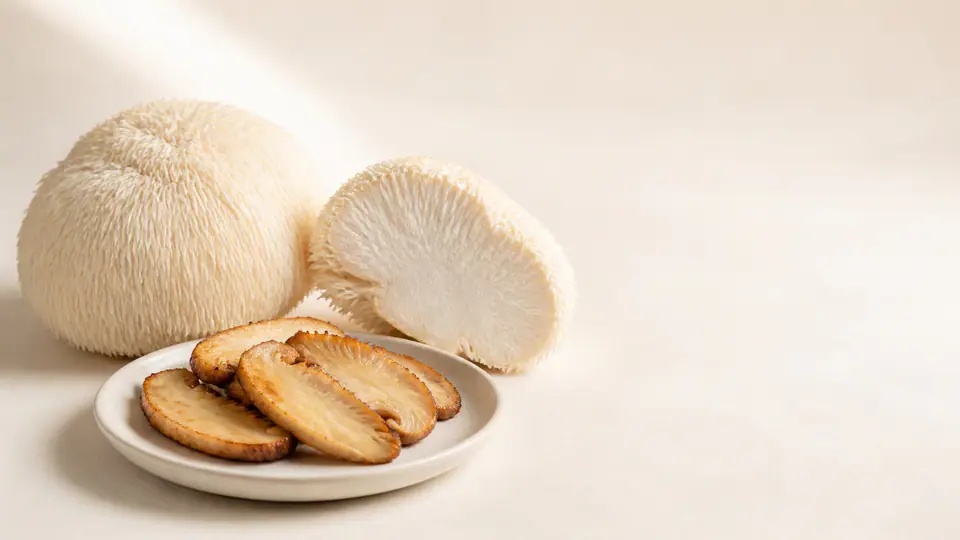
From a mushroom with drooping white spines to a brain health capsule
Lion's mane mushroom is said to be good for memory and nerves; is it effective when eaten as food? What is the difference between fruiting body and mycelium capsules?
To put it simply, a plate of edible mushrooms and the powder or extracts in capsules are different things that happen to share the same name. In research, the fruiting body and mycelium are parts where different components are highlighted. Therefore, you cannot guess the efficacy or content based on the product name alone.
This mushroom is white with long, soft spines drooping downward. Under the scientific name Hericium erinaceus, the NCBI classifies it as an edible basidiomycete mushroom of the Hericiaceae family. In Korea, it is called norugungdengi-beoseot, in English-speaking regions it is known as lion's mane, and in academic terms, it is sometimes called Hericium. Recently, it has frequently appeared as a raw material for brain health supplements, but looking closer, there are many steps between the simplicity of the name and the actual evidence.
Why a name alone is not enough
It is clear that lion's mane is an edible mushroom distributed as Hericium erinaceus. However, fresh mushrooms, dried fruiting body powder, mycelium cultures, hot water extracts, and alcohol extracts have different components. For example, hericenones are primarily found in the fruiting body, while erinacine research is mainly linked to the mycelium. If a product label only says "lion's mane," it is impossible to know which part was used or how it was processed. This means different raw materials can be included under the same name.
Consumers may associate the single term "lion's mane" with research results, but those studies were conducted on specific powders or mycelium extracts. Therefore, when choosing a product, you should first check the scientific name and whether it is the fruiting body or mycelium, what the culture substrate is, and whether the extraction ratio and actual mushroom amount are indicated.
Mushrooms on the dining table are different from mushrooms in capsules
It is difficult to place eating edible mushrooms in cooking on the same level as taking them as supplements. Clinical trials used specific powders, mycelia, or extracts, not cooked mushrooms. Fresh mushroom foods, dried powders, and concentrated extracts have different component concentrations and safety profiles.
The experience of eating it as food cannot be viewed as the same as the long-term safety of concentrated extracts, as there is a lack of long-term human data. Therefore, the reasoning that "it's fine as food, so capsules must be fine too" does not hold. Conversely, assuming that "since there is capsule research, cooked mushrooms will provide the same effect" is premature for the same reason.
The distinction between fruiting bodies, mycelium, and culture substrates
Fruiting bodies and mycelium are different growth stages of the same fungus. The fruiting body is the mushroom body we see, and the mycelium is a thread-like fungal network that absorbs nutrients. In research, more attention is focused on hericenones in the fruiting body and erinacines in the mycelium. Additionally, mycelium products often come in a form where they are grown on grains or other culture substrates and then dried.
Therefore, if the label only says "mycelium," it is often impossible to know the actual ratio of mushroom mycelium to the culture substrate. Even for fruiting body powder, the components vary depending on the concentration level and the solvent used for extraction. Without knowing these differences, it is difficult to apply research results to a specific product.
Why nerve growth factors and animal studies do not translate directly to humans
One reason for the high expectations for lion's mane is that cell and animal studies showed signals related to nerve growth factor (NGF) or nerve regeneration. However, phenomena observed in cells and animals are not results proving the prevention or treatment of dementia in humans. Many steps remain between the two, including absorption, metabolism, reaching the brain, long-term safety, and reproducibility across diverse populations.
Randomized trials in humans were limited to only 5 that included systematic reviews, and it is difficult to state definitive efficacy as the subjects, formulations, and results varied. While improvements in cognitive scores were observed in small-scale trials for mild cognitive impairment, this was only a result observed during administration and is not evidence that it suppressed the occurrence or progression of dementia. A pilot study observing 41 healthy young adults for 28 days provided only exploratory results and did not confirm general memory improvement.
What to check first if you have concerns about memory
Before considering lion's mane products, it is important to first categorize your situation. The approach differs depending on whether it is simple forgetfulness, diagnosed mild cognitive impairment or dementia, or whether it is accompanied by depression or anxiety. You should also check if you are receiving standard evaluation and treatment.
If memory decline progresses rapidly or daily functioning decreases, prioritizing a cognitive evaluation is more important than relying on supplements. Supplements are not treatments that change the cause of a disease, and especially in a diagnosed state, a decision should be made after consulting with a medical professional.
When to take and when to avoid
When using Lion's Mane mushroom with other supplements or medications, check if you are taking other complex brain health products. There may be overlapping ingredients or other components that could potentially interact.
Regarding safety, gastrointestinal discomfort, headaches, and allergic reactions have been reported. Caution is advised for those with mushroom allergies or asthma. Due to a lack of data on use during pregnancy, breastfeeding, childhood, and chemotherapy, the general rule is not to add concentrated products arbitrarily. If symptoms such as difficulty breathing, facial swelling, generalized hives, or decreased consciousness occur, you must immediately seek help from 119 or the emergency room.
Criteria to Check Today
So, what should you look for? First, verify the exact species rather than the nickname "brain mushroom," whether it is the fruiting body or mycelium, what kind of extract it is, and the actual amount of mushroom contained. Next, remember that NGF (Nerve Growth Factor), mechanisms in animal studies, small improvements in cognitive scores, and dementia prevention are three distinct stages.
When choosing a product, please check the following:
| Checklist Item | Reason |
|---|---|
| Indication of scientific name Hericium erinaceus | Confirmation of the same species |
| Whether it is fruiting body, mycelium, cultured grain, or extract | Comparability with research subjects |
| Extraction ratio and actual mushroom amount | Basis for estimating content |
| Whether it can be used during pregnancy, breastfeeding, childhood, or chemotherapy | Lack of safety data |
While this ingredient has a long history as an edible mushroom, human evidence for its use as a brain health supplement is still in the early stages. Between the simplicity of the name and the complexity of the research, the most realistic starting point is to look at accurate ingredient information alongside the limitations of current evidence.
References
- NCBI Taxonomy: Hericium erinaceus.
- Lion's mane supplementation: systematic review.
- Lion's mane in young adults: randomized pilot trial.
- Lion's mane and mild cognitive impairment: randomized trial.
This text explains the origin of the raw materials, the scope of research, and precautions before consumption. As this cannot replace individual diagnosis or treatment, please consult a medical professional if you are taking medication or if symptoms persist. If sudden and severe symptoms such as difficulty breathing or decreased consciousness occur after consumption, seek help from 119 or the emergency room.

Medical Staff Review
Director Choi Yeon-seung
Chief Director of Baekrokdam Korean Medicine ClinicLion's Mane Mushroom Dictionary Entry, reviewed the safety of expressions and the scope of verification before administration.
Review scope: Ingredient origin, human studies, concomitant medications, safety of intake · Last reviewed 2026-08-17
- Graduated from Kyung Hee University College of Korean Medicine
- Providing Korean medicine treatment since 2010
- Consultations for Gongjindan, Gyeongokgo, Nokyong (Deer Antler) restorative medicine, and customized restorative herbal medicine