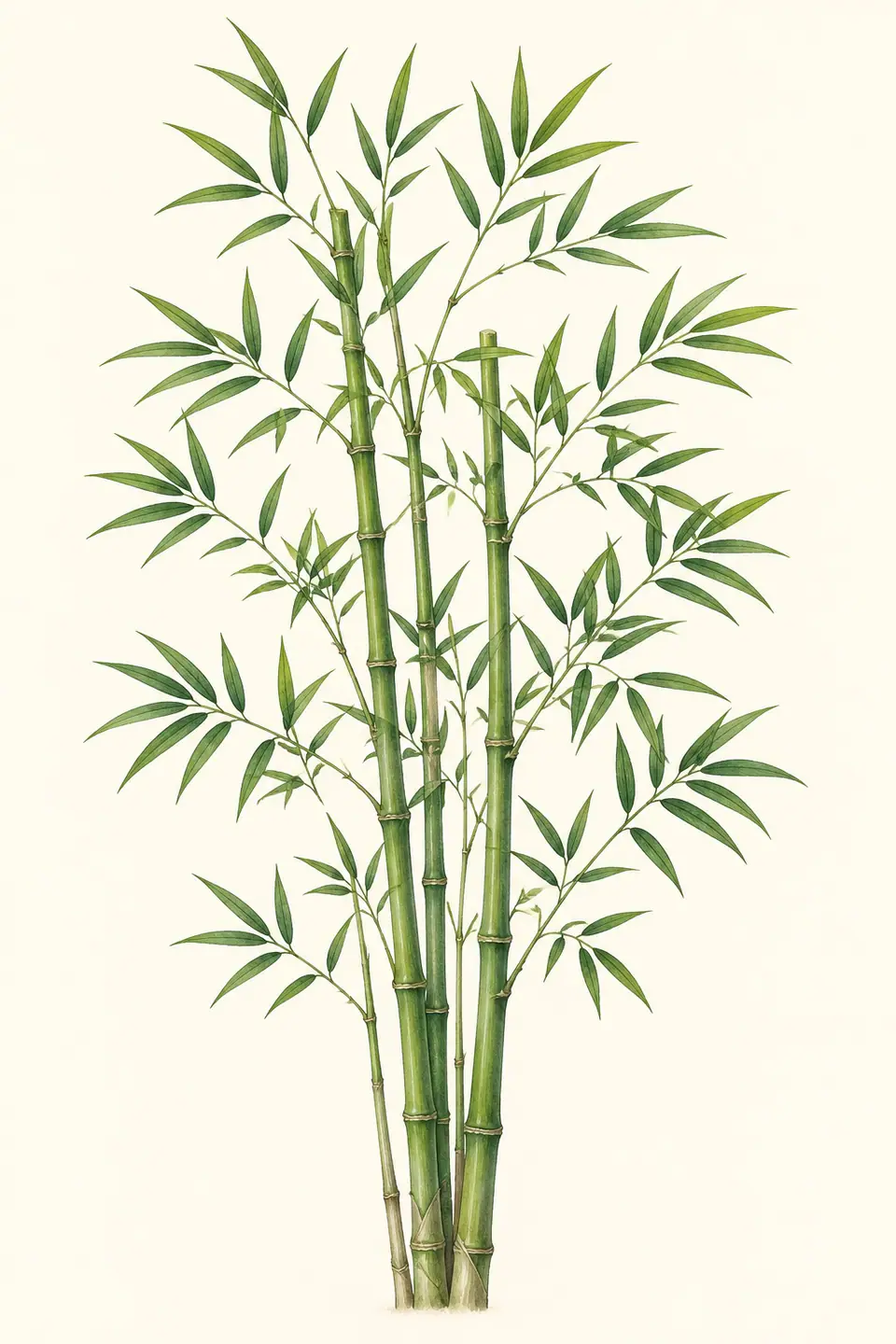
Leaves for Clearing the Heart, Jukyeop (Bamboo Leaf)
The first appearance of Jukyeop (Bamboo Leaf) in the 《Shennong Bencao Jing》 is slightly different from the 'refreshing bamboo forest image' we commonly imagine today. It is recorded as follows. “竹葉,味苦平。主咳逆上氣溢筋急,惡瘍,殺小蟲。” In other words, Jukyeop was recorded from the beginning as a medicinal herb to help the communication of the lungs and Qi, and to treat swellings (ulcers) caused by heat. Later, the 《Mingyi Bielu》 added that it "primarily treats phlegm-heat in the chest, coughing, and rebellious Qi," and the 《Bencao Gangmu》 left an anecdote about using Jukyeop for "seasonal jaundice." Although it is a single line of classical record, it already contains the essence of Jukyeop as a 'leaf that lowers the heat of the heart and releases the heat of the body.'
Many people regard Jukyeop as 'just a refreshing bamboo leaf tea.' However, in classical texts, Jukyeop is not merely an ingredient for a cup of tea, but a medicinal herb that holds a specific place in a prescription. The Jukyeop-tang in the 《Jingui Yaolue》 was used for postpartum stroke, fever, facial flushing, and headache, and the Jukyeop-shigao-tang in the 《Shanghan Lun》 is a prescription to treat deficiency heat, irritability with thirst, and vomiting remaining after a febrile disease. Both of these prescriptions combine Jukyeop with tonic medicines such as ginseng, licorice, and jujube. In other words, Jukyeop is not simply a 'cooling' herb, but plays the role of organizing heat and clearing the mind among Qi-tonifying herbs.
However, this 'clearing and lowering' power is not always appropriate. The Traditional Knowledge Portal of Korea specifies that "pregnant women should not take it," and because Jukyeop is cold, sweet, and bland in nature, it may actually be burdensome for those with a cold body or a weak stomach. Therefore, Jukyeop is a medicinal herb where 'how much, for whom, and within which prescription' it is used is particularly important. I will summarize those criteria one by one below.
Summary at a Glance
As its name suggests, Jukyeop is light, but in reality, it is a leaf used to manage heat in the heart, stomach, and lungs. The table below summarizes its origin, properties, and precautions at a glance.
| Category | Content |
|---|---|
| Origin | Chinese name: 竹葉, Scientific name Phyllostachys nigra var. henonis. Leaves of Phyllostachys nigra (a variety of black bamboo) from the Gramineae family; harvested in the previous year and dried in the sun for use. |
| Properties and Meridian Tropism | Sweet, bland, and cold (甘淡寒). Non-toxic. Primarily acts on the Heart Meridian and Stomach Meridian, and is related to the lungs and biliary tract. |
| Representative Aliases | It is also called Jukyeop (竹葉) or Damjukyeop (淡竹葉), but scientifically refers to the leaves of this specific variety. |
| Efficacy Recorded in Literature | Clears heat and relieves irritability, calms the heart and relieves spasms, promotes fluid production and urination, clears and cools the blood, stops vomiting, and resolves phlegm-heat. Traditionally used for irritability and thirst from febrile diseases, mouth and tongue ulcers, pediatric convulsions, heat-related lymphadenopathy, and scanty urination. |
| Main Components and Modern Research | P. nigra var. henonis Experimental research on the antioxidant activity of leaf extracts, immunomodulation such as the inhibition of IL-12 production, and cardiovascular functional research have been reported. |
| Combination & Precautions | Caution is required as the direction of action may change when used in combination with tonic medicines for Yang or Yin deficiency. While the Traditional Knowledge Portal specifies that pregnant women should not take it, classical texts such as the 《Dongui Bogam》 contain records of its use for pregnancy-related symptoms under professional prescription. |
Is this medicinal herb right for me?
Jukyeop is a medicinal herb that lowers heat in the heart, stomach, and lungs, while simultaneously managing thirst and urinary discomfort. However, it may be burdensome if your body is cold or if you are pregnant. I have categorized this into the following three situations.
- Generally suitable cases: Traditionally considered when heat rises, the mind is unsettled, the mouth and tongue are ulcerated, and there is thirst; or when urine is scanty and red, or the face flushes easily.
- Cases requiring caution: For those who naturally have a cold body, weak digestion, or frequent diarrhea, the cold nature of Jukyeop may further irritate the stomach. Additionally, while it was used in specific prescriptions (such as Jukyeop-tang for fetal irritability) in the 《Dongui Bogam》, the Traditional Knowledge Portal of Korea lists it as contraindicated for pregnant women, so consultation with a Korean medicine doctor is essential.
- Cases to avoid: It is best avoided by those with a severely cold body and diarrhea, or those with clear cold symptoms (Han-jeung). Pregnant women should also avoid taking it alone without a professional prescription.
Practical Q&A
I have gathered frequently asked questions about Jukyeop from the clinic. Although this herb seems light and refreshing like its name, it can be burdensome depending on the constitution and situation, making the timing of consultation important. The following questions are organized in that context.
Does Jukyeop help when I have a lot of heat and severe thirst?
Yes, traditionally Jukyeop has been used to manage irritability with thirst and thirst caused by heat. The 《Bencao Shugouyuan》 records its action to "clear the heart and supplement Qi" and "treat wasting-thirst," and the 《Bencao Gangmu》 also shares an anecdote of using Jukyeop for "seasonal jaundice." However, since the cause of thirst may stem from diabetes or thyroid disease rather than simple dehydration, it is necessary to first distinguish the cause through consultation with a Korean medicine doctor.
Is it okay to drink Jukyeop tea every day?
Jukyeop (bamboo leaf) is a medicinal herb with cold and light properties. According to records from the Traditional Knowledge Portal, people with a cold constitution or pregnant women should exercise caution when taking it. If you have a constitution characterized by weak digestion, cold hands and feet, or frequent diarrhea, long-term or high-dose consumption of bamboo leaf tea may instead place a burden on the gastrointestinal tract. Even when consumed as a tea, it is recommended to use it temporarily; if you plan to take it continuously, it is best to decide after a consultation.
Is Jukyeop the same medicinal herb as Damjukyeop?
No. Jukyeop ( Phyllostachys nigra var. henonis) and Damjukyeop ( Lophatherum gracile) are distinct medicinal herbs with different scientific names. While their names are similar and some effects overlap, their origins in Korean medicine and their indications differ too much to be used interchangeably in prescriptions. Among products sold as 'bamboo leaf tea' on the market, both types may be mixed, so it is important to check the ingredients.
In which prescriptions is Jukyeop mainly used?
Jukyeop is primarily used as a supporting agent in prescriptions designed to lower heat and calm mental agitation. A representative example is Jukyeop-seokgo-tang from the "Shanghan Lun," which is used to treat residual heat, deficiency-heat agitation (heobeon), and vomiting following a febrile illness. Additionally, Jukyeop-tang from the "Jingui Yaolüe" has records of use for postpartum stroke, fever, and facial flushing, while Jukyeop-tang from the "Dongui Bogam" was used for fetal agitation (jabeon) during pregnancy. As such, the role of Jukyeop becomes clearer when combined with other herbs rather than used alone.
I am taking Western medicine; can I drink bamboo leaf tea together with it?
There are no confirmed official clinical studies directly verifying the interaction between Jukyeop and specific Western medicines. However, since Jukyeop is classified as a herb that can promote urination and affect fluid balance, it is safer for those taking diuretics, heart or kidney-related medications, or diabetes and hypertension medications to decide whether to use it concurrently after consulting with a Korean medicine doctor.
Can Jukyeop be used during pregnancy?
Records from the Traditional Knowledge Portal state that pregnant women should avoid taking it. However, the "Dongui Bogam" records Jukyeop-tang for treating mental agitation and unstable fetal movement during pregnancy; this is a classical example where a professional Korean medicine doctor prescribed it based on the patient's overall condition. Please ensure you consult a professional to decide on its use during pregnancy.
Relationship with Other Medicinal Herbs (Yakdae/Pairing)
Jukyeop's characteristics become more distinct when used with other herbs rather than alone. In traditional medicine, such pairs are called 'yakdae' (medicinal pairs). In the case of Jukyeop, it is characterized by combinations where it acts as a bridge between tonic herbs and heat-clearing herbs. It is paired with other herbs to lower mental heat without damaging energy, or to release heat while protecting body fluids.
- Jukyeop-seokgo-tang A prescription found in the "Shanghan Lun." It consists of Jukyeop, Gypsum, Pinellia, Ophiopogon, Ginseng, Licorice, and scorched rice. It has been traditionally used to treat residual heat, deficiency-heat agitation, thirst, and vomiting after a febrile illness. It is a representative example where energy-boosting herbs like Ginseng and Licorice harmonize with cold-natured herbs like Jukyeop and Gypsum within one prescription.
- Jukyeop-tang A prescription recorded in the 'Postpartum Diseases of Women' section of the "Jingui Yaolüe." It consists of Jukyeop, Pueraria root, Saposhnikovia, Platycodon, Cinnamon twig, Ginseng, Licorice, Aconite, Jujube, and Ginger. It has been traditionally used for cases of postpartum stroke accompanied by fever, facial flushing, shortness of breath, and headache.
- 子煩竹葉湯 A prescription found in the 'Miscellaneous Diseases' section of the "Dongui Bogam." It consists of Atractylodes rhizome, Ophiopogon, Scutellaria, Saposhnikovia, and green bamboo leaf. It was traditionally used for 'jabeon' (fetal agitation), where the mother feels mentally restless and fetal movement is unstable during pregnancy. However, use during pregnancy must be decided after consulting a professional Korean medicine doctor.
- Gaenggi-tang A modern Korean medicine prescription that helps recover physical strength after an illness, consisting of rice, Ophiopogon, Jujube, Ginseng, and Jukyeop. Ginseng and Jujube supplement energy, while Ophiopogon and Jukyeop lower heat in the mind and stomach.
Since Jukyeop is a herb with distinct cold properties, the ratio and duration of use are important when paired with warm-natured tonic herbs. Especially when used with warm herbs such as Ginseng, Licorice, Aconite, and Cinnamon twig, the combination must be adjusted according to the individual's constitution and symptoms, which the Korean medicine doctor will determine during the consultation.
In what form is it consumed?
The most common form of Jukyeop is drying the leaves and brewing them as a tea. When prescribed at a Korean medicine clinic, it is usually used in the form of jeontang (a method of boiling and extracting in water) along with other herbs. The different forms are explained below.
- Tea: The most common form is steeping dried Jukyeop in boiled or hot water. Also known as bamboo leaf tea, it is characterized by a refreshing and clean taste.
- Food: Using Jukyeop directly as a food ingredient is not common.
- Decoction: In Korean medicine clinic prescriptions, it is common to use Jukyeop in the jeontang form, boiling it with other herbs in water. Classical prescriptions such as Jukyeop-tang from the "Jingui Yaolüe" or Jukyeop-seokgo-tang from the "Shanghan Lun" are prepared in this manner.
- Professional Prescription: Rather than being used alone, bamboo leaf is used in combination with other medicinal herbs within traditional prescriptions such as Jukyeop-tang, Jukyeop-seokgo-tang, and Damjukyeop-tang. Those who are pregnant or have a cold constitution must consult a professional Korean medicine doctor before making a decision.
Interactions and Safety During Use
While bamboo leaf can be used lightly like a tea, it has a cold nature and diuretic effects, which may be burdensome depending on your body's condition. In particular, caution is required for those who are pregnant, have a cold constitution, or are taking Western medications. The confirmed items are summarized below.
- Pregnancy: The Traditional Knowledge Portal of Korea specifies that "pregnant women should not take it." However, in classics such as the Dongui Bogam, there are prescriptions containing bamboo leaf for "Ja-beon" (irritability during pregnancy), but these are classical examples judged by a professional Korean medicine doctor based on the patient's condition. If you are pregnant, you must decide after a consultation.
- Cold sensitivity or deficient-cold constitution: Due to its cold nature and diuretic effect, it may actually aggravate symptoms in those who have a cold body, frequent diarrhea, or weak energy.
- Concurrent Use with Western Medicine: If you are currently taking any medication or are receiving prescriptions related to the heart, kidneys, or blood pressure, you need to consult a Korean medicine doctor as bamboo leaf may affect fluid balance or drug action.
- Long-term or high-dose use: Unlike drinking it occasionally as a tea, when used long-term in a Korean medicine prescription, it must be adjusted while monitoring changes in constitution and symptoms.
Whether bamboo leaf is appropriate should be determined by looking at your overall constitution, current medications, and pregnancy status, rather than by a single symptom. If you have any questions or are taking any medications, please be sure to mention them during your medical evaluation.
If you experience these symptoms
Bamboo leaf may feel light like a tea, but it has a cold nature and diuretic effects, which can be burdensome depending on your body's condition. The following signs can be seen as warnings that bamboo leaf may not be suitable for you. If these symptoms appear, it is safer to first notify the attending Korean medicine doctor who provided the prescription rather than reducing the dose or stopping it on your own.
- The abdomen feels cold and diarrhea becomes more frequent Because of the cold nature and diuretic effect of bamboo leaf, it may manifest as gastrointestinal burden for those with a cold body or a weak stomach.
- Hands and feet feel colder or fatigue accumulates Excessive or long-term intake may affect body temperature regulation and energy consumption.
- Abnormal symptoms such as anxiety, uterine contractions, or bleeding occur during pregnancy It is specified as contraindicated for pregnant women in the Traditional Knowledge Portal of Korea, and pregnancy-related prescriptions in the Dongui Bogam are special cases used under the prescription of a professional Korean medicine doctor.
- Urine volume increases excessively or symptoms like dehydration occur Strong diuretic effects may occur.
- New symptoms appear while taking Western medications Especially if you are taking diuretics, diabetes medication, or heart-related medications, the overall prescription must be reviewed together.
If symptoms are severe or persist, please consult your attending Korean medicine doctor and visit an emergency medical institution if necessary.
Differences from other restorative medicines
Bamboo leaf is closer to a heat-clearing medicine (Cheongyeol-yak) that lowers heat and calms mental restlessness rather than a restorative tonic. However, when paired with Ginseng or Ophiopogon japonicus, which supplement the body's energy, it helps manage restlessness and thirst without damaging energy while releasing heat. Typical restorative tonics like Gongjin-dan or Gyeongok-go focus on supplementing deficiency patterns (Heo-jeung) and filling Qi and Blood, whereas bamboo leaf is used when heat or irritability is distinct. A representative example is Jukyeop-seokgo-tang from the Shanghan Lun, where it is used with Ginseng, Ophiopogon japonicus, Licorice, and non-glutinous rice to simultaneously treat remaining heat after a febrile illness and energy deficiency.
On the other hand, if the primary goal is recovery after illness or chronic loss of energy, a Qi-supplementing (Bo-gi) prescription centered on Ginseng, Jujube, and Ophiopogon japonicus may be more appropriate. Gyeonggi-tang, which contains bamboo leaf, is also used with Ginseng, Ophiopogon japonicus, and Jujube, making it a composition suitable for post-illness fatigue accompanied by heat. In other words, bamboo leaf is insufficient for 'only supplementing Qi' and lacking for 'only lowering heat'; it can be seen as a medicinal herb that acts as a bridge between restorative tonics and heat-clearing medicines.
Exactly which category it falls into depends on whether your current primary symptoms are heat and irritability, or energy deficiency and deficiency patterns. It is best to confirm through a medical consultation whether bamboo leaf is necessary or if another restorative tonic is more appropriate.
References
- You can check the origin, properties, medicinal nature, meridian tropism, indications, and usage of bamboo leaf at the Herbal Medicine Resource Research Center of the Korea Institute of Oriental Medicine. Korea Institute of Korean Medicine, Herbal Medicine Resource Research Center, Bamboo Leaf
- You can find information on the properties, contraindications, efficacy, and main indications of bamboo leaf on the Traditional Knowledge Portal. Traditional Knowledge Portal, Bamboo Leaf
- In the original text of the "Jingui Yaolue," you can find the Bamboo Leaf Decoction (Jukyeop-tang) used for postpartum stroke and febrile headaches. theqi.com — 金匱要略 婦人產後病 竹葉湯
- In the original text of the "Shennong Bencao Jing," you can find the evidence of bamboo leaf's first inclusion in pharmacognosy. guoxue3000.com — 神農本草經 竹葉
- On PubMed, you can find experimental research regarding the antioxidant activity of leaf extracts from the black bamboo variant. PubMed — Evaluation of antioxidant and prooxidant activities of bamboo leaf extract
- You can find bibliographies and abstracts of modern research related to bamboo leaf. PubMed academic paper
- In the Asia Pacific Journal of Clinical Nutrition, you can find functional research on bamboo leaf extracts related to cardiovascular health. Asia Pac J Clin Nutr 2008 — bamboo-leaf extracts cardiovascular benefits
If you would like to check if this medicinal herb is right for you or which prescription it should be used with, please leave a medical inquiry. For those who find it difficult to visit the clinic, non-face-to-face consultations are available; we will provide guidance after first reviewing your current condition and current medications.

Medical Staff Review
Director Choi Yeon-seung
Chief Director of Baekrokdam Korean Medicine ClinicBamboo Leaf Dictionary Entry, reviewed the safety of expressions and the scope of verification before administration.
Review Scope: Clinical Accuracy, Pharmacology, Contraindications, Combinations, QA · Last Reviewed 2026-08-16
- Graduated from Kyung Hee University College of Korean Medicine
- Providing Korean medicine treatment since 2010
- Consultations for Gongjindan, Gyeongokgo, Nokyong (Deer Antler) restorative medicine, and customized restorative herbal medicine