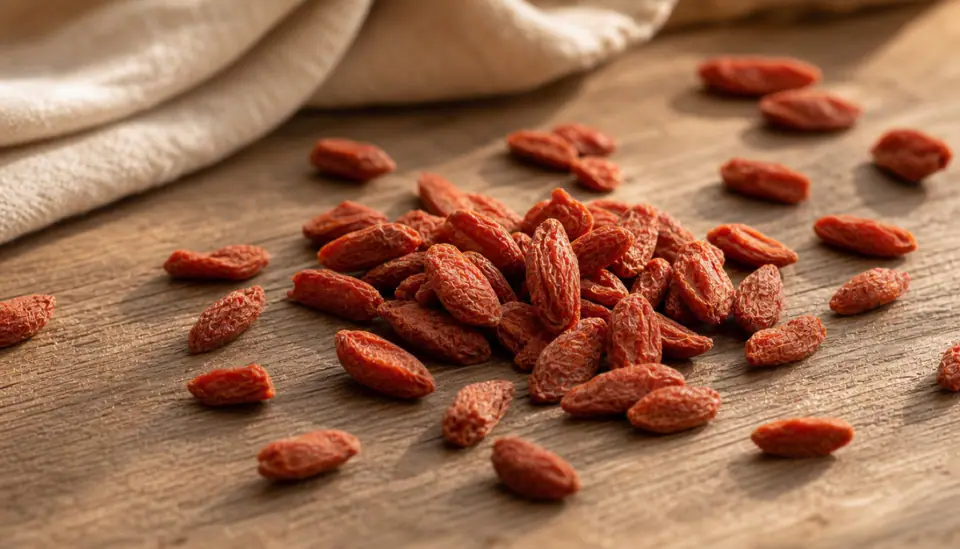
Geolroja, the red berry that cares for the eyes and chronic exhaustion
The "Shennong Bencao Jing" classifies Goji berries (Gugija) as a first-grade herb, stating, "Long-term intake strengthens muscles and bones, lightens the body, prevents aging, and provides endurance against cold and heat." The "Mingi Byeollok" further notes that it "replenishes essence and qi... benefits the liver, improves vision, and strengthens muscles and bones," while the "Bencao Gangmu" summarizes its effects as "nourishing the kidneys, moistening the lungs, benefiting the liver, and improving vision." Due to these records, Goji berries earned the nickname 'Geolroja', the child who prevents aging, or the small berry that repels senescence.
Many people commonly perceive Goji berries simply as a "healthy food for the eyes," as adding a few berries to a cup of tea can make the eyes feel relieved from fatigue. However, the original purpose of Goji berries emphasized in classical texts is deeper. It was used to nourish the Yin of the liver and kidneys, replenish essence (Jeong), and soothe a body exhausted by chronic fatigue (Heoro). The eyes are like windows through which these results are revealed. Thus, the "Dongui Bogam" states, "It clears the vision and calms the spirit, leading to longevity," and the Sasin-wan formula from "Seojukdangbang" used Goji berries alongside Rehmannia root (Sukjihwang), Atractylodes (Baekchul), and Poria cocos (Baekbongryeong) to treat "deficiency of the kidney meridian, resulting in blurred vision."
However, these red berries are not unconditionally beneficial for everyone. Goji berries are recorded as having a cold or neutral property and are herbs with a strong Yin-nourishing (Boeum) tendency. They may be inappropriate for those with a weak stomach, a cold abdomen, or during the early stages of a fever from a cold. Additionally, special caution is required for those taking anticoagulants, diabetes medications, or antihypertensive drugs, as well as for women who are pregnant or breastfeeding. While related case reports were identified in this search, the original texts of official clinical trials were not secured; therefore, you must inquire during a consultation.
Ultimately, Goji berries are not just "red berries that brighten the eyes upon eating," but a traditional restorative medicine that cares for chronic exhaustion and Liver-Kidney Yin Deficiency (Gansin-eumheo). Therefore, how much, who, and how they are used becomes important, and that is exactly the criteria covered on this page.
Summary at a Glance
Goji berries are among the most familiar names in herbal medicine, yet their true identity and usage are often surrounded by misunderstandings. If you look at the table below, you can see at a glance where this herb comes from, its properties, and what it was used for in classical texts.
| Category | Content |
|---|---|
| Origin | Hanja Name 枸杞子, Scientific Name Lycium chinense Mill. (Solanaceae). The mature fruits of Lycium chinense or Lycium barbarum (Lycium barbarum L.) are used after being sun-dried. |
| Properties and Meridian Tropism | Property: Cold or Neutral; Taste: Bitter or Sweet, there are differing views depending on the literature. Meridian Tropism: Liver, Kidney, and Lung. |
| Representative Aliases | Geolroja (small berry that prevents aging), Jigolja, Cheokbo, Hong-idda, Cheonjingja, etc. |
| Efficacy Recorded in Literature | "Shennong Bencao Jing": "Long-term intake strengthens muscles and bones, lightens the body, prevents aging, and provides endurance against cold and heat" / "Mingi Byeollok": "Replenishes essence and qi... benefits the liver, improves vision, and strengthens muscles and bones" / "Bencao Gangmu": "Nourishes the kidneys, moistens the lungs, benefits the liver, and improves vision." Efficacy based on OASIS: Replenishing essence and improving vision (Ikjeong-myeongmok), nourishing the liver and kidneys (Jabogan-sin). |
| Main Indications | Liver-Kidney Yin Deficiency (Gansin-eumhyu), dizziness (Du-hun), vertigo (Mok-hyeon), blurred vision with excessive tearing (Mok-hon-daru), wasting-thirst (Sogal), soreness and weakness of the lower back and knees (Yo-chil-san-yeon), and cough due to chronic exhaustion (Heoro-haesu), etc. |
| Forms of Intake | Traditionally used as tea, consumed as dried fruit, prepared as a decoction (Jeontang), or infused in alcohol. |
| Combination & Precautions | As a restorative medicine with a Yin-nourishing (Boeum) tendency, caution is needed against excessive intake for those in the early stages of an external fever (Oegam) or those with a weak digestive system or a cold constitution. Potential interactions have been reported when used with anticoagulants, diabetes medications, or antihypertensive drugs, but official original texts require further verification in this search. It is advisable to consult a specialist before intake during pregnancy or breastfeeding. |
Is this medicinal herb right for me?
Because Goji berries are often encountered as tea or health foods, it is easy to think of them as a "safe restorative for everyone." However, both in classical texts and modern clinical practice, this is a herbal medicine with a distinct Yin-nourishing (Boeum) tendency. Depending on your constitution and the situation of intake, it may cause discomfort; therefore, it is recommended to first check yourself against the following three criteria.
- Generally suitable cases: Traditionally known as a suitable herb for those who frequently experience eye fatigue or blurred vision, suffer from thirst and difficulty falling asleep at night, feel a deficiency in the Yin of the liver and kidneys, have relatively good digestion, and wish to consistently consume small amounts as tea or decoctions.
- Cases requiring caution: For those with a cold abdomen and frequent diarrhea, or a weak stomach, excessive intake may cause indigestion even if the property of Goji berries is cold or neutral. Additionally, it is best to avoid them during the early stages of a cold fever or external contraction (Oegam), as the Yin-nourishing property may prolong the symptoms. Those taking anticoagulants, diabetes medications, or antihypertensive drugs, or those who are pregnant or breastfeeding, should decide after consulting a specialist.
- Cases to avoid: For those with severe abdominal coldness and recurring diarrhea, or those with clear cold symptoms (Hanjeung) rather than heat; those with acute cold symptoms such as external fever, sore throat, or body aches; and those who are pregnant or breastfeeding, please do not self-administer without a separate consultation, as official safety evaluation original texts have not been secured.
Practical Q&A
The questions most frequently asked in the clinic about Goji berries are generally similar: "Can I drink it as a tea?", "Is it only good for the eyes?", "Can I take it with other medications?" Below, we provide answers to these actual questions based on classical and modern information. However, since individual constitutions and medication interactions vary, please note that a specific decision on intake must be made through a consultation.
Can I drink Goji berry tea every day?
Consuming small amounts in the form of food or tea has been widely used traditionally. The "Sepsengbang" even records brewing Goji berries and Schisandra in boiling water as "effective as a tea substitute." However, since Goji berries are a medicine with a distinct Yin-nourishing (Boeum) tendency, excessive intake may cause discomfort such as indigestion for those with a cold abdomen, frequent diarrhea, or during a period of cold fever. Rather than drinking it every day, it is better to consume it while verifying if it suits your constitution.
Are there other benefits besides eye health?
Classical texts focus not only on the eyes but also on nourishing the liver and kidneys. The 'Myeong-ui Byeol-rok' states, "It supplements essence and qi, makes one plump and healthy, treats wasting-thirst, nourishes the liver, brightens the eyes, and strengthens the muscles and bones," and the 'Boncho Gangmok' summarizes it as "nourishing the kidneys, moistening the lungs, nourishing the liver, and brightening the eyes." In other words, while Goji berries (Gugija) have a clear effect on brightening the eyes, the basis for this lies in supplementing the liver and kidney yin. In modern terms, you can understand it as a medicinal herb related to overall recovery from fatigue and depletion, as well as eye health.
I am taking anticoagulants; is it okay to consume Goji berries?
This part requires verification. While there have been several case reports mentioning that Goji berries may increase the effect of anticoagulants such as warfarin, thereby increasing the risk of bleeding, these are not currently verifiable official clinical trial texts. Therefore, if you are taking anticoagulants, please be sure to consult your primary physician or Korean medicine doctor before using supplements or Korean herbal medicine containing Goji berries.
What if I am taking diabetes or blood pressure medication?
Similarly, verification is required. Concerns that Goji berries may overlap with blood glucose-lowering or blood pressure-lowering effects are repeatedly raised in commercial health information, but official clinical trial texts have not been confirmed. If you are taking diabetes medication, insulin, or blood pressure-lowering agents, it is safer to decide after consulting a professional.
Can I take it during pregnancy or breastfeeding?
We recommend consulting a professional before consumption during pregnancy or breastfeeding. Some commercial health media mention that pregnant or breastfeeding women should avoid it due to components that promote menstruation, but there are no official clinical safety evaluation texts available. As this is a matter requiring verification, please inquire during your consultation.
When taken as a Korean herbal medicine prescription, which prescriptions is it used with?
Goji berries reveal their characteristics better when blended with other medicinal herbs rather than used alone. For example, Sasin-wan from 'Seojukdang-bang' combines Goji berries with Rehmannia glutinosa, Atractylodes macrocephala, and Poria cocos to strengthen the eyes and nerves. Gugija-hwan from 'Seonghye-bang' was used with Ginseng, Schisandra chinensis, and Rubus coreanus to supplement depletion and essence-qi. Gugija-ju from 'Cheon-geum-bang' is known to have been used by soaking Goji berries in alcohol to treat tearing caused by liver deficiency. Since these combinations are all prescribed according to constitution and symptoms, it is more appropriate to use them under the prescription of a Korean medicine doctor rather than self-administering.
Relationship with Other Medicinal Herbs (Yakdae/Pairing)
Goji berries are medicinal herbs whose true value is revealed when used with other herbs rather than alone. In Korean medicine, such pairs are called 'Yak-dae,' where herbs of different properties are blended to act more stably within a single prescription. Since Goji berries have a strong tendency to supplement yin and brighten the eyes, they are often paired with herbs that nourish the yin of the liver and kidneys or herbs that relieve eye fatigue. However, because the yin-supplementing property is strong, it may be an inappropriate combination for those with yang deficiency or a cold stomach, so it is important to look at the overall context of the prescription.
We would like to introduce representative examples among the prescriptions we provide where Goji berries form a core combination.
- Goji berry + Rehmannia glutinosa + Atractylodes macrocephala + Poria cocos — Sasin-wan: A prescription from 'Seojukdang-bang' cited in 'Boncho Gangmok'. Goji berries are the main ingredient, combined with Rehmannia glutinosa, Atractylodes macrocephala, and Poria cocos to make honey-based pills (Yeon-mil-hwan). It has been traditionally used for blurred vision or itchy eyelids caused by kidney meridian depletion.
- Goji berry + Rehmannia glutinosa + Ginseng + Poria cocos (with spirit) + Schisandra chinensis — Gugija-hwan: A prescription found in 'Seonghye-bang', recorded to treat severe depletion, improve complexion, and, if taken long-term, make the body feel light and boost energy. It is structured so that Goji berries harmonize with other restorative medicines to supplement essence and strengthen muscles.
- Goji berry + Schisandra chinensis — Chi-so-gal: A simple combination from 'Seopsaeng-bang', where Goji berries and Schisandra chinensis are powdered and steeped in boiling water to drink like tea. It was traditionally used for 'so-gal', meaning excessive thirst and polyuria.
- Goji berry + Rehmannia glutinosa + Ophiopogon japonicus + Poria cocos + Astragalus membranaceus — Gugija-hwan: A modified prescription from 'Boje-bang', used for cases of severe thirst, fatigue, and frequent urination, described as 'so-sin'.
The point to remember about Goji berry combinations is that, beyond the simple image of being a 'tonic good for the eyes,' prescriptions are designed to supplement the yin of the liver and kidneys. Therefore, yin-supplementing prescriptions containing Goji berries may not be appropriate during the early stages of a cold with fever, in cases of frequent diarrhea or a cold abdomen, or when external contraction symptoms are prominent. Since specific combinations and dosages vary depending on an individual's constitution and current symptoms, it is advisable to decide after consulting a Korean medicine doctor.
In what form is it consumed?
Goji berries are as accessible as a cup of healthy tea, but the methods of consumption are more diverse than one might think. Since the daily amount and the effect on the body can vary depending on the form in which they are consumed, I will first explain the characteristics of each form.
- Available as tea Goji berry tea is the most common form. The Seopsangbang records a method of steeping them in boiling water and drinking it like tea. Guidance on Hongcheon specialty products also introduces a method of slowly simmering 6 to 12g of goji berries in 600cc of water over low heat.
- Available as food (fresh, dried, juice, powder) Dried goji berries can be eaten as they are, or consumed as fresh goji berry juice, fermented syrup, or powder. The Bencao Gangmu also records a method of eating them like fruit, stating that those from Hexi and Ganzhou taste like grapes.
- Decoction required When included in a Korean herbal medicine prescription, goji berries are decocted with other medicinal herbs or used as a liquid extract. Data on Hansol Goji Berry (herbal medicine) from OASIS and comedi.kr also state that it is used appropriately according to prescriptions.
- Self-administration not recommended Daily consumption at the level of food or tea is generally possible. However, if you are taking anticoagulants, diabetes medication, or blood pressure medication, or if you are pregnant, breastfeeding, or have a weak digestive system, it is advisable to consult a professional before consumption.
Interactions and Safety During Use
While goji berries are an accessible medicinal herb like tea or a snack, ignoring their properties as a Korean herbal medicine may cause discomfort depending on concurrent medications or your constitution. Below is a summary of currently identified interactions and precautions.
- Concurrent use with anticoagulants (e.g., Warfarin) There are several case reports suggesting that goji berries may increase anticoagulant effects, thereby increasing the risk of bleeding. However, since the original texts of official clinical trials were not directly obtained in this search, it is safest to consult a professional when using them concurrently.
- Concurrent use with diabetes medication or insulin There are concerns regarding the possibility of hypoglycemia due to overlapping blood-glucose-lowering effects, but original official clinical evidence was not obtained. Caution is required when used concurrently.
- Concurrent use with antihypertensive agents There are concerns about overlapping blood pressure reduction due to polyphenol and saponin components, but again, the official original text was not obtained. Consultation is recommended when used concurrently.
- Cold constitution or those with weak gastrointestinal function Goji berries are described as having a cold or neutral property; therefore, those who frequently experience abdominal coldness or diarrhea may experience indigestion if consumed in excess.
- Cold fever or early stages of external contraction Due to their strong yin-tonifying tendency, they may not be appropriate during the early stages of an external infection.
- Pregnancy and Breastfeeding Traditional information and commercial media mention caution due to components that may promote menstruation, but original official clinical safety evaluation texts were not obtained. Please consult medical staff before consumption during pregnancy or breastfeeding.
Although goji berries are regarded as a relatively safe food, the honest answer is that 'verification is required' if you are taking concurrent medications or have a specific constitution or condition. Please be sure to mention this during your consultation before taking them.
If you experience these symptoms
These symptoms can be signals that appear when goji berries are taken in excess or for a long period. Do not dismiss them as simply 'not fitting your constitution,' but must inform your attending Korean medicine doctor or medical institution. Prompt medical evaluation is especially necessary if you are taking anticoagulants, diabetes medication, or antihypertensive agents, or if you are pregnant or breastfeeding.
- Persistent abdominal pain, diarrhea, or abdominal bloating Goji berries are rich in fiber and have a cold (or neutral) property, so excessive consumption may strain the digestive system. If symptoms persist for more than 2 to 3 days, a visit to the hospital is recommended.
- Increased Tendency for Bleeding There are numerous case reports indicating that Goji berries (Gugija) may increase the anticoagulant effect when taken with anticoagulants; therefore, immediate medical evaluation is necessary if symptoms such as gum bleeding, nosebleeds, or skin bruising occur.
- Hypoglycemia symptoms (dizziness, cold sweats, rapid heartbeat) When taken with diabetes medication or insulin, there is a concern that blood glucose-lowering effects may overlap; please consult your attending medical staff if related symptoms appear.
- Dizziness, feeling of temporary drop in blood pressure If you are taking antihypertensive medication, the blood pressure-lowering action may overlap due to the polyphenol and saponin components of Goji berries.
- Menstrual irregularities or abdominal discomfort Taking Goji berries may not be appropriate in special situations such as pregnancy, lactation, or those related to menstruation; professional consultation is required if related symptoms occur.
If the following symptoms appear, please use an emergency medical institution (or call 119): severe abdominal pain accompanied by vomiting or fever, massive bleeding, decreased consciousness, difficulty breathing, chest pain, paralysis of one side of the limbs, etc.
Differences from other restorative medicines
Although Goji berries are categorized under the name of 'restorative medicine' (boyak), they are actually medicinal ingredients that act in a very specific direction. When people think of restorative medicine, representative supplements like Gongjindan or Gyeongokgo often come to mind, but Goji berries occupy a different position. Gongjindan is a prescription focused on overall energy replenishment and immune regulation, while Gyeongokgo is a prescription with strengths in supplementing blood and bodily fluids. In contrast, Goji berries have a distinct tendency to supplement the yin of the liver and kidney, contributing particularly to clarity of vision and mental stability.
This is why the Dongui Bogam describes Goji berries as "supplementing essence and qi, brightening the eyes and calming the mind, and promoting longevity." Rather than simply meaning it provides energy, this expression emphasizes restoration in the direction of brightening the complexion, clearing the eyes, and easing the mind. Therefore, it may be more appropriately considered for cases where fatigue is not general, but accompanied by eye fatigue, a feeling of not being refreshed after sleep, or facial flushing and dry mouth after menopause.
However, these differences vary depending on your constitution and current symptoms. It is most accurate to confirm whether Goji berries are appropriate or if Gongjindan or Gyeongokgo is a better fit through a direct consultation. It is advisable to determine the type and dosage of restorative medicine that is right for you through an examination and medical interview by a doctor of Korean medicine.
References
- Evidence material 1 regarding Goji berries: GBIF plant classification data.
- Evidence material 2 regarding Goji berries: Korea Institute of Korean Medicine official data.
- Evidence material 3 regarding Goji berries: Korea Institute of Korean Medicine official data.
- Evidence material 4 regarding Goji berries: Korea Institute of Korean Medicine official data.
- Evidence material 5 regarding Goji berries: Korea Citation Index academic paper.
- Evidence material 6 regarding Goji berries: Korea Citation Index academic paper.
- Evidence material 7 regarding Goji berries: Korea Citation Index academic paper.
- Evidence material 8 regarding Goji berries: PubMed academic paper.
If you would like to check if this medicinal herb is right for you or which prescription it should be used with, please leave a medical inquiry. For those who find it difficult to visit the clinic, non-face-to-face consultations are available; we will provide guidance after first reviewing your current condition and current medications.

Medical Staff Review
Director Choi Yeon-seung
Chief Director of Baekrokdam Korean Medicine ClinicGoji berry dictionary entry, reviewed the safety of expressions and the scope of verification before administration.
Review Scope: Clinical Accuracy, Pharmacology, Contraindications, Combinations, QA · Last Reviewed 2026-08-16
- Graduated from Kyung Hee University College of Korean Medicine
- Providing Korean medicine treatment since 2010
- Consultations for Gongjindan, Gyeongokgo, Nokyong (Deer Antler) restorative medicine, and customized restorative herbal medicine