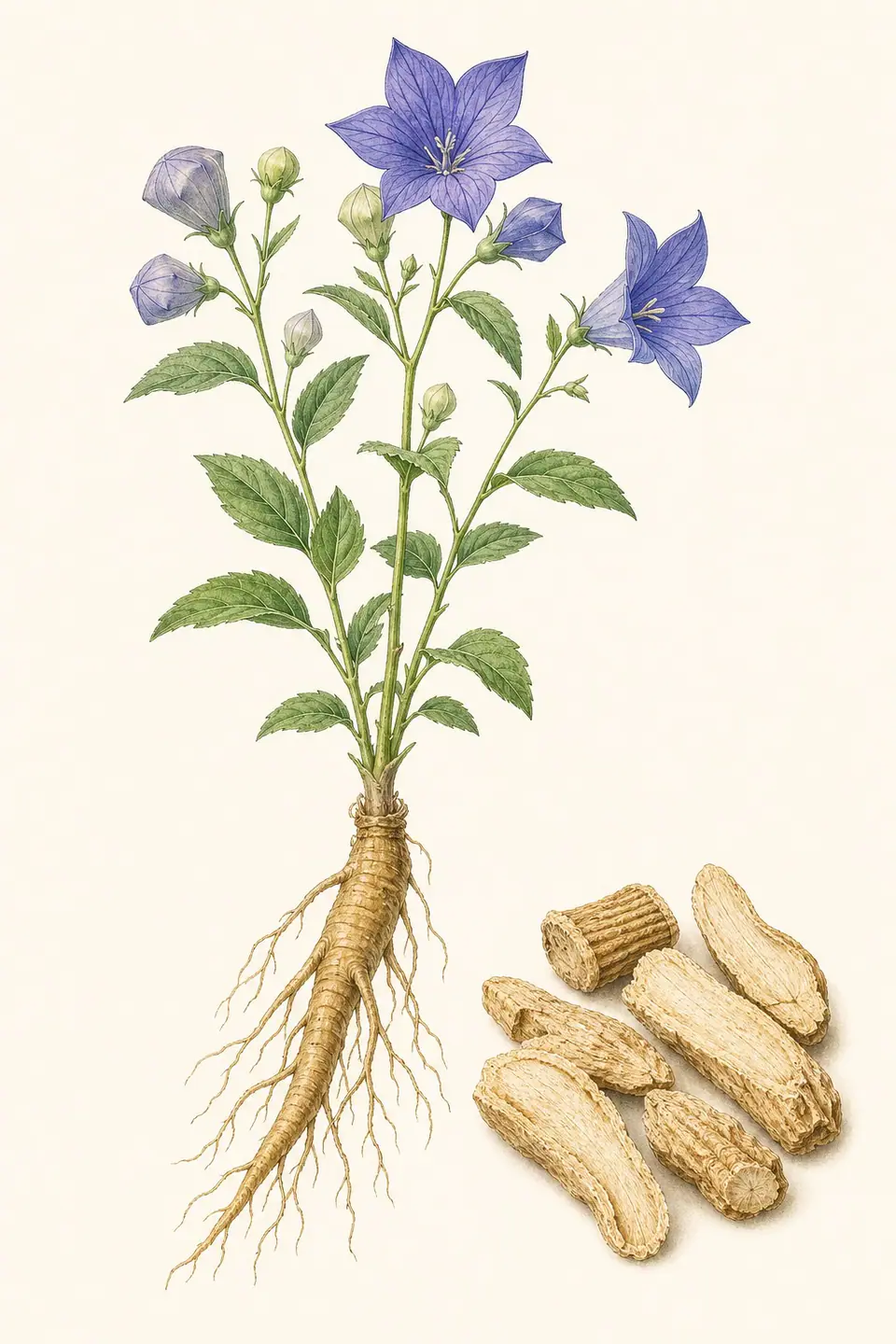
The Boat (舟楫), the Vessel that Lifts the Lungs
The 《Ben Cao Bei Yao》 describes Platycodon (Gilgyeong) as “the boat (舟楫) for all medicines, carrying them afloat.” This means it acts like a boat floating on water, lifting other medicinal ingredients upward. Specifically, it is explained to lift the energy of the lungs (肺) to clear blockages in the throat (咽喉) and chest. This nickname is also confirmed in various prescriptions found in the 《Dongui Bogam》. In prescriptions such as Jeungson Yeoseong-tang, Hyeonggye-tang, and Tonggwan-eum from the 《Dongui Bogam》, which are used when the throat is swollen or the voice is lost, Platycodon is a key ingredient precisely because of this 'lifting power.'
However, the image of a 'boat that lifts against the current' also represents the limitation of this herb. Platycodon has a strong property of ascending and dispersing. Therefore, while it is useful when cough, phlegm, or throat blockages are concentrated in the upper body, it may actually be counterproductive for chronic coughs or hemoptysis (coughing up blood) caused by Yin deficiency (陰虛), as it may lift the energy too much. The 《Ben Cao Gang Mu》 categorized its properties as “bitter, acrid, and neutral,” and the 《Ben Cao Xin Bian》 instructs on dosage and location of the disease, stating, “use more if the pathogen is above, and less if the pathogen is below.” In other words, Platycodon is a medicinal herb used only after first determining 'where' the problem is located.
As such, the efficacy of Platycodon is fully realized only within specific conditions of use. As discussed below, when combined with Licorice, it becomes Gamgil-tang to clear the throat, and when combined with Aurantii Fructus (Jigak), it becomes Gilgyeong-jigak-tang to relieve chest tightness. However, these combinations are not always safe. It may not be appropriate for those with a Yin-deficient constitution, chronic cough, or cough mixed with blood. Therefore, 'how much, for whom, and how' it is used becomes crucial when using Platycodon, and that is exactly what this page covers.
Summary at a Glance
First, we will summarize the core identity and characteristics of Platycodon. This table allows you to see at a glance which plant this herb comes from, its properties, and its traditional uses.
| Category | Content |
|---|---|
| Origin | Herbal Medicine Name Platycodon (Gilgyeong). Scientific Name Platycodon grandiflorum Dried root of (Jacq.) A.DC., which corresponds to the balloon flower root. |
| Properties and Meridian Tropism | Bitter (苦), acrid (辛), and neutral (平). Primarily acts on the Lung Meridian (肺經). |
| Representative Aliases | The Boat (舟楫) of Medicines A nickname from the 《Ben Cao Bei Yao》 calling it “the boat for all medicines.” |
| Efficacy Recorded in Literature | Traditionally used to lift the energy of the lungs to soothe the throat (宣肺利咽), resolve phlegm (祛痰), and discharge pus (排膿). |
| Main Ingredients | Saponins (such as platycodin D) are known as the primary active ingredients. |
| Combinations and Contraindications | Due to its strong property of lifting lung energy, it is combined when energy needs to be lifted against the current (e.g., throat swelling, phlegm, cough). Conversely, it is not suitable for chronic cough or hemoptysis caused by Yin deficiency (陰虛). |
Is this medicinal herb right for me?
Platycodon is a medicinal herb that lifts the energy of the lungs to clear blockages in the throat and chest. Therefore, it is often considered when the throat is swollen, the voice is lost, or the chest feels tight and obstructed. However, because this 'lifting power' is a property that 'lifts against the current,' it may actually worsen symptoms in a state where the body already lacks the energy that should settle downward. Please check the following three criteria first.
- Generally suitable casesIndications: When the throat is swollen and painful, the voice is lost, the chest feels tight, or there is a feeling of Qi stagnation or blockage, cases where symptoms of throat and lung energy blockage, for which Platycodon is traditionally used, are primary.
- Cases requiring cautionCautions: In states that appear to be 'Yin deficiency (陰虛),' such as a prolonged cough accompanied by physical weakness, dry mouth, or night sweats, the lifting property of Platycodon may further deplete energy. Caution is also required if there are symptoms of hemoptysis (coughing up blood).
- Cases to avoidContraindications: Use is contraindicated in cases of chronic cough and hemoptysis caused by Yin deficiency (陰虛). Classical texts such as the 《Ben Cao Gang Mu》 and 《Ben Cao Bei Yao》 record avoiding combined use with Bletilla (Baekgeup), Longan (Yongan), and Gentiana scabra (Yongdamcho), and advise against eating pork together; however, these are traditional records of incompatibility, and evidence for such interactions in modern clinical practice has not been confirmed. If you are pregnant, breastfeeding, or taking Western medications, please inform your practitioner during the consultation, as official safety evaluation data is currently insufficient.
Practical Q&A
We have collected frequently asked questions about Platycodon from the clinic. Knowing in which situations this herb is considered and what its limitations are will allow for a more detailed conversation during your consultation. The answers below are summarized based on currently confirmed academic and classical evidence; any adjustments based on individual constitution and symptoms must be decided after consulting with a Korean medicine doctor.
Is Platycodon only used when the throat is swollen or the voice is lost?
No. While throat (咽喉) issues are representative, Platycodon serves to lift the energy of the lungs to resolve tightness and blockage. The 《Ben Cao Bei Yao》 describes this as “the boat (舟楫) for all medicines.” While prescriptions like Jeungson Yeoseong-tang, Hyeonggye-tang, and Tonggwan-eum from the 《Dongui Bogam》 are used for throat swelling and loss of voice, Gilgyeong-jigak-tang is used for situations involving chest tightness and Qi stagnation (痞氣). In short, the common denominator is a 'feeling of being blocked upward.'
Why is it used together with Licorice?
The combination of Platycodon and Licorice began with Gilgyeong-tang in the 《Shanghan Lun》 and 《Jin Gui Yao Lue》. The original composition is 1 liang of Platycodon and 2 liang of Licorice. While Platycodon lifts lung energy and clears throat blockages, Licorice moderates and harmonizes that action to prevent excessive ascending. The 《Ben Cao Gang Mu》 also records cases where this combination was applied as Yeoseong-tang by adding herbs such as Schizonepeta, Saposhnikovia, and Forsythia. As such, Platycodon is used more stably when paired with other medicinal herbs rather than alone.
Why does the 'lifting force' also become a weakness?
The core property of Platycodon (Gilgyeong) is 開提肺氣, opening and lifting the energy of the lungs. However, this force also has the nature of pushing upward against the natural flow. Texts such as the 《Bencao Gangmu》 and 《Bencao Beiyao》 record that Platycodon should not be used for chronic cough or coughing up blood caused by Yin deficiency (陰虛). The 《Bencao Qiuzhen》 also warns, “久嗽不宜妄用”, that it should not be used carelessly in cases of long-term coughing. This is because it may exacerbate symptoms when energy needs to settle downward or when the body is already in a dry or weakened state.
Can it be used during pregnancy?
There is currently a lack of official clinical safety evaluations. While traditional prescriptions such as Botae-eum from the 《Dongui Sasang Sinpyeon》 or Gilgyeong-san from the 《Bangyak Hapbyeon》 contain records of use during pregnancy, these are only records from traditional medical literature and do not provide evidence to guarantee safety during modern pregnancy or breastfeeding. If you are considering a prescription containing Platycodon during pregnancy, please be sure to consult with a Korean medicine doctor.
Can I take this along with Western medicine?
Some commercial medical information sites mention interactions with warfarin, digoxin, atropine, and antihypertensive agents, but official academic evidence from sources such as PubMed or the Ministry of Food and Drug Safety has not been secured. Therefore, a clear determination regarding concurrent use with Western medicine requires verification. If you are currently taking any medication, please inform us before the prescription.
Is it possible to be allergic to Platycodon?
Some commercial sites state that caution is needed for those with allergies to balloon flower or Platycodon. However, official epidemiological evidence is lacking. If you have had adverse reactions after consuming balloon flower in the past, it is safer to inform us in advance during your consultation.
Relationship with Other Medicinal Herbs (Yakdae/Pairing)
Platycodon plays a more distinct role when paired with other medicinal herbs rather than when used alone. In traditional medicine, such pairs are called “Yakdae (藥對).” Depending on how the 'force that pulls from bottom to top' of Platycodon is combined with other herbs, the direction of the prescription changes. Below are representative examples where Platycodon forms a core combination in verified classics and official materials.
-
Platycodon + Aurantii Fructus (Jigak), Gilgyeong-jigak-tang This is a prescription included in the 《Ryu-jeung Hwal-in-seo》 and 《Bangyak Hapbyeon》(1884). It consists of 7.5g Platycodon, 7.5g Aurantii Fructus, 3.75g Licorice, and 5 slices of Ginger, and has been traditionally used when the chest feels tight and there is distress due to blocked Qi (痞氣). It is structured to balance the flow of energy between the upper and lower body by combining the ascending and lung-opening action of Platycodon with the Qi-regulating and descending action of Aurantii Fructus.
-
Platycodon + Licorice (Gamcho), Gamgil-tang series This begins with “Gilgyeong-tang” from the 《Shanghan Lun》 and 《Jingui Yaolue》. It is a simple composition of 1 nyang (兩) of Platycodon and 2 nyang of Licorice, where Platycodon opens blockages in the lungs and throat, and Licorice serves to neutralize and coordinate. The 《Bencao Gangmu》 also records that Emperor Renzong of Song applied this by adding Schizonepeta (Hyeonggae), Saposhnikovia (Bangpung), and Forsythia (Yeongyo) to create “Yeoseong-tang.” This is a core pair traditionally used when throat pain and pus in the lungs are a concern.
-
Platycodon + Licorice + Schizonepeta (Hyeonggae), etc., Jeungson-yeoseong-tang This is a prescription included in the External Diseases section of the 《Dongui Bogam》. It consists of 80g Platycodon, 60g roasted Licorice, and 20g each of Aurantii Fructus and Saposhnikovia, and has been traditionally used for hoarseness (音啞) where the throat is swollen and the voice does not come out well.
-
Platycodon + Licorice + Schizonepeta Spica (Hyeonggae-su), Hyeonggae-tang This appears in the External Diseases section of the 《Dongui Bogam》 and the 《Saminbang》. It consists of 80g Platycodon, 40g Licorice, and 20g Schizonepeta Spica, and was traditionally used for throat swelling, pain, and loss of voice (語音不出).
-
Platycodon + Ginseng (Insam) + Atractylodes (Baekchul) + Poria (Bokryeong), etc., Tonggwan-eum This is a prescription included in the External Diseases section of the 《Dongui Bogam》. It consists of Platycodon, Licorice, Ginseng, Atractylodes, Red Poria, Saposhnikovia, Schizonepeta, Mint, and processed Ginger, and has been traditionally used when throat pain is severe and speaking is difficult due to throat obstruction (喉痹).
-
Platycodon + Astragalus (Hwanggi), White Peony (Baekjakyak), Scutellaria (Hwanggeum), Ginseng, Ophiopogon (Maekmundong), Rehmannia (Saengjihwang), etc., Jageum-san This is a prescription included in the Miscellaneous Diseases section of the 《Dongui Bogam》. It is traditionally used for heat caused by deficiency-exhaustion of the heart and lungs (心肺虛勞熱), where Platycodon lifts the energy of the lungs to open a pathway for other tonic and heat-clearing herbs to act.
Regarding combination contraindications, the 《Bencao Gangmu》 and 《Bencao Beiyao》 state that Platycodon “fears (畏)” Bletilla (Baekgeup), Longan (Yongan), and Gentiana (Yongdamcho), and “avoids (忌)” pork. However, these records pertain to traditional theories of incompatibility and mutual opposition; official research on how this manifests in modern clinical practice has not been confirmed. Verification is required. Please inquire during your consultation.
In what form is it consumed?
Platycodon is a medicinal herb used according to prescriptions at a Korean medicine clinic. We have summarized the general usage by form based on verified data.
- Tea: Not common.
- Food: Not common.
- Decoction (煎湯, boiled form): This is traditionally the most common form. The Compendium of Materia Medica (Bencao Gangmu) describes a method of peeling the skin, soaking it in rice water overnight, slicing it thinly, and lightly roasting it before use. Data from the Traditional Knowledge Portal and the Korea Institute of Oriental Medicine also record aqueous extraction and decoction as the basic methods of use for Platycodon grandiflorum (balloon flower root).
- Professional Prescription: It is used as a key medicinal ingredient in traditional prescriptions for the lungs and throat, such as Gilgyeong-jigak-tang, the Gamgyeong-tang series, Jeungson-yuseong-tang, and Tonggwan-eum. It may also be used in formulation forms based on the Ministry of Food and Drug Safety's data on Platycodon powder and the standards of the Korean Pharmacopoeia.
Since the specific dosage and duration of intake vary depending on your constitution and symptoms, it is recommended to determine these with a doctor of Korean medicine during your consultation.
Interactions and Safety During Use
Platycodon is used to clear blockages in the throat and chest due to its role as a 'vessel' that lifts the energy of the lungs, but this lifting force also requires caution. Below are the safety standards summarized from verified classical and official sources.
- Contraindicated for chronic cough or coughing up blood (hemoptysis) caused by Yin deficiency (陰虛): Because Platycodon has a property that lifts and disperses energy, it may actually aggravate symptoms in conditions where body fluids (Jin-yeok) are already deficient and blood is mixed with cough. Both the Compendium of Materia Medica and the Traditional Knowledge Portal point out this fact.
- Use with caution in cases of prolonged coughing: Materia medica books in the lineage of the Compendium of Materia Medica contain the record, "Do not use recklessly for long-term coughs." When a cough becomes chronic, simply lifting the energy may be insufficient or inappropriate.
- Classical records on incompatibility and interactions: The Compendium of Materia Medica and Bencao Beiyao record that Platycodon is avoided (畏) when used with Bletilla striata, Longan, and Gentiana scabra, and its combined use with pork is avoided (忌). While these points require further verification from a modern materials science perspective, they are standards referred to when composing traditional prescriptions.
- Possibility of hypersensitivity: Caution is required for those with allergies to balloon flower or Platycodon. However, as official epidemiological evidence is lacking, it is advisable to observe for any adverse reactions when taking it for the first time.
Modern official safety evaluations regarding pregnancy, breastfeeding, or concurrent use with Western medicines (such as warfarin, digoxin, atropine, antihypertensives, etc.) have not been confirmed at this time. While there are records of use during pregnancy in traditional prescriptions, it is difficult to use these as evidence for modern clinical safety. If you are considering taking it, please decide after consulting with a doctor of Korean medicine.
If you experience these symptoms
If these signs appear
Platycodon is a medicinal ingredient that lifts the energy of the lungs to clear blockages in the throat and chest. However, because this 'lifting force' also has the property of pushing against the natural flow of energy, if the following signals appear during intake, you should not reduce the dose on your own or continue taking it, but instead notify the prescribing doctor of Korean medicine. In particular, if coughing, phlegm, or throat pain worsens, or if you feel more internal heat, Platycodon may not be suitable for your symptoms or constitution.
- Coughing worsens or phlegm persists: While Platycodon is an ingredient that lifts energy to discharge phlegm, it is contraindicated for chronic cough or coughing up blood caused by Yin deficiency; if symptoms worsen during intake, you must stop and seek consultation.
- Throat becomes more swollen or pain increases: Although Platycodon is used to clear throat blockages, it may actually increase symptoms in cases of severe rising heat or incorrect diagnosis.
- Chest tightness or palpitations worsen: The lifting and dispersing properties of Platycodon may push against the flow of energy, leading to chest discomfort or abnormal heartbeats.
- Digestive symptoms such as nausea, abdominal discomfort, or diarrhea: The Classic of Materia Medica (Mingyi Bielu) also mentions effects on the intestines and stomach; indigestion may occur in cases of overdose or constitutional incompatibility.
- Allergic reactions such as rash, itching, or difficulty breathing: Since commercial medical information sites mention the possibility of hypersensitivity reactions to balloon flower root (Platycodon grandiflorus), please stop taking the medicine immediately if such symptoms appear.
If these symptoms are severe or accompanied by systemic allergic reactions, such as difficulty breathing, difficulty swallowing due to throat swelling, or swelling of the face and lips, it is safe to visit an emergency medical institution. Even for herbal medicines prescribed at a Korean medicine clinic, individual reactions may vary, so please notify us promptly of any abnormal symptoms.
Differences from other restorative medicines
Platycodon grandiflorus is closer to a 'communication' herb that clears blocked energy and lifts it upward, rather than a 'tonifying' herb. Therefore, its nature is fundamentally different from traditional restorative tonics such as Gongjindan or Gyeongokgo. While restorative tonics focus on filling deficiencies and boosting energy, Platycodon grandiflorus is used to resolve states where energy is blocked and unable to rise.
Gongjindan is a widely known restorative tonic aimed at overall energy supplementation and treating physical and mental exhaustion. Gyeongokgo is also known as a restorative and blood-tonifying prescription that supplements qi and blood and improves complexion. The biggest difference between these and Platycodon grandiflorus is whether the goal is 'supplementation' or 'communication.' While Gongjindan or Gyeongokgo are prescriptions that fill what is lacking in the body, Platycodon grandiflorus acts as a pathway opener when there is a feeling of tightness or blockage because the energy of the lungs and throat cannot rise.
Another difference is the scope of the purpose of use. While Gongjindan is considered a restorative tonic for relatively broad deficiency syndromes, Platycodon grandiflorus is used more directly for symptoms centered on the lung meridian and throat, such as coughing with phlegm, throat swelling with loss of voice, or chest tightness and blocked qi. The reason Platycodon grandiflorus is called the 'boat and oar of various medicines' in the Ben Cao Bei Yao is that it leads other medicinal ingredients to effectively reach the lungs and the upper burner (Sangcho). In other words, rather than being a restorative tonic itself, it is closer to a 'guide' that helps the effects of restorative tonics or other herbs reach the lungs and throat.
Because of this, it is often difficult to determine on one's own whether Platycodon grandiflorus is necessary or if a restorative tonic like Gongjindan or Gyeongokgo is more appropriate. This is because the prescription direction changes depending on whether a cough or throat discomfort is a simple aftereffect of a cold, caused by energy deficiency, or caused by blocked qi. If you are currently taking or considering taking restorative tonics, it is important to first distinguish whether your current symptoms are 'caused by deficiency' or 'caused by blockage.' This distinction is made through examination and consultation with a Korean medicine doctor. During the consultation, providing details such as the onset of symptoms, the amount and color of phlegm, characteristics of the cough, and your general constitution will help determine a more accurate direction.
References
- Evidence material 1 regarding Platycodon grandiflorus: Korea Citation Index academic paper.
- Evidence material 2 regarding Platycodon grandiflorus: Korea Citation Index academic paper.
- Evidence material 3 regarding Platycodon grandiflorus: Korea Citation Index academic paper.
- Evidence material 4 regarding Platycodon grandiflorus: PubMed academic paper.
If you would like to check if this medicinal herb is right for you or which prescription it should be used with, please leave a medical inquiry. For those who find it difficult to visit the clinic, non-face-to-face consultations are available; we will provide guidance after first reviewing your current condition and current medications.

Medical Staff Review
Director Choi Yeon-seung
Chief Director of Baekrokdam Korean Medicine ClinicPlatycodon grandiflorus Dictionary Entry, reviewed the safety of expressions and the scope of verification before administration.
Review Scope: Clinical Accuracy, Pharmacology, Contraindications, Combinations, QA · Last Reviewed 2026-08-16
- Graduated from Kyung Hee University College of Korean Medicine
- Providing Korean medicine treatment since 2010
- Consultations for Gongjindan, Gyeongokgo, Nokyong (Deer Antler) restorative medicine, and customized restorative herbal medicine