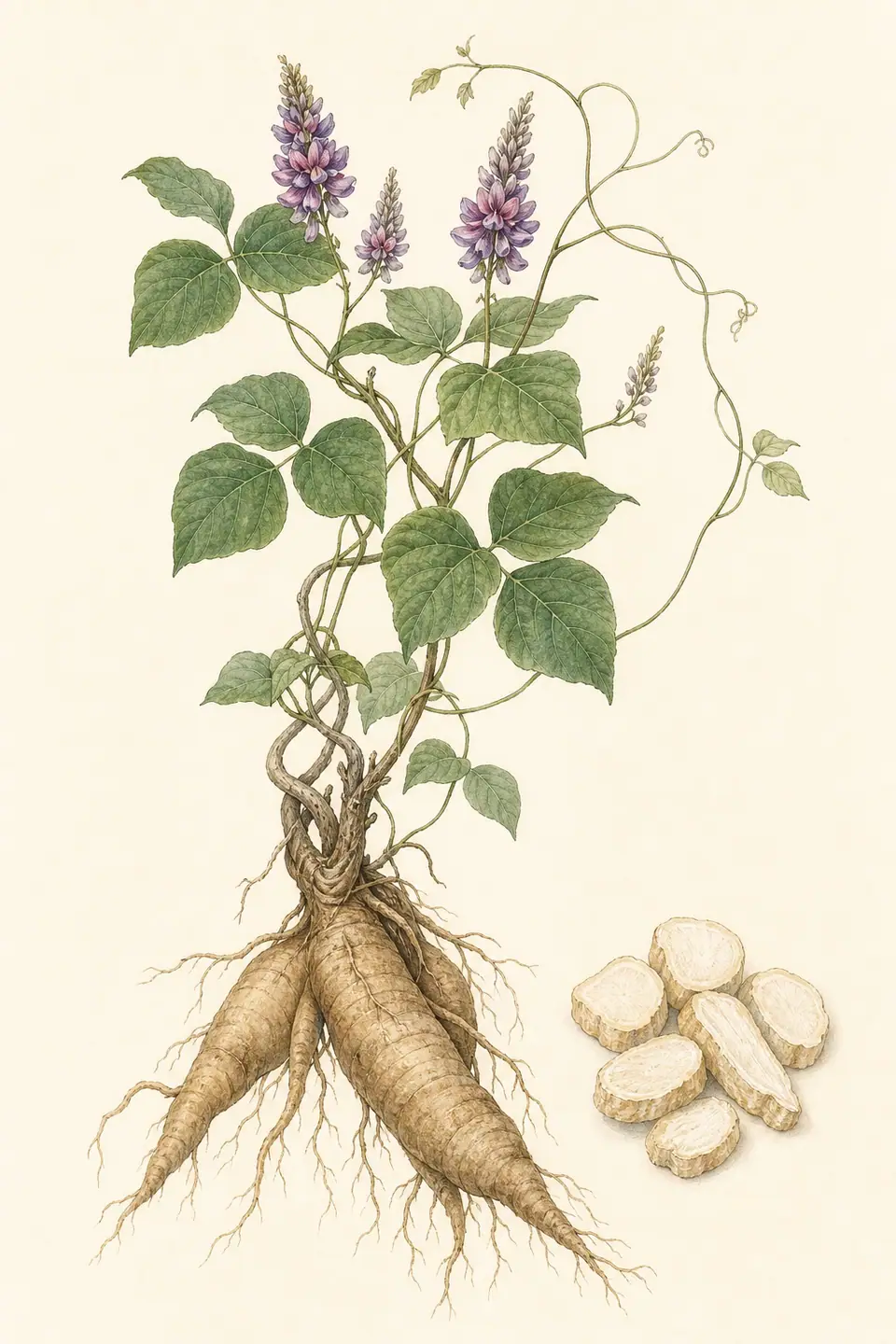
Geongal (Dried Kudzu Root), a stem that draws up heat from wind-cold
The 'Shanghan Lun' (Treatise on Cold Damage) introduces a prescription called 'Galgeun-tang'. Composed only of Galgeun, Ephedra, Cinnamon twig, Peony, Jujube, Ginger, and Licorice, this prescription has been traditionally used for symptoms where wind-cold is entangled in the body's surface, causing a stiff back, lack of perspiration, and accompanying diarrhea. Here, Galgeun, or Geongal, is not simply a 'fever-reducing' medicinal herb. In 'Cheonhwa-san' found in the Miscellaneous Diseases section of the 'Dongui Bogam', Geongal is combined with Cheonhwabun, Raw Rehmannia, Ophiopogon, Schisandra, and Licorice to manage Sogal (wasting-thirst syndrome), and it is also a key component of the '3-So' (three types of wasting-thirst) prescriptions in 'Hwangryeon-jihwang-tang'. The fact that the same root appears both in the release of the exterior for wind-cold exogenous diseases and for internal Sogal means this herb possesses a dual direction: 'opening the exterior and raising the fluids of the stomach'.
However, the common image of 'kudzu root' is far from the true nature of Geongal. While kudzu processed into drinks or foods gives the impression of quenching thirst and reducing fever, in Korean medicine, Geongal is described as 'cool, sweet, and pungent', acting to draw the heat of exterior syndromes outward and generate fluids in the stomach meridian. The Geongal entry in the Traditional Knowledge Portal of Korea describes its properties as 'pungent and hot', while the Galgeun entry in the Korea Institute of Oriental Medicine's convergence research center describes it as 'sweet, pungent, and cool'. Despite originating from the same plant, these differences in naming and interpretation exist. This shows that Geongal is not simply a 'cold herb', but can play different roles depending on the context of the prescription and the depth of the symptoms.
Due to this duality, Geongal is used with great care in clinical practice, but it is also a medicinal herb that requires caution. Modern sources such as WebMD recommend consulting a healthcare provider when there are existing conditions or when taking prescription medications, and the Geongal entry in the Traditional Knowledge Portal of Korea contains records of abortifacient effects. Self-administration during pregnancy or lactation is not recommended. Additionally, animal study results have reported that puerarin, a major component of Pueraria lobata, may offset the anticoagulant effect of warfarin, necessitating a thorough review when used concurrently with Western medicine.
Ultimately, Geongal is a medicinal herb where the dosage, the patient, and the duration of use are as important as its classical role of 'releasing wind-cold and promoting stomach fluids'. Below, we provide detailed guidance on the combined prescriptions and precautions for Geongal.
Summary at a Glance
Geongal (Dried Kudzu Root) is a root herb used widely, from inducing perspiration and releasing the exterior in wind-cold exogenous diseases to generating fluids, reducing fever, and raising yang to stop diarrhea in Sogal. The table below summarizes the core identity and characteristics of this herb at a glance.
| Category | Content |
|---|---|
| Origin | Hanja Name 乾葛, Scientific Name Pueraria lobata (Willd.) Ohwi Root of kudzu (Fabaceae) |
| Properties and Meridian Tropism | Sweet, pungent, and cool; acts primarily on the Spleen and Stomach meridians |
| Representative Aliases | Geongal, Gamgal, Bungal, Nokgwak |
| Efficacy Recorded in Literature | Releasing the exterior and relaxing muscles, erupting rashes, reducing fever and generating fluids, raising yang to stop diarrhea |
| Main Ingredients | Isoflavone components such as puerarin |
| Combination & Precautions | Potential interactions when used with prescription drugs such as anticoagulants (e.g., warfarin), cardiovascular, metabolic, or anticancer drugs; self-administration not recommended during pregnancy or lactation |
Is this medicinal herb right for me?
Geongal is a medicinal herb with a wide range of effects in inducing perspiration, reducing fever, and generating fluids (promoting body fluids). However, having a wide range of effects also means it may not be the right direction for certain situations. Below are the criteria to consider when evaluating the use of Geongal.
- Generally suitable cases: Traditionally used in the early stages of wind-cold exogenous diseases when the back is stiff, there is no perspiration, and diarrhea is present, or in cases of dry mouth and polydipsia (excessive drinking) caused by Sogal. Prescriptions such as Galgeun-tang from 'Shanghan Lun' and Cheonhwa-san and Hwangryeon-jihwang-tang from 'Dongui Bogam' have been prescribed in these contexts.
- Cases requiring caution: Consultation is required first if you are taking prescription medications, have cardiovascular or metabolic diseases, or are considering long-term or high-dose use. Animal studies have reported that puerarin, a major component of Pueraria lobata, may offset the anticoagulant effect of warfarin, and some studies have raised the possibility of liver damage from kudzu root extract.
- Cases to avoid: Do not self-administer during pregnancy or lactation. There are records of abortifacient effects in the Geongal entry of the Traditional Knowledge Portal of Korea, and modern data lacks sufficient safety data regarding pregnancy and lactation. Additionally, if you believe your constitution or symptoms are closer to Spleen-Stomach Deficiency-Cold (a constitution where the functions of the stomach and spleen are weak and cold), it is advisable not to use it alone without consulting a doctor of Korean medicine.
Practical Q&A
We have collected frequently asked questions about Geongal from the clinic. The answers below are based on the standards explained during consultations at Baekrokdam Korean medicine clinic; whether an individual should take it must be decided through a consultation with a doctor of Korean medicine.
Are Geongal and Galgeun different medicinal herbs?
Galgeun and Geongal often refer to the root of the same plant, the kudzu (Fabaceae), Pueraria lobatahowever, the interpretation may vary depending on the name, processing state, and prescription context. While the Traditional Knowledge Portal of Korea describes the properties of 'Geongal' as 'pungent and hot', the 'Galgeun' in the Korea Institute of Oriental Medicine's convergence research center is described as 'sweet, pungent, and cool'. Even for the same root, the direction of action can change depending on what name it is used under in a prescription and how it is combined with other herbs, so it is important to examine the prescription context during consultation.
Why is Geongal included in prescriptions for Sogal?
Sogal is a traditional concept comparable to modern diabetes, dealing with a group of symptoms including 'dry mouth, excessive drinking, and increased urine volume'. Cheonhwa-san in the Miscellaneous Diseases section of 'Dongui Bogam' consists of Cheonhwabun, Raw Rehmannia, Geongal, Ophiopogon, Schisandra, Licorice, and charred rice to manage Sogal, and Hwangryeon-jihwang-tang manages the '3-So' using Coptis, Raw Rehmannia, Cheonhwabun, Schisandra, Angelica, Ginseng, Geongal, Poria, Ophiopogon, and Licorice. Here, Geongal is combined to reduce fever and generate fluids. However, as the concept differs from modern diabetes treatment, consultation with medical staff is necessary for combined treatment for blood glucose control.
Can I take herbal medicine containing Geongal while taking warfarin?
Caution is required. In animal studies, Pueraria lobataIt has been reported that puerarin, a primary component, may counteract the anticoagulant effects of warfarin. Therefore, if you are taking anticoagulants such as warfarin or prescription medications for cardiovascular or metabolic conditions, please consult your attending medical staff before taking Korean herbal medicine.
Can Geongal be used during pregnancy?
Self-administration of Geongal is not recommended during pregnancy or lactation. The Traditional Knowledge Portal of Korea contains records of abortifacient effects for Geongal, and there is insufficient safety data regarding pregnancy and lactation in modern literature. If you are planning a pregnancy or are currently pregnant or breastfeeding, please be sure to mention this during your consultation.
Does Geongal put a strain on the liver?
It is generally known to be well-tolerated; however, some studies have raised the possibility of biochemical and histopathological liver damage when kudzu root extract was administered at 10mg/day for 4 weeks. Caution is required for long-term or high-dose use. If you have concerns regarding your liver function, please mention them during your consultation.
Can prescriptions containing Geongal be used in the early stages of a cold?
Galguntang from the Sanghanron is traditionally used for symptoms where wind-cold is trapped on the body surface, causing a stiff back, lack of perspiration, and accompanying diarrhea. However, the same prescription is not applicable to all colds. Depending on your constitution or underlying conditions, a different prescription may be more appropriate if you have a distinct feeling of heat and severe sore throat. Since the prescription is determined based on the onset of symptoms and your overall physical condition, it is safer to decide through a consultation rather than self-diagnosis.
Relationship with Other Medicinal Herbs (Yakdae/Pairing)
Geongal shines most when it is used in combination with other medicinal herbs within a prescription rather than alone. In traditional medicine, such pairs are called 'Yakdae,' referring to a structure where herbs of different properties either combine their strength in one direction or balance each other out to prevent excessive action. In the case of Geongal, its various effects, such as inducing perspiration to release the exterior (pyobal), generating fluids to clear heat (saengjin-haeyeol), and raising yang to stop diarrhea (seungyang-jisa), manifest differently depending on the intent of the prescription; therefore, the key lies in which herbs it is paired with.
Below are representative combinations of Geongal identified in classical and clinical prescriptions.
-
Geongal + Cheonhwabun + Saenggeonjihwang + Maekmundong + Omija + Gamcho — Cheonhwasan A prescription from the Jikjifang used to treat Xiao Ke (wasting-thirst syndrome), where Geongal serves as a pillar for generating fluids and clearing heat. While Cheonhwabun, Maekmundong, and Omija work to replenish body fluids, Geongal acts as a supporting link to release heat and promote the flow of fluids.
-
Geongal + Hwangryeon + Saengjihwang + Insam + Maekmundong + Gamcho — Hwangryeonjihwang-tang A prescription from the Hoechun used for the 'Three Wastes' (San Xiao). While Hwangryeon extinguishes heat and Saengjihwang and Maekmundong replenish yin fluids, Geongal participates in dissipating heat and raising energy to organize the complex pathways of wasting-thirst syndrome.
-
Geongal + Mahwang + Gyesim + Hwanggeum + Siho + Ganghwal + Bangpung, etc. — Sinbi-jwagyeong-tang From the Deokhyo, used for symptoms where wind, cold, summer-heat, and dampness enter the foot meridian, causing the legs and knees to become stiff, swollen, and painful. Geongal is positioned to release wind-cold from the body surface and contributes to opening blocked meridians alongside perspiration-inducing and wind-expelling herbs such as Mahwang and Gyesim.
-
Geongal + Injin + Jeokbongryeong + Changchul + Jisil + Haengin + Jeonho + Gamcho — Gami-guichul-tang A prescription used in modern clinical practice to treat chronic hepatitis; it utilizes Geongal's properties of clearing heat, generating fluids, and raising energy to help the flow of heat and resolve liver stagnation.
Although derived from the same plant, the focus of the prescription may shift depending on whether it is called 'Geongal' or 'Galgeun.' In classical texts, the name Geongal tends to be used in the context of inducing perspiration, raising yang, and treating exterior syndromes, while Galgeun is used more in the context of generating fluids, clearing heat, and treating the spleen and stomach. In actual prescriptions, one must read the combination with other herbs to see which direction it points, as much as the difference in these names.
Precautions for CombinationGeongal is a medicinal herb with dissipating and yang-raising properties. Therefore, it must be carefully considered alongside the overall structure of the prescription in cases where body fluids are significantly depleted, digestive function is markedly decreased due to weak stomach qi (wiggi), or there is diarrhea caused by deficiency syndrome rather than heat. As classical definitive texts regarding contraindications for specific constitutions or conditions require further verification, please consult a doctor of Korean medicine before use.
In what form is it consumed?
Geongal is a medicinal herb traditionally prescribed in the form of a decoction (boiled herbal tea) at Korean medicine clinics. Here is a summary of the forms commonly encountered today.
- Tea/Tea bags: This is uncommon. Geongal is more often decocted according to a specific prescription rather than simply steeped as a raw material.
- Food/Ingredients: This is uncommon. While arrowroot itself is used as food, Geongal as a Korean medicine prescription is handled as a medicinal herb rather than a food ingredient.
- Decoction: This is the traditional and common form. In prescriptions such as Cheonhwasan, Hwangryun-jihwang-tang, and Seungma-hwagi-eum found in the Dongui Bogam, Geongal is decocted together with other medicinal herbs for consumption.
- Professional Prescription: As a rule, it should be prescribed at a Korean medicine clinic to match an individual's constitution and symptoms. Geongal is most often used in combination with other herbs rather than alone.
Since the specific dosage and duration of intake vary depending on the individual's condition, it is safest to decide after consulting with a Korean medicine doctor.
Interactions and Safety During Use
While Geongal has been used widely throughout a long tradition, it is also a medicinal herb that requires caution regarding modern drug interactions or specific physical conditions. Below is a summary of confirmed interactions and safety information.
- Concurrent use with Warfarin: Animal study results indicate that puerarin, a major component of Pueraria lobata, may offset the anticoagulant effect of Warfarin. If you are taking anticoagulants, you must consult your healthcare provider before using preparations containing Geongal.
- Potential interactions with cardiovascular, metabolic, or anticancer drugs: Potential pharmacokinetic and pharmacodynamic interactions have been raised when Pueraria lobata is used concurrently with various prescription drugs. If you are currently taking any medication, please be sure to inform the Korean medicine clinic during your visit.
- Potential for liver damage: There is a study suggesting the possibility of biochemical and histopathological liver damage when 10mg/day of kudzu root extract was administered for 4 weeks. Caution is required for long-term or high-dose use.
- Pregnancy and Breastfeeding: The Korean Traditional Knowledge Portal contains records of Geongal causing abortion (miscarriage), and modern data lacks sufficient safety data for pregnancy and lactation. If you are pregnant or breastfeeding, do not self-administer and decide through consultation.
- Differences in interpretation by constitution and symptoms: Although Geongal and Galgeun originate from the same plant, the interpretation of their properties and flavors may differ depending on the prescription context or source material. It is safest for a Korean medicine doctor to determine if it is suitable for your symptoms and constitution.
If you are considering prescriptions or supplements containing Geongal, we recommend checking your current medications, pregnancy/breastfeeding status, and liver function first, and deciding through consultation.
If you experience these symptoms
Geongal is a medicinal herb with a wide range of effects for inducing perspiration, reducing fever, and generating fluids, but unexpected reactions may occur depending on specific constitutions or concurrent use. The following signals are cases that require caution based on confirmed data regarding Geongal intake. Even for mild discomfort, it is safer to inform your attending Korean medicine doctor first rather than adjusting the dose yourself.
- Increased Tendency for Bleeding: Changes such as easy bruising of the skin, bleeding from the gums or nose, or blood in the urine or stool may occur. In particular, caution is needed as animal study results show that puerarin, a major component of Pueraria lobata, may offset the anticoagulant effect of Warfarin when used concurrently with anticoagulants such as Warfarin.
- Signs of liver function abnormality: Changes such as fatigue, loss of appetite, discomfort in the upper right abdomen, and darkening of urine color are common warning signs mentioned in studies on potential hepatotoxicity. A study administering 10mg/day of kudzu root extract for 4 weeks reported the possibility of biochemical and histopathological liver damage.
- Self-administration during pregnancy: The Traditional Knowledge Portal of Korea contains records of abortifacient effects for Geongal, and modern data lacks sufficient safety information regarding pregnancy and breastfeeding. If you are pregnant, possibly pregnant, or breastfeeding, you must consult a Korean medicine doctor before use.
- Uncertainty Regarding Long-term or High-dose Use: While most report that it is generally well-tolerated, safety regarding long-term or high-dose use is not clear. Continuous use should only proceed under regular medical monitoring.
If symptoms are severe or worsen rapidly, please visit an emergency medical institution and provide information on the herbal medicines and prescriptions you are currently taking.
Differences from other restorative medicines
Geongal is a medicinal herb traditionally used to 'lower heat, promote body fluids, and release the exterior (body surface)'. Therefore, it is closer to a 'regulatory' herb that changes the flow of symptoms rather than a restorative tonic. Its starting point is different from restorative tonics like Gongjindan or Gyeongokgo, which supplement energy or blood. While Gongjindan supplements deficiency and Gyeongokgo moisturizes the skin and blood, Geongal is often used as a supporting agent in prescriptions to relieve excessive moisture caused by restorative tonics or to open symptoms caused by blocked heat.
However, even under the name of Galgeun or Geongal from the same plant origin, the weight of its actions, such as moisturizing, fever reduction, or inducing perspiration, varies depending on the context of the prescription. Therefore, to the question, "Is Geongal a restorative tonic similar to Gongjindan or Gyeongokgo?", the answer is that "it is a medicinal herb that regulates the flow of symptoms, and its interaction must be examined when used in combination with restorative tonics." It is correct to determine whether Geongal is necessary and in what combination it should be included after comprehensively considering your constitution, any restorative tonics you are currently taking, and the direction of your symptoms. If you mention the restorative tonics you are taking during your consultation, we will provide specific guidance on what role Geongal may play in your case.
References
- Geongal Evidence Material 1: PubMed academic paper.
- Geongal Evidence Material 2: doi.org evidence.
- Geongal Evidence Material 3: PubMed academic paper.
- Geongal Evidence Material 4: GBIF plant classification data.
- Geongal Evidence Material 5: PubMed academic paper.
- Geongal Evidence Material 6: PubMed academic paper.
- Geongal Evidence Material 7: PubMed academic paper.
- Geongal Evidence Material 8: NCBI original academic data.
If you would like to check if this medicinal herb is right for you or which prescription it should be used with, please leave a medical inquiry. For those who find it difficult to visit the clinic, non-face-to-face consultations are available; we will provide guidance after first reviewing your current condition and current medications.

Medical Staff Review
Director Choi Yeon-seung
Chief Director of Baekrokdam Korean Medicine ClinicGeongal Dictionary Entry, reviewed the safety of expressions and the scope of verification before administration.
Review Scope: Clinical Accuracy, Pharmacology, Contraindications, Combinations, QA · Last Reviewed 2026-08-16
- Graduated from Kyung Hee University College of Korean Medicine
- Providing Korean medicine treatment since 2010
- Consultations for Gongjindan, Gyeongokgo, Nokyong (Deer Antler) restorative medicine, and customized restorative herbal medicine