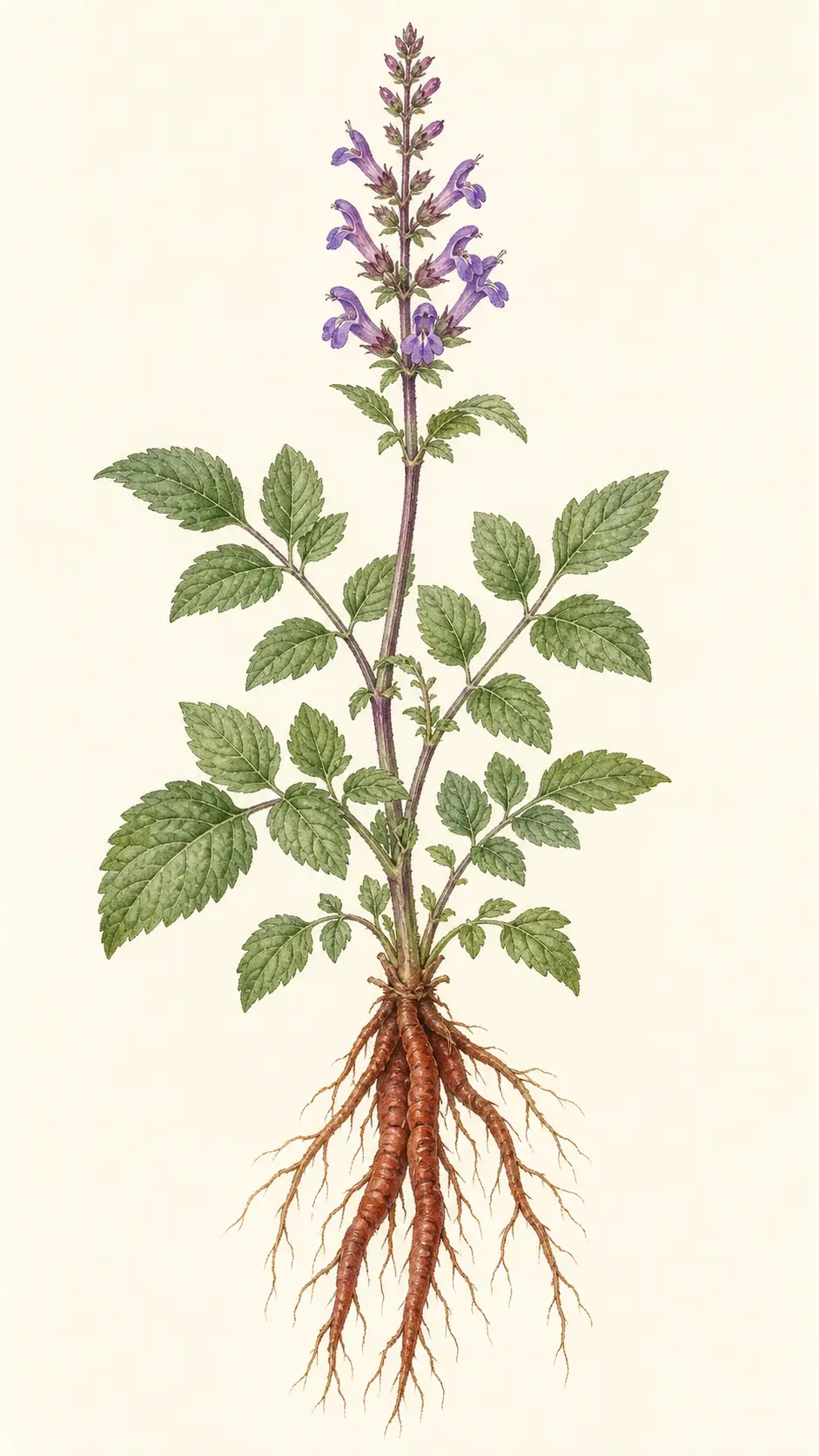
Danshen, the Red Blood of the Pericardium
The 《Ben Cao Chong Yuan》 describes Danshen as follows: “The taste is bitter, the nature is slightly cold, and it is non-toxic. It governs evil qi in the heart and abdomen, treats intestinal borborygmus like flowing water, resolves accumulations of cold and heat, breaks up masses and removes nodules, and stops irritability and fullness, while benefiting qi.” This means it treats pathological factors in the chest and abdomen, resolves accumulations of cold and heat, breaks down masses, and relieves anxiety and oppression. The 《Ben Cao Jian Yao Fang》 summarizes it more directly: “Mainly treats blood nourishment, stabilizes the spirit, breaks up old blood, generates new blood, stabilizes the living fetus, expels the dead fetus, stops uterine bleeding, and regulates menstruation and activates blood.” As such, Danshen is a medicinal herb that ‘resolves old blood and creates new blood,’ and has been regarded in tradition as a representative ‘blood-level medicine (Xuefen medicine).’ True to its name, red (Dan) root (Shen), Danshen enters the Heart meridian, Pericardium meridian, and Liver meridian to regulate the flow of blood.
It is easy to view Danshen simply as a ‘tonic that helps blood circulation,’ but the core emphasis of the classics is slightly different. Danshen is not merely an herb that ‘smooths the blood,’ but possesses a dual nature: it resolves ‘old, stagnant blood (Su-xue)’ and generates ‘new blood (Xin-xue),’ while simultaneously stabilizing the mind. The 《Ben Cao Shu Gou Yuan》 states, “It opens the vessels, benefits qi, nourishes blood, nourishes the spirit, and stabilizes the will,” and the 《Dongui Bogam》 expanded its use to “treat leg weakness and numbness, paralysis of the four limbs, drain pus and stop pain, regenerate skin and flesh, break up old blood, supplement new blood, stabilize the living fetus, expel the dead fetus, and regulate irregular menstruation in women.” In other words, Danshen is a medicinal herb that governs not only blood issues but the entire pathway through which blood reaches the mind, uterus, and limbs.
However, this ‘power to move the blood’ is not always safe. While Danshen is used for postpartum blood stasis, menstrual irregularities, and pain in the heart and abdomen, the ‘Danshen Ointment’ in the 《Pu Ji Fang》 records that pregnant women take it in late pregnancy to ‘make things slippery for an easier birth.’ The fact that the same herb contains opposing effects, ‘stabilizing the living fetus and expelling the dead fetus’, shows that Danshen is not a simple blood tonic, but a regulatory herb whose direction is determined by ‘situation, dosage, and combination.’ In modern times, potential interactions between Danshen and the anticoagulant Warfarin have been reported, and since the risk of bleeding may increase, consultation with medical staff is essential when used concurrently.
Therefore, the most important questions regarding Danshen are ‘how much, who, and how to use it.’ For those with blocked blood and a feeling of oppression, it opens the path of communication, but if used incorrectly, it can move the blood excessively and become dangerous. On this page, we will examine the classical role and modern precautions of Danshen together, summarizing when it is needed and when caution is required.
Summary at a Glance
As its name suggests, Danshen is a medicinal herb closely linked to ‘blood’ starting from its red root. The table below summarizes its core identity, properties, and the most important points to check when using it at a glance.
| Category | Content |
|---|---|
| Origin | Chinese name Danshen, Scientific name Salvia miltiorrhiza Bunge. A crude drug made from the dried root of a perennial herb belonging to the mint family (Salvia). |
| Properties and Meridian Tropism | Bitter taste, slightly cold or neutral nature (微寒·平), non-toxic. A ‘blood-level medicine (Xuefen medicine)’ that acts on the Heart meridian, Pericardium meridian, and Liver meridian. |
| Representative Aliases | Jeoksam (Red Ginseng/Root), Gwilseoncho, Mokyangyu, Chukma, etc. |
| Efficacy Recorded in Literature | Activating blood and removing stasis (resolving stagnant blood to let it flow), cooling blood and reducing swelling (cooling blood heat and calming inflammation), removing irritability and stabilizing the mind, regulating menstruation and stopping pain. |
| Main Ingredients | Tanshinones and salvianolic acids are receiving attention. |
| Combination & Precautions | When used with tonics for Yang or Yin deficiency, there may be concerns regarding incompatibility, so a separate consultation is required. As the risk of bleeding may increase when used with anticoagulants or antiplatelet agents, please be sure to inform your medical provider. |
Is this medicinal herb right for me?
Since Danshen is a medicinal herb that handles blood, it is important to first examine who it is suitable for and who should be especially cautious. Based on verified data regarding precautions by constitution/symptom and information on interactions with Western medicines, we have summarized this into three situations.
- Generally suitable cases: Cases that correspond to traditional indications for Danshen where heat and stagnation in the blood level (Xuefen) are combined, such as irregular menstruation or pain, amenorrhea, pain in the heart and abdomen, postpartum abdominal pain due to stasis, boils and toxic swellings, swelling and pain due to heat-bi syndrome, and irritability, anxiety, or insomnia.
- Cases requiring caution: Cases where the patient is taking anticoagulants such as warfarin, antiplatelet agents, or NSAIDs, or has a tendency to bleed. Potential interactions between Danshen and warfarin have been reported since 2001, with concerns regarding increased INR and bleeding risk. Additionally, there are in vitro and animal studies suggesting that Danshen extract components may affect CYP450 and P-gp, but clinical data are limited; therefore, you must consult with medical staff when using them concurrently.
- Cases to avoid: You should avoid using Danshen if you have a bleeding disorder or are pregnant, especially in conditions with a risk of prenatal or postpartum hemorrhage. As recorded in the 《Ben Cao Jian Yao Fang》, “stabilizes the living fetus, expels the dead fetus”, it has an effect that expels a dead fetus; thus, blood-level medicines related to pregnancy must be used only under professional judgment.
These three criteria are meaningful within the clinical context of evaluating the entire prescription, concurrent medications, and the individual's constitution, rather than judging Danshen in isolation. If you are considering a prescription containing Danshen, it is safest to first disclose any current Western medications and any history of bleeding.
Practical Q&A
We have collected frequently asked questions about Danshen from the clinic. We will address your curiosities regarding the characteristics of the herb, concurrent use, constitution, and forms of administration, while guiding you that it is always best to consult a Korean medicine doctor when necessary.
In what situations can Danshen be considered?
Danshen is classified as a ‘blood-level medicine (Xuefen medicine)’ in tradition. The 《Ben Cao Chong Yuan》 describes it for “evil qi in the heart and abdomen, accumulations of cold and heat, breaking masses and removing nodules, and stopping irritability and fullness,” and the 《Ben Cao Jian Yao Fang》 describes it for “breaking old blood, generating new blood, and regulating menstruation and activating blood.” In other words, it is a medicinal herb used to resolve old blood and promote new blood. The OASIS Traditional Medicine Information Portal's herbal encyclopedia summarizes its effects as activating blood and removing stasis, cooling blood and reducing swelling, removing irritability and stabilizing the mind, and regulating menstruation and stopping pain. This relates to irregular menstruation, menstrual pain, pain in the heart and abdomen, postpartum abdominal pain due to stasis, irritability and anxiety, and boils and toxic swellings. However, these indications are only meaningful when included in a prescription under the diagnosis of a Korean medicine doctor.
What should I do if I am taking an anticoagulant like warfarin?
Particular caution is required for concurrent use. In 2001, Annals of Pharmacotherapythe report “Interaction between Warfarin and Danshen” stated that Danshen may increase the anticoagulant effect of warfarin, potentially leading to an increase in INR and a risk of bleeding. Since the risk of bleeding may also increase when used with antiplatelet agents, anticoagulants, or NSAIDs, if you wish to use Korean herbal medicine concurrently, you must inform and consult your prescribing medical provider.
What if I am pregnant or have a constitution prone to frequent bleeding?
Danshen (Salvia miltiorrhiza) is a medicinal herb with a tendency to actively promote blood circulation. The 'Boncho Ganyoyang' records that it can 'stabilize a living fetus but expel a dead fetus,' and thus it has traditionally been handled with caution regarding fetal health. If you have a bleeding disorder or are pregnant or breastfeeding, it is safe to decide whether to take it alone or include it in a prescription only after consulting with a Korean medicine doctor.
In what forms is Danshen usually used?
Traditionally, it is often decocted in doses of 6–15g, a dosage range that can also be confirmed in the herbal information provided by the Korea Pharmaceutical Information Center. In modern times, there are also Bokbang-danshen (compound Danshen) preparations with Danshen as the main ingredient. Bokbang-danshen, as recorded in the 'Chinese Pharmacopoeia,' combines Danshen with Panax notoginseng and borneol and is used for conditions such as chest pain caused by Qi stagnation and blood stasis. However, these preparations must also be used under the prescription and supervision of professional medical staff.
Are there representative prescriptions where Danshen is used with other medicinal herbs?
Yes, a representative example is Cheonwangbosim-dan found in the 'Dongui Bogam'. It combines 18.75g of Danshen with ginseng, angelica gigas, raw rehmannia root, ophiopogon root, asparagus root, scrophularia root, schisandra berry, polygala root, ziziphus seed, apricot seed, porphyra, aconitum, platycodon root, and coptis root. In this formula, Danshen is used to calm the mind, nourish the heart blood, and provide sedation. Additionally, Danshen-san from the 'Boncho Ganyoyang' is a single-herb prescription where Danshen alone is taken warm with yellow wine to treat irregular menstruation or the failure to discharge postpartum lochia. Since these prescriptions must be modified to fit an individual's condition, it is important to confirm suitability through a consultation.
Relationship with Other Medicinal Herbs (Yakdae/Pairing)
Danshen's characteristics become more distinct when paired with other herbs rather than when used alone. In traditional medicine, such pairs are called 'Yakdae' (medicinal pairs), and Danshen primarily pairs with herbs that manage blood. In some prescriptions, it plays a role in nourishing and stabilizing heart blood, while in others, it is used to resolve long-standing blood stasis and manage pain. The combinations listed below are all prescriptions actually recorded in classical texts or modern standards.
- Danshen + Ginseng, Angelica, Raw Rehmannia, Ophiopogon, etc., Cheonwangbosim-dan: A prescription found in the Internal Medicine section of the 'Dongui Bogam'. Danshen is used to nourish heart blood and stabilize the mind, forming a structure that supplements the deficiency of the mind and body along with ginseng, ophiopogon, and raw rehmannia.
- Danshen alone, Danshen-san: A single-herb prescription recorded in 'Bencao Jianyao Fang' and 'Puji Fang'. It is a traditional usage where Danshen is ground into powder and taken warm with yellow wine to manage irregular menstruation or the failure to discharge postpartum lochia.
- Danshen + Panax notoginseng, Borneol, Bokbang-danshen: A modern Chinese herbal preparation included in the 'Chinese Pharmacopoeia'. It is a prescription for managing chest pain caused by Qi stagnation and blood stasis and has been studied in modern times in relation to angina pectoris in coronary heart disease.
- Danshen + Achyranthes, Rehmannia, Astragalus, Phellodendron: A combination introduced in 'Boncho Sulguwon', traditionally used for the purpose of 'strengthening walking' (Geonbo) in relation to walking or lower limb function.
- Danshen + Ginseng, Ophiopogon, Ziziphus seed, Rehmannia: A multi-herb combination mentioned in the same 'Boncho Sulguwon' for the purpose of 'supplementing Qi and nourishing blood'.
Because Danshen has a strong effect on managing blood, caution is absolutely necessary when using it in combination with anticoagulants or antiplatelet agents. In particular, the potential for interaction with Warfarin has been academically reported since 2001, and as the risk of bleeding may increase, it is safe to consult with medical staff regarding concurrent use.
In what form is it consumed?
Traditionally, the most common form of Danshen is as a decoction boiled in water. While various processed products are available today, the concentration of ingredients and the purpose differ between those prescribed at a Korean medicine clinic and those encountered in daily life. We provide guidance on four different forms below.
- Tea While there are forms of lightly steeping Danshen to drink, it is not generally widely used as a traditional single-herb tea. Since the active ingredients of Danshen include fat-soluble components, simply steeping it in water may not sufficiently extract the effective ingredients.
- Food It is not common to use Danshen as a daily food ingredient. It has a strong bitter taste and aroma characteristic of medicinal herbs and possesses blood-activating properties, making it unsuitable as a food ingredient.
- Decoction (boiling in water for consumption) This is the most traditional and common method of consumption. It is recorded as 'decocted for consumption' in texts such as the 'Bencao Gangmu'. In Korean medicine clinic prescriptions, Danshen is often boiled with other herbs and taken as a herbal medicine decoction. Data from the Korea Pharmaceutical Information Center describes the general dosage as 6–15g, decocted in water.
- Professional Prescriptions and Preparations Herbal medicine preparations with Danshen (Salvia miltiorrhiza) as the main ingredient exist as modern Chinese herbal medicines, such as Bokbang-dansam, and are primarily used in prescriptions addressing cardiovascular symptoms. Additionally, Danshen is included in classical prescriptions such as Cheonwang-bosim-dan, Dansam-san, and Dansam-go. It is appropriate to use these prescriptions according to an individual's constitution and symptoms through a consultation with a Korean medicine doctor.
Since Danshen is a medicinal herb that acts on the blood, who prescribes it, in what ratio, and for how long it is used is more important than the form of administration. In particular, if you are taking antiplatelet or anticoagulant medications, please be sure to consult a Korean medicine doctor before using products containing Danshen.
Interactions and Safety During Use
Since Danshen is a medicinal herb that acts on the blood, caution is required when combined with other medications or for specific constitutions. The following information summarizes findings from classical and modern academic materials; for your safety, the decision on whether to take it must be made after consulting a Korean medicine doctor.
- Concurrent use with anticoagulants and antiplatelet agents There have been reported cases of increased INR and risk of bleeding when using Warfarin and Danshen together. The possibility of bleeding should also be kept in mind when used concurrently with antiplatelet agents, NSAIDs, etc.
- Potential relation to CYP450 and P-gp There are studies from in vitro and animal experiments suggesting that tanshinone and salvianolic acid, the main components of Danshen, may affect drug metabolism enzymes or transport proteins, but confirmed interactions in clinical practice are still limited.
- Persons with a tendency toward bleeding Since Danshen is a medicinal herb with blood-activating properties, caution should be exercised when taking it if you have a bleeding disorder or are before or after surgery.
- Pregnancy and Lactation Traditionally, there are records of Danshen being used for regulating menstruation and postpartum blood stasis, but during pregnancy, you must consult a professional regarding its use in relation to fetal stability.
- Overuse and long-term use Although recorded as non-toxic in classical texts, it is advisable to avoid long-term or high-dose administration in modern practice, considering the possibility of drug interactions and differences in individual constitutions.
Danshen is a medicinal herb whose value is revealed when used in balance with other herbs within a prescription. Rather than taking it alone, we recommend using it after a comprehensive review of your constitution and current medications through a consultation at a Korean medicine clinic.
If you experience these symptoms
If you experience these symptoms
Danshen is a medicinal herb that manages blood flow and the stability of the mind and body. Therefore, if specific signals appear during administration, it is important to notify your attending Korean medicine doctor first rather than dismissing them as a simple 'adjustment period' to the medicine. The symptoms below are cases recorded as precautions in classical and modern academic materials regarding Danshen. Please check them in order from mild to severe.
- Easy bruising of the skin, or bleeding from the gums or nose While Danshen helps blood flow, it can place a burden on people with a tendency to bleed. Extra care is needed if you are concurrently taking anticoagulants or antiplatelet agents.
- Sudden increase in menstrual flow or prolonged menstrual period Due to the blood-moving properties of Danshen, those who naturally have heavy or prolonged menstruation may experience an exacerbation of these symptoms.
- Abdominal discomfort or frequent diarrhea Because Danshen has a slightly cool nature or a strong bitter taste, it may cause digestive discomfort in people with weak gastrointestinal systems.
- Dizziness or feeling of irregular heartbeat As it is a medicinal herb that acts on the heart blood, if you feel chest tightness or heart rate abnormalities after administration, stop taking it immediately and consult your doctor.
- Allergic reactions, skin rash, itching, difficulty breathing, facial swelling Although rare, these are reactions possible with herbal medicines in general. If accompanied by difficulty breathing or facial edema, visit an emergency medical institution.
In particular, if you are taking anticoagulants such as warfarin, antiplatelet agents such as aspirin or clopidogrel, or NSAID antipyretic analgesics like ibuprofen, the risk of bleeding may increase. Therefore, you must inform your Korean medicine doctor and medical staff both before and after taking Danshen. It is safer to accurately communicate your medication status and follow instructions rather than reducing the dose or stopping the medication on your own.
Differences from other restorative medicines
Danshen is often discussed within the category of 'boyak' (restorative medicine). However, in traditional medicine, the direction of 'boyak' varies clearly. Some restorative medicines replenish energy (Qi), some enhance essence (Jeong), and others manage the flow and stability of blood (Hyeol). Danshen is a medicinal herb closer to the latter, focusing on caring for the heart blood and the flow of blood.
The difference becomes even clearer when compared to representative restorative medicines like Gongjindan or Gyeongokgo. Gongjindan is traditionally known for stabilizing the mind and body and supplementing Qi and blood, while Gyeongokgo is closer to 'bo-eum' (supplementing yin), focusing on the lungs and kidneys. In contrast, rather than focusing broadly on supplementing energy or essence like these, Danshen is specialized in managing the blood portion (hyeol-bun) of the heart and liver and aiding the flow of blood. Therefore, rather than being used alone as a 'restorative medicine that supplements everything,' Danshen is often paired with other herbs in prescriptions that address heart blood deficiency or states where the flow of blood feels blocked.
Another difference lies in its nature and taste (seong-mi). Danshen has a bitter taste and a slightly cool or neutral property, so even as a restorative medicine, it does not have a tendency to provide 'hot' supplementation. This is significant when blood must be managed in a state accompanied by heat or a feeling of oppression in the body. On the other hand, Gongjindan and Gyeongokgo have a different direction of supplementation than Danshen; if you confuse them under the same name of 'boyak,' you may make an unsuitable choice.
Ultimately, whether Danshen is necessary or another restorative medicine is more appropriate must be decided by looking at the overall state of the body. It is important for a Korean medicine doctor to determine whether the focus should be on the flow of blood and stability of the mind and body, the supplementation of energy or essence, or whether both need to be addressed together. We recommend deciding on the specific choice through a medical consultation.
References
- Evidence materials related to Danshen 1: Korea Institute of Korean Medicine official data.
- Evidence materials related to Danshen 2: koreantk.com evidence materials.
- Evidence materials related to Danshen 3: GBIF plant classification data.
- Evidence materials related to Danshen 4: Korea Citation Index academic paper.
- Evidence materials related to Danshen 5: Korea Citation Index academic paper.
- Evidence materials related to Danshen 6: Korea Citation Index academic paper.
- Evidence materials related to Danshen 7: PubMed academic paper.
- Evidence materials related to Danshen 8: PubMed academic paper.
If you would like to check if this medicinal herb is right for you or which prescription it should be used with, please leave a medical inquiry. For those who find it difficult to visit the clinic, non-face-to-face consultations are available; we will provide guidance after first reviewing your current condition and current medications.

Medical Staff Review
Director Choi Yeon-seung
Chief Director of Baekrokdam Korean Medicine ClinicDanshen Dictionary Entry, reviewed the safety of expressions and the scope of verification before administration.
Review Scope: Clinical Accuracy, Pharmacology, Contraindications, Combinations, QA · Last Reviewed 2026-08-16
- Graduated from Kyung Hee University College of Korean Medicine
- Providing Korean medicine treatment since 2010
- Consultations for Gongjindan, Gyeongokgo, Nokyong (Deer Antler) restorative medicine, and customized restorative herbal medicine