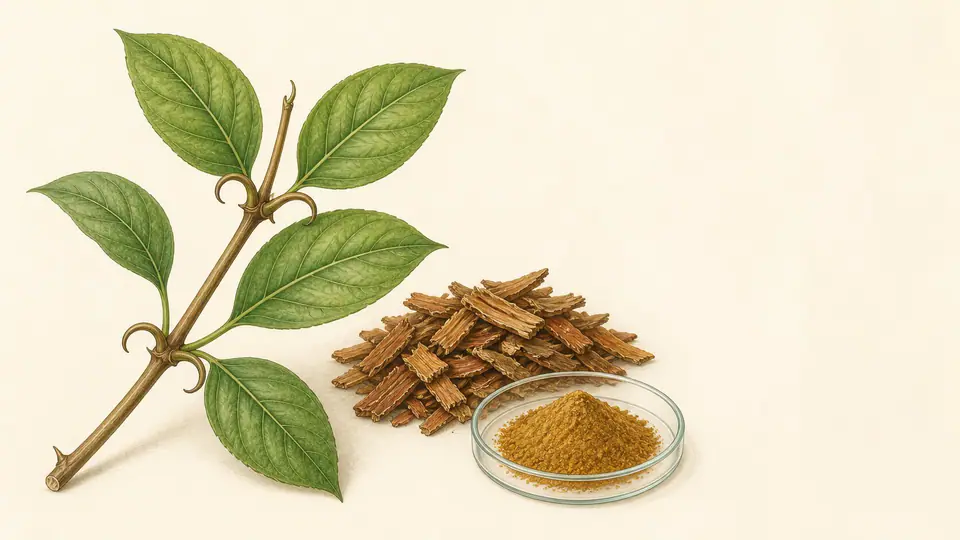
Asking while holding onto the hooks of the Amazon vine
Would taking cat's claw help with joint inflammation or immunity? In short, there are too few high-quality studies on humans to conclusively recommend it for any health purpose. While there is one small signal regarding arthritis, it was merely a preliminary trial where a specific extract was added to existing treatments. It is also an ingredient where expectations for immunity and the risk of autoimmunity conflict with each other.
This is called uña de gato in Spanish, or 'cat's claw' in Korean. It refers to vines of the Rubiaceae family, Uncaria tomentosa or U. guianensis, which climb trees using hook-shaped thorns. Kew classifies U. tomentosa as a recognized tropical vine species of Central and South America, and the NCCIH describes these two species as representative of cat's claw. However, commercial products are mainly extracts of the stem bark or root bark of U. tomentosa. Several differences arise here. Effects can vary by species, and even within the same species, components and experimental results differ depending on whether the stem bark or root bark is used, as well as the oxindole alkaloid chemotype.
So, what should we look for? The name alone is not enough.
Ingredients where species and parts differ despite the same name
Both U. tomentosa and U. guianensis fall under the name 'cat's claw'. Commercial products in the US are primarily U. tomentosa, and the preparations used in research vary by species and chemotype. The components extracted from the stem bark, root bark, and leaves are not the same, and experimental results also vary according to the oxindole alkaloid chemotype. Therefore, the results of an extract from a specific study cannot be directly applied to general cat's claw products.
This point connects to other naming confusions. Cat's claw is not the same ingredient as cat's foot, devil's claw, or the Korean herbal medicine Uncaria rhynchophylla (Jogudeung). They may be mixed up due to similar names or folk images, but they follow different botanical paths.
Why there are expectations for arthritis
There is one 24-week double-blind study that fuels expectations for cat's claw regarding joint health. In a study of 40 patients with rheumatoid arthritis, there was a signal of a small reduction in the number of tender joints when a specific U. tomentosa extract was added to existing sulfasalazine or hydroxychloroquine treatment. However, this was a preliminary trial and not a study to replace medication.
A 2024 meta-analysis on inflammation reported some reductions in IL-6 and NF-κB in preclinical data combining 24 animal studies. However, this does not prove a treatment effect for arthritis in humans. There is a significant gap between changes in inflammatory markers in test tubes and animals and direct effects on human pain or joint damage.
The two sides of the term 'immunity'
Cat's claw is also sold with the image of supporting immunity. However, the possibility of further activating the immune system is not the same as the advantage mentioned in advertisements; it can actually be problematic for people with autoimmune diseases or those receiving immunosuppressive therapy after an organ transplant. It is an ingredient too complex to be explained by the single term 'immunity'.
Differences in product forms
Most commercial cat's claw products are in the form of extracts or concentrated capsules. They often claim to be standardized extracts rather than raw teas or powders, but the species, part used, and chemotype vary by product. Therefore, it is difficult to determine which research to reference based solely on the 'cat's claw' label.
| Category | Points to Check |
|---|---|
| Species | Whether it is U. tomentosa or U. guianensis |
| Part | Whether it is the stem bark, root bark, or leaves |
| Chemotype | What the oxindole alkaloid chemotype is |
| Intended purpose | Whether the expectation is for arthritis, immunity, infection, or cancer |
| Concurrent use status | Whether it is intended to replace standard treatment or be used as a supplement |
When taking with medications
Theoretically, it is suggested that cat's claw may slow blood clotting. There is also a possibility of interaction with anticoagulants, antiplatelet agents, and blood pressure medications. Verification is essential before surgery or if you are taking such medications. Additionally, it is safer not to add this arbitrarily if you are taking immunosuppressants.
Individual circumstances and safety signals
Short-term oral use for up to 6 months has been reported as generally tolerable, but there is insufficient information regarding long-term use, topical application, or safety data for specific products. It may not be safe during pregnancy, and data for breastfeeding are lacking. If shortness of breath, facial swelling, or abnormal bleeding occurs, you must receive a prompt medical evaluation immediately.
The Gap Between Human Evidence and Expectations
The NCCIH states that there are very few high-quality human trials and no evidence to draw conclusions for any health purpose, including arthritis, cancer, or infection. It is important not to extrapolate small supplementary trials or inflammatory markers in animals to the treatment of arthritis, cancer support, or infection prevention.
Similar names, different ingredients
Cat's claw is easily confused with devil's claw, cat's foot, and Uncaria rhynchophylla. However, these are different plants. You must verify the exact scientific name, plant part, and extraction form rather than relying on the imagery of the name.
Criteria to Check Today
If you are considering cat's claw, first verify these three things: First, whether the product is U. tomentosa or U. guianensis, and which plant part and chemotype it is. Second, whether the expectation is for arthritis, immunity, infection, or cancer, and whether it will replace standard treatment or be used as a supplement. Third, whether you have an autoimmune disease, organ transplant, bleeding disorder, or are taking immunosuppressants, anticoagulants, or blood pressure medications.
Rather than the single term 'immunity,' the realistic standard for evaluating this ingredient is to first verify the exact species, plant part, and extract, as well as the current immune status and medications being taken, and to avoid extrapolating small supplementary trials or animal inflammatory markers to the treatment of arthritis, cancer, or infection.
References
- NCCIH: Cat's Claw.
- Kew Plants of the World Online: Uncaria tomentosa.
- U. tomentosa adjunct in rheumatoid arthritis: randomized trial.
- U. tomentosa anti-inflammatory studies: preclinical systematic review.
- Cat's claw toxicology and clinical evidence: critical review.
This text explains the origin of the raw materials, the scope of research, and precautions before consumption. As this cannot replace individual diagnosis or treatment, please consult a medical professional if you are taking medication or if symptoms persist. If sudden and severe symptoms such as difficulty breathing or decreased consciousness occur after consumption, seek help from 119 or the emergency room.

Medical Staff Review
Director Choi Yeon-seung
Chief Director of Baekrokdam Korean Medicine ClinicCat's Claw Dictionary Entry, reviewed the safety of expressions and the scope of verification before administration.
Review scope: Ingredient origin, human studies, concomitant medications, safety of intake · Last reviewed 2026-08-17
- Graduated from Kyung Hee University College of Korean Medicine
- Providing Korean medicine treatment since 2010
- Consultations for Gongjindan, Gyeongokgo, Nokyong (Deer Antler) restorative medicine, and customized restorative herbal medicine