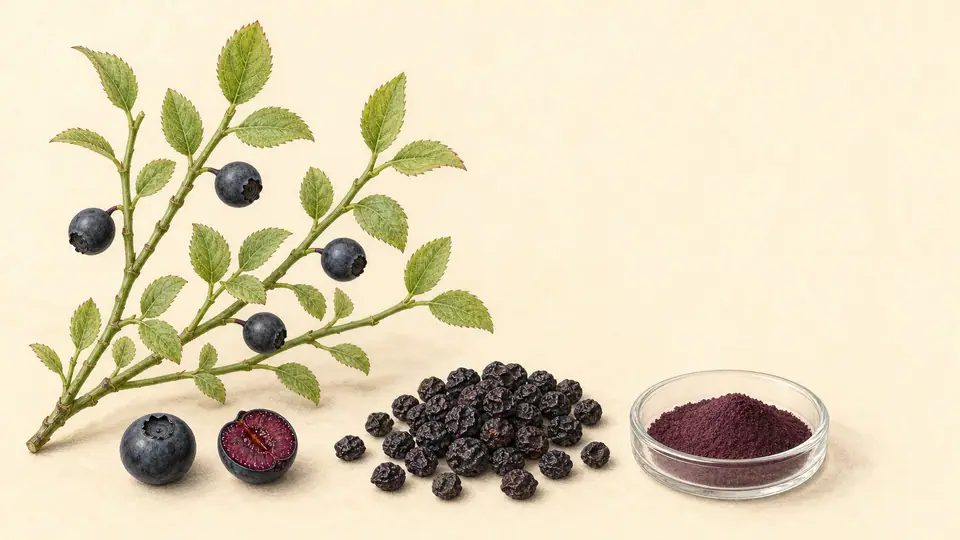
A Big Legend Brought by a Small Berry, and the Radar
Will taking bilberry supplements help with eye fatigue or night vision? In short, there is currently no definitive evidence that they improve night vision or digital eye strain in healthy individuals. While certain extracts have influenced specific indicators in some limited trials, it is difficult to generalize those results to all bilberry products.
This question begins with a story about British Royal Air Force pilots during World War 2. At the time, it was told that bilberry jam was the secret to their night bombing capabilities. The NCCIH suggests that this story may have been a myth or an explanation used to hide the use of newly introduced radar at the time. The legend has persisted, and its name is still attached to eye health supplements today. This article follows how that legend meets scientific review and what we actually need to verify.
What Kind of Berry is Bilberry?
Bilberry is the dark blue-black berry of a plant in the Ericaceae family, Vaccinium myrtillusKew classifies this plant Vaccinium myrtillusas being in the same genus as common blueberries, but it is not the same species. It is also called the European blueberry, but this nickname often leads to it being mistaken for common blueberries, maqui berries, or blackcurrants. They are different species. Fresh fruit, jam, leaf tea, and anthocyanin-standardized berry extracts are also not the same form of exposure. One familiar name often masks several differences.
Anthocyanins and Vision: Two Different Stories
It can be confirmed that bilberries contain anthocyanins or antioxidant components. However, the presence of these components does not automatically lead to clinical results showing improved vision or the treatment of eye diseases. The existence of a component and its effect on the human body are two different claims. Many supplement descriptions skip these two steps in a single sentence. We need to distinguish that boundary.
Night Vision in Healthy Individuals: What Did Systematic Reviews Show?
Expectations regarding night vision are the oldest. In a systematic review of 12 placebo-controlled trials, the 4 most rigorous recent trials showed no improvement in night vision for healthy individuals. There were no rigorous studies on pathological night vision loss. In other words, the belief that it helps you see better in the dark is not supported by large-scale, rigorous evidence.
Reviews on Digital Eye Strain Show Similar Results
Another systematic review on Computer Vision Syndrome found that oral berry extracts failed to improve visual fatigue in 7 randomized trials and failed to improve dry eye symptoms in 4 trials. Note the term 'berry extract' here. This result encompasses various berry extracts, not just bilberry, so it should not be read as a conclusion for bilberry extracts alone.
How Much Do Positive Small-Scale Trials Actually Mean?
Not all results are negative. In a 12-week trial of 109 people, a specific 240 mg standardized bilberry extract improved some ciliary accommodation indicators. However, this is a small-scale result for a single product. It cannot be presented as representative of all bilberry products or the systematic reviews as a whole. There is a gap between a single positive trial and established efficacy.
Berries, Leaf Tea, and Extracts Are Not the Same
Research on bilberry cannot be applied to other forms. Fresh berries or jams represent food-level exposure. Leaf tea is a different part of the plant than the berry. The NCCIH explains that using bilberry leaves in large amounts or for long periods may not be safe and emphasizes that they are not viewed as the same as berry extracts. Anthocyanin-standardized berry extracts are another category. You must first check the product label to see which part of the plant is used and which ingredients it is standardized to.
Can I take this with other medications?
Bilberry berries appear to be safe in typical food amounts. The NCCIH explains that berry extracts were well-tolerated in studies up to 160 mg per day for up to 6 months, but concentrations vary by product. There is insufficient safety data for supplement amounts, which exceed food levels, during pregnancy or breastfeeding. If you are taking medication, it is necessary to share the product label, including all mixed ingredients, with your healthcare provider or pharmacist.
Should I wait for a supplement to work when eye symptoms occur?
If you experience a sudden decrease in vision, vision blocked as if by a curtain, new flashes and floaters, or severe eye pain, you must seek an immediate evaluation rather than waiting for a response to a supplement. This principle applies to all eye supplements, not just bilberry. Structural changes in the eye are often cases that nutritional supplements cannot resolve.
Summary of Differences from Similarly Named Substances
Bilberry is a different species from common blueberries, maqui berries, and blackcurrants. Different plants are mixed under the same 'berry' name. Furthermore, berry foods, berry extracts, and leaf teas are different exposures; and normal night vision, digital eye strain, and diagnosed eye diseases are different issues. Misunderstandings arise when all these distinctions are grouped under the single name 'bilberry' for one product.
Then, what should I look for?
Check three things first when choosing a product. First, whether the product is Vaccinium myrtillus a single berry extract or mixed with other berries or lutein. Second, whether the anthocyanin standardization amount and daily dose are actually similar to those in the research products. Third, whether you are relying on supplements while experiencing sudden blurred vision, flashes, increased floaters, or vision loss in one eye.
The NCCIH evaluates that bilberry has not been clearly proven useful for any health condition. Rather than the nickname 'berry good for the eyes,' a realistic starting point for understanding this ingredient is to first check the exact species and plant part, standardized ingredients, negative evidence and limited individual trials regarding normal night vision, and the cause of symptoms and emergency warning signs.
References
- NCCIH: Bilberry usefulness and safety.
- Kew Plants of the World Online: Vaccinium myrtillus.
- Bilberry and night vision: systematic review.
- Nutritional supplements for computer vision syndrome: systematic review.
- Standardized bilberry extract and visual display terminal load: randomized trial.
This text explains the origin of the raw materials, the scope of research, and precautions before consumption. As this cannot replace individual diagnosis or treatment, please consult a medical professional if you are taking medication or if symptoms persist. If sudden and severe symptoms such as difficulty breathing or decreased consciousness occur after consumption, seek help from 119 or the emergency room.

Medical Staff Review
Director Choi Yeon-seung
Chief Director of Baekrokdam Korean Medicine ClinicBilberry Glossary, reviewed the safety of expressions and the scope of verification before administration.
Review scope: Ingredient origin, human studies, concomitant medications, safety of intake · Last reviewed 2026-08-17
- Graduated from Kyung Hee University College of Korean Medicine
- Providing Korean medicine treatment since 2010
- Consultations for Gongjindan, Gyeongokgo, Nokyong (Deer Antler) restorative medicine, and customized restorative herbal medicine