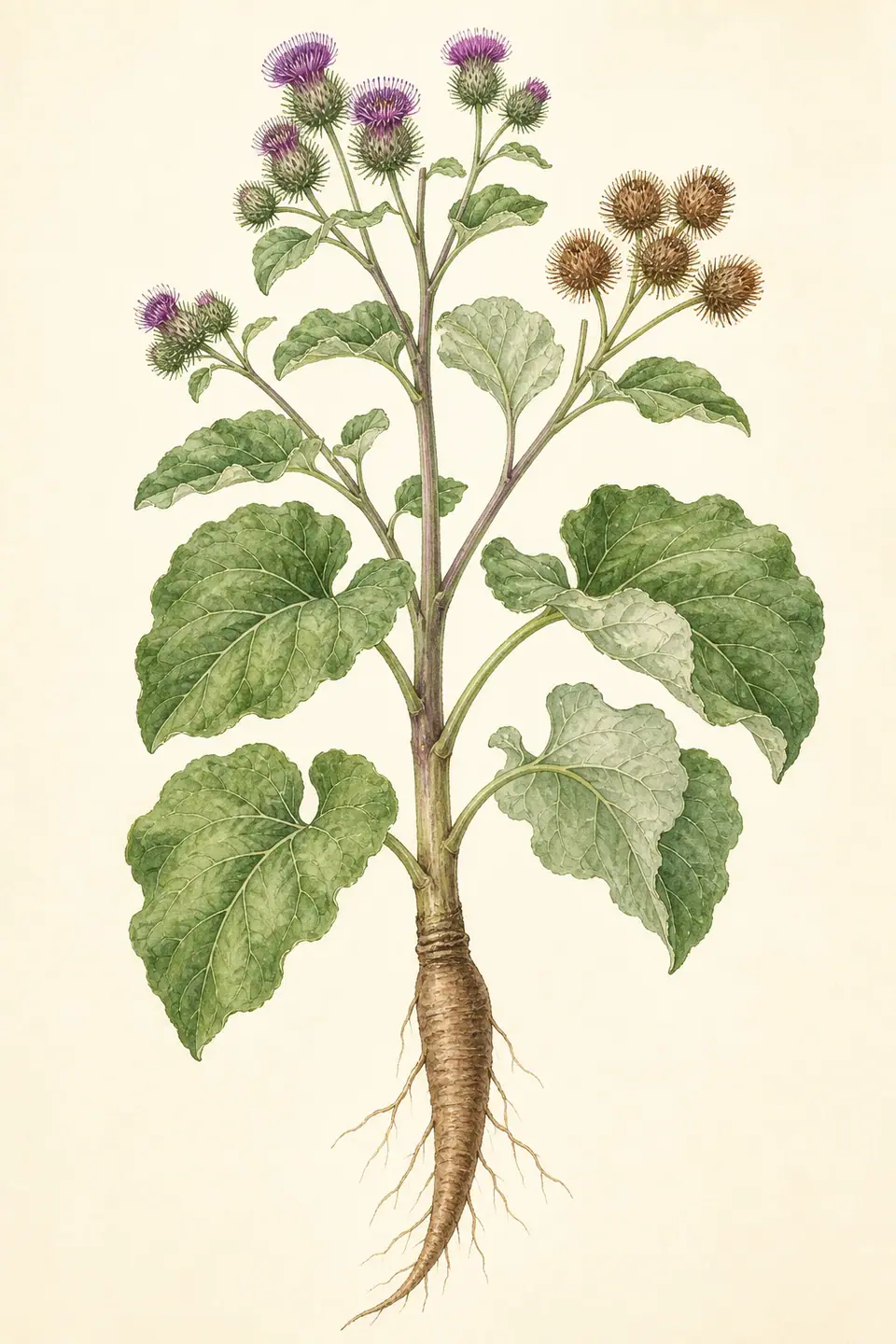
Fruits that Brighten the Eyes, Power that Opens the Throat, Ubangja (Burdock Fruit)
In the Compendium of Materia Medica, Li Shizhen explained the old name for Ubangja, 'Aksil.' It means, "The shape of the fruit is unsightly and has many thorns that cling." The description by Su Song in the same book is even more vivid: "The shell has many thorns, so when a mouse passes by, it sticks and cannot be removed, hence it is called 'Seojeomja' (mouse-sticking seed)." This name comes from the way burdock fruits cling to fabric or fur. Today's name, 'Ubangja,' also originates from the seeds (ja) of the burdock plant (ubang).
This medicinal herb is commonly known as a "fruit good for the eyes." In the Danhui Bielu, Ubangja is recorded as a remedy for "mokjeok," which refers to symptoms where the eyes become congested and red. However, understanding its use merely as an "eye supplement" is only seeing half the picture. The properties of Ubangja are acrid (sin) and bitter (go) in taste, and cold (han) in nature. While it possesses a cold nature, it works to coolly resolve the exterior syndrome (pyojeung), reducing fever and expelling heat toxins. It is used when redness in the eyes is caused by heat rising upward, rather than being a herb that tonifies the eyes themselves.
This "downward-driving power" creates a tension with the modern perception of linking Ubangja to constipation relief. Because its nature is cold (han) and lubricating (hwalli), it can help bowel movements pass smoothly; however, this also means there are people who may experience diarrhea or abdominal discomfort. This is the same context in which it is used to resolve heat in the throat (pharynx), as seen in the "Gegwan-bang" of the Compendium of Materia Medica, or in the early stages of febrile abscesses (ongjeo) of the breast, as seen in the Hyeongbang-ubang-tang of the Medical Golden Mirror. This is due to its property of not pulling heat upward, but rather dispersing it through the exterior (pyosan) and sending it downward smoothly.
Therefore, Ubangja is not a "convenient herb" that cares for the eyes and intestines simultaneously for everyone. For those with qi deficiency (giheo) lacking strength, those who naturally have loose stools or frequent diarrhea, or those whose abscesses have already ulcerated and burst, it may actually aggravate the symptoms. The dosage, the herbs it is paired with, and the duration of use are the standards for safety. We will examine these standards step by step below.
Summary at a Glance
Ubangja is a medicinal herb with many faces, as seen from its various names. The table below summarizes its core identity at a glance, and each item will be explained in detail in the following text.
| Category | Content |
|---|---|
| Origin | Asteraceae/Compositae Burdock (Arctium lappa L.) mature fruit (seed). Korean herbal medicine name: Ubangja, scientific name Arctium lappa |
| Properties and Meridian Tropism | 辛·苦, 寒; 無毒. 肺經·胃經 |
| Representative Aliases | Aksil, Seojeomja, Daeryeokja |
| Efficacy Recorded in Literature | Reducing fever in wind-heat (pungyeol) exterior syndromes, swelling and pain of the throat (pharynx), promoting the eruption of wind-heat rashes and smallpox, detoxifying and dispersing swellings of sores and abscesses |
| Main Ingredients | Fatty oils (arctiin, arctigenin, etc.), inulin, polyphenols |
| Combinations and Contraindications | Used with Forsythia, Honeysuckle, and Dandelion for detoxifying heat toxins. Use with caution in cases of qi deficiency (giheo), spontaneous loose stools (daebyeon-jari), diarrhea, already ulcerated abscesses (ongjeo-igwe), or smallpox with a pale complexion due to qi deficiency. |
Is this medicinal herb right for me?
Ubangja is a medicinal herb used to expel wind-heat (pungyeol) and resolve heat toxins. However, because its nature is cold (han) and lubricating (hwalli), it does not provide the same effect for everyone. We have summarized the suitability by constitution and symptom into three categories as confirmed during medical evaluations.
- Generally suitable cases: It may be suitable for swelling and pain of the throat caused by wind-heat common cold (pungyeol-gammo), or cases accompanied by swellings or skin rashes caused by heat toxins. It may also be considered to help bowel movements for those with a tendency toward constipation and clear heat symptoms (yeoljeung).
- Cases requiring caution: Caution is required for those who have somewhat loose stools but exhibit wind-heat exterior syndromes, or those taking diabetes medication or diuretics, as concurrent use may lead to hypoglycemia or dehydration. Pregnant and breastfeeding women should also consult a professional before use, as official safety data is limited.
- Cases to avoid: It should be avoided by those with qi deficiency (giheo), spontaneous loose stools (daebyeon-jari), diarrhea, or loose stools due to qi deficiency (giheo-byeondang), as well as those whose abscesses (ongjeo) have already ulcerated. In cases where smallpox does not erupt with a white color due to qi deficiency, Ubangja may actually worsen the symptoms.
Practical Q&A
We have collected frequently asked questions about Ubangja from the clinic. Since this herb is known as a health food for the eyes, many people wonder from "whether it is okay to take it alone" to "who should avoid it." Based on confirmed facts, we provide answers below on the premise of a professional consultation.
Is Ubangja only good for the eyes?
No. Ubangja is known to be "good for the eyes" because its fever-reducing action for exterior syndromes (pyojeung) helps lower the heat when wind-heat (pungyeol) rises upward, making the eyes red and hot. Classics such as the Compendium of Materia Medica record its use for swelling and pain of the throat, skin rashes caused by wind-heat, and swellings where toxins have accumulated. In other words, rather than being a herb that directly tonifies the eyes, Ubangja is a herb that manages eye symptoms as part of the process of expelling heat and toxins.
Are burdock tea and Ubangja the same thing?
They are not the same. Burdock tea is primarily made by steeping dried burdock roots (geun) and is commonly used as a food. In contrast, Ubangja refers to the use of mature burdock seeds (ja) as a Korean herbal medicine, and it has a separate pharmacognosy name, Arctii Fructus. Since the shape, use, and dosage standards are all different, it is not appropriate to use Ubangja in the same way you would drink burdock tea.
Can I take it on my own?
It is not recommended. Ubangja is a Korean herbal medicine that requires decoction (boiling), and generally, 3 to 9g is used according to the prescription. Because its nature is cold (han) and lubricating (hwalli), it may cause abdominal pain or diarrhea depending on the person's constitution or symptoms. It is not advisable to self-administer without the diagnosis and prescription of a professional Korean medicine doctor.
Who should avoid it?
Traditionally, use is avoided for those with a Qi-deficient (氣虛) constitution, those with diarrhea or chronic loose stools (自利), and those with boils or abscesses (癰疽) where the lesion has already ruptured into an ulcer. Additionally, during pregnancy, use should be prohibited or approached with extreme caution as the herb has a cold nature, promotes bowel movements, and the seeds are rich in fatty oils. As there is a lack of available official data regarding safety during breastfeeding, please inquire separately during your consultation.
Are there any precautions when using this with Western medicine?
Potential interactions have been raised when used in combination with certain Western medicines. When used with diuretics, the diuretic effect may be enhanced, increasing the risk of dehydration; when used with diabetes medication, the blood-glucose-lowering effect may be additive, increasing the risk of hypoglycemia. Regarding direct interactions with anticoagulants, definitive evidence has not been confirmed in academic literature. If you are currently taking any medication, please be sure to inform us before the prescription.
What signs after taking this indicate that I should visit a clinic?
If abdominal pain, diarrhea, or loss of appetite persist after intake, or if allergic reactions such as skin rash, itching, or swelling occur, you must stop taking the medicine and seek medical evaluation. If you are using diabetes medication or diuretics, particular attention is needed for symptoms such as dizziness, sweating, palpitations, dry mouth, or decreased urination. In such cases, please consult us immediately.
Relationship with Other Medicinal Herbs (Yakdae/Pairing)
The properties of Ubangja (Arctii Fructus) become more distinct when used with other medicinal herbs rather than alone. Since it has the power to push wind-heat to the surface and resolve toxic heat, it becomes a pillar of prescriptions for treating inflammatory symptoms of the throat or skin when paired with herbs of a similar direction; conversely, it does not pair well with tonic-type herbs. In traditional medicine, these pairing relationships are called 'Yakdae' (藥對). We introduce representative prescriptions where Ubangja forms the core combination.
- Ubangja + Platycodon (桔梗) · Licorice (甘草) · Scrophularia (玄蔘) · Cimicifuga (升麻) — Ubangja-tang (牛蒡子湯): A prescription found in the 'Uihak-ipmun' (醫學入門) (1575) and the supplementary volume of the 'Dongui Bogam' (東醫寶鑑). It traditionally combines 7.5g of Ubangja with 3.75g each of Platycodon, Licorice, Scutellaria, Scrophularia, Cimicifuga, Akebia, and Rhinoceros horn for throat swelling and pain (咽喉腫痛), lockjaw (牙關緊急), and boils/abscesses (瘡癰).
- Ubangja + Schizonepeta (荊芥) · Saposhnikovia (防風) · Forsythia (連翹) · Honeysuckle (金銀花) · Dandelion (蒲公英) — Hyeongbang-ubang-tang (荊防牛蒡湯): A prescription found in the edited surgical section of 'Uijong-geumgam' (醫宗金鑑). It is used for Chwiyu (吹乳, early-stage breast engorgement or breast abscesses), and is characterized by using roasted and powdered Ubangja to regulate bowel movements.
- Ubangja + Pueraria (葛根) · Adenocaulon (貫衆) · Licorice (甘草) · Salted Fermented Soybean (鹽豉) — Galgeun-ubangja-tang (葛根牛蒡子湯): A prescription found in 'Boje-bang' (保濟方) and 'Oegwa-jeongyo' (外科精要), traditionally used for seasonal toxins (時毒) or head swelling known as 'Daedu-byeong' (大頭病).
- Ubangja + Schizonepeta spikes (荊芥穗) · Human Placenta (紫河車) · Rhubarb (大黃) — Saseong-san (四聖散): A prescription found in 'Deoksaeng-dang-bang' (德生堂方). It was used for urgent throat conditions such as throat and mouth inflammation (咽喉口齒), throat closure (喉閉), and tonsillitis (乳蛾).
When combining herbs, both the cold nature (寒性) and the bowel-promoting effect (滑利) of Ubangja must be considered. In cases of Qi deficiency (氣虛), loose stools, or where a boil has already ruptured into an ulcer, prescriptions centered on Ubangja may actually aggravate the symptoms; therefore, it is necessary to use them under the diagnosis of a Korean medicine doctor.
In what form is it consumed?
Ubangja is different from burdock root tea. While burdock root is commonly brewed as a tea for food, Ubangja refers to the use of mature burdock seeds as a Korean herbal medicine, so the form and purpose are clearly distinguished. We have summarized the confirmed forms of intake into four categories below.
- Drinking as tea, Not common: Burdock root tea is common as a food, but brewing Ubangja seeds separately as a tea is not a general form of intake within the category of Korean herbal medicine.
- Consumption as food, Not common: Ubangja seeds are classified as a Korean herbal medicine (Arctii Fructus) and are not used as a food ingredient like burdock root.
- Decoction (煎服), Most common: As a Korean herbal medicine, Ubangja is usually decocted in doses of 3–9g. The seeds are often roasted and crushed before use to ensure the efficacy is well extracted.
- Professional Prescription, Required: Arctium lappa (Ubangja) is a medicinal herb included in prescriptions tailored for wind-heat exterior syndromes or symptoms combined with heat-toxins. Since the dosage and combination vary depending on an individual's constitution, symptoms, and other concurrent herbs, it is appropriate to use it under the prescription of a Korean medicine doctor.
Interactions and Safety During Use
As Arctium lappa has the power to dispel wind-heat and release heat-toxins, it acts in various ways within the body. Therefore, caution is required when used for specific constitutions or in combination with other medications. Below are the confirmed interactions and contraindications.
- Those with Qi deficiency or loose stools/diarrhea Arctium lappa has a cold nature and a lubricating effect, which may aggravate these symptoms.
- Cases where an abscess has already ulcerated The toxin-dispersing action may potentially irritate the ulcerated surface.
- Cases where smallpox or rashes are pale and have weak eruption due to Qi deficiency It may instead cause toxins to remain trapped inside the body.
- Those with physical deficiency or soft stools Gastrointestinal symptoms may worsen.
Caution is also required when using in combination with Western medications.
- When taken with diuretics The diuretic effect of Arctium lappa/burdock may enhance the effect of diuretics, increasing the risk of dehydration.
- When taken with diabetes medication (hypoglycemic agents) The blood-sugar lowering effect may be additive, increasing the risk of hypoglycemia.
- Interaction with anticoagulants Direct academic evidence has not been confirmed, so a consultation is necessary.
Official safety data for pregnancy and lactation periods are limited. In particular, for pregnant women, use should be prohibited or approached with extreme caution due to its cold nature, lubricating effect, and the abundance of fatty oils in the seeds. As safety data for breastfeeding women are also insufficient, you must decide after a consultation.
Additionally, cases of contact dermatitis related to burdock/Arctium lappa have been reported, so those using it for the first time should be mindful of skin reactions.
As a Korean herbal medicine ingredient, Arctium lappa should in principle be decocted and consumed according to the prescription of medical staff or a Korean medicine doctor. Rather than self-administration, we recommend a consultation first to comprehensively evaluate your constitution and current medications.
If you experience these symptoms
If these symptoms appear
While Arctium lappa is used to dispel wind-heat and release heat-toxins, its cold nature and lubricating effect may affect the gastrointestinal tract, skin, blood sugar, and fluid balance if taken in excessive amounts, for long periods, or if it does not suit one's constitution. The following are known warning signs that may appear during the intake of Arctium lappa. Even for mild discomfort, it is safer to inform your prescribing Korean medicine doctor first rather than reducing the dose or stopping on your own.
- Abdominal pain, diarrhea, or loss of appetite The cold nature and lubricating properties of Arctium lappa, as well as the fatty oils contained in the seeds, may irritate the gastrointestinal tract.
- Skin rash, itching, swelling Cases of contact dermatitis related to burdock and Arctii Fructus (burdock seed) have been reported.
- Dizziness, sweating, palpitations These are signs of hypoglycemia, which may occur if used in combination with diabetes medication.
- Dry mouth, decreased urination, dizziness These are signs that may indicate a possibility of dehydration when used in combination with diuretics.
- When continuing administration after an abscess has already ruptured into an ulcer The detoxifying action for swellings may irritate the ulcerated surface.
If symptoms are severe or accompanied by difficulty breathing, decreased consciousness, severe hives or swelling, or persistent vomiting and diarrhea, please visit an emergency medical institution immediately.
Differences from other restorative medicines
Arctii Fructus is a medicinal herb whose actual properties are quite different from the 'tonic-like image' its name might suggest. As it possesses the power of 'Sosan' (dispersing) to release wind-heat and clear heat-toxins, it is a herb used to push heat out of the body when heat is concentrated; it differs in nature from restorative tonics that supplement energy or fill deficiencies.
Traditional restorative agents such as Gongjindan or Gyeongokgo are formulated to supplement deficiency syndromes (Heojeung) and replenish essence (Jeong), energy (Qi), and spirit (Shin). In contrast, Arctii Fructus has such distinct and sharp properties that it is called 'Akshil' in the Compendium of Materia Medica; it may actually be burdensome for those with energy deficiency (Qi-heo) or those experiencing loose stools and diarrhea. It is rare for a herb that clears heat-toxins in a febrile state to be included in the same prescription as a restorative tonic that fills a deficient state. Rather, prescriptions containing Arctii Fructus are closer to treating wind-heat exterior syndromes, sore throat and swelling, or inflammatory skin symptoms.
Therefore, Arctii Fructus is often unsuitable for questions such as "I am looking for a tonic because my vision is dim" or "Can I take this as a fatigue recovery agent?" If the symptoms are redness of the eyes or caused by wind-heat, it may be used in combination with other herbs, but simple eye fatigue or vision loss due to deficiency requires a completely different approach.
It is safe to determine whether Arctii Fructus is suitable for your constitution and symptoms, or if restorative agents like Gongjindan or Gyeongokgo are more appropriate, through examination and consultation with a Korean medicine doctor. Rather than taking it on your own believing it to be a tonic, please first verify if it is a prescription where Arctii Fructus should be included.
References
- Evidence material related to Arctii Fructus 1: GBIF plant classification data.
- Evidence material related to Arctii Fructus 2: GBIF plant classification data.
- Evidence material related to Arctii Fructus 3: Korea Citation Index academic paper.
- Evidence material related to Arctii Fructus 4: Korea Citation Index academic paper.
- Evidence material related to Arctii Fructus 5: Korea Citation Index academic paper.
- Evidence material related to Arctii Fructus 6: PubMed academic paper.
- Evidence material related to Arctii Fructus 7: PubMed academic paper.
- Evidence material related to Arctii Fructus 8: PubMed academic paper.
If you would like to check if this medicinal herb is right for you or which prescription it should be used with, please leave a medical inquiry. For those who find it difficult to visit the clinic, non-face-to-face consultations are available; we will provide guidance after first reviewing your current condition and current medications.

Medical Staff Review
Director Choi Yeon-seung
Chief Director of Baekrokdam Korean Medicine ClinicArctii Fructus Dictionary Entry, reviewed the safety of expressions and the scope of verification before administration.
Review Scope: Clinical Accuracy, Pharmacology, Contraindications, Combinations, QA · Last Reviewed 2026-08-16
- Graduated from Kyung Hee University College of Korean Medicine
- Providing Korean medicine treatment since 2010
- Consultations for Gongjindan, Gyeongokgo, Nokyong (Deer Antler) restorative medicine, and customized restorative herbal medicine