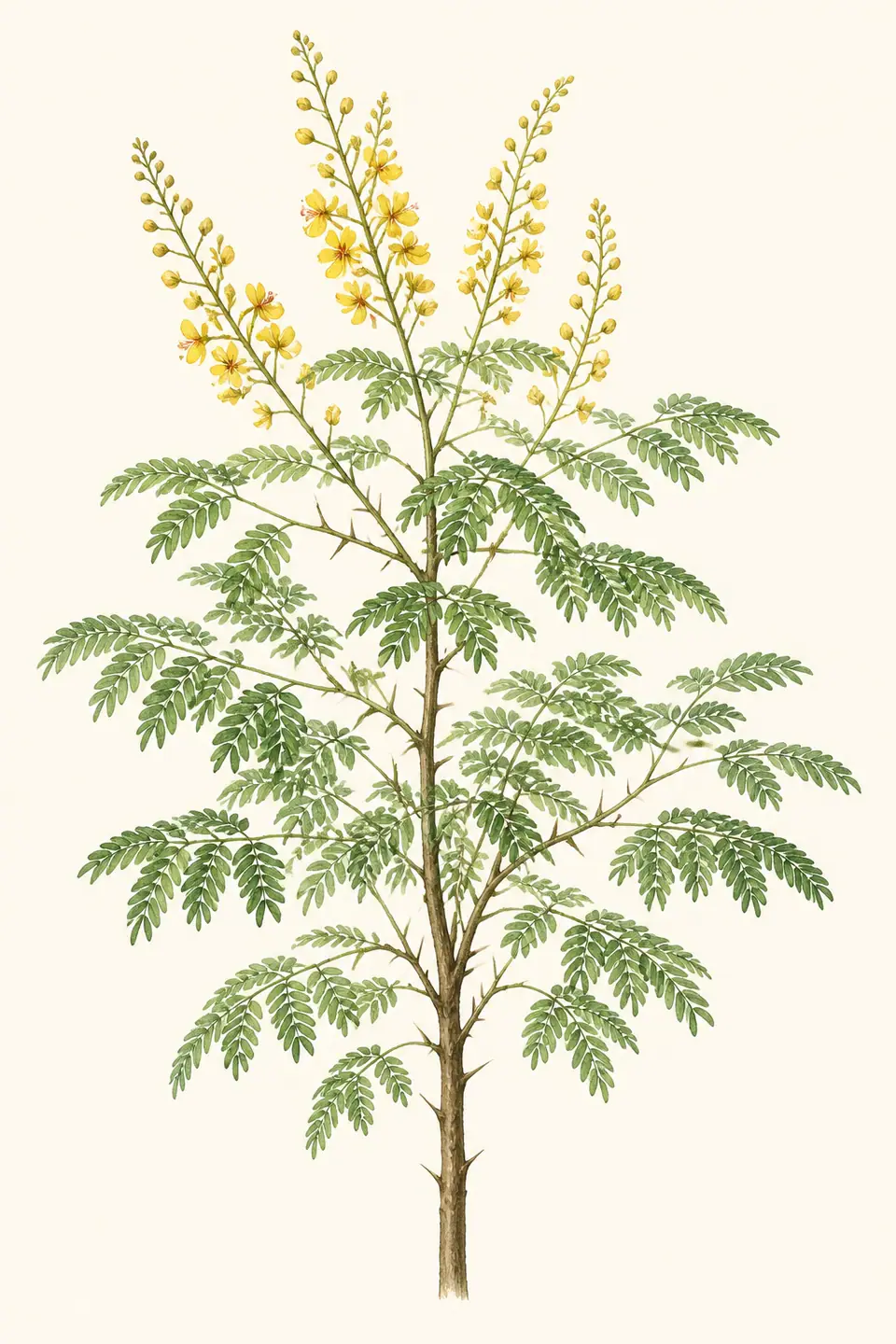
Sappan Wood (Somok): The Red Wood that Pierces the Blockages of the Blood Level
The Dongui Bogam classifies Sappan Wood (Somok) as a 'medicine for the blood level (hyeol-bun).' This expression is far from the gentle image of 'purifying the blood.' In traditional medicine, the blood level refers not simply to the space where blood flows, but to a domain dealing with states where stagnation has accumulated within the blood, preventing smooth flow. Looking at the prescriptions in the Dongui Bogam, Sappan Wood is mostly used for bruises, fractures, muscle and tendon injuries, or coughing caused by blood stasis. In the Myoyak Gangseong-dan formula, it is prepared by decocting 'half a cup each of water and wine with one mace of Sappan Wood' to be held in the mouth, and in the Danggui-eum formula, 'equal parts of Daehwang, Sappan Wood, raw and dried Jihwang, Danggui, and Red Shaoyao' are 'administered with warm wine.' The Ben Cao Shu Gou Yuan briefly evaluates Sappan Wood as 'performing its function by circulating the blood.' This single line best reveals the essence of Sappan Wood.
When people hear 'helps blood circulation,' they often imagine blood becoming clear and smooth. However, the power of Sappan Wood works in the opposite direction. It has the property of piercing blockages and dispersing accumulations, specifically, rupture and dispersion (sanjeok). For this reason, it has been traditionally contraindicated for pregnant women and patients with bleeding disorders. Adding this 'piercing power' to a body that is already leaking blood or carrying a fetus increases the risk. It is a medicinal herb quite different from the mild nuance associated with the expression 'purifying the blood.'
Due to these properties, Sappan Wood is often used by decocting it with other medicinal herbs rather than being boiled and drunk alone as a tea. In the Si-mul-tang-ga-mi of the Dongui Bogam, and the Tongseong-eum, Dae-sok-myeong-eum, and So-sok-myeong-eum of the Shaolin Zhenchuan Shangke Mifa, Sappan Wood is positioned within combinations that circulate blood stasis after injuries or bruises. Modern research reports that components such as brazilin, brazilein, sappan chalcone, and protosappanin A are related to antioxidant, anti-inflammatory, and blood flow improvement effects. However, these research results do not immediately guarantee clinical safety.
Ultimately, Sappan Wood is a medicinal herb where 'how much, with whom, and how it is used' is extremely important. Because it has the power to move stagnant blood, it cannot be used during pregnancy, lactation, in the presence of hemorrhagic diseases, before or after surgery, or when taken concurrently with anticoagulants or antiplatelet agents. Self-administration is not recommended; it is a medicinal herb used through the prescription and decoction of a doctor of Korean medicine. On this page, we will examine both the classical role and modern precautions of Sappan Wood.
Summary at a Glance
This table summarizes at a glance what kind of medicinal herb Sappan Wood is and how its power is used in tradition. Please check the sources, modern scientific name, and precautions.
| Category | Content |
|---|---|
| Origin | Hanja name: 蘇木, Scientific name Caesalpinia sappan L., A plant-based medicinal herb confirmed with the same scientific name in GBIF. |
| Properties and Tropism | Verification is required. Official sources such as the Korean Pharmacopoeia, Herbal Medicine Standards, or KIOM/OASIS have not been secured. |
| Representative Alias | Sufangmu, Sufangmu, Red Wood, sappan wood, The specific origins of these classical aliases require further verification. |
| Efficacy recorded in literature | Used in the Dongui Bogam for prescriptions treating bruises, fractures, muscle/tendon injuries, and coughing due to blood stasis. Recorded in the Ben Cao Shu Gou Yuan as 'performing its function by circulating the blood.' |
| Main Ingredients | PubMed reviews have reported brazilin, brazilein, sappan chalcone, and protosappanin A as major components. |
| Combinations and Contraindications | As it is traditionally used as a herb to circulate blood flow, it cannot be used or requires consultation with medical staff during pregnancy, lactation, hemorrhagic diseases, or before and after surgery. There is no confirmed evidence regarding its specific combination relationship with restorative medicines for nourishing Qi or Yin. |
Is this medicinal herb right for me?
Sappan Wood is classified in tradition as a 'medicine for the blood level (hyeol-bun)' and is used to treat states where blood is stagnant and not flowing. Its indications and contraindications are as clear as its potency. Please check the items below that apply to your condition first.
- Generally suitable cases: This applies when a doctor of Korean medicine determines that you have symptoms where Sappan Wood is used in traditional prescriptions, such as bruising and remaining pain after bruises, fractures, or muscle/tendon injuries, or coughing due to blood stasis. It can be used as a decoction at a medical institution when it aligns with the context of prescriptions like Myoyak Gangseong-dan, Danggui-eum, or Si-mul-tang-ga-mi from the Dongui Bogam.
- Cases requiring caution: You must consult a doctor of Korean medicine if you are taking anticoagulants or antiplatelet agents, have a tendency to bleed, or are before or after surgery. Because Sappan Wood acts to circulate blood flow, it may theoretically increase the risk of bleeding. Additionally, children and the elderly should not self-administer this herb.
- Cases to avoid: Avoid use if you are pregnant, breastfeeding, have a hemorrhagic disease, or intend to take it on your own as a standalone tea or food product. Even in classical prescriptions, Sappan Wood is used by decocting it with other herbs, and it has been traditionally contraindicated for pregnant women and patients with bleeding. Please confirm whether it is safe for you to take through a consultation with a doctor of Korean medicine.
Practical Q&A
Just as its name 'medicine for the blood level' suggests, Sappan Wood is a herb where knowing when to use it and when to avoid it is critical. We have gathered frequently asked questions from consultations and will answer them with verified facts.
Is Sappan Wood a medicine that purifies the blood?
The expression 'purifying the blood' is close to a modern misconception. What Sappan Wood addresses in the Dongui Bogam and Ben Cao Shu Gou Yuan is not 'clear blood,' but rather a state where blood is stagnant and not flowing.It has been traditionally used in situations such as bruises, fractures, muscle/tendon injuries, or coughing due to blood stasis, and its action is closer to 'dispersion (sanjeok)', scattering that which has accumulated. Therefore, rather than viewing Sappan Wood as a simple 'detoxifier' or 'purifying tea,' it is more appropriate to understand it as a prescription medicinal herb used only after a doctor of Korean medicine has evaluated the patient's blood level state.as is appropriate.
Can I receive a prescription containing Sappanwood (Somoek) after a bruise or fracture?
It is correct that it has been used in that context traditionally. In the 'Myoyak Gangseong-dan' of the 《Dongui Bogam》, it was used for bruises, fractures, and muscle or tendon injuries by decocting 'half a cup each of water and alcohol with 1 jeon of Sappanwood (Somo)'. Sappanwood is also included in the 'Tongseong-eum', 'Daesukmyeong-eum', and 'Sosukmyeong-eum' of the 'Shaolin Zhenchuan Shangke Mifang'. However, all of these prescriptions administered in a decocted form (boiled as a liquid)and depending on the timing and location of the injury, and whether there is bleeding, Sappanwood may be included or should be avoided. In particular, it is a general rule not to use it in the early stages when bleeding has not yet stopped.
Can I drink Sappanwood as a tea or eat it as a food?
are not recommended. In classical prescriptions, Sappanwood is not consumed as a standalone tea, but rather together with other herbal ingredients decocted (boiled) and administeredtogether with other medicinal herbs. While it is used as a food coloring in Southeast Asia, this is different from consumption for medicinal purposes. As it is a medicinal herb that promotes blood circulation, it is safer to use it via a prescription from a Korean medicine doctor rather than self-administering.
Can it be used during pregnancy or before surgery?
As a rule, it should not be used by those who are pregnant, breastfeeding, have bleeding disorders, or are in the pre- and post-operative periods. Sappanwood is traditionally classified as a herb that promotes the flow of 'blood,' and theoretically, the risk of bleeding may increase when used in combination with anticoagulants or antiplatelet agents. However, since specific clinical interaction studies on Sappanwood were not secured for this entry, please be sure to inform your Korean medicine doctor if you are taking any medications.
What signs should I look for that indicate I need to visit a hospital?
While no specific reports of overdose reactions to Sappanwood have been confirmed, as it is a herb that promotes blood circulation and carries a risk of bleeding, you must stop taking it and seek consultation if the following signs appear: skin bruising or bleeding, gum bleeding, bloody or black stools, abdominal pain, vomiting, indigestion, dizziness, low blood pressure, or signs of liver/kidney dysfunction such as jaundice or changes in urine. Long-term or high-dose administration must only be conducted under the supervision of a Korean medicine doctor.
Can I take it together with restorative medicines like Gongjindan or Gyeongokgo?
Based on available information, it is not. Although Gyeongokgo is mentioned in the same chapter of the Dongui Bogam (Miscellaneous Diseases-2), there is no evidence that Sappanwood is a component of Gyeongokgo. No official or classical evidence was found in this entry indicating that Sappanwood is included in other restorative prescriptions such as Gongjindan or Yukmijihwang-hwan. Since specific combinations or interactions with restorative medicines require verification, please be sure to consult a professional if you wish to take them together.
Relationship with Other Medicinal Herbs (Yakdae/Pairing)
Sappanwood is not used alone. Its properties become more distinct when paired with other herbs, which is traditionally called "Yakdae" (medicinal pairs). Especially in situations where blood stagnation must be resolved, Sappanwood is combined with other blood-circulating or downward-directing herbs to utilize their respective directions. We introduce representative combinations confirmed in the Dongui Bogam and specialized literature on wounds and bruises.
- Sappanwood + Myrrh (Myoyak), etc. — 沒藥降聖丹: A prescription found in the Dongui Bogam (Miscellaneous Diseases-3); for bruises, fractures, or fascia injuries, Sappanwood is decocted in equal parts water and alcohol and administered. “水酒各半盞入蘇木一錢同煎去蘇木調藥空心熱服” Sappanwood (Sae-mok) is used to open areas blocked by blood stasis.
- **Sappanwood + Daewang (Rhubarb) + Dang-gui (Angelica gigas) + Saeng-geon-ji-hwang (Fresh Rehmannia glutinosa) + Jeok-jak-yak (Red Peony Root)** — 當歸飮: A prescription found in the Miscellaneous Diseases-2 section of the Dongui Bogam, used when the lungs are damaged by trauma and coughing occurs with black blood. “大黃蘇木生乾地黃當歸赤芍藥各等分…溫酒調服” Sappanwood and Daewang move stagnant blood downward, while Dang-gui, Jeok-jak-yak, and Ji-hwang manage the damaged blood components.
- **Sappanwood + Daewang (Rhubarb) + Samul-tang (Four-Substance Decoction)** — **Added for Blood Cough (Hyeol-gi-chim)**: When treating coughing caused by blood stasis in the Miscellaneous Diseases-2 section of the Dongui Bogam, Daewang and Sappanwood are added to Samul-tang “酒調服或水煎服” to complete the formula. Within the blood-tonifying action of Samul-tang, Sappanwood plays a supporting role in circulating stagnant blood.
- **Sappanwood + Sokmyeong-eum (Sokmyeong Decoction) series** — 通聖飮·大續命飮·小續命飮: Prescriptions for wounds and trauma listed in the Shaolin True Transmission Secret Formulas for Traumatology, containing approximately 1 jeon to 6 bun of Sappanwood to help circulate blood stasis.
Sappanwood is a medicinal herb with a clear tendency to promote blood circulation. Therefore, when used in combination with anticoagulants or antiplatelet agents, there is a theoretical risk of increased bleeding. It should not be used during pregnancy, breastfeeding, by individuals with hemorrhagic diseases, or before and after surgery. Since further verification of specific contraindications in combinations is required, please be sure to mention this during your consultation.
In what form is it consumed?
Traditionally, Sappanwood has been used more as a decoction brewed with other medicinal herbs rather than as a standalone tea. Looking at the prescriptions in the 《Dongui Bogam》, the primary methods are decocting it in water and alcohol, as in 'half a cup each of water and alcohol with 1 jeon of Sappanwood', or mixing dried powder into warm alcohol, as in 'administered with warm alcohol'. This means that because Sappanwood possesses properties to resolve blood stasis as a 'blood-level medicine', it is more appropriate to use it within the context of a prescription rather than consuming it as a simple everyday beverage.
- Drinking as tea: Not common. The use of Sappanwood brewed as a standalone tea is not found in classical prescriptions.
- **Use as food or seasoning**: There are cases where it is used as a food coloring (red) in some Southeast Asian regions, but this is not for medicinal purposes. From a Korean medicine perspective, consumption in food form is not recommended.
- Decoction: This is the traditional method of administration. In the Dongui Bogam and prescriptions for wounds and trauma, Sappanwood is confirmed to be decocted in water or alcohol and taken with other medicinal herbs.
- Professional Prescription: Recommended. Since Sappanwood is a medicinal herb with clear effects on promoting blood circulation and specific contraindications regarding bleeding and pregnancy, it is appropriate to use it as prescribed under the diagnosis of a Korean medicine doctor. Self-administration is not recommended.
Interactions and Safety During Use
As Sappanwood has the power to resolve and circulate blood stasis, it is a medicinal herb where one must first determine when to use it and when to avoid it. The following points are summarized based on currently identified evidence and traditional contraindications.
- Pregnancy and Breastfeeding: Since Sappanwood is traditionally classified as a blood-circulating herb, the general rule is not to use it during pregnancy or breastfeeding.
- **Hemorrhagic diseases / Before and after surgery**: Administration should be avoided in conditions where there is a risk of bleeding or when surgery is pending.
- Concurrent use with anticoagulants or antiplatelet agents: As Sappanwood is a herb that affects blood circulation, using it with anticoagulants or antiplatelet agents may theoretically increase the risk of bleeding. However, as clinical interaction studies have not yet been confirmed, please consult a professional regarding concurrent use.
- **Children and the elderly**: Due to its tendency to promote blood circulation, self-administration by children or the elderly is not recommended.
- Overdose and long-term use: Sappanwood is a medicinal herb used for short periods according to a prescription, rather than for long-term consumption as a standalone tea or daily food. If you experience skin bruising, bleeding, gum bleeding, bloody or black stools, abdominal pain, vomiting, dizziness, low blood pressure, jaundice, or changes in urination during use, stop taking it immediately and visit a Korean medicine doctor or a medical institution.
Sappanwood has traditionally been used as a 'medicine for the blood level,' but its usage conditions are as strict as its potency. Please ensure through a consultation whether it is appropriate for your condition and if it is compatible with other medications or restorative herbal medicines you are currently taking.
If you experience these symptoms
These symptoms are signals that could theoretically appear during excessive or long-term use due to the property of Sappanwood to resolve blood stasis and promote blood flow. However, these signals should be considered general precautions for medicinal herbs that promote blood flow or carry a risk of bleeding, rather than clinical reports specific to Sappanwood. If the following symptoms appear, do not reduce or stop the dosage on your own; please notify the prescribing Korean medicine doctor first.
- Easy bruising of the skin or bleeding that does not stop
- Gum bleeding, bloody stools (stools mixed with blood), or black stools (black-colored stools)
- Abdominal pain, vomiting, indigestion
- Dizziness or a feeling of low blood pressure
- Signs of liver or kidney dysfunction, such as jaundice or abnormal changes in the color or amount of urine
If symptoms are severe or progress rapidly, it is safe to visit an emergency medical institution.
Differences from other restorative medicines
Sappanwood is a medicinal herb used to resolve blood stasis. Therefore, its properties differ from restorative herbal medicines like Gongjindan or Gyeongokgo, which supplement energy and fill deficiencies. Just as restorative medicines are used for those who are generally deficient in energy rather than those with blocked blood, Sappanwood is appropriately combined only when there is stasis.
Looking at prescriptions containing Sappanwood in the Dongui Bogam, it is used to resolve blood stasis after bruises or fractures, or in cases of coughing mixed with blood stasis. On the other hand, while Gyeongokgo is mentioned in the cough section of the same book, there is no evidence that Sappanwood is one of its ingredients. In other words, Sappanwood is closer to a medicinal herb used short-term in prescriptions to circulate blocked blood, rather than being a component of restorative medicine.
Whether Sappanwood is necessary or if a restorative herbal medicine is more appropriate must be determined by evaluating your condition. The direction of the prescription differs between cases of pain that feels like blocked blood or bruising that lasts long after a trauma, and cases of overall lack of energy and easy fatigue. We will confirm which specific prescription is right for you through a consultation.
References
- Sappanwood evidence material 1: GBIF plant classification data.
- Sappanwood evidence material 2: PubMed academic paper.
- Sappanwood evidence material 3: PubMed academic paper.
- Sappanwood evidence material 4: PubMed academic paper.
If you would like to check if this medicinal herb is right for you or which prescription it should be used with, please leave a medical inquiry. For those who find it difficult to visit the clinic, non-face-to-face consultations are available; we will provide guidance after first reviewing your current condition and current medications.

Medical Staff Review
Director Choi Yeon-seung
Chief Director of Baekrokdam Korean Medicine ClinicSappanwood Dictionary Entry, reviewed the safety of expressions and the scope of verification before administration.
Review Scope: Clinical Accuracy, Pharmacology, Contraindications, Combinations, QA · Last Reviewed 2026-08-16
- Graduated from Kyung Hee University College of Korean Medicine
- Providing Korean medicine treatment since 2010
- Consultations for Gongjindan, Gyeongokgo, Nokyong (Deer Antler) restorative medicine, and customized restorative herbal medicine