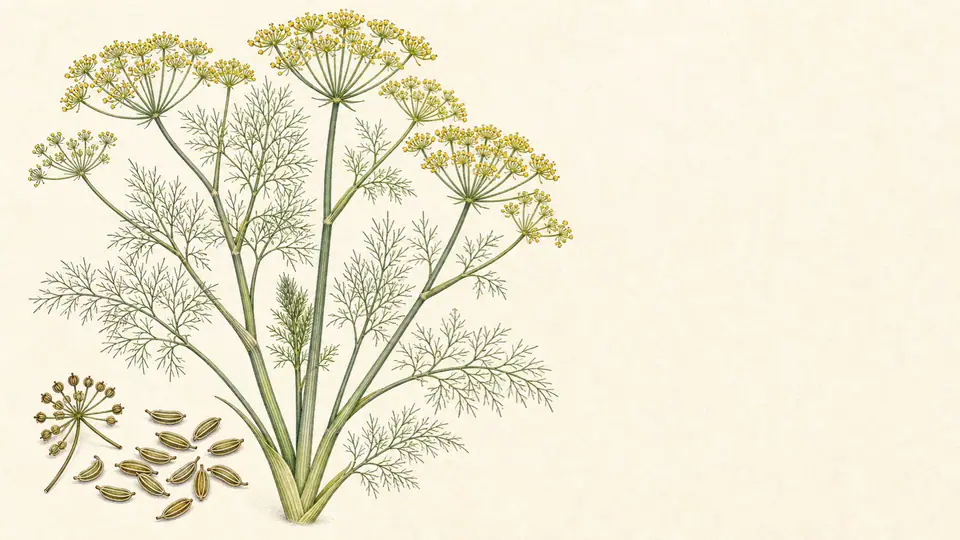
Small Sweet and Bitter Berries Can Become Medicine at Certain Moments
Can I drink fennel tea or use essential oils for gas or menstrual pain? In one sentence: using a pinch as a food spice is not the same as consuming tea or essential oils for health purposes. Extra caution is required, especially for those who are pregnant, breastfeeding, or for children.
Fennel is a spice that provides the familiar sweetness and aroma found in bread, sausages, and curry. However, as the same name is applied to medicinal herbs, teas, concentrated essential oils, and supplements, the level of exposure and safety standards change. Let's examine those boundaries.
Where the questions begin
Questions about fennel usually fall into two categories: post-digestive gas or abdominal discomfort, and menstrual pain. In that case, can we view seeds sprinkled on food and a drop of essential oil as having the same safety profile? No. In both cases, the familiarity of it being 'natural' often precedes judgment. However, fennel as defined by the Korean Pharmacopoeia of the Ministry of Food and Drug Safety refers to the ripe fruit of Foeniculum vulgare. Leaves, bulbs, or concentrated essential oils cannot be viewed by the same standard. Furthermore, anise (Pimpinella anisum) and star anise (Illicium verum) are separate plants that only have similar names. Therefore, the name 'fennel' alone does not specify exactly what is being referred to.
Identity of the Ingredient: One Fruit, Multiple Parts
The true form of fennel is a small, oblong brown fruit. The pharmacopoeia is based on this fruit. However, in the market, various forms such as leaves, bulbs, essential oils, anethole, and estragole are mixed under the name fennel. These have different levels of exposure. Tea made by boiling the whole fruit differs in both amount and concentration from a single drop of essential oil. Therefore, the first thing to check is whether it is the 'ripe fruit' or another part or a concentrate.
Reasons for Expectation: Menstrual Pain Research and Its Limitations
A 2020 systematic review on menstrual pain involving 12 trials reported signals of pain reduction compared to a placebo. This result increased expectations for fennel. However, researchers stated that the heterogeneity of the placebo comparisons was very high and that more robust research is needed. The formulations used in the trials also varied; some may have been essential oils, some capsules, and some other extracts. Therefore, it is difficult to apply the possibilities found in a specific formulation directly to general fennel tea. Rather than concluding that it 'is effective,' it is more accurate to say that 'possibilities were seen in some studies, but it is not yet confirmed.'
Why Caution is Needed Regarding Infant Colic
There are claims that fennel helps with infant colic. This is based on an old single trial that evaluated a specific fennel seed oil emulsion. However, this trial is not a basis for administering essential oils at home or arbitrarily preparing tea. Essential oils are concentrates, and an infant's metabolic capacity differs from that of an adult. The 2024 EMA monograph does not recommend use for children under 4 years due to insufficient data. For children aged 4 to 12, it is not recommended without a separate risk assessment if estragole exposure exceeds guideline values. Therefore, the reasoning that 'it will be fine for a child because it is natural' is dangerous.
Differences in Formulation: A Pinch, a Cup, a Drop
A pinch in food, tea, capsules, and essential oils create different levels of exposure even with the same raw material. When used as a spice, the amount is small and the duration is short. Tea is steeped in water, which may lower the concentration of components, but it is difficult for us to know that concentration exactly. Capsules may or may not be standardized formulations. Essential oils are the most concentrated form. The key component here is estragole. The EMA places restrictions on children and long-term use due to estragole exposure. Therefore, when choosing a product, you should look at which part was used, the formulation, the estragole content, and the duration of use, rather than just the name 'fennel.'
| Category | Points to Check |
|---|---|
| Raw Material/Food | Whether it is ripe fruit, and if it is a small amount used as a spice |
| Tea | Part used, steeping concentration, duration of use |
| Capsules/Supplements | Whether standardized, estragole content, duration of use |
| Essential oil | Oral use prohibited, contact of undiluted liquid with skin or mucous membranes prohibited |
When Taking Together: Medications and Personal Circumstances
Before using fennel for health purposes, you must first assess your own situation. Check if you are pregnant or breastfeeding, if the user is a child, if you have allergies to the Apiaceae family (such as celery, carrots, or coriander), or if you have hormone-related diseases or are taking related medications. The EMA 2024 monograph classifies the traditional use of fennel fruit for mild gastrointestinal spasms, menstrual cramps, and coughs from the common cold, but does not recommend its use during pregnancy or breastfeeding as safety has not been established. Avoid using medicinal doses during pregnancy or breastfeeding, and as a rule, do not give teas, essential oils, or supplements to children if the age-appropriateness and estragole content have not been verified.
Adverse Reactions and Emergency Signals
Use should be avoided if you have allergies to the Apiaceae family, such as fennel, celery, carrots, or coriander. If a rash, swelling of the lips and throat, or difficulty breathing occurs during use, stop immediately; severe reactions require evaluation by 119. Furthermore, regardless of how 'natural' fennel is, if you experience severe abdominal pain, repeated vomiting, bloody stools, or pelvic pain accompanied by the possibility of pregnancy and heavy bleeding, prompt medical evaluation takes priority over using fennel. These symptoms require a primary evaluation of the cause.
The Gap Between Human Evidence and Expectations
Expectations for fennel are often inflated by mixing 'traditional use' with 'modern research.' The EMA recognizes the traditional use of fennel fruit for mild gastrointestinal spasms, menstrual cramps, and coughs from the common cold. However, this refers to short-term, mild cases; one should not generalize the possibilities found in meta-analyses of menstrual pain or over-interpret single trials on infant colic. Considering the number of studies, consistency, and limitations, fennel is a raw material with the possibility that it 'might alleviate symptoms,' not a material that 'cures the cause.'
Similar names, different ingredients
Anise and star anise are distinct plants that merely share a similar name with fennel. Anise (Pimpinella anisum) and star anise (Illicium verum) each have their own composition and safety standards. In particular, some species that resemble star anise are toxic, so extra caution is needed. When shopping, don't just choose based on the Korean name 'fennel'; instead, make it a habit to check the scientific name or the raw material part used.
Criteria to Check Today
In other words, the following sequence is helpful when choosing fennel. First, verify if it is ripe fennel fruit, or if it is anise, star anise, leaves, bulbs, or essential oil. Second, determine if it is a pinch for food, a tea, a capsule, or an essential oil, and check if the estragole content and duration of use are known. Third, check for pregnancy, breastfeeding, childhood, Apiaceae allergies, hormone-related diseases, and current medications. Do not transfer the familiarity of a spice to the safety of an essential oil; verify the plant, part, formulation, estragole, age, and pregnancy status, and prioritize a cause evaluation if symptoms persist.
References
- Ministry of Food and Drug Safety Korean Pharmacopoeia: Fennel.
- Fennel for primary dysmenorrhea: systematic review and meta-analysis.
- Fennel seed oil emulsion for infantile colic: randomized trial.
- EMA EU herbal monograph: sweet fennel fruit.
- Fennel composition, benefits and safety review.
This text explains the origin of the raw materials, the scope of research, and precautions before consumption. As this cannot replace individual diagnosis or treatment, please consult a medical professional if you are taking medication or if symptoms persist. If sudden and severe symptoms such as difficulty breathing or decreased consciousness occur after consumption, seek help from 119 or the emergency room.

Medical Staff Review
Director Choi Yeon-seung
Chief Director of Baekrokdam Korean Medicine ClinicFennel Dictionary Entry, reviewed the safety of expressions and the scope of verification before administration.
Review scope: Ingredient origin, human studies, concomitant medications, safety of intake · Last reviewed 2026-08-17
- Graduated from Kyung Hee University College of Korean Medicine
- Providing Korean medicine treatment since 2010
- Consultations for Gongjindan, Gyeongokgo, Nokyong (Deer Antler) restorative medicine, and customized restorative herbal medicine