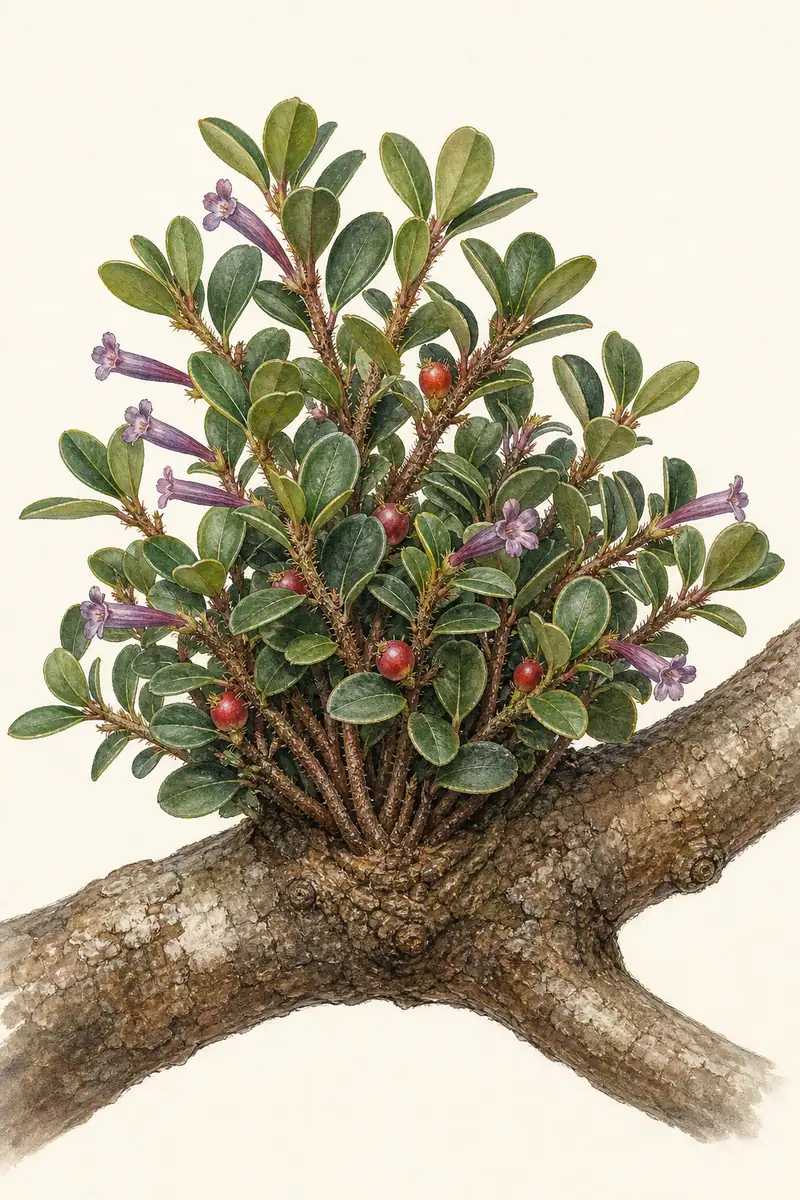
Sang-gi-saeng (Mulberry Mistletoe), a medicine that sits on a tree like a bird
The name 'U-mok' or 'Wan-dong' was first recorded in the 《Erya》, and 'Sang-sang-gi-saeng' was first recorded in the 《Shennong Bencao Jing》. It is said that this name mimics the appearance of a bird perched on a tree. Li Shizhen's explanation in the 《Bencao Gangmu》 is as follows: “此物寄寓他木而生,如鳥立于上,故曰寄生、寓木、蔦木.” It means that seeing a plant that lives leaning on a tree other than a mulberry tree looked like a bird sitting on a branch, so it came to be called 'Gi-saeng' (parasite). The same book also lists aliases such as 'Gi-seol', 'U-mok', 'Wan-dong', and 'Tsa', allowing us to guess how many names this small plant has been called since long ago.
However, there is more than just the origin of the name behind these aliases. The 《Bencao Yanyi》 contains a tragic anecdote resulting from the failure to distinguish between 'real Sang-gi-saeng' and 'fake Sang-gi-saeng'. Guo Zhongshi, a physician of the Song Dynasty, stated that 'real mulberry parasite is guaranteed to be effective when ingested,' but it was recorded that a person who received a parasite from another tree from a neighboring town because it was hard to find in the Jiangnan region 'died within one month of administration.' “鄰邑有人,僞以他木寄生送之,服之逾月而死. 哀哉!” This anecdote is a classic warning showing that the issue is not simply distinguishing between medicines with similar names, but that whether it parasitized a specific tree, in other words, whether it is an authentic product, can be directly linked to life.
Today, Sang-gi-saeng is also called by the friendly name 'Mulberry Mistletoe,' but its efficacy is by no means light. The 《Shennong Bencao Jing》 records that it 'primarily treats lower back pain, stiffness of the back in children, carbuncles and swellings, stabilizes the fetus, nourishes the skin, strengthens hair and teeth, and grows beards and eyebrows,' and the 《Bencao Gangmu》 adds that it 'assists muscles and bones, benefits the blood vessels, treats unstoppable bleeding during pregnancy, and makes the fetus firm.' This duality, strengthening the waist and skeletal frame while stabilizing the fetus, acting strongly on one side and gently on the other, is the characteristic of Sang-gi-saeng. Therefore, the common perception that 'it is a natural herb, so it will be safe for everyone' requires caution regarding this medicinal material.
Sang-gi-saeng has been traditionally used for cases where fetal movement is unstable during pregnancy, when postpartum sequelae remain, or when the waist and knees ache due to long-term wind-dampness. However, the 《Zhongyao Xue》 warns that wind-dampness medicines can easily damage Yin-blood, so those with Yin-blood deficiency should use it with caution; modern data also requires caution for patients with Yin-deficiency fire hyperactivity, damp-heat constitutions, or spleen-stomach deficiency-cold. There are also theoretical concerns regarding concurrent use with anticoagulants or antihypertensive agents, making it difficult to use together without consultation.
Ultimately, Sang-gi-saeng is not a medicinal material that 'parasitizes' lightly, as its name suggests. Which tree it was collected from, whose constitution it fits, how much and for how long it is used, and what it is used with are all important. The content covered on this page provides exactly those standards.
Summary at a Glance
From the 《Shennong Bencao Jing》 to the 《Bencao Gangmu》, this small plant living on mulberry trees has been recorded not as a simple wind-dampness medicine, but as a medicinal material standing on the boundary between supplementing deficiency (Bo-heo) and stabilizing the fetus (An-tae). The table below summarizes the identity and core characteristics of Sang-gi-saeng at a glance.
| Category | Content |
|---|---|
| Origin | Hanja name Sang-gi-saeng, Scientific name Taxillus chinensis (DC.) Danser. A plant of the Loranthaceae family that grows leaning on trees including mulberry trees. The medicinal part is the dried stem and branches with leaves (帶葉莖枝). |
| Properties and Meridian Tropism | 《Shennong Bencao Jing》·《Mingyi Bielu》: Bitter, Sweet, Neutral, Non-toxic. 《Chinese Pharmacopoeia》: Bitter, Sweet, Neutral. Meridian tropism: Liver and Kidney meridians. |
| Representative Aliases | Sang-sang-gi-saeng, Gi-saeng, Gi-seol, U-mok, Wan-dong, Tsa, Gi-saeng-su, Gi-saeng-cho, Gwang-gi-saeng, Hwang-gi-saeng. Traditional Korean names include Hwang-gi-saeng, Sang-sang-gi-saeng, Gi-saeng-su, and Gi-saeng-cho. |
| Efficacy Recorded in Literature | Removes wind-dampness, supplements Liver and Kidney, strengthens muscles and bones, stabilizes the fetus. 《Shennong Bencao Jing》: Lower back pain, stiffness of children's backs, carbuncles/swellings, fetal stabilization, skin luster, strengthening of teeth and hair. 《Mingyi Bielu》: Female uterine bleeding (Beng-zhong), postpartum sequelae, promotion of lactation, wounds. 《Bencao Gangmu》: Assists muscles and bones, benefits blood vessels, treats unstoppable bleeding during pregnancy, makes the fetus firm. |
| Main Components and Pharmacology | Flavonoids (e.g., quercetin) have been academically reported. There are theoretical concerns regarding anticoagulant and antihypertensive effects, but human interaction clinical trials have not been confirmed. |
| Combinations and Contraindications | Avoid use in those without wind-dampness. Use with caution in those with Yin-blood deficiency. Caution for patients with Yin-deficiency fire hyperactivity, damp-heat constitution, or spleen-stomach deficiency-cold (abdominal pain, diarrhea). Consultation required when used with anticoagulants or antihypertensive agents. Use during pregnancy must be under the guidance of a Korean medicine doctor. |
Is this medicinal herb right for me?
Sang-gi-saeng is a medicinal material with a strong supplementing deficiency (Bo-heo) character, treating wind-dampness while supplementing the Liver and Kidney and stabilizing the fetus. Therefore, rather than regarding it simply as 'a medicine used when the body feels stiff,' it is important to first examine whether it matches the individual's constitution and disease pattern. The criteria below are organized based on classical records and modern safety information.
- Generally suitable cases: Long-term lower back, knee, or joint pain; feeling of numbness or weakness in the limbs; cases judged as wind-dampness pain; accompanied by musculoskeletal weakness due to Liver-Kidney deficiency; cases where fetal movement is unstable or there is a tendency for placental bleeding during pregnancy, and a Korean medicine doctor determines an An-tae (fetal stabilization) prescription is necessary.
- Cases requiring caution: Constitutions with Yin-blood deficiency, tendency toward Yin-deficiency fire hyperactivity, damp-heat constitution, or spleen-stomach deficiency-cold with frequent abdominal pain or diarrhea; those taking anticoagulants (e.g., warfarin) or antihypertensive agents; those who are pregnant, breastfeeding, or planning pregnancy.
- Cases to avoid: Cases with no wind-dampness symptoms at all; attempting self-administration during pregnancy without a prescription; those with a tendency to bleed or frequent dizziness due to low blood pressure; attempting arbitrary concurrent use with other restorative medicines or herbal medicine preparations.
Particularly regarding pregnancy, it has been traditionally used for fetal stabilization, with records in the 《Yaoxing Lun》 stating it 'firms the fetus and stops bleeding during pregnancy,' but human clinical data on uterine smooth muscle is limited. Therefore, it must be used only under the prescription of a Korean medicine doctor during pregnancy, and if abdominal pain, bleeding, or changes in fetal movement occur during administration, a hospital must be visited immediately.
Practical Q&A
We have collected frequently asked questions about Sang-gi-saeng from the clinic. The answers below are based on classical records and modern safety information and may vary depending on individual constitution and disease pattern; we recommend that the decision to prescribe be made through consultation with a Korean medicine doctor.
Can Sang-gi-saeng be used during pregnancy?
The 《Shennong Bencao Jing》 and 《Bencao Gangmu》 record that Sang-gi-saeng (Mulberry Parasite) is used for 'stabilizing the fetus' and 'stopping bleeding during pregnancy.' The 《Yaxing Lun》 also states, 'It can make the fetus firm and is primarily used for stopping bleeding during pregnancy.' However, these are traditional records of use; self-diagnosis and self-administration during pregnancy are not recommended. If you are pregnant or planning a pregnancy, please be sure to consult a Korean medicine doctor.
I am taking anticoagulants or antihypertensive medication; can I use this together?
Some medical information sources have raised theoretical concerns that the flavonoids contained in Sang-gi-saeng may affect blood coagulation, and that its blood-pressure-lowering effect could lead to excessive hypotension when used concurrently. However, since clinical trials on human interactions have not been confirmed, it is safe to notify and consult your Korean medicine doctor and physician if you are taking prescription drugs, anticoagulants, or antihypertensive medications.
Can I boil and drink it like tea?
While it is sometimes used in folk medicine as Sang-gi-saeng tea or Sang-gi-saeng egg tea, Sang-gi-saeng is managed as a medicinal plant (herbal medicine) in both Korea and China. The traditional dosage in the 《Chinese Pharmacopoeia》 is 9–15g via decoction, and there is insufficient safety evaluation data for its use as a general food. Even if consumed in tea form, it is advisable to limit use to short-term, low-dose administration under a professional prescription.
What constitutions or symptoms require caution?
The 《Study of Chinese Materia Medica》 guides that because wind-dampness medicines can easily damage Yin-blood, those with Yin-blood deficiency should use them with caution. Additionally, modern data suggests that caution is needed for those with Yin deficiency and hyperactivity of fire, damp-heat constitution, or those experiencing abdominal pain or diarrhea due to spleen and stomach deficiency-cold. The Traditional Knowledge Portal of Korea also contains records stating that 'those without wind-dampness should avoid taking it.'
What signs should I look for that indicate I need to visit a hospital?
If you experience digestive symptoms such as abdominal pain, diarrhea, nausea, or loss of appetite; allergic reactions such as skin rash, itching, hives, or difficulty breathing; bleeding tendencies such as bleeding gums, bruising, or nosebleeds; hypotension symptoms such as dizziness, vertigo, or fainting; or fatigue, jaundice, changes in urine volume, or edema, stop use immediately and visit a hospital or Korean medicine clinic. During pregnancy, you must seek prompt medical evaluation especially if there is abdominal pain, bleeding, or changes in fetal movement.
Can I take this along with restorative medicines like Gongjin-dan or Gyeongok-go?
Professional literature regarding the direct concurrent use of Sang-gi-saeng with specific restorative medicines such as Gongjin-dan or Gyeongok-go has not been confirmed. Sang-gi-saeng is a wind-dampness medicine with a deficiency-tonifying nature that tonifies the liver and kidneys, strengthens muscles and bones, and stabilizes the fetus. While it may be possible to use it with restorative medicines that tonify Qi, nourish Yin, and benefit essence and blood depending on the symptoms, a pattern identification based on the individual's constitution and condition is required. Please be sure to consult a Korean medicine doctor when using it with other restorative medicines or herbal medicine preparations.
Relationship with Other Medicinal Herbs (Yakdae/Pairing)
Sang-gi-saeng is rarely used alone. Because of its property to treat wind-dampness while tonifying the liver and kidneys, its utility becomes clear only when paired with other medicinal herbs. In traditional medicine, such pairs are called 'Yak-dae' (medicinal pairs). Since Sang-gi-saeng has a strong deficiency-tonifying tendency, its role is particularly evident when combined with strengthening medicines or fetus-stabilizing medicines. Below are representative combinations and prescriptions found in the classics.
- Dok-hwal (Angelica pubescens) + Sang-gi-saeng — Dok-hwal-gi-saeng-tang: A prescription found in the 《Bi-geup-cheon-geum-yo-bang》. It contains Dok-hwal, Sang-gi-saeng, Du-chung, Woo-seul, Se-sin, Geum-cho, Bok-ryeong, Yuk-gye, Bang-pung, Cheon-gung, In-sam, Gam-cho, Dang-gwi, Jak-yak, and Geon-ji-hwang to remove wind-dampness, stop pain, tonify the liver and kidneys, and supplement Qi and blood. It has been traditionally used for chronic Bi-syndrome (obstruction syndrome), pain in the lower back and knees, or difficulty in flexing and extending the limbs.
- Sang-gi-saeng + Gyo-tae (Donkey-hide gelatin) + Sok-dan + To-sa-ja Su-tae-hwan: A prescription found in the 《Ui-hak-chung-jung-sam-seo-rok》, traditionally used for fetal bleeding or fetal instability.
- Sang-gi-saeng + Cheon-gung + Baek-chul + Dang-gwi + Bok-ryeong + Gam-cho Sang-gi-saeng-san: A prescription found in Volume 77, 'Various Prescriptions for Treating Pregnancy Fright,' of the 《Tae-pyeong-seong-hye-bang》. It was used for pregnancy fright, fetal instability, unstable miscarriage, and pain in the chest. It is recorded that '3 jeon should be decocted with half a piece of ginger and 3 jujubes in one jung-jan of water, boiled down to 6 bun, filtered, and taken lukewarm at any time.'
Contraindications based on combinations have not been clearly confirmed through research. However, as Sang-gi-saeng is a wind-dampness medicine with a strong deficiency-tonifying tendency, combinations for those with Yin-blood deficiency, Yin deficiency and hyperactivity of fire, damp-heat constitution, or spleen and stomach deficiency-cold are only possible after consultation with a Korean medicine doctor.
In what form is it consumed?
Sang-gi-saeng is a herbal medicine made from the dried leaves, stems, and branches of a plant that lives leaning on a mulberry tree. Due to its characteristics, the principle is to prepare it as a decoction according to a prescription rather than using it lightly like a general food. The actual usage patterns for each form are summarized below.
- Tea (Substitute Tea): Used limitedly. It is known in folk medicine as Sang-gi-saeng tea or Sang-gi-saeng egg tea, but it may be considered in short-term, low-dose amounts only when there are prescription indications as a herbal medicine. Long-term consumption as a general health tea is not recommended.
- Food/Food Products: Not common. Both Korea and China manage Sang-gi-saeng as a medicinal plant, namely a herbal medicine, and there is insufficient safety evaluation data for its use as a general food.
- Decoction (boiling in water): This is the most common form. According to the Chinese Pharmacopoeia and traditional administration methods, 9~15g is decocted in water for consumption; Korean pharmaceutical information also guides that it should be 'used appropriately according to prescriptions, etc.'
- Professional Prescription (Korean medicine clinic prescription): This is the recommended form. Sang-gi-saeng is typically prescribed in combination with other medicinal herbs in formulas such as Dokhwal-gisaeng-tang, Sang-gisaeng-san, or Sutaehwan, rather than being used alone. In particular, it is safe for those who are pregnant, breastfeeding, taking anticoagulants or antihypertensive drugs, or have a constitution of Yin deficiency with hyperactivity of fire (Eum-heo-hwa-wang) or damp-heat (Seup-yeol) only after consulting a Korean medicine doctor.
Interactions and Safety During Use
While Sang-gi-saeng has been used for a long time for the purposes of stabilizing pregnancy (An-tae) and tonifying deficiency (Bo-heo), it is not unconditionally safe for everyone. Below is a summary of precautions regarding constitution and symptoms, as well as theoretical concerns regarding interactions raised in modern medical information.
Precautions by Constitution and Symptoms
- Yin and Blood Deficiency (Eum-hyeol-bu-jok): As the study of Chinese Materia Medica suggests that wind-dampness medicines can easily damage Yin and blood, cautious use is required for those with Yin and blood deficiency.
- Eum-heo-hwa-wang (Yin deficiency with hyperactivity of fire), Damp-Heat Constitution (Seup-yeol-che-jil): Modern data recommends caution as symptoms may worsen when taken by individuals with this constitution.
- Spleen and Stomach Deficiency-Cold (Bi-wi-heo-han): For those who frequently experience abdominal pain or diarrhea, the properties of Sang-gi-saeng may place a burden on digestive function, so consultation is necessary before use.
- Absence of Wind-Dampness: The Traditional Knowledge Portal of Korea records that 'those without wind-dampness (Pung-seup) should avoid taking it.'
Pregnancy and Breastfeeding
Sang-gi-saeng has extensive records of use for stabilizing pregnancy (An-tae) and treating fetal leakage (Tae-ru) in texts such as the Shennong Bencao Jing, Mingyi Bielu, Bencao Gangmu, and Yaoxing Lun. However, modern human clinical data is limited, and some modern medical information sources recommend that pregnant women must use it under the guidance of a Korean medicine doctor. Self-diagnosis and self-administration during pregnancy are not recommended.
Theoretical Concerns When Combined with Western Medicine
Based on the flavonoid components contained in Sang-gi-saeng, some medical information sources raise the following theoretical concerns. However, human interaction clinical trials have not been confirmed.
- Anticoagulants (e.g., warfarin): There is a theoretical concern that it may affect blood coagulation.
- Antihypertensive drugs: There is a theoretical concern that the blood pressure-lowering effect of Sang-gi-saeng may cause excessive hypotension when used concomitantly.
If you are taking prescription medications, anticoagulants, or antihypertensive drugs, or if you are pregnant or breastfeeding, please decide on herbal medicine prescriptions including Sang-gi-saeng only after consulting with a Korean medicine doctor.
If you experience these symptoms
If you experience these symptoms
Although Sang-gi-saeng is a herbal medicine with strong tonifying properties for deficiency (Bo-heo), the body may send different signals if it does not suit your constitution or if taken in excessive amounts or for a long period. The symptoms listed below are warnings mentioned in classical and modern safety information regarding the use of Sang-gi-saeng. Even for mild discomfort, it is important to notify the prescribing Korean medicine doctor first rather than reducing the dose or stopping on your own. This is especially true if you are taking anticoagulants or antihypertensive drugs, or if you are pregnant.
- Digestive Symptoms: abdominal pain, diarrhea, nausea, loss of appetite
- Skin and Allergic Reactions: skin rash, itching, hives, difficulty breathing
- Bleeding tendency: bleeding gums, easy bruising, nosebleeds, etc.
- Symptoms related to low blood pressure: dizziness, vertigo, feeling of fainting
- Signs of liver or kidney dysfunction: fatigue, jaundice, changes in urine volume, edema
- Abnormalities during pregnancy: abdominal pain, bleeding, changes in fetal movement
If any of the above symptoms such as difficulty breathing, fainting, severe abdominal pain, bleeding, or jaundice occur, or if there are changes in fetal movement during pregnancy, please stop taking the medicine immediately and contact an emergency medical institution or your attending Korean medicine doctor.
Differences from other restorative medicines
Sang-gi-saeng (mulberry mistletoe) is a wind-dampness medicine with the property of supplementing deficiency (Bo-heo). Therefore, its nature is slightly different from typical restorative medicines that simply 'boost energy.' It is a medicinal herb that works through both supplementation and circulation, treating wind-dampness while nourishing the liver and kidneys, which in turn helps stabilize the joints and the fetus. Due to these characteristics, its use is distinguished from typical restorative medicines such as Gongjin-dan or Gyeongok-go.
Gongjin-dan is a restorative medicine primarily used to supplement the heart and kidneys and calm the spirit, while Gyeongok-go strongly focuses on supplementing Qi and nourishing Yin-blood. In contrast, rather than focusing on supplementing general deficiency like the others, Sang-gi-saeng is a medicinal herb focused on the stability of the liver, kidneys, muscles, bones, and the fetal origin (Tae-won). In classical prescriptions, Sang-gi-saeng is found in formulas that combine the treatment of wind-dampness, reinforcement, and fetal stabilization, such as Dokhwal-gisaeng-tang, Sang-gi-saeng-san, and Sutaehwan.
Whether Sang-gi-saeng can be used in combination with other restorative medicines depends on an individual's constitution and medical condition. Since different restorative medicines have different purposes, it is safest to determine if Sang-gi-saeng is right for you and which restorative medicines should be combined and in what order through a consultation with a Korean medicine doctor.
References
- Evidence materials related to Sang-gi-saeng 1: GBIF plant classification data.
- Evidence materials related to Sang-gi-saeng 2: PubMed academic paper.
- Evidence materials related to Sang-gi-saeng 3: PubMed academic paper.
- Evidence materials related to Sang-gi-saeng 4: PubMed academic paper.
If you would like to check if this medicinal herb is right for you or which prescription it should be used with, please leave a medical inquiry. For those who find it difficult to visit the clinic, non-face-to-face consultations are available; we will provide guidance after first reviewing your current condition and current medications.

Medical Staff Review
Director Choi Yeon-seung
Chief Director of Baekrokdam Korean Medicine ClinicSang-gi-saeng Dictionary Entry, reviewed the safety of expressions and the scope of verification before administration.
Review Scope: Clinical Accuracy, Pharmacology, Contraindications, Combinations, QA · Last Reviewed 2026-08-16
- Graduated from Kyung Hee University College of Korean Medicine
- Providing Korean medicine treatment since 2010
- Consultations for Gongjindan, Gyeongokgo, Nokyong (Deer Antler) restorative medicine, and customized restorative herbal medicine