Between Thorny Stems and Red Fruits, Which Baeknyeoncho Are You Looking At?
Many people ask if they should eat the fruit of Baeknyeoncho for blood sugar and weight loss, or if the stems, powders, and juices provide the same effect. In short, the fruits and cladodes (stem segments) are different parts of the plant, and juices, powders, and extracts are different formulations; therefore, the same effects cannot be expected. The name 'Baeknyeoncho' alone does not specify the species, the part used, or the processing method.
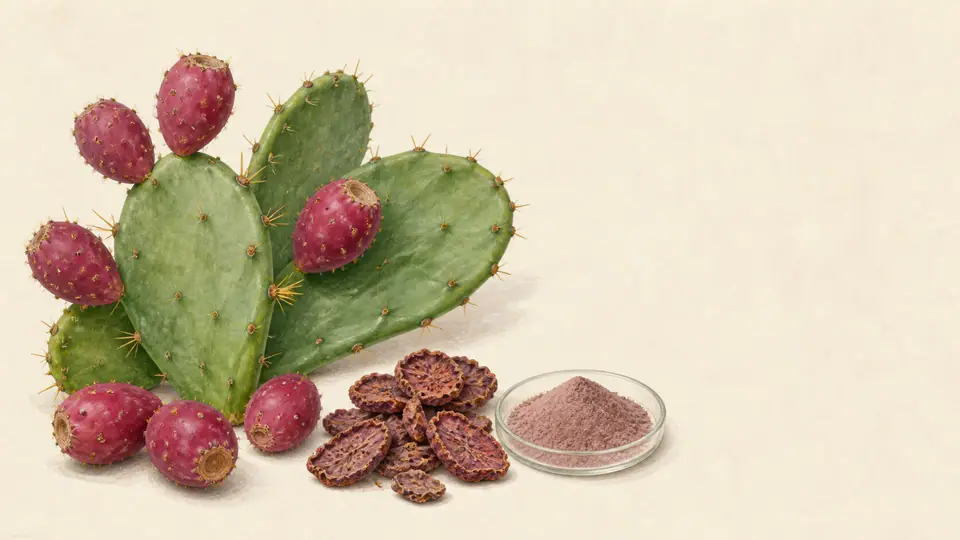
The flat parts of the prickly pear cactus are not leaves, but cladodes (stem segments). The red fruits are the berries, which contain seeds. The fruits, cladodes, and seeds differ in their composition of dietary fiber, sugars, fats, and pigments. Essentially, the components vary depending on the part of the same cactus.
The Species and Parts Hidden Behind the Name 'Baeknyeoncho'
In Korea, 'Baeknyeoncho' primarily refers to the fruits or cladodes of the Opuntia ficus-indica species. However, it is difficult to confirm the exact species based on the commercial name alone. While Kew classifies O. ficus-indica as a paddle-shaped cactus of Mexican origin that bears edible fruit, it is necessary to separately verify whether the scientific name is explicitly listed on the product.
The Opuntia humifusa species, often called 'Cheonnyeoncho' as an inland wintering type, is a distinct plant, not simply another name for Baeknyeoncho. The components and research results for its fruits, cladodes, juices, powders, seed oils, and extracts also differ. While the name Baeknyeoncho is familiar, it is easy to misapply research results from other Opuntia species if you do not check the scientific name and the part used on the product label.
If a product is labeled only as 'Baeknyeoncho' on the front of the package, what should you ask first? You must first verify the exact scientific name of the ingredient and whether the part used is the fruit or the cladode. Only then can you determine which research study to compare with the efficacy claims listed on the back.
From Red Pigments and Desert Food to Health Ingredients
Baeknyeoncho attracts attention as a health ingredient because of the pigments in the red fruit, the dietary fiber in the cladodes, and the image of a plant that grows in arid environments. The antioxidant capacity of pigments like betalains has been confirmed in test tubes. However, antioxidant capacity does not automatically mean it works for blood sugar control, weight loss, or the treatment of inflammatory diseases. A vivid color does not guarantee effectiveness for a specific disease.
The pigments, vitamins, and dietary fiber in the red fruit have nutritional properties as food. However, this is not clinical evidence that they reduce the need for diabetes medication or prevent complications. There is a gap between the expectation that pigments and fiber may be beneficial for health and the effects actually proven in human studies.
Fruits vs. Cladodes: How Do Research Results Differ?
In a systematic review of 20 human studies, cladodes showed some signals of reducing postprandial blood glucose. In contrast, the fruits generally had no significant effect on blood glucose or insulin. There were also significant differences in research bias and product types. In other words, expectations for cladodes and fruits yield different results, even for the same Baeknyeoncho.
A review of 7 randomized trials found that O. ficus-indica supplementation did not significantly reduce body weight. While there were some signals regarding body fat, blood pressure, and total cholesterol, these are difficult to confirm due to the small number of heterogeneous studies. A small change in post-meal blood glucose is a different matter from long-term HbA1c improvement or weight loss. A short-term blood glucose curve and the management of chronic diseases that change quality of life have different clinical meanings, even when using the same ingredient.
Are Juices, Powders, and Extracts the Same?
Since results differ between fruits, cladodes, and mixed extracts, a bottle of Baeknyeoncho juice or powder cannot be assumed to have the same dosage or effect as a specific cladode trial. Depending on the formulation, whether it is fresh fruit, juice, syrup, powder, or dietary fiber extract, the actual part used and its concentration vary.
In particular, Baeknyeoncho syrups, concentrates, and sweetened beverages may contain high amounts of sugar, unlike the raw material. If choosing a product for blood sugar purposes, you must first check the nutrition facts and the serving size. It is unlikely that products containing added sugar help with blood sugar management. Even for powders or capsules, you must check which part was concentrated, how it was processed, and the daily intake amount.
When Taking Diabetes Medication or Having a Sensitive Gut
Cladode or dietary fiber products may cause abdominal bloating, diarrhea, or nausea. When taken with diabetes medication, there is a possibility that blood glucose may drop further. Therefore, if you are taking such medication, it is necessary to monitor your blood glucose to check for changes.
Raw materials with remaining glochids (tiny spines) can irritate the skin, mouth, and throat. When preparing it yourself, wear gloves, or it is better to choose edible products where spines have been safely removed. There is insufficient safety data regarding high-concentration extracts for pregnant women, breastfeeding women, and children. The safety of other Opuntia species should not be automatically applied to Baeknyeoncho.
Distinguishing Between Similar-Looking Ingredients
The following factors must be compared: the O. ficus-indica lineage versus the O. humifusa lineage of prickly pear; fruit, stem segments, seeds, or seed oil; whole foods versus sugar-added syrups, juices, powders, or extracts; and postprandial blood glucose/antioxidant markers versus glycated hemoglobin, weight, or complications.
In other words, when choosing prickly pear, you must look at four levels of distinction simultaneously. The species, part of the plant, formulation, and expected indicators are all different. Antioxidant test results should not be equated with blood glucose improvement, stem segment research should not be equated with fruit juice, and single-meal blood glucose changes should not be linked to long-term diabetes treatment.
Then, what should I look for?
The selection criteria are simple. Rather than relying on the commercial name 'Baeknyeoncho' or the red color, verify the scientific name, plant part, formulation, and added sugars; then, examine the gap between fruit and stem research, and between single-meal blood glucose and long-term diabetes or weight results. When choosing a product, check the following: whether the scientific name is O. ficus-indica or another Opuntia; whether it is the fruit, stem segment, seed, or seed oil; whether it is fresh fruit, juice, syrup, powder, or dietary fiber extract, and what the sugar content and actual daily dose are; and whether you are taking diabetes medication, are pregnant, breastfeeding, have intestinal diseases, have a cactus allergy, or have experienced hypoglycemia.
If severe hypoglycemia symptoms, difficulty breathing, facial swelling, persistent vomiting, or severe abdominal pain occur, stop consumption and seek help from medical staff, the emergency room, or 119. While prickly pear is an attractive ingredient to enjoy as a food, it is rational to look at the contents rather than the name when expecting health benefits.
References
- Kew Plants of the World Online: Opuntia ficus-indica.
- Opuntia products, blood glucose and insulin: systematic review.
- Opuntia ficus-indica, body weight and cardiovascular risk: systematic review and meta-analysis.
This text explains the origin of the raw materials, the scope of research, and precautions before consumption. As this cannot replace individual diagnosis or treatment, please consult a medical professional if you are taking medication or if symptoms persist. If sudden and severe symptoms such as difficulty breathing or decreased consciousness occur after consumption, seek help from 119 or the emergency room.

Medical Staff Review
Director Choi Yeon-seung
Chief Director of Baekrokdam Korean Medicine ClinicPrickly Pear Dictionary Entry, reviewed the safety of expressions and the scope of verification before administration.
Review scope: Ingredient origin, human studies, concomitant medications, safety of intake · Last reviewed 2026-08-17
- Graduated from Kyung Hee University College of Korean Medicine
- Providing Korean medicine treatment since 2010
- Consultations for Gongjindan, Gyeongokgo, Nokyong (Deer Antler) restorative medicine, and customized restorative herbal medicine