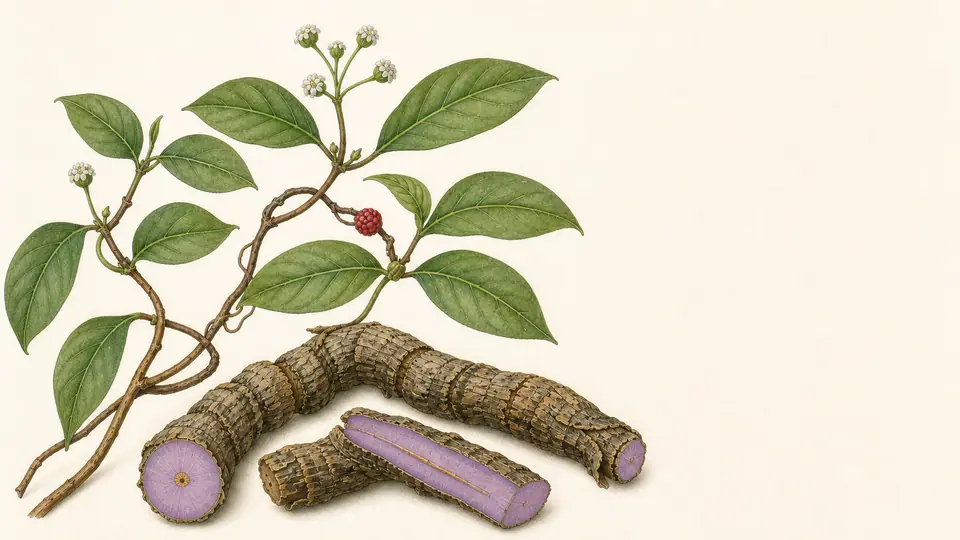
A medicinal herb that removes the woody core and uses the tough root bark
Can Pagukcheon, which is said to be good for energy, sexual function, and bone health, be taken for a long time? In short, the answer depends on the form of intake and the intended purpose. While Pagukcheon is familiar as a medicinal herb for tonifying yang and male health, current major human clinical trials have emerged from standardized oligosaccharide medicines used to treat depression. Long-term consumption of general teas, pills (hwan), or concentrates cannot be viewed as the same level of exposure as those studies.
Then, where does the evidence differ between the raw root and oligosaccharide medicines, and how is it different from Noni?
What kind of root is Pagukcheon?
The Korean Pharmacopoeia of the Ministry of Food and Drug Safety defines Pagukcheon as the root of Morinda officinalis, with the fibrous roots removed, pressed, and dried. Raw roots containing a large amount of the hard center, known as the xylem (woody core), differ from the form specified by the pharmacopoeia. Therefore, the proportion of bark, xylem, and fibrous roots is one of the criteria for determining the quality of the raw material.
Noni belongs to the same Morinda genus but uses the fruit of Morinda citrifolia. Research on fruit juices or powders cannot be transferred as evidence for the Pagukcheon root. The species are different, and the parts used are different.
Where do the nicknames 'tonifying yang' and 'sexual function' come from?
Pagukcheon is traditionally remembered as a medicinal herb used for tonifying yang, sexual function, and the health of the waist and bones. A 2017 comprehensive review summarized the polysaccharides, oligosaccharides, anthraquinones, iridoids, and preclinical pharmacology. However, it concluded that further research on mechanisms, quality, and interactions between components is necessary. A 2024 review of Pagukcheon polysaccharides also stated that further verification of structure-activity, toxicology, and clinical pharmacology is required.
Just because signals related to bone metabolism or sexual function are seen in preclinical trials does not mean the same effects are certain in humans. In particular, raw root teas, pills (hwan), or general concentrated products cannot be seen as reproducing those signals exactly.
What were the primary focuses of human clinical trials?
A systematic review of Pagukcheon oligosaccharide capsules for depressive disorders included 7 studies and 1,384 participants. However, this is data regarding a specific medicine and indication. It is not evidence for raw root tea or sexual function products. In other words, the most advanced human research under the name of Pagukcheon concerns standardized oligosaccharide medicines for the indication of depression and does not directly support tonifying yang, sexual function, or bone health.
Then, what should you look for? First, check if the ingredient listed on the product label is the root of M. officinalis and whether it is in the form of raw material, extract, oligosaccharide capsules, or isolated polysaccharides.
Exposure varies by product form
| Category | Characteristics |
|---|---|
| Raw root decoction | A form where the root as defined by the pharmacopoeia is decocted and used as is |
| Oligosaccharide capsules | Standardized pharmaceuticals primarily used in depression clinical practice |
| Isolated polysaccharides | Ingredient groups requiring further verification in the 2024 review |
| Noni fruit/juice | Inappropriate as evidence for Pagukcheon due to different species/parts |
Raw roots with high woody content, noni fruit, root decoctions/extracts, oligosaccharide capsules, and isolated polysaccharides are not the same raw materials or exposures. Therefore, one should not assume that "because it is Pagukcheon, all effects are the same."
When using with other medications
Do not arbitrarily decide on the concurrent use of antidepressants, sleeping pills, or hormone-related medications; prioritizing informing your medical staff or pharmacist about the products you are taking is essential. The existence of depression research on Pagukcheon oligosaccharide pharmaceuticals does not provide a basis for arbitrarily using general Pagukcheon products with antidepressants or sleeping pills.
Additionally, if you are taking osteoporosis medication or other concentrated herbal medicines, it is important to clearly specify which form of Pagukcheon you are using.
Determine which symptoms appeared first
You must first verify the duration of fatigue, sexual dysfunction, lower back pain, and depressive symptoms, and whether you have received a standardized evaluation. These symptoms may not be issues that can be addressed by Pagukcheon alone. If you experience thoughts of self-harm, severe depression, sudden paralysis, changes in bowel or bladder function, chest pain, or difficulty breathing, immediate professional evaluation is the priority rather than taking more Pagukcheon.
Signals that may appear at high doses
High-dose data mentioned the possibility of agitation, insomnia, and discomfort. If sleep worsens or severe agitation occurs after taking concentrated products, discontinue use and seek evaluation. There is insufficient human safety data regarding pregnancy, lactation, children, liver/kidney disease, and long-term high-concentration intake.
Criteria for distinguishing name confusion with Noni
Pagukcheon root and noni fruit are often confused because they both belong to the Morinda genus. However, the root of Morinda officinalis and the fruit of Morinda citrifolia are different species and different parts of the plant. Applying research results from noni juice to Pagukcheon root products exceeds the boundaries of the evidence.
Final Decision Criteria
Rather than relying on nicknames like "tonifying yang," the realistic criteria for selecting this material are to verify the species, root part, formulation, and the actual cause of symptoms, and to avoid extending the results of standardized oligosaccharide pharmaceuticals to general Pagukcheon products or other purposes. Whether it can be taken long-term depends not on the raw material itself, but on the form used, the accompanying symptoms, and the concurrent medications.
References
- Ministry of Food and Drug Safety Korean Pharmacopoeia: Pagukcheon.
- Morinda officinalis comprehensive review.
- Morinda officinalis oligosaccharide for depressive disorder: systematic review.
- Morinda officinalis polysaccharides systematic review.
This text explains the origin of the raw materials, the scope of research, and precautions before consumption. As this cannot replace individual diagnosis or treatment, please consult a medical professional if you are taking medication or if symptoms persist. If sudden and severe symptoms such as difficulty breathing or decreased consciousness occur after consumption, seek help from 119 or the emergency room.

Medical Staff Review
Director Choi Yeon-seung
Chief Director of Baekrokdam Korean Medicine ClinicPagukcheon Dictionary Entry, reviewed the safety of expressions and the scope of verification before administration.
Review scope: Ingredient origin, human studies, concomitant medications, safety of intake · Last reviewed 2026-08-17
- Graduated from Kyung Hee University College of Korean Medicine
- Providing Korean medicine treatment since 2010
- Consultations for Gongjindan, Gyeongokgo, Nokyong (Deer Antler) restorative medicine, and customized restorative herbal medicine