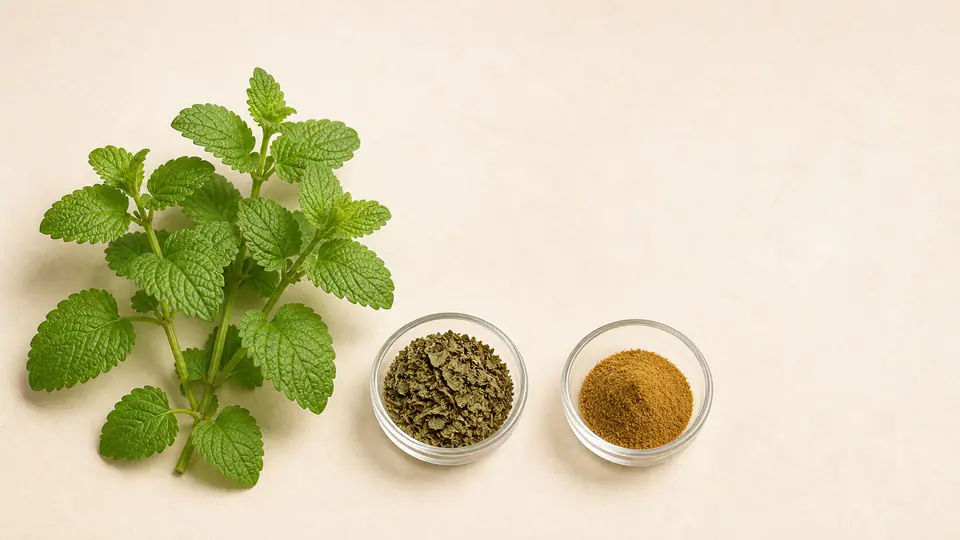
The scent is familiar, but there are many different types of lemon balm behind that name
When I can't sleep or feel anxious, can I drink lemon balm tea or take extracts? Is it okay to use with thyroid medication? In short, a cup of tea can be seen as long-standing traditional use, but concentrated extracts or complex sleep aids are different levels of exposure, and the concurrent use of thyroid medication must be discussed with a medical professional. This is because there are actually various formulations under the name 'lemon balm,' and the gap between expected effects and proven effects varies for each.
Focusing on herbs that use the leaves of Melissa officinalis L., we will calmly examine how names and formulations differ, how much expectation is realistic, and what should be checked first when making a choice today.
What kind of plant is lemon balm?
Lemon balm is a herb that uses the leaves of the Lamiaceae plant Melissa officinalis L. as tea, dried powder, or water/alcohol extracts. Because the name contains 'lemon,' it is easy to confuse it with lemon fruit or lemongrass, but these are different plants. The scent of lemon balm comes from the leaves, and even if they are called by the same name, the exposure differs if the botanical identity is different.
Therefore, when looking at a product, the first step is to check if it is a Melissa officinalis leaf preparation rather than choosing based solely on the name 'lemon balm.' This is where a single name begins to blur the issue.
What uses does the EMA recognize?
The European Medicines Agency (EMA) considers Melissa officinalis leaf preparations usable for mild stress, sleep aid, and abdominal bloating. However, this conclusion is based on tradition used for over 30 years, not on therapeutic effects confirmed through clinical trials. This creates an important distinction: there is long-term use and some signals of score improvement in certain studies, but it is not an effect established through sufficient clinical trials.
Meta-analyses related to anxiety and depression have reported signals of score improvement. However, because the number of studies is small and the research methods, formulations, and subjects vary greatly, it is difficult to determine the exact effect size. The fact that temporary stress scores or ease of falling asleep appeared in small studies does not prove the treatment or recurrence management of chronic insomnia, anxiety disorders, or depression.
A cup of tea, extracts, and essential oils are not the same lemon balm
Under the name lemon balm, there are leaf teas, dried powders, water or alcohol extracts, essential oils, and complex sleep products mixed with ingredients like valerian or passionflower. These are not the same exposures. Leaf tea is a low-concentration beverage, whereas standardized extracts or rosmarinic acid standardized extracts are concentrated, and essential oils are another formulation where the scent is concentrated. Complex sleep products are mixed with other sedative herbs, making it impossible to isolate the effect of lemon balm alone.
Therefore, results from a study on how leaf tea worked cannot be applied directly to extract capsules or complex products. When choosing a product, you must look at which part of the plant was used, the formulation, and the concentration.
| Category | Leaf tea / Dried powder | Standardized extract / Essential oil | Complex sleep product |
|---|---|---|---|
| Relationship with other formulations | Low-concentration beverage form | Concentrated extract or fragrance concentrate | Cannot isolate the effect of lemon balm alone |
| Application of research results | Cannot be applied directly to different formulations even if they have the same name | Cannot be applied directly to different formulations even if they have the same name | Cannot be applied directly to different formulations even if they have the same name |
Is it okay to use this with thyroid medication?
In vitro and animal data have suggested the possibility that lemon balm may inhibit TSH activity. However, clinically meaningful changes in thyroid function in humans have not been established. In other words, an in vitro signal should not be interpreted as a treatment for a disease or a replacement for medication.
If you have a thyroid condition or are taking thyroid medications such as levothyroxine, it is necessary to consult a healthcare provider before use. This does not mean that lemon balm definitely affects the thyroid, but rather that uncertainties should not be overlooked when managing a medical condition.
What situations should I be cautious of when taking this?
When taking it for the first time, you should consider the possibility of drowsiness or decreased alertness. For safety, it is better to avoid your first experience if you need to drive or operate machinery. For the same reason, you should not arbitrarily combine it with alcohol, sleeping pills, or sedatives. Overlapping sedative ingredients may cause greater drowsiness or loss of concentration than expected.
As there is insufficient safety data for pregnancy, lactation, or children under 12, the general rule is not to use concentrated preparations arbitrarily. If symptoms persist for more than 2 weeks, or if you experience insomnia, anxiety, depression, or severe abdominal pain that impairs daily functioning, you should seek a medical evaluation rather than continuing with herbal intake alone. If sudden and severe symptoms appear, such as difficulty breathing, facial swelling, decreased consciousness, or thoughts of self-harm, stop use immediately and seek help from 119 or an emergency room.
What is the boundary between expectations and evidence?
Expectations for lemon balm generally fall into three categories. First, a daily expectation to relieve mild tension with leaf tea. Second, a supportive expectation to aid sleep with extracts. Third, a therapeutic expectation to manage anxiety disorders, depression, or thyroid diseases.
The first is within the scope of traditional use according to the EMA. The second has signals from some small studies but is not confirmed. The third is not supported by current evidence. In other words, small study results suggesting that falling asleep became slightly easier should not be expanded to the treatment of chronic insomnia, nor should in vitro TSH inhibition signals be linked to the management of thyroid disease.
How do I distinguish between similar names and different formulations?
When choosing lemon balm, three comparisons are helpful. First, distinguish between Melissa officinalis, lemon fruit, and lemongrass. Second, distinguish between leaf tea or dried powder and standardized extracts, essential oils, and complex products. Third, distinguish between traditional use and effects established through randomized clinical trials. Finally, distinguish between temporary tension or difficulty falling asleep and persistent insomnia, anxiety disorders, and depression.
Without these distinctions, a single sentence like 'lemon balm is good for sleep' mixes up a cup of tea with complex capsules, and mild stress with the treatment of a disease. So, what should you look for?
Criteria to check when making a choice today
Before the refreshing scent or the nickname 'sleep herb,' you should first verify the exact plant, part used, and formulation. Next, consider personal circumstances such as overlapping sedative ingredients, thyroid conditions or medication use, and pregnancy or lactation. Finally, look at the difference between traditional use and established therapeutic evidence.
Specifically, you should ask yourself the following: Is what I am using now lemon balm leaf tea, powder, a single extract, essential oil, or a complex sleep product? What is the actual daily dose? Does it overlap with sleeping pills, sedatives, antihistamines, or alcohol? Do I need to drive or operate machinery? Do I have a thyroid condition, take thyroid medication, or am I pregnant or lactating? And do I have insomnia, anxiety, or depressive symptoms lasting more than 2 weeks?
By answering these questions while making your choice, you can determine for yourself that lemon balm is a raw material that is more than just a familiar name.
References
- EMA: Melissae folium herbal medicinal product summary.
- EMA: European Union herbal monograph on Melissa officinalis leaf.
- Lemon balm for depression and anxiety: systematic review and meta-analysis.
This text explains the origin of the raw materials, the scope of research, and precautions before consumption. As this cannot replace individual diagnosis or treatment, please consult a medical professional if you are taking medication or if symptoms persist. If sudden and severe symptoms such as difficulty breathing or decreased consciousness occur after consumption, seek help from 119 or the emergency room.

Medical Staff Review
Director Choi Yeon-seung
Chief Director of Baekrokdam Korean Medicine ClinicLemon Balm Dictionary Entry, reviewed the safety of expressions and the scope of verification before administration.
Review scope: Ingredient origin, human studies, concomitant medications, safety of intake · Last reviewed 2026-08-17
- Graduated from Kyung Hee University College of Korean Medicine
- Providing Korean medicine treatment since 2010
- Consultations for Gongjindan, Gyeongokgo, Nokyong (Deer Antler) restorative medicine, and customized restorative herbal medicine