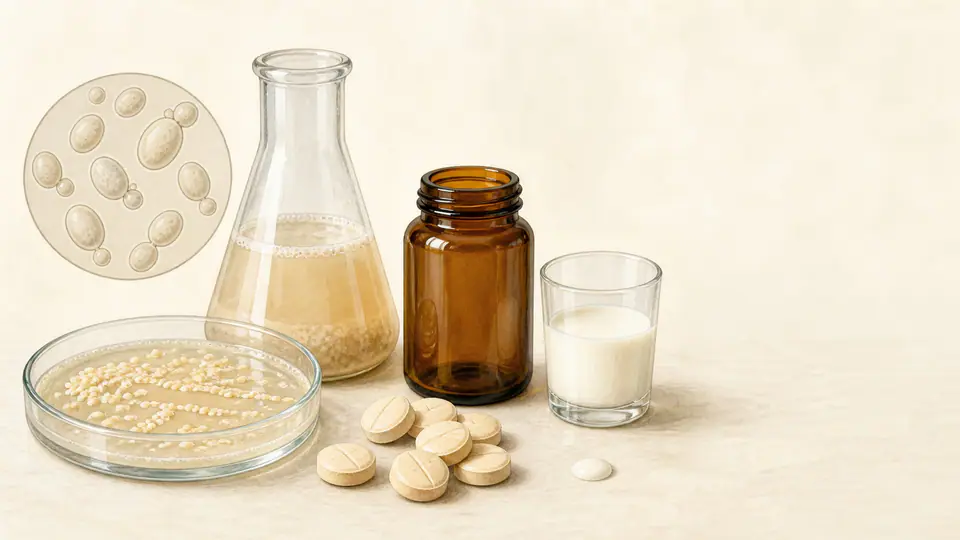
The Gap Left on the Adult Table by Childhood Intestinal Enzymes
If you experience abdominal pain every time you drink milk, should you take lactase? Does it help with milk allergies? In short, lactase is an enzyme supplement that helps break down lactose; it is not a cure for milk allergies or intestinal diseases. It is more important to first distinguish the cause of your symptoms.
Our bodies are prepared from birth to produce lactase in the villi of the small intestine, which breaks down lactose into glucose and galactose. This enzyme is necessary for the lactose in milk to be absorbed in the intestines. However, as growth progresses, the activity of this enzyme gradually decreases or is not maintained in some people. When the remaining lactase cannot handle the amount of lactose in the milk being consumed, symptoms such as abdominal discomfort, diarrhea, and gas occur. This is a common manifestation of what is known as lactose intolerance.
However, low lactase activity does not necessarily lead to symptoms. Depending on the amount of lactose consumed or the state of the gut microbiota, there may be no symptoms. Therefore, malabsorption and intolerance are not the same thing. This distinction is the starting point to consider when choosing a lactase supplement. Then, can you determine you have lactose intolerance based solely on the experience of abdominal pain?
Why Lactase is Necessary: Where Lactose Comes From and Where it Gets Blocked
Lactose is a sugar found in milk and dairy products. If lactase in the small intestine cannot break it down, the lactose moves directly into the large intestine, where intestinal bacteria ferment it. During this process, gas and water increase, leading to diarrhea or abdominal discomfort. This is exactly where lactase works. As an enzyme in the small intestinal villi, it helps absorption by dividing lactose into glucose and galactose.
The problem is that lactase levels are not constant throughout life. Primary lactase non-persistence is a phenomenon where enzyme activity naturally declines with age. In this case, taking lactase tablets does not make the small intestine produce more enzymes again. On the other hand, secondary deficiency, where lactase temporarily decreases due to small intestine damage or disease, can improve after treating the underlying cause. Even if the symptoms are the same, the response differs if the cause is different.
Why Lactase is Promising: Human-Based Evidence and Practical Tools
What is the extent of the evidence confirmed here? The NIDDK explains that lactase tablets or drops can help some people manage symptoms of lactose intolerance. This does not mean it completely eliminates symptoms for everyone. Rather, it means it can be seen as one way to manage daily life without having to completely cut out lactose.
Most people do not need to cut out lactose entirely. Depending on the individual, they can tolerate about 12g of lactose, equivalent to one cup of milk, with no symptoms or only mild symptoms. Yogurt or aged cheeses have lower lactose content and may be easier to tolerate than milk due to the influence of microbial enzymes. In this context, lactase plays a supportive role in bridging the gap between lactose intake and symptoms.
Same Principle, Different Timing: Differences Between Tablets, Drops, and Lactose-Free Milk
There are three main ways to use lactase. First, enzyme tablets taken immediately before a meal; these help break down the lactose consumed during that meal. Second, drops added to milk in advance; these are left to react for a certain period before drinking. Third, lactose-free products where lactose is pre-digested during manufacturing. All three products use the lactase principle, but the timing of action differs.
Tablets and drops are flexible in that individuals can choose when to use them. Lactose-free milk is convenient because it is sold with the lactose already broken down, but the milk proteins remain. Therefore, while lactose-free milk can be a substitute for lactose intolerance, it is not a safe substitute for a milk protein allergy. This is a point where a single name can obscure the issue.
The Boundary with Milk Allergy: Symptoms Lactase Cannot Resolve
Lactase is merely a lactose-digesting enzyme and cannot block the immune response to milk proteins. If a milk allergy is suspected, symptoms such as hives, wheezing, or throat swelling may appear. Lactase is not helpful for these signals, and immediate allergy response is required. Taking more lactase tablets will not reduce the allergic reaction.
Lactose intolerance and milk protein allergy may have overlapping symptoms, but the principles are different. The former is a deficiency of digestive enzymes, while the latter is an overreaction of the immune system. Lactase is only a supportive tool for the former and does not apply to the latter. Since it is difficult to distinguish the two based on abdominal symptoms alone, other signals must be observed together.
Timing of Intake and Individual Circumstances: When, How Much, and With What
The response to lactase depends on the active units of the product, the timing of intake, and the amount of lactose. It is not appropriate to simply increase the dose just because symptoms persist. It is necessary to check the FCC lactase units of the tablet, the timing of intake, and the amount of lactose in that specific meal together.
For example, even with the same milk, the amount of lactose varies significantly depending on whether it is one cup or two, whether it is yogurt or cheese, or if it is a lactose-free product. Recording the amount of milk, the timing when symptoms appear, and how symptoms differ with yogurt, aged cheese, or lactose-free products will serve as a basis for selection.
Safety Signals: Symptoms That Should Not Be Dismissed as Lactase-Manageable
Lactase is merely a digestive aid, not a diagnostic tool. Symptoms such as bloody stools, persistent diarrhea, weight loss, severe dehydration, or growth retardation should not be dismissed as simple lactose intolerance; you must seek medical evaluation. In particular, if nocturnal diarrhea, anemia, or growth issues in children are present, other intestinal diseases or malabsorption syndromes should be suspected.
Additionally, excessively restricting dairy products can lead to a deficiency in calcium and vitamin D intake. Whether you use lactase, choose lactose-free products, or reduce dairy, it is important to plan for alternative foods and nutrition. Just because an enzyme helps with digestion does not mean it automatically balances your nutrition.
Primary Deficiency vs. Secondary Deficiency: Difference Between Treating the Cause and Providing Support
Lactase tablets help break down the lactose consumed during a meal, but they do not make the small intestine produce lactase again or provide a permanent cure. Primary lactase non-persistence is a physiological change related to age, so the root cause cannot be changed with enzyme supplements. In this case, lactase serves as a symptom management tool.
On the other hand, secondary deficiency caused by small intestinal diseases can recover after the underlying cause is treated. When the villi of the small intestine are damaged by Celiac disease, Crohn's disease, or intestinal infections, lactase production also decreases. In such cases, taking lactase tablets alone will not eliminate the cause. Treating the cause and using enzyme support are not separate, but should be considered together.
Similar Names, Different Principles: Malabsorption, Intolerance, Lactose-Free, and Allergy
Lactose malabsorption and lactose intolerance are often used interchangeably, but they are subtly different. Malabsorption refers to a state where lactose is less decomposed due to low lactase activity, while intolerance refers to the state where symptoms appear as a result. Since some people may have low lactase activity without symptoms, it is meaningful to distinguish between the two.
Lactase tablets and lactose-free milk use the same principle but act at different times. Lactose intolerance and milk protein allergy may have similar symptoms, but their mechanisms are different. Primary lactase deficiency and secondary deficiency caused by small intestinal disease have different possibilities for recovery. These four comparisons are distinctions that should be kept in mind when choosing a lactase product.
Criteria to Check Today: What to Look at Before Choosing Lactase
There are three things to check before choosing lactase. First, the amount of milk, the timing of symptoms, and how symptoms differ with yogurt, aged cheese, or lactose-free products. Second, the FCC lactase units of the tablet, the timing of intake, and the amount of lactose in the meal. Third, whether there are signals of weight loss, bloody stools, nocturnal diarrhea, anemia, growth issues in children, or milk protein allergy.
Rather than choosing lactase based solely on the impression that milk causes discomfort, it is first necessary to distinguish the amount of lactose, the timing of symptoms, and allergy signals. Lactase is a tool to help digest a specific meal; it is not a cure for intestinal disease or milk allergy. Consulting a pharmacist or medical professional with these criteria will allow for a more specific choice.
References
- NIDDK: Treatment for lactose intolerance.
- NIDDK: Eating, diet and nutrition for lactose intolerance.
- AAAAI: Lactose intolerance defined.
- Lactase-treated milk and lactose malabsorption review.
This text explains the origin of the raw materials, the scope of research, and precautions before consumption. As this cannot replace individual diagnosis or treatment, please consult a medical professional if you are taking medication or if symptoms persist. If sudden and severe symptoms such as difficulty breathing or decreased consciousness occur after consumption, seek help from 119 or the emergency room.

Medical Staff Review
Director Choi Yeon-seung
Chief Director of Baekrokdam Korean Medicine ClinicLactase Glossary, reviewed the safety of expressions and the scope of verification before administration.
Review scope: Ingredient origin, human studies, concomitant medications, safety of intake · Last reviewed 2026-08-17
- Graduated from Kyung Hee University College of Korean Medicine
- Providing Korean medicine treatment since 2010
- Consultations for Gongjindan, Gyeongokgo, Nokyong (Deer Antler) restorative medicine, and customized restorative herbal medicine