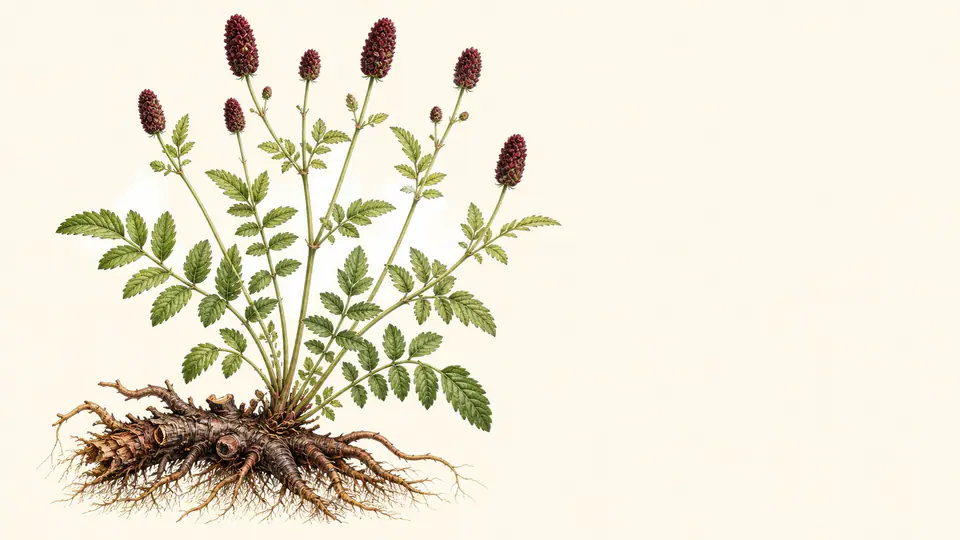
Beneath the red flower clusters, can astringent roots stop bleeding?
Does taking Jiyu orally or sprinkling it on a wound help stop bleeding? In short, while there are in vitro and animal studies regarding hemostasis for Jiyu and Jiyutan, these are not clinical evidence that they treat actual bleeding in humans. Therefore, rather than using Jiyu as first aid, it is better to first identify the cause of the bleeding and check any medications currently being taken.
This raw material is easily confused because several forms share one name. Young leaves of the burnet plant are known to be edible, the roots are used as medicinal herbs, and Jiyutan, which is charred black by roasting over fire, is classified as a different product. Just because they come from the same plant does not mean they share the same evidence. The discussion on Jiyu must begin by distinguishing their identities.
Which part is called Jiyu?
Domestic herbal medicine standards define Jiyu as the root of Sanguisorba officinalis or its long-leaved variety, S. officinalis var. longifolia. In other words, official Jiyu is the root. Conversely, young leaves, flowers, or aerial parts encountered as food have separate identities, even if they come from the same plant. Isolated components such as tannins, gallic acid, or polysaccharides also do not share the same evidence as the whole root.
Then, what should we look for? When choosing a raw material, the key is to first ask, 'Is it the root or not?' If research on young leaves is applied to root products, or root research is applied to leaf products, expectations become distorted.
Where do expectations for hemostasis come from?
Expectations for the hemostatic effects of Jiyu are mainly related to components such as tannins, gallic acid, and polysaccharides. A 2026 review on polysaccharides summarized signals for anti-inflammation, wound healing, and hemostasis, but noted that most existing research is at the in vitro level and that data on in vivo efficacy and safety are insufficient. The fact that a coagulation response was observed in a test tube is an interesting starting point, but it is not evidence that bleeding stops when administered to humans or applied to a wound.
A review of hemostatic medicinal plants points out that in addition to the action of promoting coagulation, potential interactions with anticoagulants and antiplatelet drugs must be examined. In other words, both the possibility that Jiyu can clot blood and the possibility that it may interfere with the action of other medications remain open.
Raw Jiyu and Jiyutan: How processing and formulation change things
Jiyu is also used as Jiyutan, which is carbonized by roasting over fire. The components change before and after processing. While processing research showed that Jiyutan samples under 250-degree conditions showed differences in rat bleeding models, this is not a human bleeding treatment trial. Furthermore, a pharmacokinetic comparison of tannins was conducted using rat plasma research, showing that raw Jiyu and Jiyutan do not have the same composition.
In other words, research on raw Jiyu cannot be applied directly to Jiyutan, nor can research on Jiyutan be applied to raw Jiyu. When choosing a product form, one must distinguish whether it is raw Jiyu, Jiyutan, powder, herbal decoction, or a topical product.
| Category | Key Question |
|---|---|
| Raw Jiyu vs. Jiyutan | Cannot share the same dosage and evidence |
| Root vs. Leaves, Flowers, Aerial parts | Jiyu is the root according to herbal medicine standards |
| Whole root vs. Isolated components | Tannins and polysaccharides have separate identities |
| In vitro coagulation vs. human bleeding | Not clinical evidence |
The reality of applying to wounds or oral ingestion
Caution is required when sprinkling Jiyu (burnet root) powder on a wound during bleeding. Applying powder of unknown origin to an open wound makes it difficult to manage foreign substances or contamination. If there are deep or gaping wounds, bleeding that does not stop after 10 minutes of direct pressure, black stools, vomiting blood, or heavy vaginal bleeding, immediate medical evaluation takes priority over Jiyu. Applying clean pressure to stop bleeding is a more realistic first step.
The same applies to oral ingestion. There is no clinical evidence that Jiyu treats gastrointestinal, uterine, or anal bleeding. Adding medicinal herbs to bleeding of unknown cause may instead delay proper evaluation.
When to first check interactions with current medications
There are clear situations where Jiyu or Jiyutan (charred burnet root) should not be added arbitrarily. If you are taking anticoagulants, antiplatelet agents, or anti-inflammatory analgesics, it is advisable not to add Jiyu or Jiyutan. The same applies if you have an upcoming surgery or procedure. This is because, under the guise of helping to stop bleeding, it may instead complicate bleeding tendencies.
While the term 'hemostasis' suggests stopping blood, it actually encompasses two possibilities: promoting coagulation and interacting with anticoagulant or antiplatelet drugs. If you are taking medication, you must check the possibility of drug interactions before selecting ingredients.
Data limitations for pregnancy, lactation, children, and liver/kidney disease
There is insufficient data on the long-term oral safety and interactions of Jiyu for pregnancy, lactation, children, and those with liver or kidney disease. This does not mean it is 'dangerous,' but rather that it is 'unknown.' Caution is required when deciding on long-term use in an unknown state.
If safety has not been proven for a specific group, it is more rational to reduce exposure or prioritize medical consultation rather than expecting efficacy.
The Gap Between Human Evidence and Expectations
Research on Jiyu is centered on in vitro and animal models. While results showing that Jiyutan samples made a difference in rat bleeding models are interesting, these are not human bleeding clinical trials. In vitro coagulation reactions are a different matter from the causes and emergency treatment of actual bleeding.
Therefore, viewing Jiyu as a 'medicinal herb used when bleeding' is different from viewing it as an 'emergency treatment substitute.' The former recognizes its position as a traditional medicinal plant, while the latter is intervening in an emergency situation without clinical evidence.
Distinguishing Similar Names from Different Ingredients
Four distinctions are important when choosing Jiyu. First, whether it is the root or the young leaves, flowers, or aerial parts. Second, whether it is raw Jiyu or Jiyutan. Third, whether it is the whole root or isolated components such as tannins or polysaccharides. Fourth, whether it is an in vitro coagulation study or a study on actual human bleeding.
If these distinctions are not maintained, different ingredients and evidence become mixed under the name 'Jiyu.' Consumers should develop the habit of checking these four points when looking at product labels.
Realistic criteria to check today
To summarize the discussion on Jiyu: do not mistake astringency or preclinical hemostatic signals for emergency treatment; verify the origin, processing, and current medications, and prioritize pressure and medical evaluation over medicinal herbs for bleeding of unknown cause.
Specifically, there are three questions to verify. First, is it the root of Sanguisorba officinalis or Sanguisorba remotiflora, or the young leaves, flowers, aerial parts, or another Sanguisorba species? Second, is it raw Jiyu, Jiyutan, powder, decoction, or a topical product, and what is the cause of the wound or bleeding? Third, are you taking anticoagulants, antiplatelet agents, or anti-inflammatory analgesics, or do you have a bleeding disorder, liver disease, or a scheduled surgery?
Only after verifying these three points can you decide whether to choose Jiyu or visit a medical institution first.
References
- Ministry of Food and Drug Safety Crude Drug Standard: Jiyu.
- Sanguisorba officinalis polysaccharides review.
- Charcoal-frying and hemostatic markers of Sanguisorbae Radix.
- Pharmacokinetics of tannins before and after processing.
- Medicinal plants as potential hemostatic agents.
This text explains the origin of the raw materials, the scope of research, and precautions before consumption. As this cannot replace individual diagnosis or treatment, please consult a medical professional if you are taking medication or if symptoms persist. If sudden and severe symptoms such as difficulty breathing or decreased consciousness occur after consumption, seek help from 119 or the emergency room.

Medical Staff Review
Director Choi Yeon-seung
Chief Director of Baekrokdam Korean Medicine ClinicJiyu Dictionary Entry, reviewed the safety of expressions and the scope of verification before administration.
Review scope: Ingredient origin, human studies, concomitant medications, safety of intake · Last reviewed 2026-08-17
- Graduated from Kyung Hee University College of Korean Medicine
- Providing Korean medicine treatment since 2010
- Consultations for Gongjindan, Gyeongokgo, Nokyong (Deer Antler) restorative medicine, and customized restorative herbal medicine