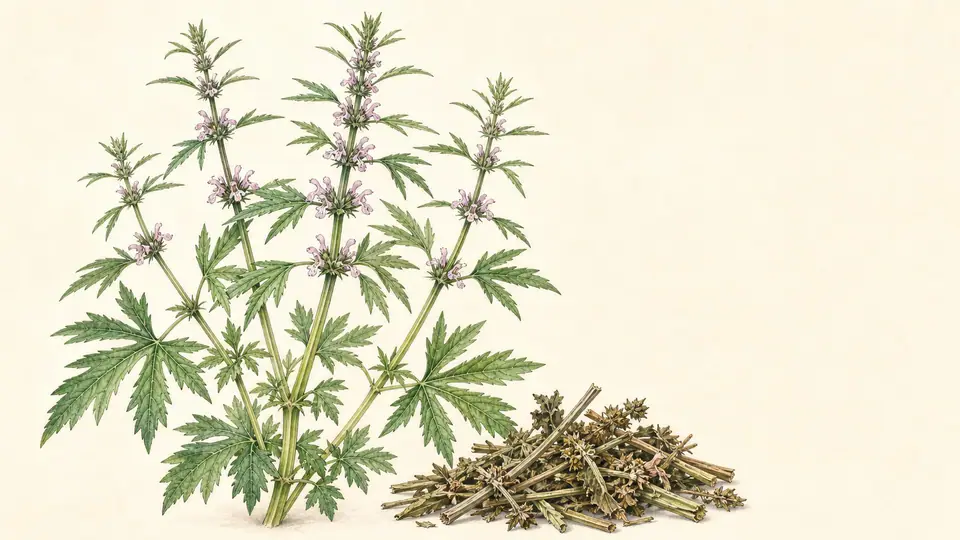
How Stems and Leaves Before Flowering Became an Injectable
Can I drink Motherwort as a tea for menstruation or postpartum recovery?
Simply put, the efficacy of tea or decoctions has not been proven in humans. Rather, a significant portion of the human-based evidence regarding Motherwort comes from injectables used in hospitals, and even that evidence was of low or very low quality. It is difficult to view tea brewed at home and injectables used in medical settings as having the same formulation or evidence base.
Then why is Motherwort called the woman's herb, and where does the gap between tea and injectables arise?
The Identity of Motherwort: One Plant, Many Different Substances
Ikmocho is the dried aerial part of Leonurus japonicus Houttuyn harvested before or at the time of flowering. The Korean Herbal Medicine Resources Research Center's standard terminology also designates this aerial part as the reference standard. Even from the same plant, the seed, known as Chung‑ulja, is handled separately. Furthermore, Ikmocho injections, water decoctions, essential oils, and isolated alkaloids differ in plant part and dosage form, so they should not be mixed based on the same rationale.
In other words, under the single name 'Motherwort,' several different substances exist: aerial parts, seeds, injectables, essential oils, and isolated components. You should not expect the same effects just because the name is the same.
Why it is Nicknamed the 'Woman's Herb'
The interest in Motherwort regarding the uterus and bleeding was based on traditional use and preclinical pharmacological research. Pharmacological and toxicological literature reviews summarized various preclinical signals, including uterine-related actions. However, these reviews concluded that further toxicity research and standardization of terminology are required.
The existence of preclinical signals does not mean they act the same way in humans. In particular, it is difficult to assume that those signals are delivered intact when consumed as tea or concentrates.
Evidence in Humans Primarily Derived from Injectables
A systematic review covering the prevention of uterine bleeding after miscarriage included 9 trials and 1,675 participants. This review primarily evaluated the combination of Motherwort injectables and oxytocin. Consequently, there were signals of reduced bleeding, but the quality of evidence was generally low or very low.
The important point here is that the efficacy of combined injectables cannot be generalized to oral teas, decoctions, or health foods. Injectables are standardized formulations administered in a prescribed manner at medical institutions, whereas tea boiled at home differs in concentration and absorption pathway.
Why Formulations Must Be Distinguished: Water Decoctions, Injectables, and Essential Oils
Motherwort essential oil is a different substance from a water decoction. Toxicity of Motherwort essential oil was observed in zebrafish embryo experiments. However, this experiment is not data for determining the human oral hazard dose. At the same time, it serves as evidence that essential oils and water decoctions cannot be viewed as the same.
| Category | Characteristics |
|---|---|
| Dried aerial parts / Water decoction | Traditional form of use, lack of human clinical evidence |
| Injectable | Used in hospitals; most studies involve combination with oxytocin |
| Essential oil | Preclinical toxicity signals present; oral safety unknown |
This table is used to distinguish between different substances that fall under the same name.
Pregnancy and Bleeding: The First Things to Check
As this is a medicinal herb that may affect the uterus and bleeding, you should not self-administer it if you are pregnant or could be pregnant; please consult an obstetrician-gynecologist or a Korean medicine doctor first. If you experience heavy bleeding after childbirth or miscarriage, dizziness, fainting, severe abdominal pain, or fever, do not try to manage it with tea or concentrates; seek emergency evaluation immediately.
This does not mean that Leonurus japonicus (Ikmocho) is bad. It means that the cause of the bleeding must be identified first.
When Using with Other Medications
If you are using anticoagulants or antiplatelet agents, have a bleeding disorder, or are before or after surgery, do not start use arbitrarily as combination safety has not been established. Essential oils, injectables, and concentrated extracts are not the same as traditional water decoctions, and there is insufficient data on long-term oral safety and pregnancy/lactation.
In other words, before starting Leonurus japonicus, you must first disclose the form of the product, what other medications you are using, and your current health condition.
Similar names, different ingredients
The aerial parts and the seeds of Leonurus japonicus are different parts of the same plant. Oral teas/decoctions and medical injectables are called by the same name but are different formulations. Water extracts and essential oils contain different groups of components. Traditional use and human clinical evidence cannot be placed on the same level.
When a single name covers all these differences, it clouds the decision-making process.
Criteria to Check Today
Rather than the nickname 'the herb that is good for women,' you must first check the plant part, formulation, possibility of pregnancy, and bleeding status. The key is not to apply research on injectables as evidence for the self-administration of teas or concentrates.
If you are considering Leonurus japonicus, first ask yourself: Which form is it (dried aerial parts, tea, pill, concentrate, essential oil, or injectable)? Is there a possibility of pregnancy, or are you currently experiencing pregnancy, postpartum bleeding, or menorrhagia? Are you using anticoagulants? Are you trying to self-manage abdominal pain and bleeding? Have you checked for the cause and emergency signals?
If you do not have answers to these questions, it is safer to consult a professional.
References
- Leonurus japonicus entry based on the Standard Korean Medicine Terminology of the Society of Korean Medicine.
- Motherwort injection after induced abortion: systematic review and meta-analysis.
- Leonurus japonicus ethnopharmacology, phytochemistry and toxicology review.
- Motherwort alkaloids and essential-oil toxicity in zebrafish embryos.
This text explains the origin of the raw materials, the scope of research, and precautions before consumption. As this cannot replace individual diagnosis or treatment, please consult a medical professional if you are taking medication or if symptoms persist. If sudden and severe symptoms such as difficulty breathing or decreased consciousness occur after consumption, seek help from 119 or the emergency room.

Medical Staff Review
Director Choi Yeon-seung
Chief Director of Baekrokdam Korean Medicine ClinicLeonurus japonicus Dictionary Entry, reviewed the safety of expressions and the scope of verification before administration.
Review scope: Ingredient origin, human studies, concomitant medications, safety of intake · Last reviewed 2026-08-17
- Graduated from Kyung Hee University College of Korean Medicine
- Providing Korean medicine treatment since 2010
- Consultations for Gongjindan, Gyeongokgo, Nokyong (Deer Antler) restorative medicine, and customized restorative herbal medicine